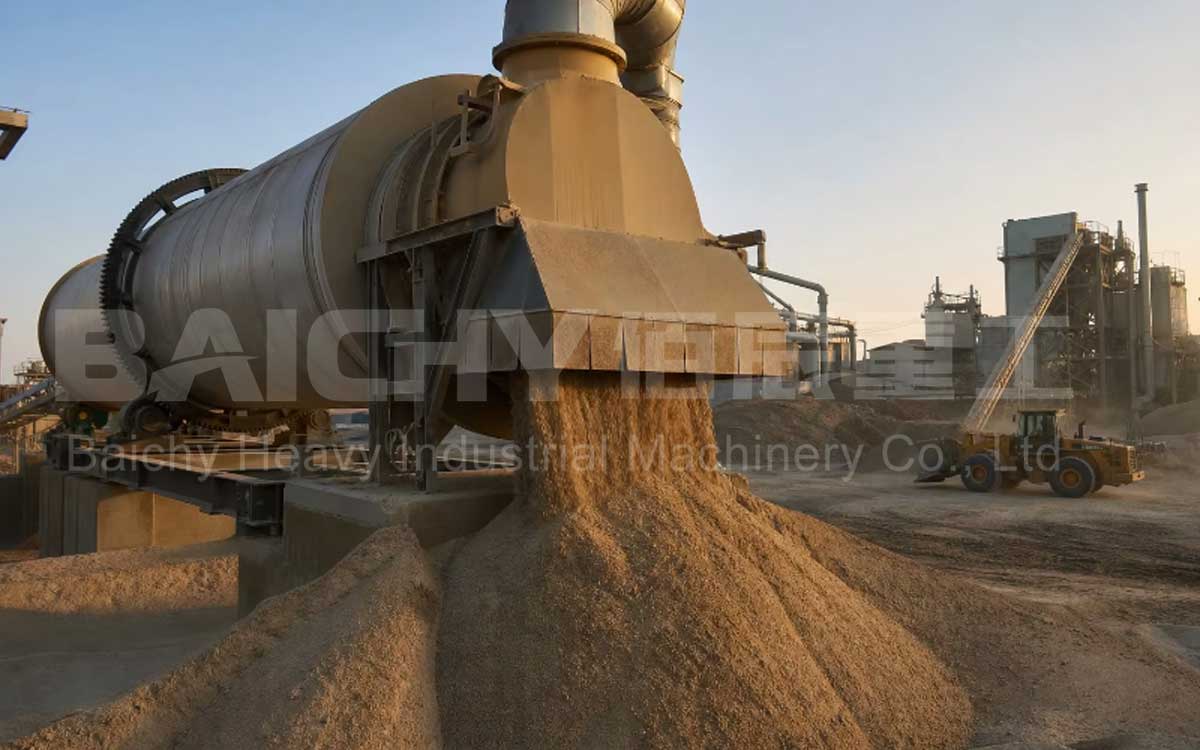
Indirect-heating rotary dryer
The critical factor in selecting drying equipment for high-purity silica sand lies not in the drum itself, but in the method of contact between the heat source and the material. In direct heating systems, combustion flue gas is fed into the drum; alkali metals, sulfur, and ash adhere to the particles via the gas stream, potentially causing a significant spike in Fe₂O₃ content—thereby downgrading the entire batch. While counter-flow rotary dryers offer the highest thermal efficiency (65–80%), they expose the driest material to the hottest flue gas, posing similar risks for heat-sensitive materials like kaolin. Switching to an indirect-heating rotary dryer isolates contamination at the source, albeit at the cost of 10–20 percentage points lower thermal efficiency and 20–35% higher specific fuel consumption. For a 20 t/h high-purity silica sand line, indirect heating incurs an additional annual fuel cost of approximately $50,000–$100,000; however, the loss from a single batch being downgraded due to contamination falls within the same order of magnitude. Thus, trading quantifiable fuel costs for guaranteed product quality is the more economical choice.
I. Heat Source Contamination: The Costliest Hidden Expense in Drying High-Purity Silica Sand
The "purity" of high-purity silica sand is achieved through successive stages of washing, magnetic separation, flotation, or acid leaching. Drying is the final link in the chain; if contamination is introduced at this stage, all prior efforts are wasted. Direct heating introduces contamination via four pathways:
Alkali metal volatilization and condensation: Sodium (Na) and potassium (K) in the flue gas volatilize at high temperatures and re-condense onto the particles at lower temperatures. This introduces excess alkali into the glass-grade sand, interfering with glass melting formulas and light transmittance.
Sulfur oxide crust formation: SO₂ and SO₃ react with moisture to form sulfate crusts on particle surfaces, causing the Acid Consumption Value (ACV) of foundry sand to exceed limits.
Mechanical adhesion of ash: Coal fly ash and unburnt carbon particles adhere to fine sand grains; these are difficult to remove during screening and compromise the turbidity specifications of fracturing sand.
Oxidative discoloration: High-temperature, oxygen-rich conditions oxidize iron-bearing minerals on the surface, intensifying the coloration caused by Fe₂O₃. Common industry contract specifications (which vary by manufacturer) include: float glass sand generally requires SiO₂ ≥99.0–99.5% and Fe₂O₃ ≤0.10%; foundry sand specifications focus on acid demand and loss on ignition (LOI); and photovoltaic-grade quartz sand requires Fe₂O₃ levels as low as 0.01%. While direct heating does not necessarily result in non-compliant levels every time, it leaves the product's grade—pass or fail—to the "random combination of heat source and operating conditions." Fluctuations in moisture content, variations in fuel batches, and changes in load levels all alter the amount of contaminant deposition. For high-purity production lines, this uncertainty represents an unacceptable risk.
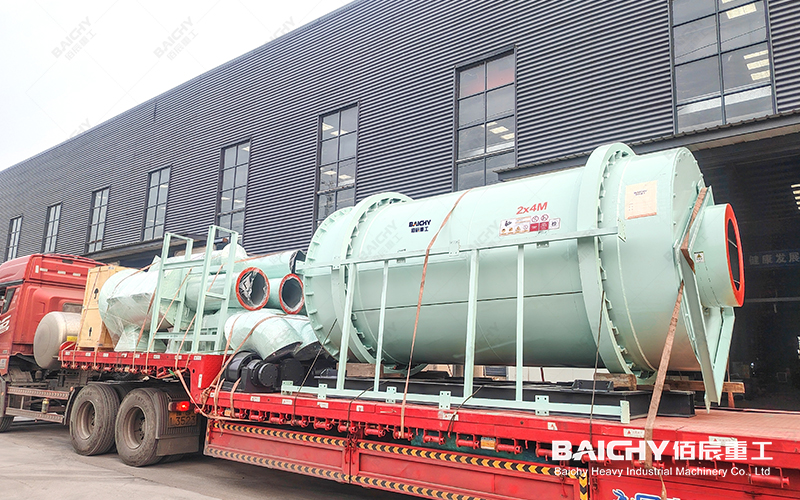
Shipment of the three-cylinder dryer
II. Counter-current Rotary Dryer: The Pinnacle of Thermal Efficiency and the Limits of Heat Sensitivity
In a counter-current setup, the material and the flue gas move in opposite directions: the wet end contacts low-temperature, humid flue gas, while the dry end contacts high-temperature, dry flue gas. This creates a significant temperature gradient across the drum and provides a strong driving force for drying, resulting in a thermal efficiency of 65–80%—an improvement of 15–25 percentage points over co-current systems (55–65%). For materials like quartz sand—which has a softening point above 1000°C and only begins its crystalline phase transformation near 870°C—using 600–700°C inlet air poses no heat-sensitivity issues. Consequently, counter-current drying is the optimal choice for bulk sand, gravel, and mineral powders in terms of fuel costs.
However, counter-current drying faces two critical limitations that are directly relevant to this topic:
The High-Purity Limit: The hottest flue gas comes into contact with the driest and "cleanest" end of the process—the finished product. Contaminants are adsorbed by the material as it travels, ultimately concentrating on the finished product at the discharge end.
The Heat-Sensitivity Limit: Properties such as kaolin whiteness, bentonite structural water, and the water of crystallization in salts begin to degrade or decompose between 250°C and 450°C. With discharge temperatures exceeding 90–120°C, heat-sensitive materials often suffer degradation in the final discharge section.
In short: Counter-current drying reserves the best thermal efficiency for bulk materials but subjects the finished product to the harshest conditions; it is suitable for heat-resistant sand and gravel, but not for high-purity or heat-sensitive materials.
III. Indirectly Heated Rotary Dryer: Physically Separating "Heat" from "Gas"
The core principle of indirect heating is simple: combustion products travel through a separate flue and never enter the dryer drum. Heat is transferred from the fuel to a clean medium, which then transfers it to the material.
There are three mainstream configurations:
| Configuration | Heat Transfer Method | Medium Temperature | Characteristics |
|---|---|---|---|
| Heat-exchanger hot-blast stove + single drum | Clean air heated via metal heat exchanger | 150–350°C | Most economical for retrofitting direct-heating lines; suitable for final moisture content ≤0.5% |
| Steam-tube bundle rotary dryer | Conduction & radiation from internal steam tubes | 120–200°C | No airflow entrainment, minimal dust; high equipment cost, low production capacity density |
| Thermal oil / jacketed type | Conduction via circulating hot oil | 200–320°C | Precise temperature control; suitable for small-to-medium capacities and highly heat-sensitive materials |
The benefits of isolation are immediate: the material contacts only the clean medium, keeping the increase in Fe₂O₃ content near the detection limit and physically blocking pathways for ash and alkali metals. The trade-offs are equally clear: heat undergoes an extra "transfer" step, resulting in a system thermal efficiency of generally 50–65%—10–20 percentage points lower than direct counter-current systems. Consequently, specific fuel consumption for the same evaporation task is 20–35% higher, and investment costs for both the heat exchanger and the main unit are increased.
IV. Quantitative Comparison: Is the Cost of Thermal Efficiency Worth It?
| Comparison Dimension | Direct-Heating (Counter-flow) Rotary Dryer | Indirect-Heating Rotary Dryer |
|---|---|---|
| Gas-Solid Contact | Combustion flue gas directly contacts the material | Heat exchange via clean medium; flue gas vented separately |
| System Thermal Efficiency (Engineering Reference) | 65–80% | 50–65% |
| Relative Specific Fuel Consumption | Baseline | +20–35% |
| Fe²O³/Ash Content Increase | Fluctuates with fuel/conditions; risk of exceeding limits | Kept near the lower detection limit |
| Product Temperature Control | Discharge temp. 90–120°C; difficult to control precisely | Precisely adjustable within medium temperature range |
| Suitability for Heat-Sensitive Materials | Poor (high-temp flue gas contacts product directly) | Good (controllable temp., no flue gas contact) |
| Initial Investment / Maintenance | Low to Medium / Low | Medium to High / Medium (e.g., heat exchanger fouling) |
Example Calculation: A 20 t/h high-purity silica sand line; feed moisture 8% (after wet processing/dewatering), target ≤0.5%. Evaporation rate E = 20 × (8% - 0.5%) &pide; (1 - 0.5%) ≈ 1.5 t/h; with 6,000 hours of annual operation, approximately 9,000 tons of water are evaporated. Based on a natural gas heat source and an industrial gas price of $0.25–$0.35/Nm³, indirect heating consumes an additional ~0.02–0.03 Nm³ of gas per kg of water evaporated, resulting in an annual fuel cost difference of approximately $50,000–$100,000.
Comparison with Purity-Related Revenue: Assuming a price difference of $15–$40 per ton (market estimate range) between glass-grade and downgraded silica sand, and an annual output of 120,000 tons—a single batch contamination event causing a downgrade would result in losses in the hundreds of thousands of dollars, alongside risks of cargo rejection and breach of contract. Fuel costs represent a quantifiable, budgetable operating expense; contamination is a low-probability, high-impact, one-off event. For high-purity and heat-sensitive materials, the additional fuel costs associated with indirect heating are essentially an insurance premium for quality preservation, not a waste of resources.
(Thermal efficiency, specific consumption, and price differentials are provided as engineering reference ranges; final calculations are based on Baichy's complimentary material drying tests and local energy prices.)
V. Typical Application Scenarios: When Indirect Heating Is Essential
| Scenario | Material Characteristics | Risks | Recommended Configuration |
|---|---|---|---|
| Glass-grade silica sand drying | 6–10% moisture after wet processing; Fe²O³ sensitivity | Alkali metal/ash contamination → Grade downgrading | Indirect heating; heat-exchanger hot-blast stove |
| Foundry sand drying | Sensitivity to acid consumption value (ACV) and loss on ignition (LOI) | Sulfur crusting → ACV exceeds limits | Indirect heating; low-sulfur fuel + heat exchange |
| Pre-drying for PV/electronic-grade quartz sand | Fe²O³ levels ≤0.01% | Any iron pickup renders material scrap | Steam tube bundle; zero flue gas contact throughout |
| Kaolin pre-drying | Sensitivity to whiteness | Oxidation/discoloration; discoloration at discharge | Low-temperature indirect heating; discharge temp <200°C |
| Post-activation bentonite drying | Structural water; high fines content | High temps destroy montmorillonite structure | Low-temp co-current or indirect heating |
| Salt/polymer granules | Highly heat-sensitive | Decomposition, discoloration, clumping | Indirect heating; strict temperature control |
| Bulk construction sand, mineral powder, iron concentrate | High-temperature resistant | No heat sensitivity issues | Direct counter-current heating (prioritizing thermal efficiency) |
A clear distinction must be made: indirect heating is not a universal solution. For bulk, heat-resistant aggregates, the thermal efficiency advantage of direct counter-current heating translates directly into fuel cost savings; blindly switching to indirect heating effectively wastes 5–20% of fuel costs annually. The inclusion of the final scenario serves specifically to prevent the opposite error: sacrificing the economic viability of bulk materials in the name of purity.
VI. Equipment Advantages: Baichy’s Engineering Implementation of Indirect Heating and Heat Source Control
Integrated Thermal System: Complete supply of hot blast stoves, heat exchangers, main drying units, cyclone and baghouse dust collectors, induced draft fans, and electrical control systems. Single-source responsibility avoids parameter mismatches often caused by multi-vendor assembly—system-wide verifiability is the prerequisite for purity control.
Clean Heat Source & Closed-Loop Temperature Control: Options for low-sulfur fuel and flue gas post-treatment; multi-point thermocouple monitoring combined with closed-loop discharge temperature control ensures the medium temperature for heat-sensitive materials remains precisely within the safe operating window.
Moisture-Proof Sealing: Air-lock discharge mechanisms and drum seals prevent the back-suction of moist air (causing re-moistening) and secondary contamination.
Distinction Between Nominal and Actual Capacity: Parameter tables specify bulk density and moisture baselines; dry material throughput drops by 20–30% when processing high-moisture feed—avoiding "nameplate illusions."
Free Material Drying Tests: Submit 5–10 kg samples; receive a report within 5 working days covering moisture curves, Fe₂O₃ content increase, and recommended configurations—obtain empirical data before placing an order.
VII. Parameter Table: Typical Configurations for Baichy Rotary Dryers
Specifications for direct-heating models are based on quartz sand (loose bulk density approx. 1.6 t/m³), counter-current operation, and an inlet air temperature of 600–700°C; capacities listed are engineering reference values. Indirect-heating models are custom-engineered, with capacity determined by heat transfer area and medium temperature; final specifications are always subject to material testing results.
| Configuration Type | Specification/Model | Reference Capacity (10% → 0.5%) | Inlet Air/Medium Temp. | Typical Application |
|---|---|---|---|---|
| Direct-heating single-drum (counter-flow) | φ1.5×12 m | 8–15 t/h | 600–700°C | Bulk construction sand, mineral powder |
| Direct-heating single-drum (counter-flow) | φ2.4×18 m | 35–55 t/h | 600–700°C | Standard model for sand & gravel lines |
| Direct-heating single-drum (counter-flow) | φ3.0×22 m | 70–110 t/h | 600–700°C | Large-scale aggregate/fine powder lines |
| Direct-heating single-drum (counter-flow) | φ3.6×25 m | 120–200 t/h | 600–700°C | Ultra-large-scale production lines |
| Indirect-heating (customized) ★ | Heat-exchanger hot blast stove + single drum | Customized based on heat transfer area (typically 5–60 t/h) | 150–350°C | High-purity silica sand, foundry sand |
| Indirect-heating (customized) ★ | Steam tube bundle rotary dryer | Customized based on heat transfer area | 120–200°C (steam) | PV-grade quartz sand, highly heat-sensitive materials |
Key Point: When processing feedstocks with 8% vs. 15% moisture content using the same equipment, the capacity difference can exceed 30%; the more stable the feed, the more compact the configuration can be. For high-purity lines, it is recommended to use a dewatering screen to reduce free water content to below 10% prior to drying; this lowers the evaporation load and minimizes the risk of impurity dissolution and re-precipitation.
VIII. Relevant Case Studies (Reference for engineering conditions; client names omitted per confidentiality agreements)
Case A (Middle East, Glass-grade silica sand drying retrofit): A glass silica sand plant needed to dry water-washed sand from 8% moisture to ≤0.5%. The original setup utilized a gas-fired, direct-heating, counter-flow single-drum dryer. Within two months of commissioning, batch-to-batch fluctuations in Fe₂O₃ content occurred—with some approaching the contractual upper limit of 0.10%—alongside complaints regarding ash adhesion. Baichy modified the system to use a gas-fired indirect heat-exchange hot-blast stove, delivering clean hot air at 280–320°C into the rotary drum. Post-modification, the iron content increase was suppressed to near the detection limit, and batch-to-batch variation was narrowed to within one-third of the contractual maximum, consistently securing "glass-grade" pricing. Although specific fuel consumption rose by approximately 25%—equating to a cost increase of less than $2 per ton of finished product—this figure is far lower than the price differential between glass-grade and downgraded sand. Certainty regarding product grade equates to pricing power.
Case Study B (Kaolin pre-drying and heat-sensitive whiteness control): A kaolin processing plant employed pre-drying prior to calcination. The original counter-current direct heating method caused localized overheating at the discharge end, resulting in batch-to-batch whiteness fluctuations and mild agglomeration. Switching to low-temperature indirect heating (heating medium ≤220°C) ensured a uniform temperature field within the drum, eliminating whiteness fluctuations and reducing agglomeration rates; consequently, the loads associated with over-grinding and screening during subsequent milling were also reduced. Strict control of pre-drying temperatures directly determines the finished product's whiteness grade and grinding energy consumption.
IX. Recommended Equipment
| Equipment | Recommended Configuration | Application/Positioning |
|---|---|---|
| Indirect-heating rotary dryer | Heat-exchanger hot blast stove + single-drum / Steam tube bundle (custom-engineered) | High-purity silica sand, heat-sensitive materials; isolates material from flue gas contamination |
| Single-drum rotary dryer (direct counter-flow) | φ1.5×12 m ~ φ3.6×25 m | Bulk high-temperature resistant sand/gravel and mineral powder; prioritizes thermal efficiency |
| Hot blast stove | Coal/gas/biomass-fired; sized according to evaporation load | Heat source; indirect types feature clean heat exchange |
| Cyclone + baghouse dust collector | Sized according to system airflow | Ensures exhaust meets emission standards; recovers fine particles |
| Dewatering screen / Spiral sand washer | Pre-dewatering before drying | Reduces feed moisture content to below 10% |
| Variable-frequency screw feeder | Stabilizes feed rate | Feed fluctuations are the primary cause of moisture and contamination issues |
Related Reading (Suggested Internal Links): Rotary Dryer Selection Guide (Category Pillar Page – Essential Link); Single-drum Rotary Dryer Parameters & Selection; Silica Sand Dryer: Solutions for Glass-grade & Foundry-grade (0.5% moisture); Integrated Line Solutions: Sand Washing – Dewatering – Drying – Grinding. For equipment selection, please provide material type, feed moisture, target moisture, Fe₂O₃ upper limit, and production capacity. Baichy provides free moisture curves and direct vs. indirect heating comparison reports based on samples, delivered within 5 working days.
FAQ
Q1: Why can't high-purity silica sand be dried using direct heating? What exactly in the combustion flue gas contaminates the material?
A: Direct heating exposes the material to flue gas; contamination arises from four sources: Alkali metals (Na/K) volatilize at high temperatures and condense on particle surfaces, interfering with glass melting formulas; SO₂/SO₃ from sulfur-containing fuels reacts with moisture to form sulfate crusts, increasing the acid demand value of foundry sand; coal fly ash and unburnt carbon particles adhere mechanically, causing turbidity levels in fracturing sand to exceed limits; high-temperature oxidizing atmospheres oxidize iron-bearing minerals on the surface, deepening the color caused by Fe₂O₃. Contracts for float-glass-grade sand typically require Fe₂O₃ content ≤0.10%; however, with direct heating, the amount of contaminant deposition fluctuates based on fuel batches and operating conditions—uncertainties that high-purity production lines cannot tolerate.
Q2: Exactly how much more fuel does indirect heating consume compared to direct heating? How much higher is the cost per ton?
A: Regarding thermal efficiency, direct counter-current heating achieves 65–80%, whereas indirect heating achieves 50–65%—a difference of 10–20 percentage points. Consequently, specific fuel consumption for the same evaporation task is approximately 20–35% higher. Based on estimates for a 20 t/h high-purity silica sand line (reducing moisture from 8% to 0.5% over 6,000 annual operating hours), the annual difference in fuel costs is roughly $50,000–$100,000 (depending on local gas prices). However, the market price spread between glass-grade and downgraded silica sand ranges from $15 to $40 per ton; with an annual output of 120,000 tons, a single batch contamination event causing a downgrade could result in losses amounting to hundreds of thousands of dollars. For high-purity materials, the additional fuel cost acts as an insurance premium for product quality rather than a waste of resources.
Q3: When should one choose direct counter-current heating, and when is indirect heating mandatory?
A: There are only two criteria: whether the material is heat-sensitive and whether its purity is sensitive to contamination. For bulk, high-temperature-resistant materials (such as construction sand, mineral powder, or iron concentrate, with softening points above 1,000°C) that lack heat sensitivity, choosing direct counter-current heating allows you to gain 15–25% higher thermal efficiency for free. Conversely, if the material is heat-sensitive (e.g., kaolin, bentonite, salts, polymers) or subject to strict contractual limits on Fe₂O₃ or ash content (e.g., glass sand, foundry sand, photovoltaic-grade quartz sand), you must select an indirect-heating rotary dryer or a low-temperature co-current system. When in doubt, conduct a drying test using 5–10 kg of material and measure the increase in Fe₂O₃ content and changes in color value before and after drying.The data will provide the answer directly.
Baichy Heavy Industry
Baichy Heavy Industry is a high-tech mining equipment company integrating R&D, manufacturing, sales, and after-sales service. Focusing on crushing, grinding, and mineral processing equipment, we provide professional solutions to our customers. We are ISO9001:2015 、certified, and our products include mobile crushing palnts, crawler crushing plant, construction waste crushing plants, jaw crushers, sand making machines, cone crushers, fine crushers, grinding mills, ball mills, etc., all with reliable performance to meet diverse project needs.
Baichy Heavy Industry – Your Trusted Partner
To ensure optimal performance of your equipment, Baichy Heavy Industry offers:
- Professional on-site installation guidance
- Comprehensive operator training
- 24/7 technical support & maintenance services
Our complete after-sales service system guarantees long-term, stable operation of your machinery with minimal downtime.
Protect Your Rights – Only Use Official Channels
To avoid scams and ensure authentic support, contact us exclusively through:
• Official Website: www.baichychina.com
• WhatsApp: +8615093222637
• Email: [email protected]
Your satisfaction is our priority – expect prompt, professional service every time.
(Note: Beware of unauthorized third parties claiming to represent Baichy. Always verify through official contacts.)