
Coal slime dryers, lignite dryers
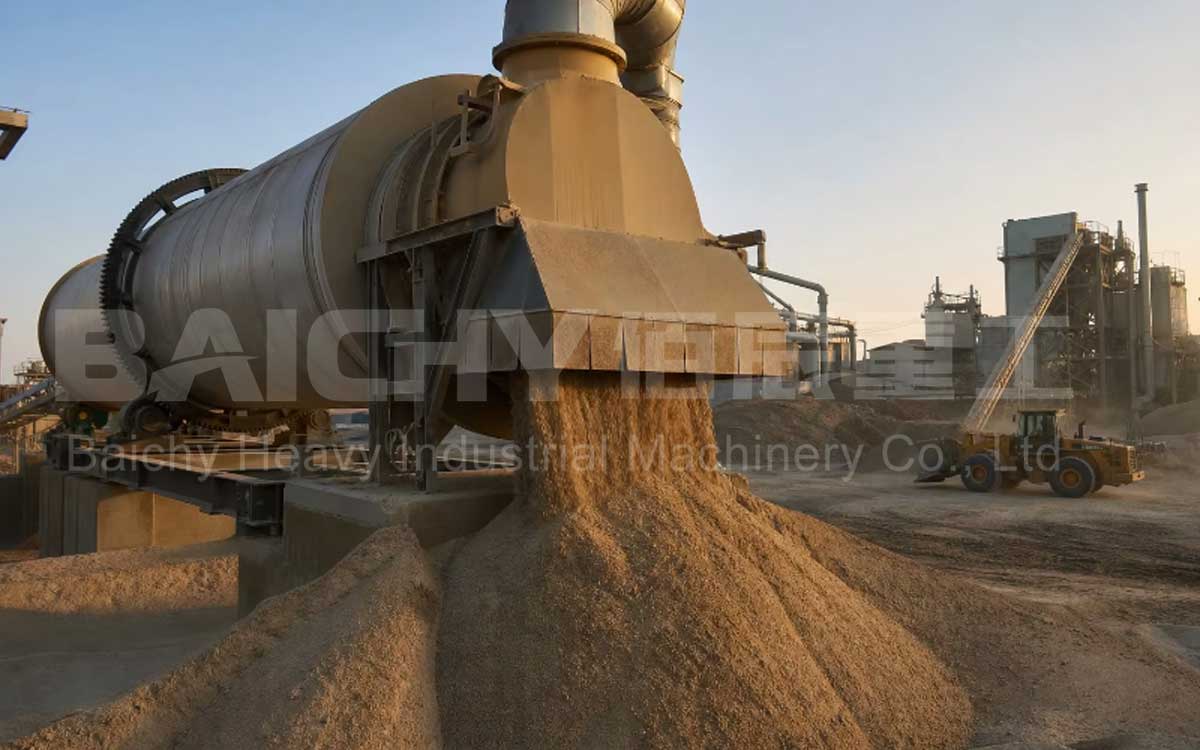
The moisture content of filter-pressed coal slime at coal preparation plants typically ranges from 20% to 30%, while the total moisture content of lignite often falls between 25% and 40%. Whether for sale, co-firing, or transport, high-moisture coal incurs significant costs associated with water content: diluted calorific value, inflated freight charges, freezing in winter, and spontaneous combustion during storage. Consequently, upgrading quality prior to utilization—by reducing moisture levels using coal slime and lignite dryers—has become a recognized strategy for coal enterprises and power plants to boost efficiency. Baichy’s rotary coal dryer can reduce the moisture content of coal slime, lignite, and raw coal from an initial 25% to below 8%, increasing the net calorific value by approximately 25% and allowing for the recovery of equipment investment within 6 to 12 months.
I. Why Upgrade Quality Before Utilization? Three Cost Factors of High-Moisture Coal
• Calorific Value: Coal is priced based on calorific value; for every 1% increase in moisture, the net calorific value drops by approximately 60–70 kcal/kg, directly lowering the settlement grade. Drying material from 25% moisture to 8% boosts the calorific value by about 25%.
• Transportation: Freight is charged by the ton; in every 100 tons of wet coal, approximately 20 tons is water. Drying allows the same transport capacity to carry more dry coal, thereby diluting the logistics cost per ton.
• Safety and Environmental Protection: Wet coal is prone to freezing in winter and spontaneous combustion in summer. With stricter environmental regulations, open-air drying is largely prohibited, making mechanical drying a compliant, continuous, and weather-independent solution. For power plants and briquette factories, high-moisture coal reduces boiler efficiency and increases the load on coal pulverizers. Since moisture impacts the entire chain from procurement to settlement, upgrading quality at an earlier stage lowers downstream costs.
II. Working Principles and Equipment Configurations for Coal Slime and Lignite Dryers
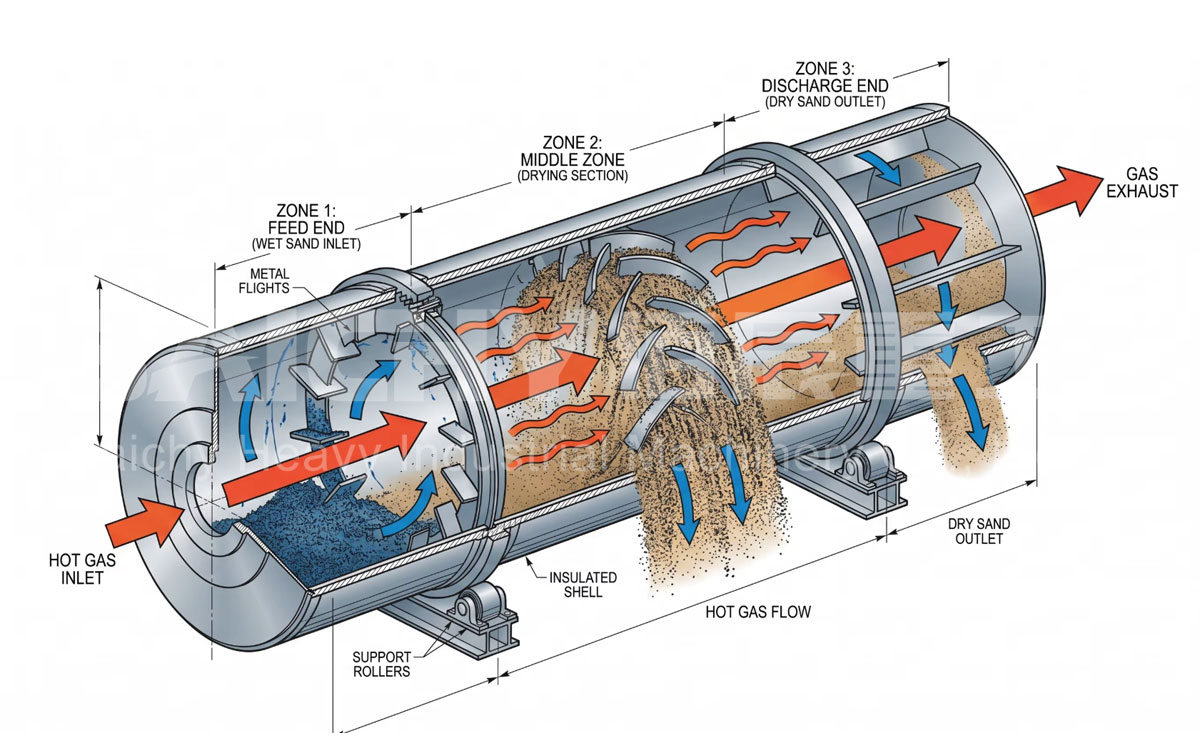
Structural and operational diagram of a three-cylinder dryer
1. Co-current Rotary Process
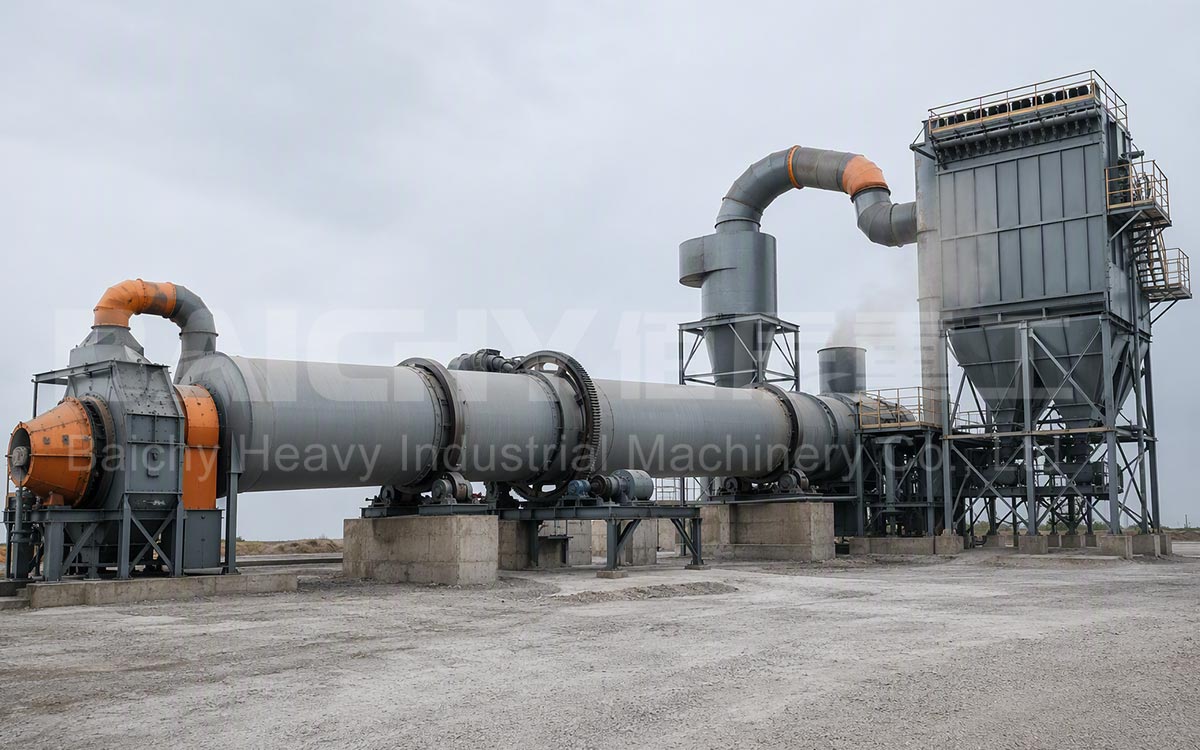
Wet coal is fed into the rotary drum via a breaking-and-feeding device, moving in the same direction as the high-temperature flue gas from the hot-blast stove. Lifting flights repeatedly toss and scatter the material, creating a dense curtain that ensures full contact between the hot air and coal particles; moisture evaporates rapidly and is exhausted by an induced-draft fan. The drum features variable-frequency speed control, allowing the residence time to be adjusted in real-time based on the incoming material's moisture content. Each material type has a specialized design: coal slime is highly viscous, so its dryer is equipped with a breaking-and-feeding device and high-strength lifting flights to prevent clumping and wall adhesion; lignite has high volatile content, so its dryer features controllable temperature zones and co-current cooling to prevent localized overheating and spontaneous combustion. A two-stage dust removal system (cyclone plus bag filter) at the discharge end ensures emissions meet standards.
2. Choosing Between Single-Drum and Triple-Drum Designs
The HG single-drum rotary dryer features a straightforward structure and low investment cost, making it suitable for small-to-medium production lines (2–25 t/h). The triple-drum dryer folds three drying stages into concentric cylinders that provide mutual thermal insulation; for the same production capacity, the equipment length is reduced by approximately 60%, making it ideal for high-capacity operations (25–100 t/h) or lignite processing sites with space constraints. Selection should be based on determining the required capacity and available site space first.
III. Typical Application Scenarios for Coal Slime Dryers
1. Resource Recovery of Coal Slime at Coal Preparation Plants
Filter-pressed coal slime has high moisture and viscosity; air-drying is restricted, and transporting it off-site often incurs a net cost. Using a coal slime dryer to reduce moisture to 8% allows the material to be blended with clean coal or supplied to power plants. This transforms the byproduct from a disposal liability (incurring costs) into a marketable dry coal product settled based on calorific value, turning losses into profits.
2. Pre-drying Lignite for Power Plants
Feeding high-moisture lignite directly into the furnace consumes significant heat for evaporation, thereby reducing boiler efficiency. Pre-drying the lignite before feeding it into the furnace allows for a higher co-firing ratio and significantly reduces system shutdowns caused by coal blockages or mill clogging—representing the most mature method for upgrading lignite quality in power generation.
3. Production of Coal Briquettes and Industrial Fuel
The briquetting process imposes strict requirements on raw material moisture content, typically necessitating a range of 8%–12%. Drying determines both the strength of the briquettes and the duration of subsequent curing; the processing capacity of the lignite dryer often acts as the bottleneck for the entire production line's output.
4. Pulverized Coal Preparation and Coking Coal Blending
Feeding wet coal into the mill reduces capacity and increases power consumption; controlling moisture prior to milling improves hourly throughput and the particle size pass rate. For demanding applications—such as coal for injection or coking—target moisture levels can be set below 5%, requiring extended drum lengths and multi-stage drying zones.
Typical Upgrading Process: Coal Bunker → Feeder → Pre-crushing (via toothed roll crusher, if lump size exceeds limits) → Dispersing Feeder → Coal Slurry/Lignite Dryer → Dust Removal → Finished Product → Blending, Briquetting, or Furnace Feeding.

Schematic diagram of the triple-drum dryer process
IV. Core Advantages of Coal Slurry and Lignite Dryers
| Technical Characteristics | Direct Benefits |
|---|---|
| Co-current rotary flow + lifting flights creating a material curtain | Rapid evaporation; uniform discharge moisture (≤8%) |
| Dispersing feeder + high-strength lifting flights | Prevents high-viscosity slurry from clumping or sticking to walls; enables continuous production during rainy seasons |
| Controllable temperature zones + co-current cooling | Prevents localized overheating of lignite; reduces risk of spontaneous combustion |
| Variable frequency drive (VFD) for drum speed | Maintains stable discharge moisture despite fluctuations in feed moisture |
| Two-stage dust removal (cyclone + bag filter) | Ensures emissions compliance; replaces open-air drying; enables continuous, compliant production |
| Multi-source heating (coal/gas/biomass) | Switchable based on local fuel price differentials; controllable operating costs |
| HG single-drum & triple-drum product lines | Full capacity coverage (2–100 t/h); suitable models for both small and large production lines |
Rotary designs feature simple structures and fewer wear parts; low replacement costs for lifting flights; superior Total Cost of Ownership (TCO) compared to other drying methods.
V. Technical Parameters of HG Series Slime Dryer (Suitable for coal slime, lignite, and raw coal)
| Model | Drum Dimensions (m) | Processing Capacity (t/h) | Input Moisture | Output Moisture | Heat Source Options |
|---|---|---|---|---|---|
| HG1212 | φ1.2×12 | 2–4 | ≤25% | ≤8% | Coal/Gas/Biomass |
| HG1514 | φ1.5×14 | 5–8 | ≤25% | ≤8% | Coal/Gas/Biomass |
| HG1816 | φ1.8×16 | 8–12 | ≤25% | ≤8% | Coal/Gas/Biomass |
| HG2018 | φ2.0×18 | 12–18 | ≤25% | ≤8% | Coal/Gas/Biomass |
| HG2418 | φ2.4×18 | 18–25 | ≤25% | ≤8% | Coal/Gas/Biomass |
Note: Processing capacity is rated based on an input moisture content of ≤25%; a material-breaking device is required for coal slime. For lignite with moisture exceeding 30%, a triple-pass dryer or an extended drum is recommended; the target final moisture is 8%–12%, as excessive drying can actually increase moisture re-absorption and the risk of spontaneous combustion. Actual capacity is subject to on-site measurement.
VI. Application Cases of Coal Slime and Lignite Dryers
Case 1: Coal slime drying at a coal preparation plant in North China (approx. 10 t/h).
Filter-pressed coal slime had a moisture content of 22%–25% and could not be air-dried during the rainy season. An HG1816 dryer equipped with a material-breaking device was installed, reducing output moisture to below 8%. The dried product was blended with clean coal for sale, increasing the value by 30–50 RMB per ton and allowing for investment recovery in approximately 8 months.
Case 2: Lignite upgrading at a base in Inner Mongolia (approx. 30 t/h).
Lignite moisture ranged from 28% to 32%; direct sales were limited by calorific value and transportation distance. A Ф2.8×6m triple-pass dryer is used to reduce moisture to 12%. The dried coal is transported to ports and power plants, opening up sales channels for both co-firing and coal briquetting, while ensuring uninterrupted production during the rainy season.
Case Study 3: Lignite pre-drying at a Southeast Asian power plant.
During the rainy season, incoming coal moisture rose above 35%, restricting co-firing ratios and causing mill blockages. After adding a drying section, co-firing ratios were restored and increased, downtime due to blockages dropped significantly, and overall fuel costs decreased.
Note: The above represents typical operating conditions; specific parameters vary by coal type and site. Detailed technical proposals for specific coal types are available upon request.
VII. Recommended Equipment Related to Coal Slime Dryers
HG Series Coal Slime Dryer (Single-drum rotary type): 2–25 t/h; processes coal slime, raw coal, and clean coal; highly recommended;
Triple-pass Dryer: 25–100 t/h; for lignite bases and large coal preparation plants; space-saving and high thermal efficiency;
ZSW Vibrating Feeder & Disaggregation Feeding Device: Ensures uniform feeding, breaks up clumps, and prevents bridging;
Coal/Gas Hot Blast Stove + Cyclone & Baghouse Dust Collectors: Integrated heat source and environmental protection solution;
2PGC Toothed Roll Crusher: For pre-crushing lumps exceeding 30mm (refer to the toothed roll crusher coal crushing solution);
Raymond Mill/Vertical Mill: For pulverized coal production; combines with the dryer to form a complete "drying + grinding" quality-upgrading line.
VIII. Coal Slime Dryer FAQ
Q1: Coal slime is very sticky; will the dryer suffer from wall adhesion or material blockages?
Conventional models do tend to experience clumping and clogging when processing coal slime directly. The HG Series coal slime dryer features an optional disaggregation feeding device and high-strength lifting flights: wet coal is broken up and dispersed before entering the drum; lifting flights are densely arranged to handle sticky materials; and variable frequency speed control regulates the material curtain thickness. This allows for continuous operation with filter-pressed coal slime (approx. 25% moisture) and ensures output moisture is ≤8%.
Q2: Lignite has high volatile matter content and is prone to spontaneous combustion; is it safe to dry lignite in a dryer?
Safety depends on proper process design. In a co-current flow process, the hot air inlet contacts high-moisture coal, causing rapid heat absorption; the material enters a cooling phase before discharge, and zoned temperature control prevents localized overheating. A final moisture content of 8%–12% is recommended to avoid over-drying, thereby reducing moisture re-absorption and the risk of spontaneous combustion during storage. Temperature monitoring can be installed at the discharge end, and dust removal systems should be selected in compliance with explosion-proof standards.
Q3: How do I select the right model for a coal slime or lignite dryer? What parameters are required?
You simply need to provide five items: coal type and initial moisture content, particle size and viscosity, target production capacity (based on dry material), target final moisture content, and available heat source and site conditions. For small to medium capacities, choose the HG single-drum series (2–25 t/h); for high capacities or sites with space constraints, choose the three-drum series (25–100 t/h). Specialized designs are required if lignite moisture exceeds 30% or if the required final moisture content is below 5%. Once you submit the parameters, we will provide a matching model and capacity curve within 24 hours.
Baichy Heavy Industry
Baichy Heavy Industry is a high-tech mining equipment company integrating R&D, manufacturing, sales, and after-sales service. Focusing on crushing, grinding, and mineral processing equipment, we provide professional solutions to our customers. We are ISO9001:2015 、certified, and our products include mobile crushing palnts, crawler crushing plant, construction waste crushing plants, jaw crushers, sand making machines, cone crushers, fine crushers, grinding mills, ball mills, etc., all with reliable performance to meet diverse project needs.
Baichy Heavy Industry – Your Trusted Partner
To ensure optimal performance of your equipment, Baichy Heavy Industry offers:
- Professional on-site installation guidance
- Comprehensive operator training
- 24/7 technical support & maintenance services
Our complete after-sales service system guarantees long-term, stable operation of your machinery with minimal downtime.
Protect Your Rights – Only Use Official Channels
To avoid scams and ensure authentic support, contact us exclusively through:
• Official Website: www.baichychina.com
• WhatsApp: +8615093222637
• Email: [email protected]
Your satisfaction is our priority – expect prompt, professional service every time.
(Note: Beware of unauthorized third parties claiming to represent Baichy. Always verify through official contacts.)