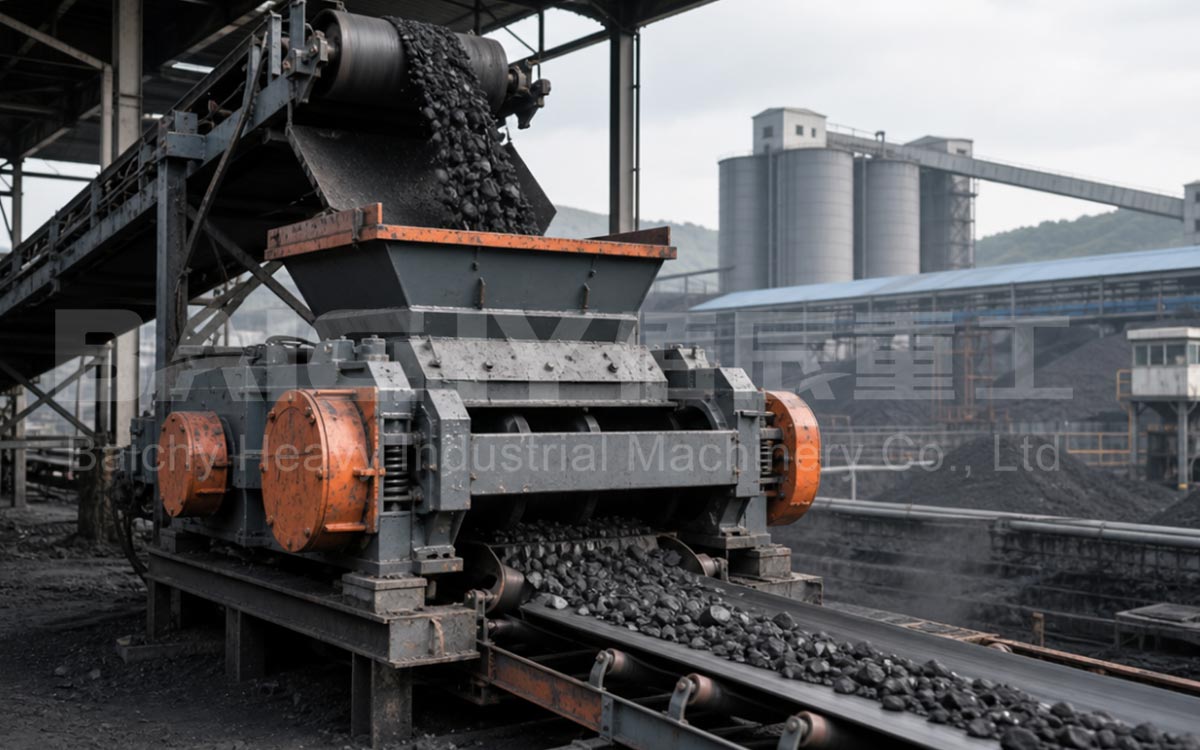
coal crushing equipment
Coal is characterized by low hardness (Protodyakonov scale f=1–3), high moisture content in certain varieties, and the frequent presence of tramp iron impurities. These three factors make the roll crusher a highly cost-effective choice for the medium-to-fine crushing stage of coal processing. Compared to hammer crushers, roll crushers keep the "oversize-to-fines" ratio (excessive pulverization) below 10%; they do not clog even when processing sticky, wet coal with 15% moisture content; and the output particle size can be flexibly adjusted between 2 mm and 35 mm by varying the roll gap. In short: while other crushers might turn coal into a pile of dust, the roll crusher produces a finished product ready for immediate furnace feeding or storage.
I. Working Principle of Roll Crushers for Coal
The core structure of a roll crusher (also known as a double-roll or twin-roll crusher) consists of two rollers rotating towards each other. Material falls into the gap between the rollers and is crushed to the target size through a combination of compression and shearing forces. The design of the roll surface determines the operational capabilities:
• Smooth rolls: Suitable for high-moisture, sticky coal; when paired with a scraper mechanism, wet coal does not adhere to the rolls or cause clogging.
• Toothed rolls: Suitable for primary (coarse) and secondary (medium) crushing of large run-of-mine coal; the toothed surface offers strong gripping power, capable of crushing 300 mm lumps down to under 50 mm in a single pass.
• Four-roll two-stage tandem configuration: Performs two stages of crushing in one continuous process, directly producing 0–3 mm coking coal or feedstock for coal briquettes.
Because they utilize low-speed compression rather than high-speed impact, roll crushers cause significantly less pulverization of the coal compared to hammer crushers. This results in a lower proportion of fine dust and simultaneous improvements in product yield and screening efficiency—the technical reasons why roll crushers are the preferred choice for coal crushing applications.

double-roll crusher
II. Typical Application Scenarios for Coal Crushing
Roll crushers are used in four key coal processing sectors: power plants, coking plants, coal preparation plants, and the coal chemical industry:
1. Power plant coal crushing (0–30 mm for furnace feed): Thermal power plants have strict requirements regarding the particle size of coal fed into the furnace (typically ≤30 mm). 1. Coal crushing: Roller crushers can directly reduce run-of-mine coal to the particle size range required for boilers. They offer high throughput and minimal dust generation; when paired with enclosed conveying systems, they effectively control coal dust pollution.
2. Coking coal crushing (0–3 mm for blending): The particle size distribution of coking coal directly determines coke quality. A four-roll crusher configuration—utilizing two stages in series to achieve a 0–3 mm product in a single pass—ensures stable blending ratios and uniform particle sizing, making it the standard choice for coking plant coal blending systems.
3. Run-of-mine coal crushing at coal preparation plants: Crushing and sizing run-of-mine coal prior to processing is essential. The low fines generation rate of roller crushers significantly reduces coal slime volume, lowers the load on downstream washing and slime water treatment circuits, and directly cuts operating costs.
4. Coal chemical industry and briquette processing: Processes such as coal gasification, briquetting, and coal-water slurry production have strict upper limits on feedstock particle size. Roller crushers offer adjustable sizing and uniform output, making them ideal for pretreatment stages across various coal chemical applications.
Typical production line flow: Run-of-mine coal bunker → ZSW vibrating feeder → Toothed roll crusher (primary crushing to <50 mm) → 2PG double-roll crusher (secondary crushing to target size) → Vibrating screen (sizing) → Finished product bunker.
III. Key Advantages of Roller Crushers for Coal Crushing
| Technical Features | Direct Benefits |
|---|---|
| Compression and shear crushing; fines generation <10% | Increases coal product yield by 5–15%; for a 50 t/h line, this saves hundreds of thousands of yuan annually by reducing fines loss |
| Smooth rolls + scrapers; no clogging with 10–15% moisture content | Allows normal operation during rainy weather or with high-moisture coal; reduces downtime for cleaning by 90% |
| Spring/hydraulic roll gap adjustment | Rapid switching of output size (2–35 mm) without stopping the machine or changing equipment |
| Low speed, large roll diameter; low electricity consumption per ton | Consumes ~30% less power than hammer crushers for the same capacity; generates less coal dust and offers higher safety |
| Hydraulic overload retraction + iron remover | Rolls automatically retract upon encountering iron or hard impurities (0.2-second response); protects roll surfaces from damage |
| Simple structure; roll shells repairable via hardfacing | Low maintenance requirements; roll shell lifespan of 6–8 months; repair costs are only 20–30% of the price of new rolls |
In addition to the benefits above, another major advantage of roller crushers is the predictability of operating costs: with fewer wear parts, fewer lubrication points, and simple operation, stable performance can be maintained without a highly skilled maintenance team, placing minimal pressure on staffing for new power plant or coking projects.
IV. Core Specifications Table (Typical Configurations for 2PG/2PGC Series)
| Model | Roll Diameter × Length (mm) | Max. Feed Size (mm) | Discharge Size (mm) | Capacity (t/h) | Motor Power (kW) |
|---|---|---|---|---|---|
| 2PG400×250 | 400×250 | ≤25 | 2-8 | 5-10 | 11 |
| 2PG610×400 | 610×400 | ≤40 | 10-30 | 15-40 | 30 |
| 2PG750×500 | 750×500 | ≤45 | 10-40 | 30-60 | 37 |
| 2PG900×700 | 900×700 | ≤60 | 10-50 | 50-120 | 45-55 |
| 2PGC600×750 (Toothed Roll) | 600×750 | ≤200 | ≤50 | 40-80 | 2×22 |
| 2PGC900×900 (Toothed Roll) | 900×900 | ≤300 | ≤50 | 80-160 | 2×37 |
Note: Capacity is rated based on limestone (1.6 t/m³); for lightweight materials such as coal and coke, a conversion factor of 0.45–0.55 applies. Actual capacity depends on specific material testing.
V. Typical Application Configuration Reference (Case Studies)
Case 1: Coal crushing line for a power plant in East China (30–50 t/h).
Operating conditions: Raw coal lump size ≤200 mm, moisture content 10–12%, containing small amounts of iron impurities. Configuration: ZSW380×96 feeder + 2PGC600×750 toothed roll crusher (primary crushing) + 2PG750×500 double-roll crusher (fine crushing to ≤30 mm) + iron remover. Selection Logic: Toothed rolls handle impacts from large lumps and the risk of tramp iron, while smooth rolls ensure consistent feed particle size. The two-stage configuration further reduces the fines generation rate compared to single-stage systems, cutting coal slime production by approximately 20%.
Case Study 2: Coal blending system at a coking plant in North China (single-pass 0–3 mm sizing).
Operating Conditions: Coking coal blending requires uniform particle sizing. Configuration: 2PG750×500 four-roll, two-stage crusher (tandem arrangement) for single-pass 0–3 mm sizing. Selection Logic: Two-stage roll crushing utilizes shearing and compression rather than impact, allowing for controlled fines generation, minimal fluctuations in the blending ratio, stable coke quality, and low screen-return rates.
Case Study 3: Run-of-mine (ROM) coal sizing and crushing at a coal preparation plant in Southeast Asia (80–120 t/h).
Operating Conditions: High-moisture lignite prone to sticking and clogging; continuous operation required during the rainy season. Configuration: 2PG900×700 smooth-roll crusher equipped with scraper devices. Selection Logic: The combination of smooth rolls and scrapers effectively prevents clogging caused by sticky, wet coal, ensuring uninterrupted production during the rainy season; the crushed product (≤50 mm) proceeds directly to the washing stage, reducing the load on the coal slime water treatment system.
Note: The above configurations serve as typical references; please refer to material test reports for specific capacity and equipment selection details.
VI. Key Selection Criteria and Pitfall Avoidance for Coal-Crushing Roll Crushers
Check feed size: The feed lump size must not exceed 1/10 to 1/15 of the roll diameter; oversized lumps require preliminary coarse crushing via a toothed roll or a grizzly screen.
Check moisture content: For high-moisture (>15%) and sticky coal, smooth rolls with scrapers are preferred; for lump coal and coke, toothed rolls are suitable.
Mandatory iron removal: Coal often contains foreign iron objects like roof bolts or wire; a magnetic separator or a hydraulic overload relief mechanism is essential (the 2PGY hydraulic model automatically retracts the roll within 0.2 seconds upon encountering iron, which is the primary reason for choosing the hydraulic version over the spring-loaded one).
Coal dust and explosion protection: Coal crushing generates dust; selecting a sealed machine body and explosion-proof motor, along with a dust collector, is recommended to meet safety production standards.
Calculate TCO: Selection should go beyond price comparison; calculate the 3-year total cost based on "equipment purchase + roll shell wear + power consumption + fines loss." The full life-cycle cost of roll crushers in coal applications is typically lower than that of hammer crushers.
VII. Recommended Related Equipment
For coal-crushing applications using roll crushers, Baichen Heavy Industry recommends the following auxiliary equipment:
2PG Series Double-Roll Crusher: The primary choice for fine coal crushing; adjustable output size (2–50 mm); suitable for power plants, coking plants, and coal preparation plants.
2PGC Series Toothed Roll Crusher: For coarse crushing of run-of-mine coal lumps; reduces material to below 50 mm in a single pass.
ZSW Series Vibrating Feeder: Ensures uniform feeding and prevents bin bridging; used at the front end of the coal crushing line.
Vibrating Screen (YK/Linear Screen): For post-crushing classification; ensures the product meets particle size specifications.
Magnetic Separator and Dust Collector: For iron removal (damage prevention) and dust control; standard equipment for safe production.
Raymond Mill/Vertical Mill: If further grinding into pulverized coal is required (e.g., for boiler injection or pulverized coal preparation), these can be combined with the roll crusher to form a complete "crushing + grinding" production line.
VIII. FAQ
Q1: What is the maximum moisture content of coal that a roll crusher can handle?
A configuration featuring smooth rolls and scrapers can handle sticky, wet coal with 10–15% moisture content without clogging; for highly sticky lignite with over 15% moisture, it is recommended to use a feeder for homogenization and to upgrade the roll-surface scraper setup—specific configurations should be determined based on material testing.
Q2: Should I choose a roll crusher or a hammer crusher for coal?
It depends on your requirements: choose a roll crusher if you need a low fines generation rate, high product yield, resistance to clogging with wet coal, and minimal dust. Hammer crushers are suitable if the material is extremely dry and a higher proportion of fines is acceptable, though they typically result in more coal dust, higher power consumption, and increased maintenance costs. For coal applications, roll crushers are generally recommended.
Q3: How is the output particle size maintained at 0–3 mm or 0–30 mm?
This is achieved by adjusting the gap between the rolls: the 2PG series features an adjustable roll gap, allowing for a continuously variable output size of 2–35 mm. For 0–3 mm coking coal, a four-roll, two-stage tandem setup for single-pass shaping is recommended, or a single-stage crusher combined with a fine screen in a closed-loop circuit. As the roll surfaces wear, the roll gap can be fine-tuned every 300–400 hours to compensate.
Baichy Heavy Industry
Baichy Heavy Industry is a high-tech mining equipment company integrating R&D, manufacturing, sales, and after-sales service. Focusing on crushing, grinding, and mineral processing equipment, we provide professional solutions to our customers. We are ISO9001:2015 、certified, and our products include mobile crushing palnts, crawler crushing plant, construction waste crushing plants, jaw crushers, sand making machines, cone crushers, fine crushers, grinding mills, ball mills, etc., all with reliable performance to meet diverse project needs.
Baichy Heavy Industry – Your Trusted Partner
To ensure optimal performance of your equipment, Baichy Heavy Industry offers:
- Professional on-site installation guidance
- Comprehensive operator training
- 24/7 technical support & maintenance services
Our complete after-sales service system guarantees long-term, stable operation of your machinery with minimal downtime.
Protect Your Rights – Only Use Official Channels
To avoid scams and ensure authentic support, contact us exclusively through:
• Official Website: www.baichychina.com
• WhatsApp: +8615093222637
• Email: [email protected]
Your satisfaction is our priority – expect prompt, professional service every time.
(Note: Beware of unauthorized third parties claiming to represent Baichy. Always verify through official contacts.)