Rock Crushers for Sale
Whether you run a quarry, a gold mine or a construction waste yard, the rock crushers you buy today will define your production capacity, your operating cost per ton and your payback period for the next 10 to 15 years. This guide explains how to choose rock crushers for sale — by rock hardness, feed size, target output and total cost of ownership — and why Baichy's jaw, cone, impact, VSI and mobile crushers deliver the most value per dollar for mid- to large-scale operations across more than 60 countries.
1. Buy the Crushing Stage, Not Just the Machine
Most plant operators make one of two mistakes when they shop for rock crushers for sale: they buy a machine too small for the real feed size, or they use a secondary-type crusher on rock abrasive enough to destroy its wear parts in weeks. The correct starting point is the crushing stage your plant needs:
| Stage | Typical Equipment | Feed Size | Output Size | Reduction Ratio |
|---|---|---|---|---|
| Primary | Jaw crusher | 300–1,000 mm | 75–300 mm | Up to 6:1 |
| Secondary | Cone / impact crusher | 100–350 mm | 20–80 mm | 4–6:1 |
| Tertiary | VSI / cone (fine) | 0–50 mm | 5–20 mm | 4–8:1 |
| Sand making | VSI sand maker | 0–50 mm | 0–5 mm | 5–10:1 |
A jaw crusher is the only sensible primary option for boulders over 500 mm. A cone crusher is the only economical option for abrasive rock like granite and basalt. An impact crusher wins on cost per ton for limestone and recycling. A VSI is required if your product is manufactured sand. If you buy the wrong stage, no amount of maintenance budget fixes it.
2. How Rock Crushers Work: From Boulder to Aggregate
Primary Crushing: The Jaw Crusher
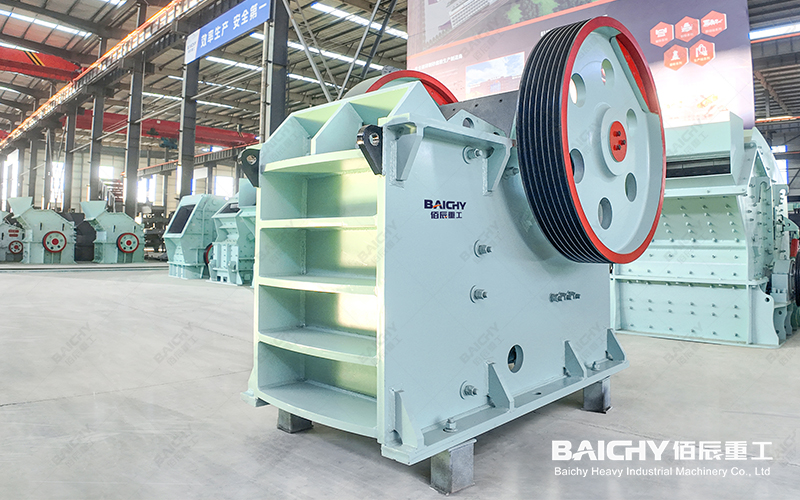
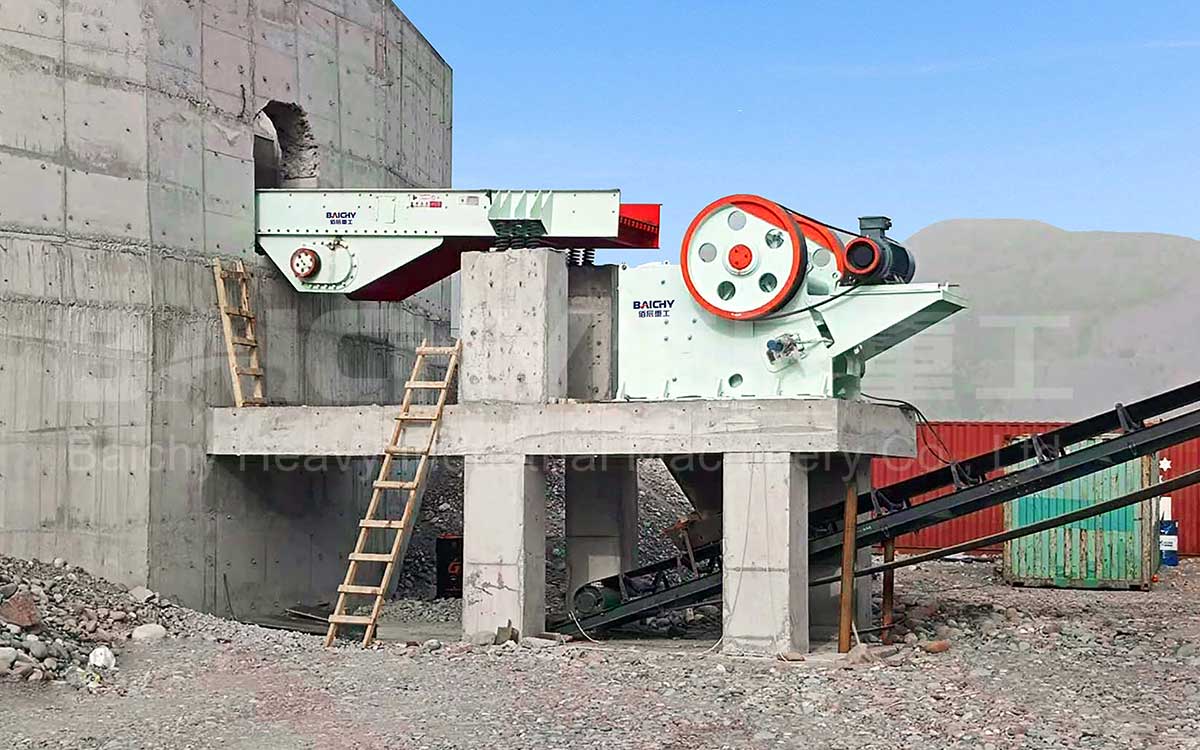
primary crushing - jaw crusher
A jaw crusher crushes rock by compression between a fixed jaw plate and a moving jaw plate. The eccentric shaft drives the moving jaw in a periodic stroke, and rock is crushed and discharged at the bottom opening. Baichy PE series jaw crushers handle feed sizes from 125 mm (PE-250×400) to 1,020 mm (PE-1200×1500), with capacities from 5 t/h to 800 t/h. Deep crushing chambers and wedge adjustment mean operators can change the discharge setting in minutes, not hours.
Secondary Crushing: Cone and Impact Crushers
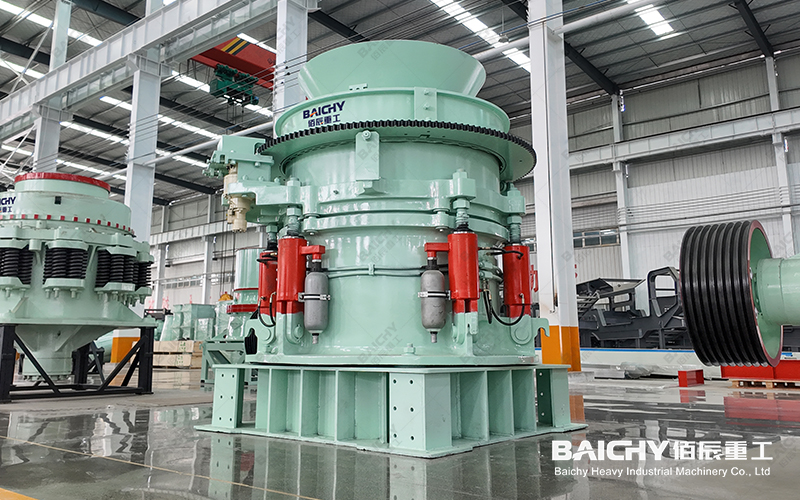
Secondary crushing - cone crusher
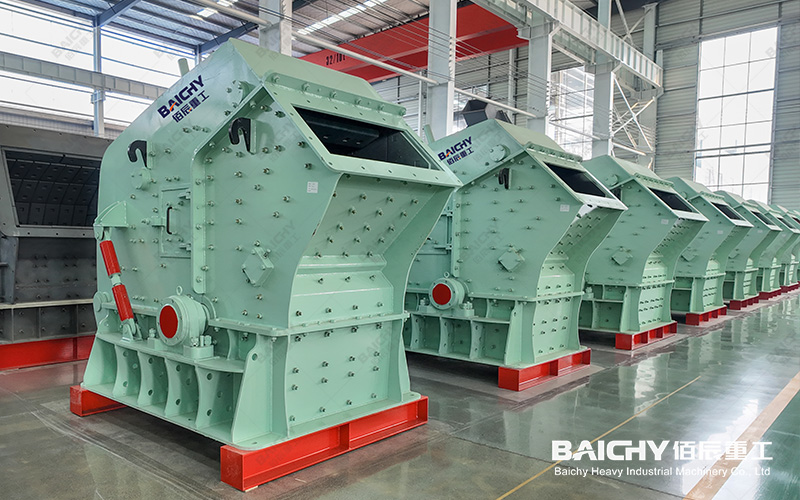
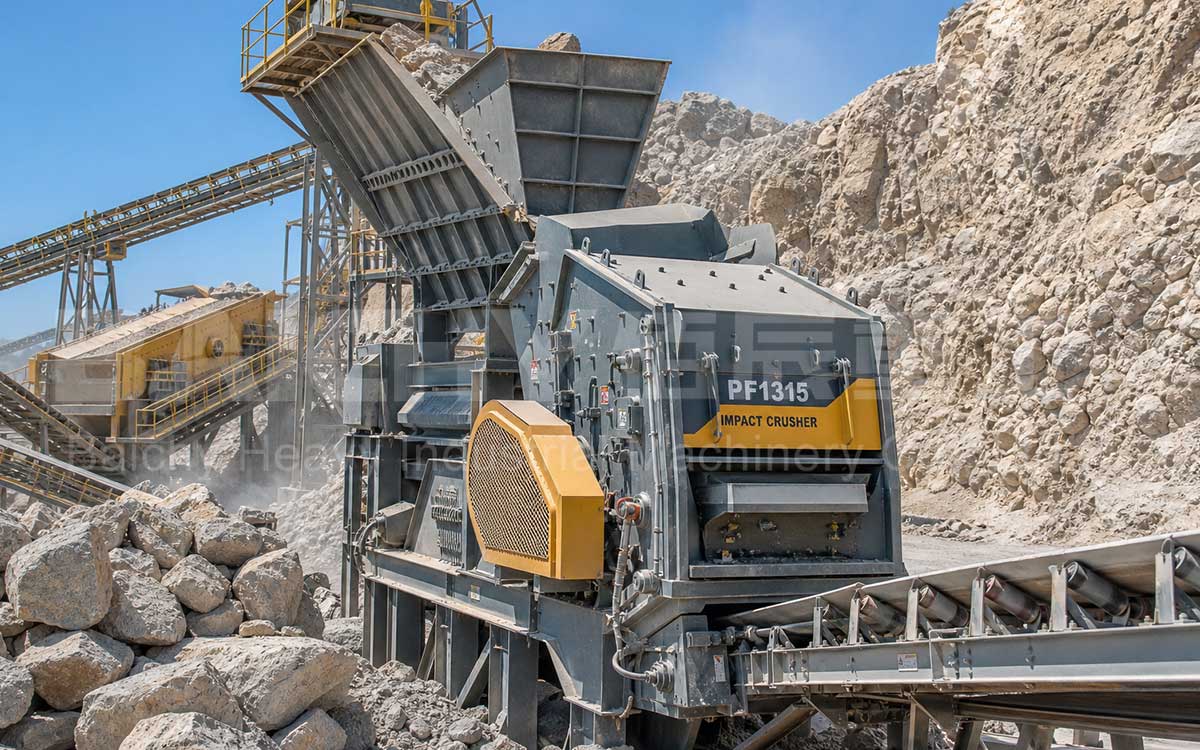
Secondary crushing - impact crusher
Cone crushers use the same compression principle but with a rotating mantle inside a concave bowl, which makes them ideal for hard, abrasive rock. Baichy CS and HP series cone crushers produce well-shaped, cubical aggregate with a low flakiness index — the property that directly improves concrete strength and asphalt performance. Impact crushers, by contrast, smash rock with high-speed rotors and are the lowest-cost choice for soft to medium rock such as limestone, dolomite and recycled concrete.
Tertiary Crushing and Sand Making: The VSI
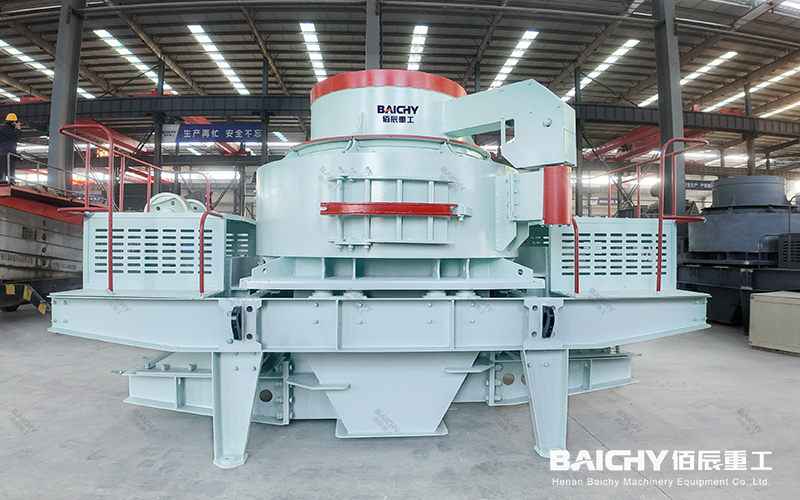
Tertiary Crushing and Sand Making - sand crusher
A VSI (vertical shaft impact) crusher throws rock against a rock-lined rotor chamber at 60–90 m/s. Rock-on-rock crushing produces the best-shaped fine aggregate on the market, with round edges and zero flat particles. Baichy VSI-9526 and VSI-1140 models convert 0–50 mm feed into 0–5 mm manufactured sand at 120–380 t/h, giving concrete producers an independent supply chain that does not depend on river sand extraction.
3. Application Scenarios: Where Rock Crushers Earn Their Keep
Quarry and Aggregate Production
Aggregate demand is the most reliable proxy for a country's infrastructure pipeline. According to the U.S. Geological Survey, global crushed stone production exceeds 50 billion tonnes per year, and emerging markets in Africa, Southeast Asia and Latin America consistently outpace supply. A typical 100–200 t/h quarry line — jaw crusher, cone crusher, screen, conveyor — can feed a ready-mix concrete plant and an asphalt plant simultaneously, with the same product selling at different price points.
Hard Rock Mining (Gold, Iron, Copper)
In mining, the crusher is the first step of the whole ore processing circuit. For example, a CIL gold plant needs crushed ore at 75% passing 12 mm before grinding; a jaw crusher plus a fine jaw or cone crusher achieves this at the lowest energy cost. Baichy has delivered crushing modules for ASGM (artisanal and small-scale gold mining) operations in Sudan and Zimbabwe, and complete iron ore lines in Russia and Brazil, where the crusher must survive -30 °C winters and 380 V/60 Hz power grids.
Construction and Demolition Waste Recycling
The global C&D waste recycling market is growing at roughly 8% per year, driven by landfill bans in the EU and China and by the rising cost of virgin aggregate. Mobile jaw crushers and impact crushers turn demolished concrete and brick into 0–40 mm recycled aggregate on-site, cutting haulage cost by up to 70%. A 50–100 t/h mobile recycling plant typically pays for itself in 12–18 months in markets where landfill tipping fees exceed USD 30 per tonne.
Manufactured Sand Production
River sand bans in Vietnam, India and the Philippines have pushed concrete producers toward manufactured sand. VSI crushers produce sand with a gradation and particle shape that actually outperforms natural sand in high-strength concrete. Baichy sand-making lines — jaw crusher, cone crusher, VSI, sand washer, fine sand recovery unit — deliver 0–5 mm sand at 50–300 t/h with a 15–25% lower unit cost than purchasing natural sand in most markets.
Road and Bridge Construction
Highway projects specify strict flakiness and crushing value limits. A two-stage jaw-plus-cone circuit produces the cubical, low-flakiness aggregate that asphalt and concrete specifiers demand, at capacities from 80 t/h (rural roads) to 450 t/h (expressways). Baichy YDPZ mobile crushing stations, available in two-, three- and four-combination configurations, can be relocated as a highway project advances, eliminating the cost of a second fixed plant.
4. Five Advantages of Baichy Rock Crushers for Sale
1. Factory-Direct Pricing, 15–25% Below Dealer-Distributed Brands
Baichy sells directly from the factory in Zhengzhou, China. For comparable capacity, buyers typically pay 15–25% less than for equivalent machines from dealer-distributed Western brands — the same Terex- or Metso-class duty cycle, without the intermediary margin. Your saving is often enough to fund the complete screen and conveyor package.
2. Honest Capacity Ratings
We quote nominal and practical capacity separately. A 60–160 t/h jaw crusher does not mean 160 t/h on river gravel with 60% moisture. Every Baichy quote includes the material type, bulk density and reduction assumptions behind the number, so the plant you design is the plant that performs.
3. Low Cost per Ton, Quantified
Wear parts are where crushers make or lose money. Baichy manganese jaw plates (Mn13Cr2 / Mn18Cr2) typically last 8–12 months in medium-hard rock; cone liners and VSI rotors are stocked in our global warehouses. With wear parts costing 30–40% less than OEM alternatives and a 55 kW motor consuming 12% less electricity per ton than oversized motors, the annual savings on a 150 t/h line exceed USD 20,000.
4. Built for Your Power Grid and Climate
Rock crushers for sale from Baichy are configured per destination: 380 V/50 Hz for Vietnam and Ethiopia, 400 V/50 Hz for South Africa (with ESKOM load-shedding options), 440 V/60 Hz for the Philippines, and -30 °C cold-climate packages for Russia and Mongolia. You do not pay for transformers or winterization after arrival.
5. EPC Support, Not Just a Machine
A crusher without a feeder, screen, conveyors and dust control is an expense, not a plant. Baichy engineers provide the complete flow sheet — from hopper to finished stockpile — with installation supervision, operator training and spare parts support for the life of the machine.
5. Field-Proven: Rock Crusher Case Studies
Philippines: 100–150 t/h River Stone Plant
A Philippine contractor processing river pebbles for concrete aggregate chose a fixed line built around the C90 jaw crusher plus a secondary cone. The line runs 20 hours per day, six days per week, producing 10–20 mm and 20–30 mm aggregate at 100–150 t/h. Because river stone is abrasive, the cone stage cut wear cost per ton by more than 40% compared with the impact crusher alternative, and the 440 V/60 Hz motor package ran without any re-wiring.
Venezuela: Mobile River Stone Crushing Line
For a river stone project in Venezuela, Baichy supplied a mobile crushing station that operates on site, following the changing riverbed extraction points. The mobile line eliminates double handling of 200,000+ tonnes of material per year, saving roughly USD 0.8–1.2 per tonne in haulage — a direct USD 160,000–240,000 annual saving at 200,000 tpy. The plant can relocate within 2–3 days using standard truck transport.
Vietnam: Pebble and C&D Waste Processing
A Vietnamese customer runs a dual-purpose line: river pebbles in the dry season, construction and demolition waste in the wet season. A jaw crusher feeds a secondary crusher that switches between cone and impact configurations, keeping the plant utilization above 85% year-round. With crushed sand prices in Vietnam up to 3× the cost of production, the line achieved payback in 14 months.
6. How to Select Rock Crushers for Sale: Five Questions to Ask
What is the rock type and hardness?
Mohs hardness above 6 (granite, basalt, quartzite) requires a jaw + cone circuit. Below 6 (limestone, dolomite, gypsum), a jaw + impact circuit is cheaper per ton.
What is the maximum feed size?
Measure the largest boulder that will enter the hopper, not the average. The crusher opening must exceed it by 15–20%.
What output size and shape do you need?
If a local specification demands flakiness below 15%, plan a cone or VSI stage from day one.
Stationary or mobile? Fixed plants are 20–30% cheaper per tonne of capacity; mobile plants win when the material moves or the site is temporary.
What is your full budget, not just the crusher price? Include feeder, screens, conveyors, dust control, installation, power connection and 2 years of wear parts.
Baichy provides this complete CAPEX estimate with every quotation.
| Your Material | Recommended Circuit | Capacity Range |
|---|---|---|
| Granite / basalt (hard, abrasive) | Jaw + cone (+ VSI for sand) | 80–450 t/h |
| Limestone / dolomite (soft–medium) | Jaw + impact | 60–300 t/h |
| River pebble / gravel | Jaw + cone | 80–250 t/h |
| C&D waste / concrete | Mobile jaw / impact | 50–150 t/h |
| Manufactured sand | Jaw + VSI + washer | 50–300 t/h |
7. Recommended Rock Crushers for Sale
Based on the scenarios above, the most requested Baichy rock crushers for sale are:
| Model | Type | Feed Size | Capacity | Output | Best For |
|---|---|---|---|---|---|
| PE-600×900 jaw crusher | Primary jaw | ≤500 mm | 60–160 t/h | 75–200 mm | Quarries, 50–150 t/h lines |
| PE-750×1060 jaw crusher | Primary jaw | ≤630 mm | 110–320 t/h | 80–230 mm | 150–300 t/h quarry lines |
| CS/HP cone crusher | Secondary | ≤235 mm | 109–440 t/h | 19–64 mm | Hard rock, cubical aggregate |
| PF-1214 impact crusher | Secondary | ≤350 mm | 80–180 t/h | 30–80 mm | Limestone, recycling |
| VSI-9526 sand maker | Tertiary / sand | ≤50 mm | 120–380 t/h | 0–5 mm | Manufactured sand |
| YDPZ mobile station | Mobile (2/3/4-combo) | Up to 700 mm | 80–450 t/h | Configurable | Remote or shifting sites |
Every machine above is available with matching feeders, screens, sand washers and belt conveyors as a complete turnkey package. See the jaw crusher series and mobile crushing station pages for full specifications, or send us your rock sample test report for a free circuit recommendation.
8. Operating Cost and Maintenance: What the Price List Never Tells You
The purchase price of rock crushers for sale is typically only 15–20% of the total cost of ownership over ten years. The rest is wear parts, electricity, downtime and labor. Three numbers decide whether a quarry makes money or just breaks even:
Wear Parts Are the Real Subscription
| Component | Material | Typical Life (medium-hard rock) |
|---|---|---|
| Jaw plates | Mn13Cr2 / Mn18Cr2 | 8–12 months |
| Cone liners | Mn18Cr2 | 6–9 months |
| Blow bars (impact) | High-chrome / martensitic | 200–400 hours on granite |
| VSI rotor + wear tips | Tungsten-carbide tipped | 600–1,000 hours |
Because Baichy manufactures these parts in-house, they cost 30–40% less than OEM equivalents and ship within 7 days. A smart operator buys the first year of wear parts with the machine — the discount on the package usually exceeds the storage cost.
Electricity Is the Second-Largest Line Item
Oversized motors are the most common silent waste in crushing plants. A 150 t/h line fitted with a correctly sized 55 kW motor instead of an 80 kW motor consumes roughly 12% less electricity per tonne — about USD 15,000–25,000 per year at typical industrial tariffs. Every Baichy circuit is motor-matched to the duty cycle, not to a generic catalog standard.
Downtime Is Priced in Tonnes
One unscheduled day on a 200 t/h line at USD 6/tonne product value means USD 9,600 in lost revenue — before repair costs. This is why we recommend stocking jaw plates, cheek plates, screen meshes and hydraulic spares from day one, and why our field engineers support commissioning and training on site. The machine that runs at 92% availability always beats the cheaper machine at 78%.
9. FAQ
Q1: How much do rock crushers for sale cost?
A complete Baichy crushing line is priced by capacity and configuration, not by machine alone. As a rule of thumb: a 50–100 t/h jaw crusher line starts around USD 80,000–150,000; a 150–300 t/h jaw + cone line typically ranges from USD 250,000–600,000, delivered and installed. Factory-direct pricing removes dealer margins, and we provide a full CAPEX/OPEX breakdown with every quotation so you compare total cost, not sticker price.
Q2: Which rock crusher is best for granite and basalt?
Granite and basalt (Mohs 6–7) require a jaw crusher for primary crushing and a cone crusher for secondary crushing. Cone crushers use compression instead of impact, which keeps wear cost per ton low on abrasive rock. If you also need manufactured sand, add a VSI sand maker as the tertiary stage. Avoid impact crushers on granite — rotor blow bars typically survive only 200–400 hours in this duty.
Q3: What is the lead time and delivery process?
Standard jaw and cone crushers are typically ready in 15–25 days; complete mobile stations and multi-machine lines take 30–45 days. Baichy arranges sea freight, provides all export documentation, and can send engineers for installation supervision and operator training. Spare parts for common wear items are stocked and shipped within 7 days of order.
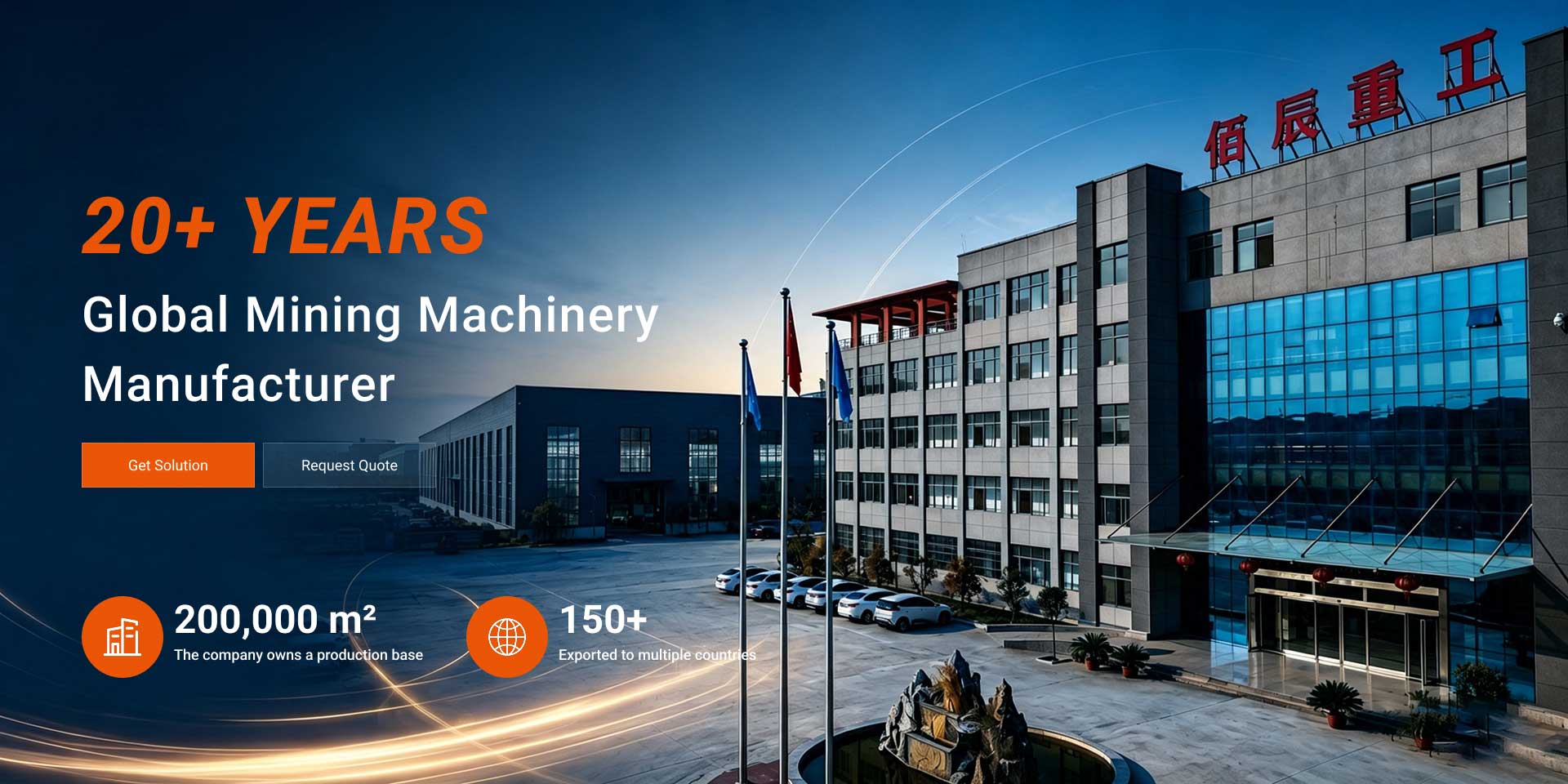
Baichy Heavy Industry
Baichy Heavy Industry is a high-tech mining equipment company integrating R&D, manufacturing, sales, and after-sales service. Focusing on crushing, grinding, and mineral processing equipment, we provide professional solutions to our customers. We are ISO9001:2015 、certified, and our products include mobile crushing palnts, crawler crushing plant, construction waste crushing plants, jaw crushers, sand making machines, cone crushers, fine crushers, grinding mills, ball mills, etc., all with reliable performance to meet diverse project needs.
Baichy Heavy Industry – Your Trusted Partner
To ensure optimal performance of your equipment, Baichy Heavy Industry offers:
- Professional on-site installation guidance
- Comprehensive operator training
- 24/7 technical support & maintenance services
Our complete after-sales service system guarantees long-term, stable operation of your machinery with minimal downtime.
Protect Your Rights – Only Use Official Channels
To avoid scams and ensure authentic support, contact us exclusively through:
• Official Website: www.baichychina.com
• WhatsApp: +8615093222637
• Email: [email protected]
Your satisfaction is our priority – expect prompt, professional service every time.
(Note: Beware of unauthorized third parties claiming to represent Baichy. Always verify through official contacts.)