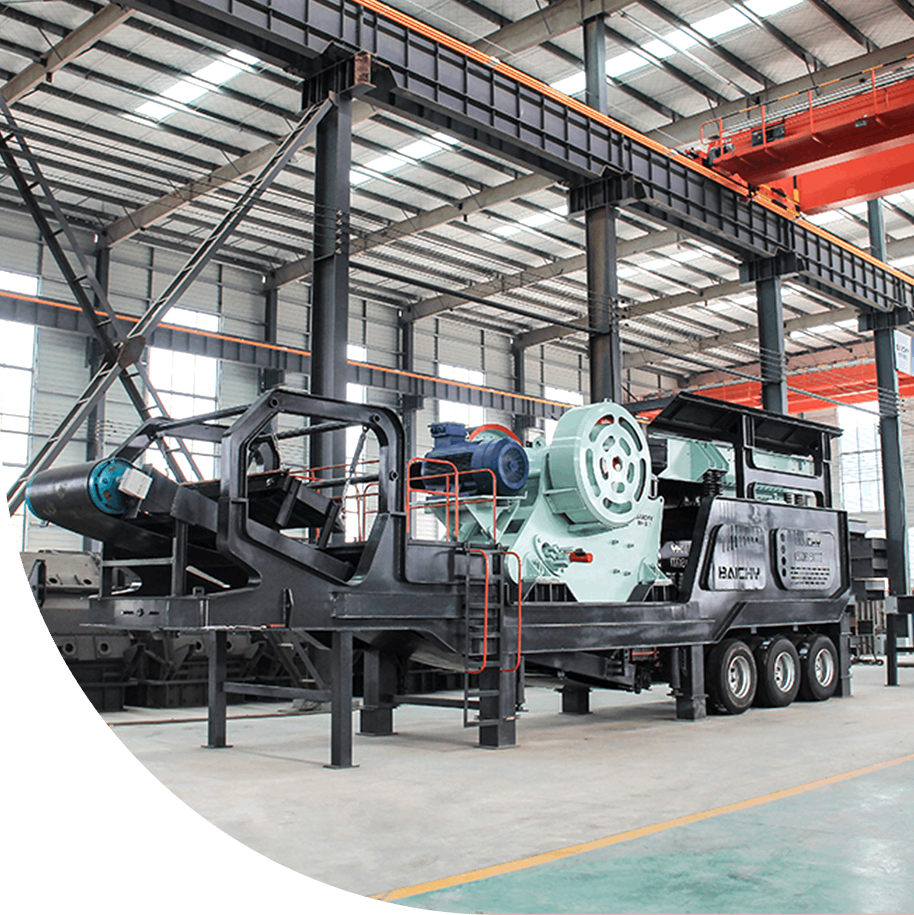


multi-roll crusher
The multi-roll crusher is a compression-type crushing machine available primarily in two-roll (2PG) and four-roll (4PG) configurations. Distinguished by low over-crushing rates, uniform output particle size, and low specific energy consumption, it is the preferred choice for crushing medium-soft materials such as coal, coke, slag, gypsum, and limestone. For coking plants, cement plants, and mineral processing facilities, the multi-roll crusher serves not only as a production-matching unit but also as the critical first quality checkpoint that determines downstream screening efficiency, mill throughput, and the pass rate of the final product. This article provides a comprehensive analysis of the selection logic for multi-roll crushers, covering five dimensions: working principles, application scenarios, core advantages, technical parameters, and case studies.
I. Working Principles and Classification of Multi-Roll Crushers
The working principle of multi-roll crushers relies on compression and shearing between rolls. Material falls between the rolls and is forced into the crushing chamber by the counter-rotating roll surfaces; crushing is achieved through a combination of compressive force and the shearing action of the roll teeth. The output particle size is precisely controlled by the gap between the rolls—a key factor ensuring predictable output sizing.
Two-Roll Crusher (2PG Series): The Mainstream Choice
The two-roll crusher features a "one fixed roll + one movable roll" structure. The movable roll is held in place by a hydraulic or spring system; if uncrushable objects (such as iron pieces or hard lumps) are encountered, the roll automatically retracts to protect the roll surface and the drive system. The 2PG series typically accepts feed sizes of ≤25–50mm and offers continuously adjustable output sizes ranging from 2mm to 30mm. It is the standard configuration for coal preparation in coking, raw material proportioning in sintering, and pre-crushing of cement clinker.
Four-Roll Crusher (4PG Series): Two-Stage Crushing in a Single Step
The four-roll crusher arranges two pairs of rolls in a vertical series. Material undergoes coarse crushing by the upper rolls before passing directly to the lower rolls for fine crushing. A single unit performs both coarse and fine crushing stages, eliminating the need for intermediate screening and material transfer. For the coal chemical and fertilizer industries—which require fine-grained products in the 2–10mm range—the 4PG series delivers equivalent production capacity with a smaller footprint and lower investment costs.
II. Typical Application Scenarios for Multi-Roll Crushers
Multi-roll crushers are utilized across four major industries: coal, building materials, chemicals, and metallurgy.
1. Coal Mining and Coking Industries
In the coal preparation stage of coking, multi-roll crushers homogenize the particle size of coal fed into the ovens. By stabilizing the proportion of fine coal (under 3mm), they directly influence coke quality and coking time. A 1.2 million-ton-per-year coal preparation plant in Indonesia employs a 2PG1000×700 double-roll crusher to pre-crush raw coal to under 30mm; even when processing wet, sticky coal, it maintains a stable hourly throughput of 80–100 tons without clogging or downtime.
2. Cement and Building Materials Industries
In the pre-crushing stages for cement raw meal and clinker, multi-roll crushers can replace certain hammer crusher units. They reduce clinker size from 40mm to under 10mm, providing a consistent feed size for ball mills and increasing mill hourly output by 8–15%. They are equally suitable for processing medium-soft materials such as gypsum, limestone, and shale.
3. Chemical and Fertilizer Industries
Chemical raw materials—such as phosphate rock, salt, and sulfur—demand high uniformity in the finished product's particle size. Four-roll crushers utilize a staged crushing logic—coarse crushing in the first stage and fine crushing in the second—to directly produce uniform 2–6mm granules, thereby avoiding material loss caused by over-pulverization.
4. Metallurgy and Slag Processing
Before entering the grinding system, blast furnace slag and steel slag are typically pre-crushed to under 10mm using multi-roll crushers. When paired with vertical mills or ball mills, this facilitates low-energy grinding, enabling steel enterprises to reduce slag processing costs by more than 10% per ton.
III. Core Advantages of Multi-Roll Crushers (Benefits)
| Technical Features | Practical Value to Buyers |
|---|---|
| Adjustable roll gap | Stepless adjustment of discharge size (2–30mm); one machine suits multi-stage processes |
| Low over-crushing rate | Higher yield of qualified product; reduced fines loss and downstream screening burden |
| Spring/hydraulic overload protection | Automatic retraction upon encountering tramp iron; protects roll surfaces; reduces unplanned downtime |
| Modular double/quad-roll design | Covers throughput range of 5–180t/h; capacity expansion possible without replacing the main unit |
| Compact structure, low center of gravity | Small footprint and low civil engineering costs; suitable for retrofitting existing plants |
| Dry and wet operation | No chamber clogging with sticky materials (moisture content ≤20%); production continues during rainy seasons |
IV. Technical Parameter Table for Multi-Roll Crushers
Typical Parameters for 2PG Double-Roll Crushers
| Model | Roll Diameter × Width (mm) | Feed Size (mm) | Discharge Size (mm) | Throughput (t/h) | Motor Power (kW) |
|---|---|---|---|---|---|
| 2PG400×250 | 400×250 | ≤25 | 2–8 | 5–10 | 2×5.5 |
| 2PG610×400 | 610×400 | ≤36 | 2–20 | 13–35 | 2×15 |
| 2PG750×500 | 750×500 | ≤40 | 2–20 | 20–60 | 2×18.5 |
| 2PG1000×700 | 1000×700 | ≤50 | 2–30 | 40–110 | 2×37 |
Typical Parameters for 4PG Quad-Roll Crushers
| Model | Roll Diameter × Width (mm) | Feed Size (mm) | Discharge Size (mm) | Throughput (t/h) | Motor Power (kW) |
|---|---|---|---|---|---|
| 4PG900×700 | 900×700 | ≤60 | 2–10 | 45–90 | 4×37 |
| 4PG1200×1000 | 1200×1000 | ≤80 | 2–15 | 90–180 | 4×55 |
Note: The above are typical configuration parameters (based on limestone at 1.6 t/m³). Actual capacity varies with material hardness, moisture content, and the wear status of the roll teeth. Customization based on site conditions is available; acceptance is subject to actual test-run data.
V. Relevant Case Studies
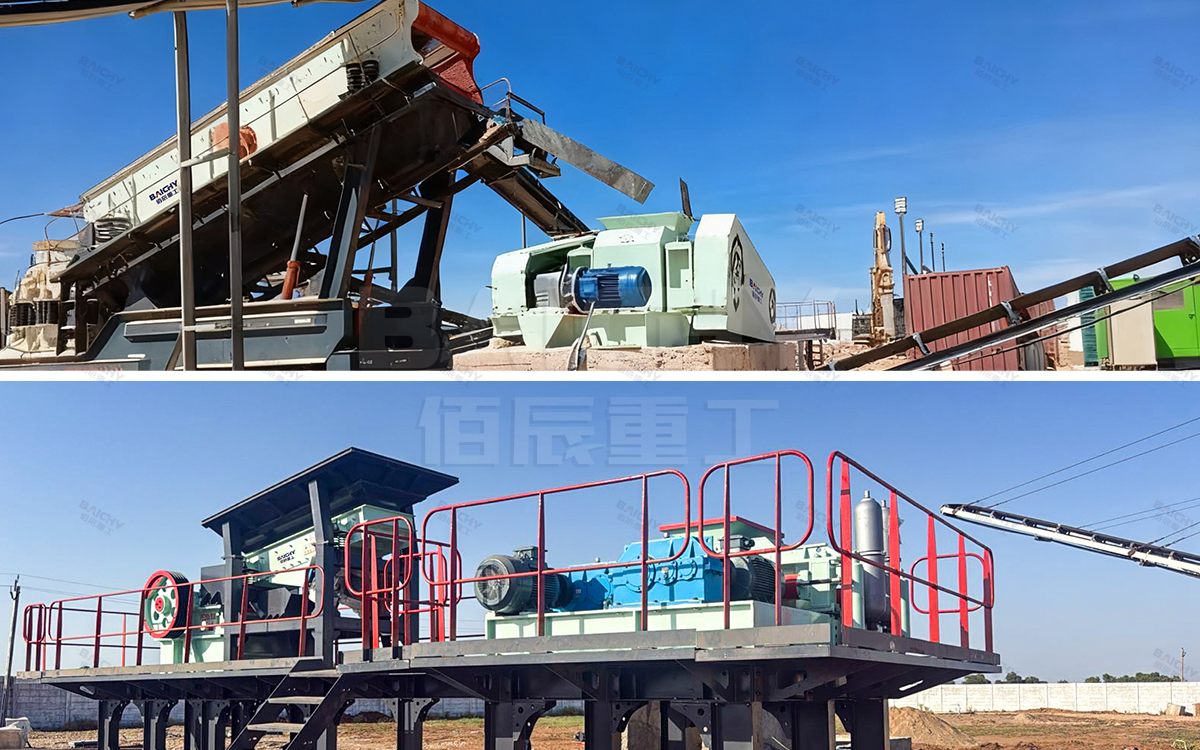
double roll crusher
Case 1 | Pre-crushing Retrofit at an Indonesian Coal Preparation Plant:
The original process used a hammer crusher, resulting in excessive dust and over-crushing, with a fine coal rate exceeding 25%. After replacing it with a 2PG1000×700 multi-roll crusher, the fine coal rate dropped to below 12%, system power consumption decreased by 18%, and the investment cost was recovered in approximately 8 months.
Case 2 | Coal Homogenization at an Indian Coking Plant:
The plant required ≥75% of feed coal to be under 3mm in size; the original two-stage crushing process could not consistently meet this standard. After adopting the 4PG1200×1000 four-roll crusher, the proportion of 2–8mm output stabilized above 85%, and coke strength (M40) improved by approximately 2 percentage points.
Note: Case study data represents a summary of typical values from similar projects; specific figures are subject to the project's test-run report.
VI. Selection Recommendations for Multi-roll Crushers
Material Hardness: Suitable for medium-soft materials with Mohs hardness ≤5; for harder materials, jaw crushers or cone crushers are recommended.
Particle Size Requirements: Choose a double-roll crusher for output sizes ≥10mm, and a four-roll crusher for ≤10mm (single-pass processing).
Moisture Content: For highly sticky materials with moisture content >20%, a toothed-roll model equipped with an anti-clogging crushing chamber design is required.
Capacity Calculation: Calculated based on measured bulk density; for example, when processing coke, the rated capacity should be adjusted using a conversion factor of 0.45–0.55. TCO Perspective: Compare costs based on a 5-year full lifecycle—factoring in roller shell lifespan, electricity consumption per ton, and spare parts cycles—rather than just the initial purchase price.
VII. Recommended Equipment
2PG Double-Roll Crusher / 4PG Quad-Roll Crusher: Core machinery for particle size control.
2PC/PCK Hammer Crusher: Alternative option for medium-crushing applications involving hard materials.
ZSW Vibrating Feeder: Ensures uniform feeding to maximize the multi-roll crusher's production capacity.
YK Series Vibrating Screen: Facilitates closed-circuit screening to ensure consistent finished product particle size.
Raymond Mill / Ball Mill: Pairs with the multi-roll crusher to form an integrated "crushing + grinding" production line.
FAQ
Q1: How do I choose between a multi-roll crusher and a hammer crusher?
Consider material hardness and requirements regarding over-crushing (fines generation). Hammer crushers suit brittle materials but produce high levels of fines and dust; multi-roll crushers utilize compression and shear forces, resulting in fewer fines and a more uniform output. For processes sensitive to particle size distribution—such as coal preparation for coking or sintering mix preparation—multi-roll crushers are the preferred choice.
Q2: Can multi-roll crushers handle wet, sticky materials?
Yes. Roll crushers outperform hammer crushers when handling sticky materials (such as wet coal or clay-rich ores) with moisture content up to 20%; they operate reliably when equipped with toothed rollers and anti-clogging crushing chambers. For rainy season operations, installing a material distributor and a roller surface cleaning device is recommended.
Q3: How are roller shells maintained after wear, and what is their lifespan?
Roller shells are made from high-manganese steel or wear-resistant alloys, with a typical lifespan of 6,000–12,000 hours when crushing medium-soft materials like coal or limestone. Once worn, they can be restored via hard-facing (weld overlay) or replaced. It is recommended to inspect roller surface wear and the roll gap during every shift and to perform quarterly maintenance on the hydraulic system; annual maintenance costs typically amount to 3–5% of the total equipment investment.
Baichy Heavy Industry
Baichy Heavy Industry is a high-tech mining equipment company integrating R&D, manufacturing, sales, and after-sales service. Focusing on crushing, grinding, and mineral processing equipment, we provide professional solutions to our customers. We are ISO9001:2015 、certified, and our products include mobile crushing palnts, crawler crushing plant, construction waste crushing plants, jaw crushers, sand making machines, cone crushers, fine crushers, grinding mills, ball mills, etc., all with reliable performance to meet diverse project needs.
Baichy Heavy Industry – Your Trusted Partner
To ensure optimal performance of your equipment, Baichy Heavy Industry offers:
- Professional on-site installation guidance
- Comprehensive operator training
- 24/7 technical support & maintenance services
Our complete after-sales service system guarantees long-term, stable operation of your machinery with minimal downtime.
Protect Your Rights – Only Use Official Channels
To avoid scams and ensure authentic support, contact us exclusively through:
• Official Website: www.baichychina.com
• WhatsApp: +8615093222637
• Email: [email protected]
Your satisfaction is our priority – expect prompt, professional service every time.
(Note: Beware of unauthorized third parties claiming to represent Baichy. Always verify through official contacts.)