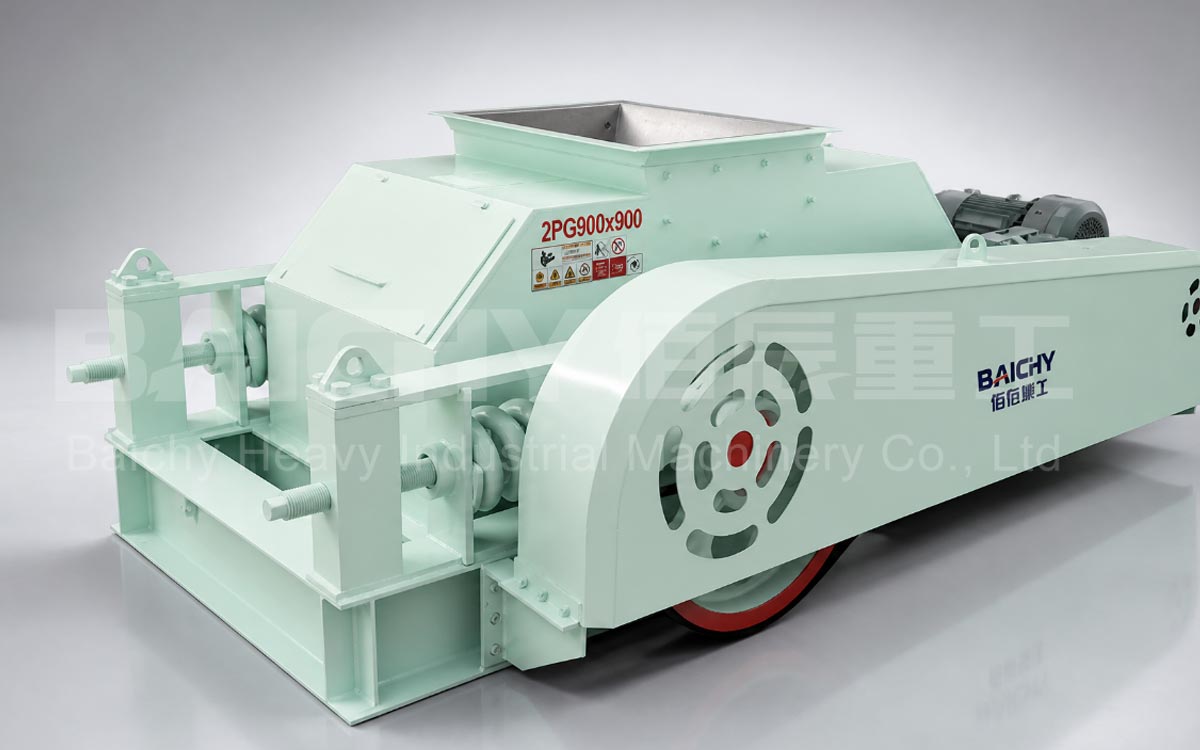
Hydraulic double-roll crusher
The hydraulic double-roll crusher (2PGY series) is the optimal solution for the medium-fine crushing and final sand-making of materials with low to medium hardness, such as coal, coke, slag, clay, and clinker. Compared to spring-type double-roll crushers, it offers three core advantages: hydraulic roll gap adjustment without stopping the machine (±1mm), automatic hydraulic retraction for overload protection (resetting within 0.2 seconds upon encountering tramp iron), and resistance to clogging with wet or sticky materials (maintaining normal operation with 10%–15% moisture content). In short: while spring-type models rely on manual labor for gap adjustment, hydraulic double-roll crushers utilize hydraulic systems—a distinction that marks a watershed moment for efficiency and safety.
I. What is a hydraulic double-roll crusher?
The hydraulic double-roll crusher features a crushing chamber formed by two counter-rotating rolls; materials are crushed through the combined forces of compression and shear. Operating at low speeds with high compressive force, its crushing mechanism differs fundamentally from the high-speed impact principles used in hammer crushers and impact crushers. Its key differences from spring-type double-roll crushers lie in the adjustment and protection systems:
• Hydraulic roll gap adjustment: Discharge particle size is determined by the roll gap; settings are configured by simply inputting the target size via the control panel, allowing for specification changes in approximately 10 minutes without stopping the machine;
• Hydraulic overload retraction: When uncrushable objects (such as iron chunks) enter the chamber, the movable roll automatically retracts within 0.2 seconds and resets instantly after the object passes, thereby protecting the gearbox and roll surfaces;
• Centralized control: A hydraulic station provides centralized oil supply; the system supports PLC integration for remote start/stop and roll gap monitoring, providing interfaces for production line automation.
II. Application Scenarios for Hydraulic Double-Roll Crushers
Hydraulic double-roll crushers are suitable for materials of low to medium hardness with a compressive strength below 150 MPa:
| Scenario | Materials | Target Output Size |
| Coal washing/coking plants | Raw coal, lump coal, coke | 10–30 mm |
| Metallurgical slag processing | Pre-crushing of furnace slag, mineral slag, steel slag | 10–50 mm |
| Construction material raw materials | Clay, shale, clinker, limestone | 2–20 mm |
| Wet/sticky conditions | High-moisture raw coal, wet clay | 6–40 mm (no clogging) |
| Manufactured sand (final crushing) | Aggregates ≤40 mm (from VSI/jaw crushers) | 0–3 mm / 0–5 mm finished sand |
III. Core Advantages of Hydraulic Double-Roll Crushers
| Technical Features | Direct Benefits |
| Hydraulic roll gap adjustment (±1 mm) | Specification changes completed in 10 minutes; annual downtime losses reduced by ~30,000–50,000 RMB |
| Hydraulic overload relief (0.2s response) | Protects roll surfaces and gearboxes from tramp iron; prevents jamming, motor burnout, and unplanned shutdowns |
| Compression crushing (oversize fines <10%) | Finished product yield (coal/coke) increased by 5–15%; fines are not wasted during screening |
| Smooth rolls + scrapers (no clogging at 10–15% moisture) | Continuous production during rainy seasons/wet material handling; cleanup downtime reduced by 90% |
| Mn18Cr2 roll shells + hard-facing repair | Service life of 6–8 months for hard materials; repair cost is only 20–30% of a new roll |
| Low speed, large roll diameter, low power consumption | Over 30% more energy-efficient than impact crushers for the same capacity |
Why is the hydraulic version a better investment? In spring-type double-roll crushers, the roll gap is locked by bolts; encountering tramp iron forces a rigid impact, leading to spring fatigue and gap drift, causing particle size to increase with wear—issues that are difficult to compensate for. Hydraulic double-roll crushers utilize hydraulics for both gap adjustment and protection, ensuring stable particle size, rapid response, and remote control capabilities; the higher initial investment is typically recouped within 6–8 months through savings on electricity and reduced downtime losses.

hydraulic twin-roll crusher
IV. Key Specifications of Hydraulic Double-Roll Crusher (Typical Configuration for 2PGY Series)
| Model | Feed Size | Discharge Size | Capacity | Power |
| 2PGY400×250 | ≤25mm | 2–8mm | 5–10 t/h | 11kW |
| 2PGY610×400 | ≤40mm | 10–30mm | 15–40 t/h | 30kW |
| 2PGY750×500 | ≤45mm | 10–40mm | 30–60 t/h | 37kW |
| 2PGY900×700 | ≤60mm | 10–50mm | 50–120 t/h | 45–55kW |
| 2PGY1000×800 (Four-roll) | ≤10mm | 0–3mm | 60–100 t/h | 2×55kW+2×45kW |
Note: Capacity is rated based on limestone (1.6 t/m³); for lightweight materials, a conversion factor of 0.45–0.55 applies. Roll gap adjustment supports a ±1mm hydraulic setting.
V. Typical Case Studies and Market Validation
Two-stage sand-making line (Southeast Asia): Mobile VSI sand-making machine (≤8mm) + 2PGY1000×800 four-roll hydraulic crusher (0–3mm) operating in a two-stage closed-loop circuit. Stable capacity of 60–100 t/h; finished sand features <5% needle-flaky particle content, 8%–12% stone powder content, and a fineness modulus of 2.3–2.8; suitable for direct supply to dry-mixed mortar and C30–C50 concrete production. See the two-stage sand-making case study for details. Fine crushing of coal gangue at a coal preparation plant: The 2PGY750×500 model processes raw coal and gangue with 12% moisture content; the smooth roll and scraper design ensures clog-free operation and a stable output size of 10–30mm. The hydraulic retraction mechanism protects the equipment against mixed-in underground metal debris, and the initial set of roll shells lasts approximately 7 months.
Cement clinker finish-crushing upgrade: A hydraulic double-roll crusher replaces the original hammer crusher; electricity consumption per ton drops by ~35%, the over-pulverization rate falls from 20% to below 8%, and total grinding electricity savings exceed 25%.
VI. Recommended Auxiliary Equipment
Hydraulic double-roll crushers have a maximum feed size limit (not exceeding 1/10–1/15 of the roll diameter), requiring matching upstream and downstream equipment:
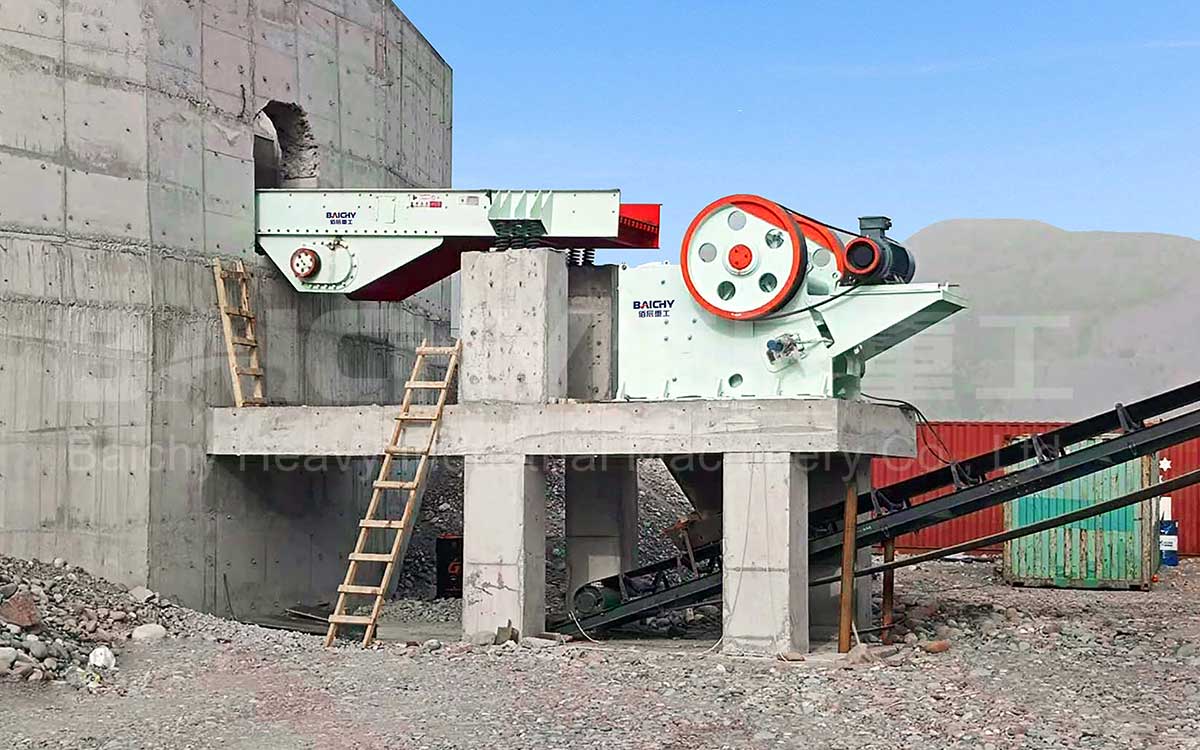
• PE Series Jaw Crusher: For initial coarse crushing to ≤60mm before feeding into the double-roll crusher;
• ZSW Vibrating Feeder: Ensures uniform feeding to extend roll shell life;
• Iron Remover: The "ideal partner" for hydraulic double-roll crushers; minimizes retraction events at the source;
• YK Circular Vibrating Screen: For closed-circuit screening; returns oversized particles for re-crushing;
• VSI Sand-Making Machine: For two-stage sand production (VSI pre-crushing → double-roll finish crushing to 0–3mm);
• Belt Conveyor: Connects various stages into a continuous production line.
VII. Selection Advice & Pitfalls to Avoid
• Consider Hardness: For compressive strength >150MPa (e.g., granite, basalt), choose jaw or cone crushers; hydraulic double-roll crushers are unsuitable;
• Check Feed Size: Feed size must match roll diameter; oversized chunks can jam rolls and damage surfaces—install a jaw crusher or grizzly screen upstream;
• Select Roll Type: Use smooth rolls + scrapers for wet/sticky materials; toothed rolls for lump coal; and a four-roll two-stage tandem setup (2PGY1000×800) for fine sand production;
• Essential Iron Removal: Hydraulic overload retraction is a last resort, not a normal operating mode; upstream iron removal can eliminate 90% of retraction incidents.
VIII. FAQ (Frequently Asked Questions)
Q1: How do I choose between a hydraulic double-roll crusher and a standard spring-type double-roll crusher?
A: Choose the spring version if you are budget-conscious, the material is clean (free of tramp iron), and particle size requirements are flexible. Choose the hydraulic version if you need to process wet/sticky or iron-bearing materials, frequently change specifications, or require automated control; the additional investment cost can be recouped within 6–8 months.
Q2: Will the hydraulic double-roll crusher clog when processing wet material?
A: No. The smooth roll and scraper design is specifically engineered for wet and sticky conditions, allowing for normal operation even with moisture content of 10%–15%. This is a key advantage over hammer crushers and impact crushers, and the primary reason coal washing plants and mines operating during rainy seasons prefer hydraulic double-roll crushers.
Q3: How is the output particle size maintained over the long term? What happens when the roll shells wear down?
A: Particle size is determined by the hydraulic roll gap, with a precision of ±1mm. After uniform wear occurs on the roll surface, the hydraulic cylinder can be fine-tuned every 300–400 hours to compensate (approx. 0.5mm adjustment, taking 5 minutes). The roll shells are made of Mn18Cr2 high-manganese steel and support hard-facing repair; the cost per repair is only 20%–30% of a new shell, and a single set can be repaired 2–3 times.
IX. Call to Action
Send us details regarding material hardness, moisture content, feed size, and target production capacity. Within 48 hours, you will receive: a technical parameter confirmation sheet for the hydraulic double-roll crusher, an FOB/CIF quotation, a production line layout diagram, and a cost-per-ton analysis.
📩 [email protected] | WhatsApp: +86-15093222637 | 🌐 www.baichychina.com
Related Reading: Mobile sand-making machine + 2PG1000×800 two-stage sand-making case study