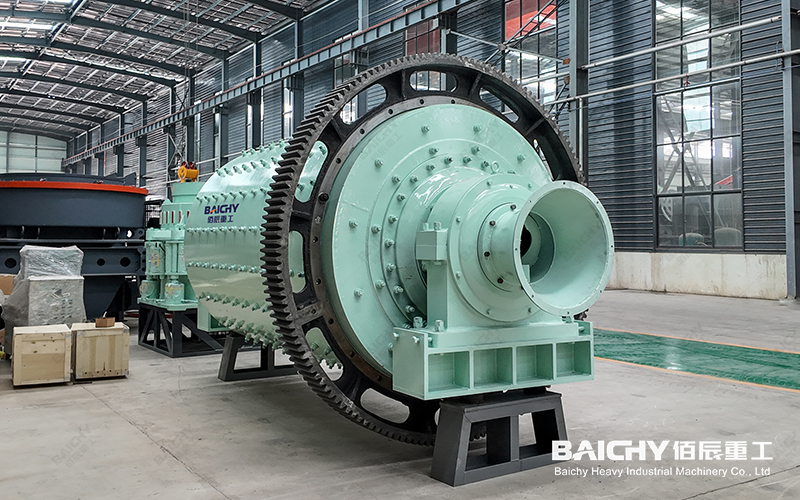
Project Overview & Market Context
The global manufactured sand market exceeded $320 billion in 2025, with a CAGR of approximately 6.5% (Grand View Research). However, the market is undergoing structural differentiation — margins on ordinary 0–5 mm sand are contracting, while the premium for 0–3 mm fine sand is widening.
Core challenge:
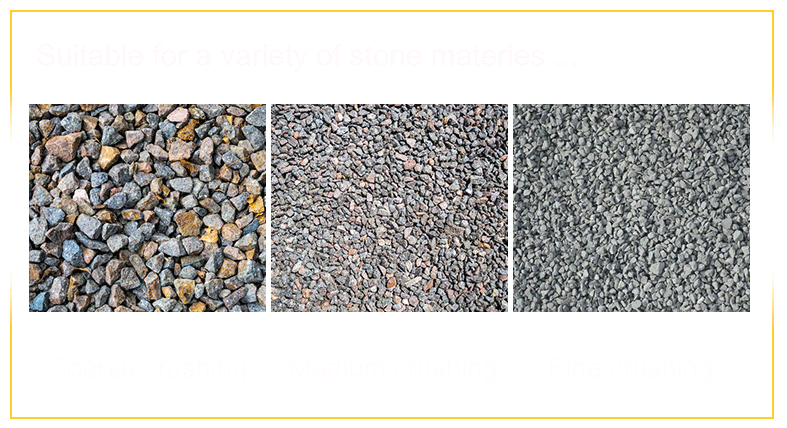
A conventional sand line (single VSI + screening) produces 0–5 mm sand, but the 0–3 mm fraction accounts for only 30%–40%. To reliably output over 60% of 0–3 mm premium sand, secondary fine crushing after the VSI is mandatory — which is precisely where the 2PG1000×800 double roller crusher delivers.
Baichy Heavy Industry's Equipment Selection Logic
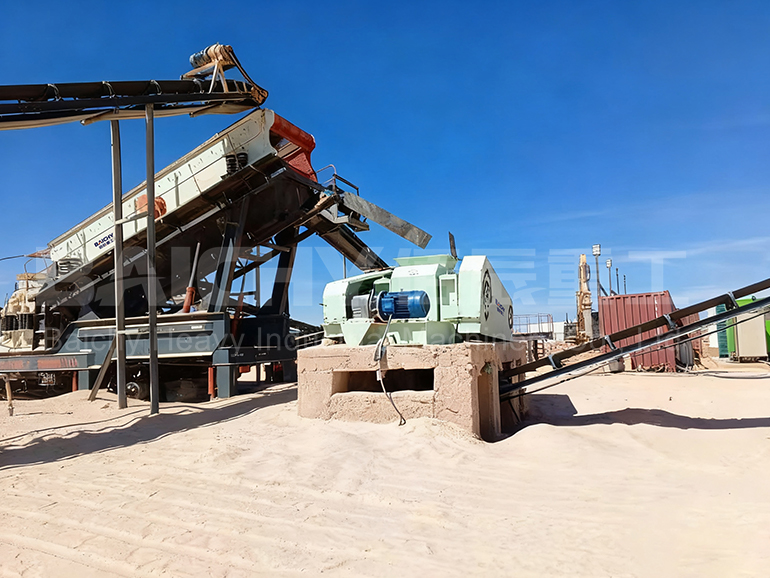
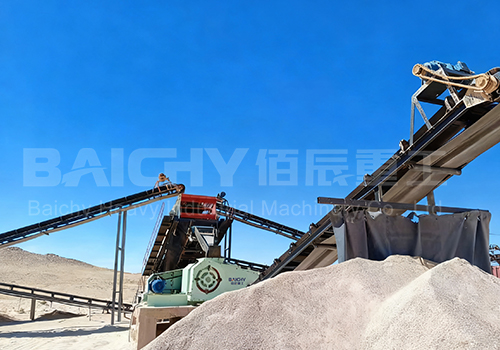
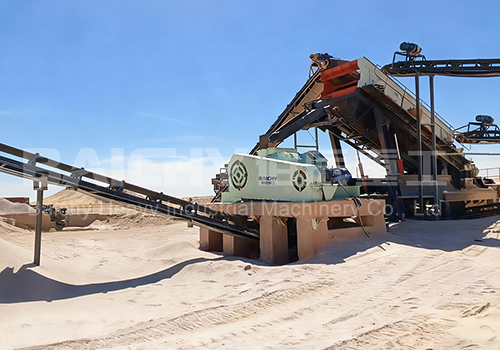
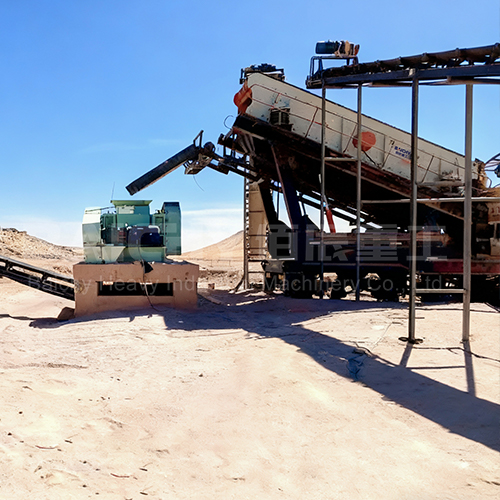
This configuration employs a 2-stage process: "mobile VSI impact sand making (8 mm) → four-roller fine compression sand making (0–3 mm)." It addresses a fundamental industry pain point: a VSI alone cannot produce enough 0–3 mm fraction; a roller crusher alone cannot handle coarse feed efficiently.
1. Mobile VSI Sand Making Machine — Primary Sand Making, Output ≤8 mm
| Parameter |
Value |
| Crusher type |
VSI vertical shaft impact crusher (wheel-mounted mobile chassis) |
| Maximum feed size |
≤40 mm |
| Processing capacity |
80–150 t/h (depending on material hardness and rotor speed) |
| Output size (adjusted) |
≤8 mm (screen-controlled, adjustable 5–10 mm) |
| Rotor speed |
1,100–1,490 r/min (VFD adjustable) |
| Motor power |
2 × 132 kW or equivalent |
| Mobility |
Wheel-mounted semi-trailer chassis, towable by tractor unit |
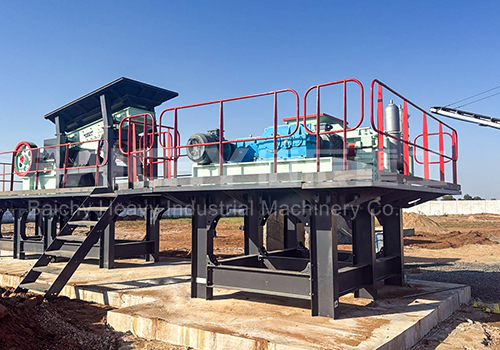
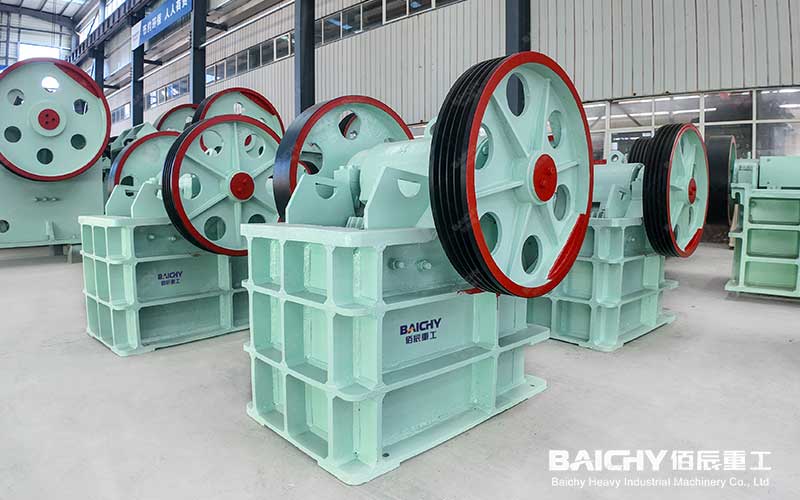
2. 2PG1000×800 Four-Roller Crusher — Secondary Fine Sand Making, Output 0–3 mm
| Parameter |
Value |
| Roller configuration |
Double roller pairs , upper + lower stage in series |
| Roller diameter × width |
1,000 × 800 mm |
| Feed size |
≤10 mm |
| Output size |
0–3 mm (adjustable to 0–5 mm) |
| Processing capacity |
60–100 t/h (at 0–3 mm output) |
| Motor power |
2 × 55 kW + 2 × 45 kW (upper and lower stages independently driven) |
| Roller skin material |
Mn18Cr2 high-manganese steel / optional hardfacing wear layer |
| Adjustment method |
Hydraulic + spring dual adjustment with overload protection |
2-stage vs single-stage sand making: Single-stage (VSI direct to 0–3 mm) relies on high-speed impact — the finished sand has sharp edges, high powder content, and an uncontrollable fineness modulus. 2-stage (VSI pre-crush to 8 mm → roller crusher compression to 0–3 mm) uses impact for particle shaping and pre-crushing, then compression for precise powder control and uniform gradation — the final sand has rounded particle shape, controllable powder content, and a stable gradation curve.
Frequently Asked Questions
Q1: Is the 0–3 mm sand from this process suitable for high-grade concrete and dry-mix mortar?
A: Yes. The two-stage process produces sand that meets or exceeds the requirements for C30–C50 high-grade concrete, dry-mix mortar, and asphalt mixtures. Key quality metrics verified on-site:
Needle-and-flake content: ≤5% (national standard GB/T 14684 limit: ≤15%)
Powder content (<0.075 mm): 8%–12% (controllable, not excessive)
Fineness modulus: 2.3–2.8 (stable in medium sand range, ideal for concrete workability)
Particle shape: rounded, not angular — improves concrete pumpability and reduces water demand
No additional shaping, classification, or washing stages are required — the finished product is ready for commercial sale directly off the line.
Q2: How is the 2PG1000×800 four-roller crusher different from a conventional double-roller crusher?
A: The 2PG1000×800 is a four-roller (double-pair) configuration — two pairs of rollers arranged in series (upper stage + lower stage) within a single machine frame. This differs from a standard twin-roller crusher in three ways:
Two-stage compression in one pass: Upper rollers pre-crush ≤10 mm feed; lower rollers finish to 0–3 mm — achieving a reduction ratio that a single roller pair cannot.
Independent motor drive per stage: 2 × 55 kW (upper) + 2 × 45 kW (lower), allowing speed and gap adjustment independently for each stage.
Mn18Cr2 high-manganese steel roller skins with optional hardfacing — wear life is 2–3× longer than standard Mn13 rollers in silica-rich feed.
The result is precise 0–3 mm output with a stable gradation curve, without the need for a secondary screening loop.