Hammer Crusher
The hammer crusher is one of the most efficient and cost-effective (in terms of investment per ton) pieces of equipment for the medium-to-fine crushing of medium-hard, brittle materials such as limestone, coal, gypsum, and cement clinker. It can achieve a product output with over 85% of particles sized ≤25mm in a single pass, thereby saving enterprises the investment and civil engineering costs associated with a secondary crushing stage. Baichy Heavy Industry is a specialized manufacturer of mining crushing, ore grinding, and mineral processing equipment. Its product lineup includes three major series—the PC (single-rotor), 2PC (double-rotor), and PCK (reversible)—offering capacities ranging from 5 to 600 t/h. These machines are operating reliably in building material, mining, and energy projects across more than 80 countries. This article provides a comprehensive breakdown of this "crushing-instead-of-grinding" powerhouse—covering its working principle, application scenarios, core advantages, and tips for proper model selection.
I. What is a Hammer Crusher: Working Principle and Equipment Structure
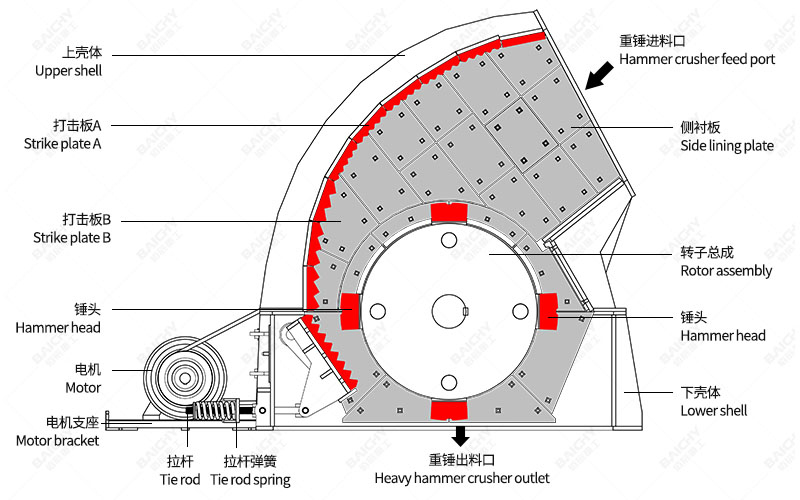
Structural diagram of a hammer crusher
The hammer crusher is a type of impact crushing equipment. Upon entering the crushing chamber, material is violently struck by hammers mounted on a high-speed rotating rotor (moving at a linear velocity of 30–60 m/s). The material then impacts the impact liners and undergoes repeated blows between the hammers and the liners; particles smaller than the gaps in the grate bars are discharged from the bottom of the machine, achieving the desired product size in a single stage.
Its core structure comprises the rotor assembly (main shaft, hammer discs, and hammers), impact liners, grate bars, the upper and lower housing, and an opening mechanism. The hammers and grate bars are the primary wear parts; Baichy offers hammers made from either high-manganese steel (Mn13) or high-chromium cast iron, extending service life by 30–50% compared to standard materials.
It is important to clarify its specific role within the crushing process: jaw crushers handle the coarse crushing of large blocks (≤1200mm), and cone crushers handle the medium-to-fine crushing of high-hardness rock, whereas this hammer crusher is best suited for medium-hard, brittle materials with an input size of ≤600mm (or ≤800mm for the 2PC series) and a target output size of 10–30mm. For materials such as limestone and coal, a single unit can replace the traditional two-stage "primary plus secondary" crushing process; this represents its core operational advantage over other crushing equipment.
II. Application Scenarios for Hammer Crushers: From Cement Plants to Mines
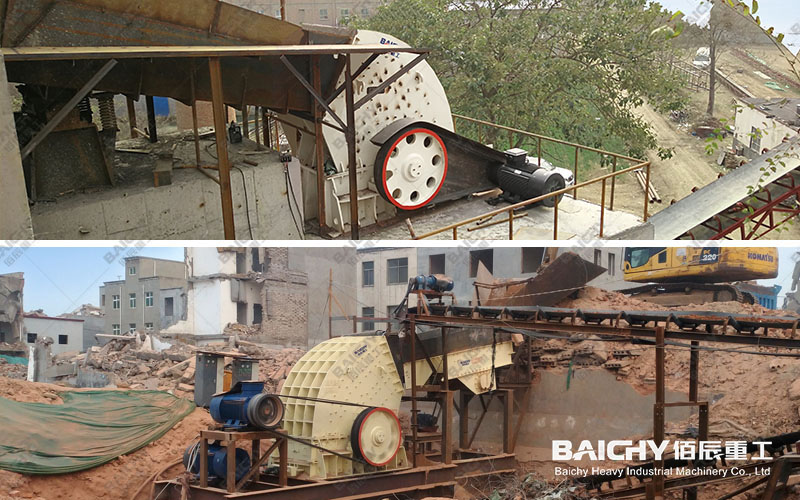
Customer site featuring a hammer crusher
1. Cement and Building Materials Industry (Largest Market): Essential for crushing limestone, clinker, and gypsum in cement production lines. For instance, in a 2,500 t/d clinker line, a single 2PC dual-rotor model can handle the entire limestone crushing process—reducing feed sizes of ≤700 mm to product sizes of ≤30 mm—thereby eliminating the need for a two-stage "jaw crusher plus impact crusher" setup and reducing both civil engineering and equipment investment costs.
2. Coal and Coking Industry: Fine crushing of raw coal, coking coal, and slag. Coal crushed to ≤15 mm can proceed directly to coal grinding or coking stages; power plants, in particular, value the machine's stability during continuous operation.
3. Mining and Mineral Processing: Fine crushing of medium-hard iron ores and non-ferrous metal ores, as well as particle size preparation prior to flotation or magnetic separation. Serving as a pre-processing step for ore grinding equipment, it reduces ore to an economical feed size for the mill, significantly boosting the mill's hourly output.
4. Chemical and Salt Industries: Breaking down and homogenizing soda ash, phosphate rock, and salt blocks. The PCK reversible model excels in scenarios requiring high resistance to clogging, thanks to its bidirectional rotation and uniform wear characteristics.
5. Soft Rock Sand Making: Sand-making lines processing shale or limestone utilize a combination of this machine and a vibrating screen to achieve "crushing instead of grinding." This setup is ideal for producing fill and base-layer materials where aggregate gradation requirements are not overly stringent.
III. Core Advantages of Hammer Crushers: Translating Specifications into Profit
High crushing ratio and single-stage shaping. It offers a crushing ratio of up to 10–25, with over 85% of the output measuring ≤25 mm, allowing a single unit to replace a two-stage crushing system. Savings extend beyond equipment procurement costs to include the second-stage civil foundation, intermediate belt conveyors, and labor for maintenance; for a 100 t/h limestone line, transitioning from a two-stage to a single-stage process reduces initial investment by approximately 25–30%.
1. Adjustable output granularity. Product specifications can be flexibly switched within the 5–30 mm range simply by changing grate bars with different aperture sizes, allowing a single production line to meet perse order requirements without replacing the main unit.
2. Low specific power consumption. Energy consumption is approximately 1.5–2.5 kWh/t for limestone processing—a saving of about 30% compared to two-stage crushing processes; based on a 100 t/h capacity and 6,000 annual operating hours, this translates to annual electricity cost savings in the range of 150,000 to 200,000 RMB.
3. Low maintenance requirements. Hammers feature a modular design allowing for inpidual replacement in about 30 minutes per unit; the housing is equipped with a hydraulic opening mechanism, eliminating the need for complete disassembly during servicing—a feature particularly beneficial for overseas projects lacking highly skilled maintenance teams.
4. Broad production capacity flexibility. The series utilizes a modular design spanning from 5 t/h pilot-scale units to 400 t/h large-scale machines; spare parts are interchangeable, and production lines can be expanded linearly simply by connecting units of the same model in parallel.
IV. Technical Parameter Table for Hammer Crushers
Table 1: Main parameters for PC series single-rotor models (Capacity based on limestone bulk density of 1.6 t/m³)
PC 系列单转子锤式粉碎机主要参数
产能基准:石灰石 1.6t/m³| 型号 | 进料粒度 (mm) | 出料粒度 (mm) | 产能 (t/h) | 电机功率 (kW) | 总重量 (t) |
|---|---|---|---|---|---|
| PC-400×300 | ≤100 | ≤15 | 5–10 | 11 | 0.8 |
| PC-600×400 | ≤120 | ≤15 | 12–25 | 22 | 1.5 |
| PC-800×600 | ≤150 | ≤15 | 25–45 | 55 | 3.9 |
| PC-1000×800 | ≤200 | ≤15 | 40–80 | 110 | 7.9 |
| PC-1200×1000 | ≤250 | ≤20 | 60–120 | 132 | 14.5 |
| PC-1600×1600 | ≤350 | ≤20 | 120–220 | 280 | 30 |
Table 2: Main parameters for 2PC series double-rotor models (Limestone application in cement clinker production lines)
2PC 系列双转子锤式粉碎机主要参数
水泥熟料线石灰石工况| 型号 | 进料粒度 (mm) | 出料粒度 (mm) | 产能 (t/h) | 电机功率 (kW) |
|---|---|---|---|---|
| 2PC-1010 | ≤600 | ≤25 | 90–130 | 2×90 |
| 2PC-1212 | ≤600 | ≤25 | 140–180 | 2×132 |
| 2PC-1414 | ≤700 | ≤30 | 200–260 | 2×200 |
| 2PC-1616 | ≤800 | ≤30 | 300–400 | 2×315 |
Note: For lightweight materials such as coal and gypsum, which have low bulk density, capacity should be adjusted by a factor of 0.45–0.7. Coefficient adjustment: For hard materials (compressive strength >150 MPa), expected production capacity should be lowered, or an alternative model selected.
V. Application Cases: Data-Driven Results
Case 1: Limestone crushing for a 2,500 t/d cement clinker line (Southeast Asia)
• Configuration: 2PC-1414 dual-rotor model + ZSW vibrating feeder
• Material: Limestone (CaO ≥50%, moisture content ≤3%, feed size ≤700 mm)
• Operational Performance: Output size ≤30 mm (over 85% ≤25 mm); stable capacity of 220–240 t/h (110% of nameplate capacity)
Benefits: Specific power consumption of 2.1 kWh/t (approx. 30% lower than the combined consumption of a two-stage jaw crusher + impact crusher process); high-chrome hammer lifespan of 6–8 months per set (annual spare parts costs reduced by approx. 20%); entire line constructed and commissioned in 45 days
Case 2: Raw coal fine crushing upgrade for a coking plant (Central Asia)
• Configuration: PC-1000×800 model replacing the original two-stage double-roll crushing process
• Material: Raw coal ≤200 mm (moisture 6–8%); target output size ≤15 mm
• Operational Performance: Capacity of 55–70 t/h; 92% product size compliance rate; specific power consumption of 1.8 kWh/t
Benefits: System reduced from 3 units to 1; installed power reduced by 45%; annual maintenance man-hours reduced by approx. 60%
VI. Guide to Avoiding Pitfalls in Hammer Crusher Selection
Hardness Limit: Suitable for medium-hard, brittle materials with compressive strength ≤150 MPa. Granite, basalt, and high-silica iron ore are strictly unsuitable; using them causes exponential hammer wear, resulting in a per-ton cost higher than that of a cone crusher. Moisture Content Limit: Recommended feed moisture content is ≤10%. Levels >15% or high-viscosity materials can clog grate bars and reduce production capacity by over 30%; in such cases, a double-roll crusher should be used, or the material should be dewatered first.
Capacity Conversion: Nameplate capacity is based on limestone. Before purchasing, please provide the material's bulk density, moisture content, and target particle size so the manufacturer can calculate the actual capacity and avoid discrepancies between the nameplate rating and real-world performance.
Hammer Material: Choose high-manganese steel for soft, tough materials and high-chromium cast iron for abrasive materials; the two types are interchangeable. It is recommended to have the manufacturer make a recommendation based on your specific operating conditions and to keep a spare set of hammers on hand.
System Integration: Install an iron remover at the feed end to prevent metal contaminants from damaging the hammers, and use a variable-frequency feeder to ensure uniform feeding. At the discharge end, use a vibrating screen for a closed-circuit loop to increase the qualified product yield to over 90%.
VII. Recommended Auxiliary Equipment for Hammer Crushers
A complete crushing and grinding production line is typically configured as follows:
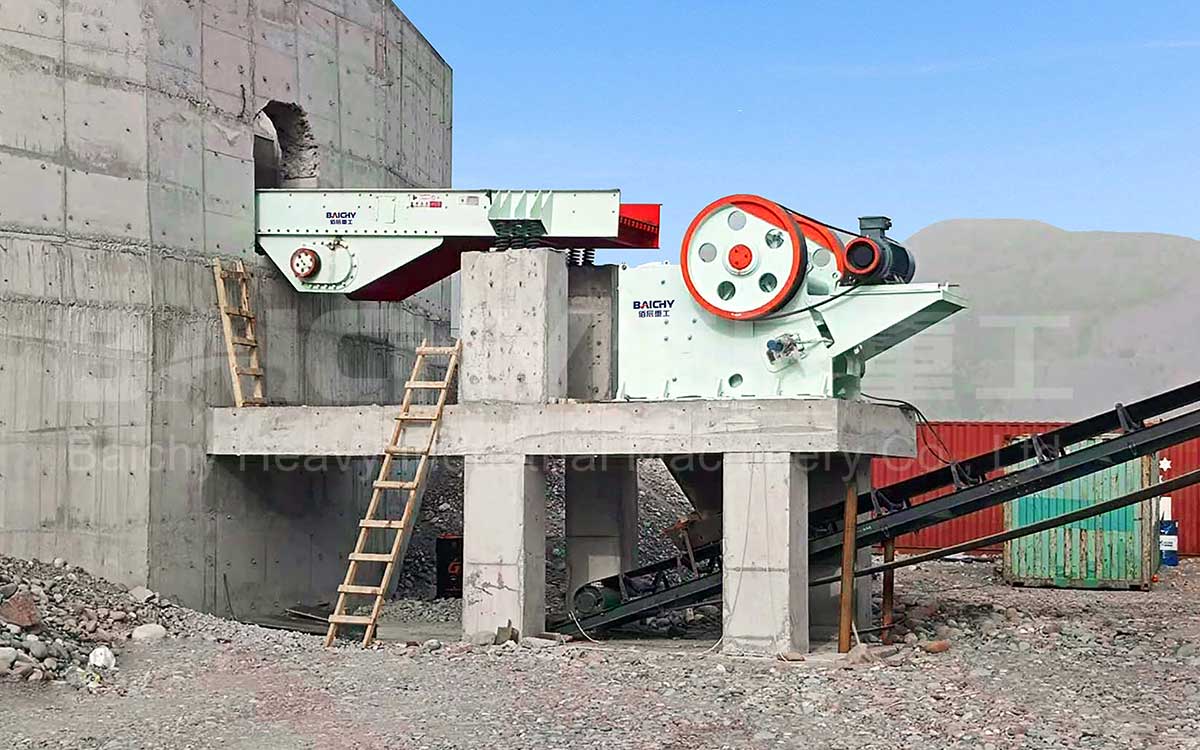
ZSW Vibrating Feeder: Ensures uniform feeding, prevents material from directly impacting the rotor, and extends hammer lifespan.
Jaw Crusher: Large feed blocks (>600mm) are first coarsely crushed by a jaw crusher before entering this machine.
YK Vibrating Screen: Handles discharge grading and closed-circuit screening, enabling multi-stage product utilization.
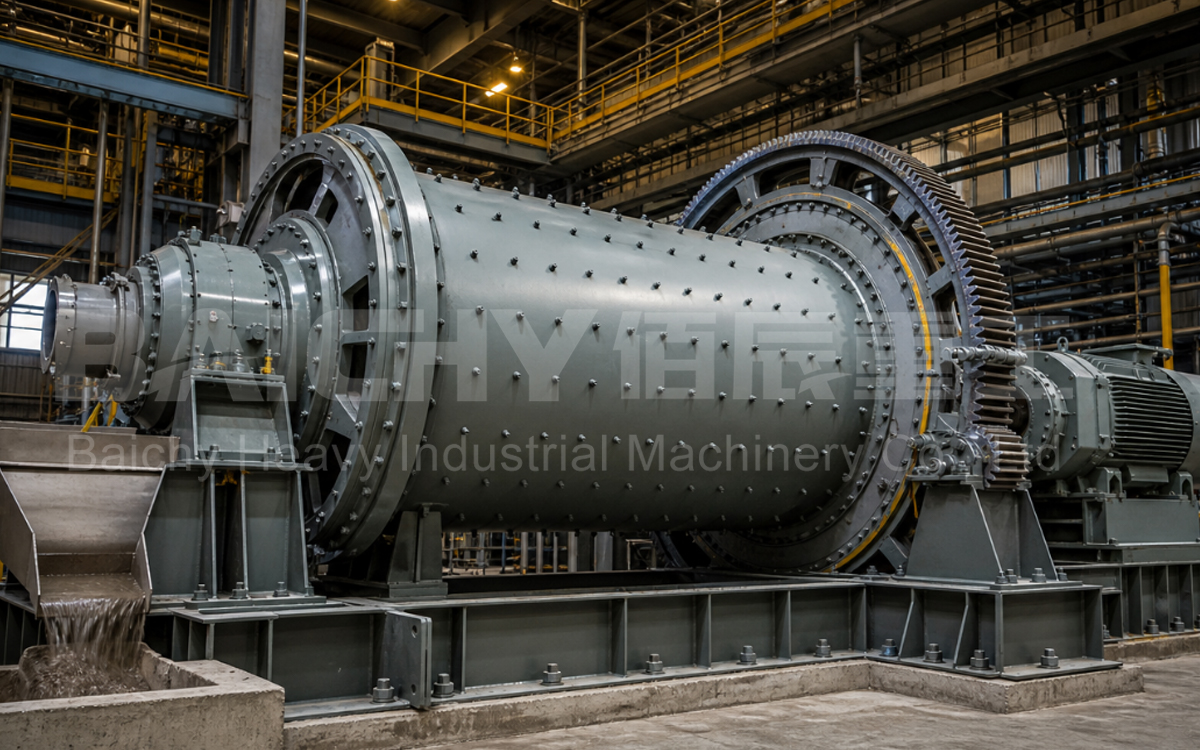
Ball Mill / Raymond Mill: This machine acts as a pre-crusher for the grinding stage, potentially increasing the mill's hourly output by 20–30%.
Baghouse Dust Collector: Controls dust emissions to meet local environmental regulations.
Need a complete process design for crushing, grinding, and mineral processing? Contact Baichy Heavy Industry for a free process flow chart and equipment selection plan, or to request on-site operation videos and test run reports.
VIII. Hammer Crusher FAQ
Q1: How do I choose between a hammer crusher and an impact crusher?
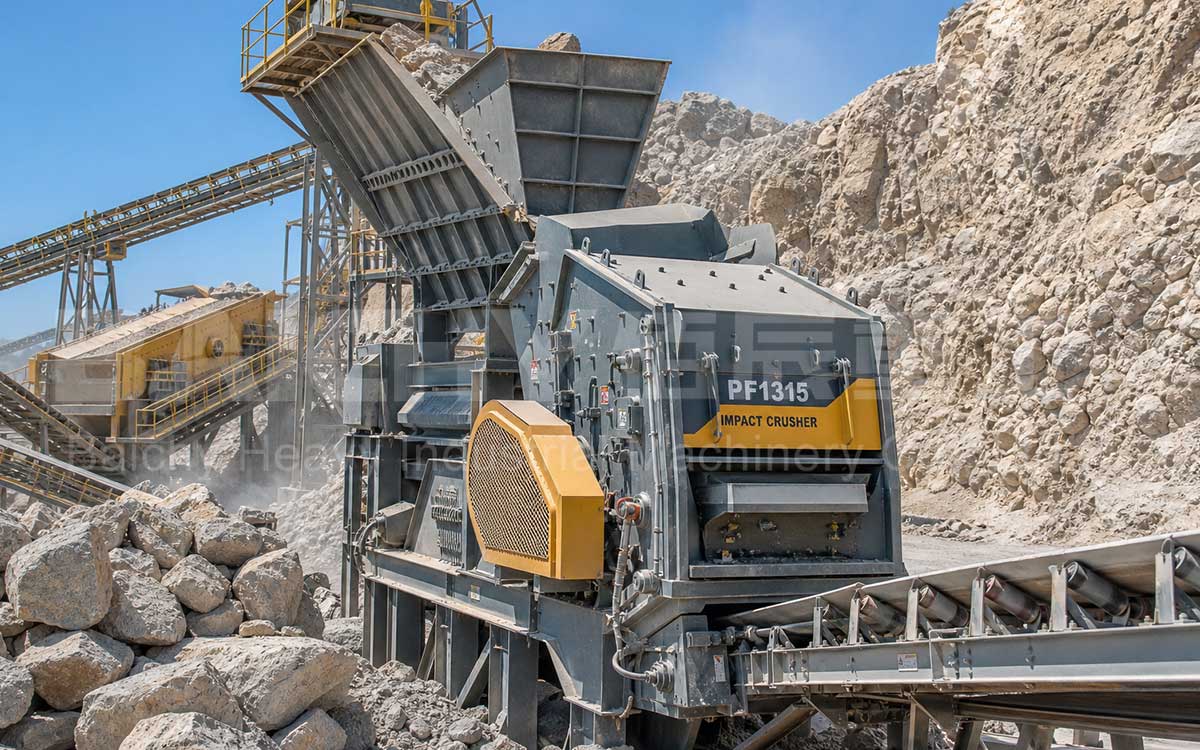
A: It depends primarily on material hardness and the target output specifications. For medium-hard, brittle materials like limestone, coal, and gypsum requiring a product size of ≤30mm, a hammer crusher is the preferred choice—it achieves single-stage shaping with lower investment and power consumption per ton. For hard rock with a compressive strength >150MPa or when cubical aggregate shapes are required, an impact crusher or cone crusher should be selected; otherwise, hammer wear will be excessive, and the particle shape will fail to meet standards.
Q2: What is the service life of the hammers?
A: It depends on the abrasiveness of the material and the hammer material. When processing limestone, a set of high-chromium hammers lasts approximately 6–8 months, while high-manganese steel lasts about 3–5 months; the lifespan can be extended by over 50% when processing low-abrasion materials like coal or gypsum. Baichy supplies genuine replacement hammers and grate bars; inpidual replacement is supported, and keeping a spare set in stock ensures continuous production.
Q3: Can materials with high moisture content be crushed directly?
A: It is recommended that the feed moisture content be ≤10%. If moisture is 10–15%, production capacity drops by 10–30%; if it exceeds 15% or the material is sticky, the grate bars are highly prone to clogging, necessitating pre-drying, dewatering, or the use of a double-roll crusher instead. Please specify the actual moisture content during equipment selection so that anti-clogging designs—such as optimized grate bar apertures and hammer arrangements—can be implemented.
Baichy Heavy Industry
Baichy Heavy Industry is a high-tech mining equipment company integrating R&D, manufacturing, sales, and after-sales service. Focusing on crushing, grinding, and mineral processing equipment, we provide professional solutions to our customers. We are ISO9001:2015 、certified, and our products include mobile crushing palnts, crawler crushing plant, construction waste crushing plants, jaw crushers, sand making machines, cone crushers, fine crushers, grinding mills, ball mills, etc., all with reliable performance to meet diverse project needs.
Baichy Heavy Industry – Your Trusted Partner
To ensure optimal performance of your equipment, Baichy Heavy Industry offers:
- Professional on-site installation guidance
- Comprehensive operator training
- 24/7 technical support & maintenance services
Our complete after-sales service system guarantees long-term, stable operation of your machinery with minimal downtime.
Protect Your Rights – Only Use Official Channels
To avoid scams and ensure authentic support, contact us exclusively through:
• Official Website: www.baichychina.com
• WhatsApp: +8615093222637
• Email: [email protected]
Your satisfaction is our priority – expect prompt, professional service every time.
(Note: Beware of unauthorized third parties claiming to represent Baichy. Always verify through official contacts.)