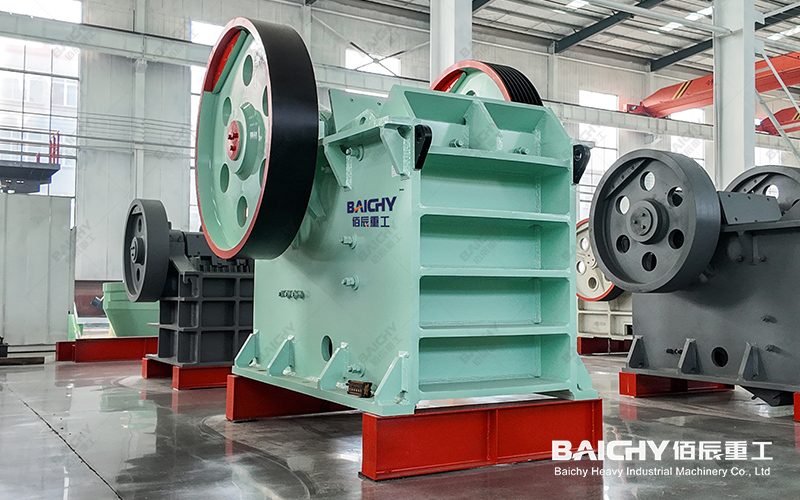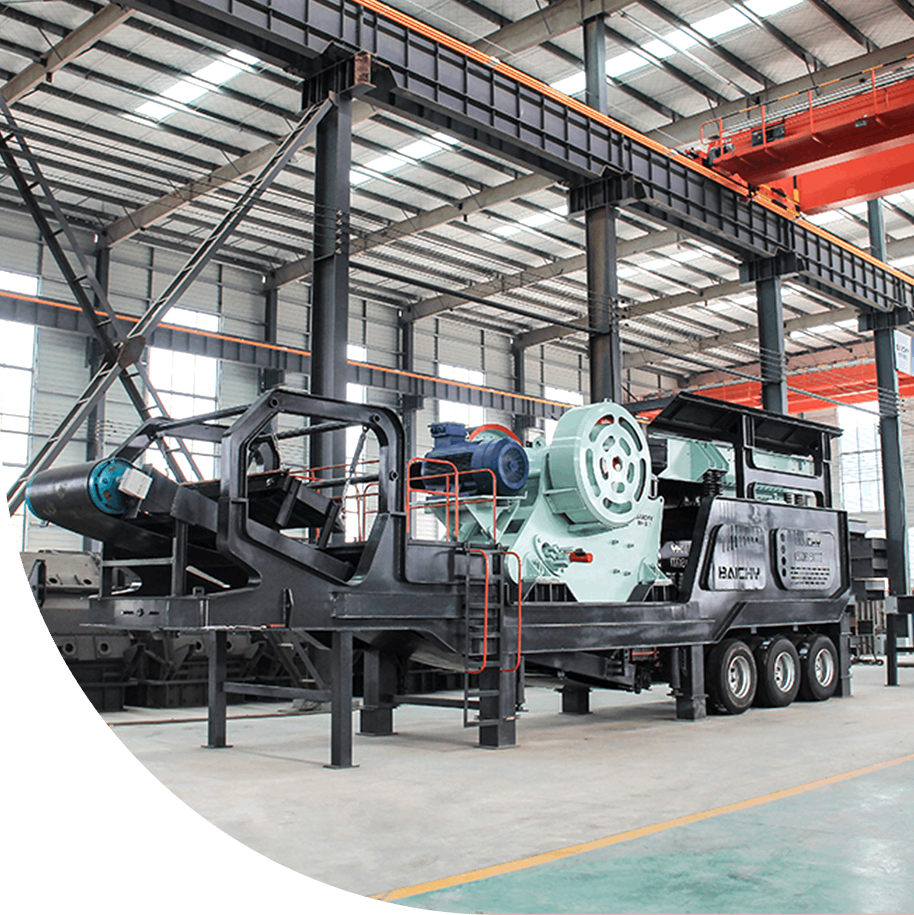

For crushing medium-hard, brittle materials such as limestone, coal, gypsum, and shale, the hammer rock crusher offers the lowest cost per ton and the fastest return on investment. It condenses the traditional two-stage process (primary and secondary crushing) into a single-stage operation; it accepts feed sizes up to 300mm and directly produces 0–15mm finished product, with an overall crushing cost 20%–30% lower than the combination of a jaw crusher and an impact crusher.
What is a hammer rock crusher? Working principle and positioning
The hammer rock crusher utilizes a high-speed rotating rotor to drive high-chromium hammer heads, crushing material through a combination of impact, shearing, and grinding. After material enters the crushing chamber, the hammer heads shatter it at a linear speed of 60–80m/s. The fragments strike the impact plate for further breakage, and particles meeting the required size are discharged through the gaps between the bottom grate bars, achieving a "single-machine, single-stage, one-pass" process.
Compared to jaw crushers (primary crushing) and impact crushers (secondary crushing), the key advantage of the hammer crusher for medium-hard, brittle materials is the consolidation of processing stages. While a traditional production line requires two or three main machines, a single hammer rock crusher can replace them all, saving on equipment procurement, civil foundation costs, and redundant investments in conveyor systems and power distribution infrastructure. This is why cement plants, thermal power plants, and mineral processing facilities widely prefer it as the solution for "single-stage crushing to final size."
Three typical configurations of hammer crushers
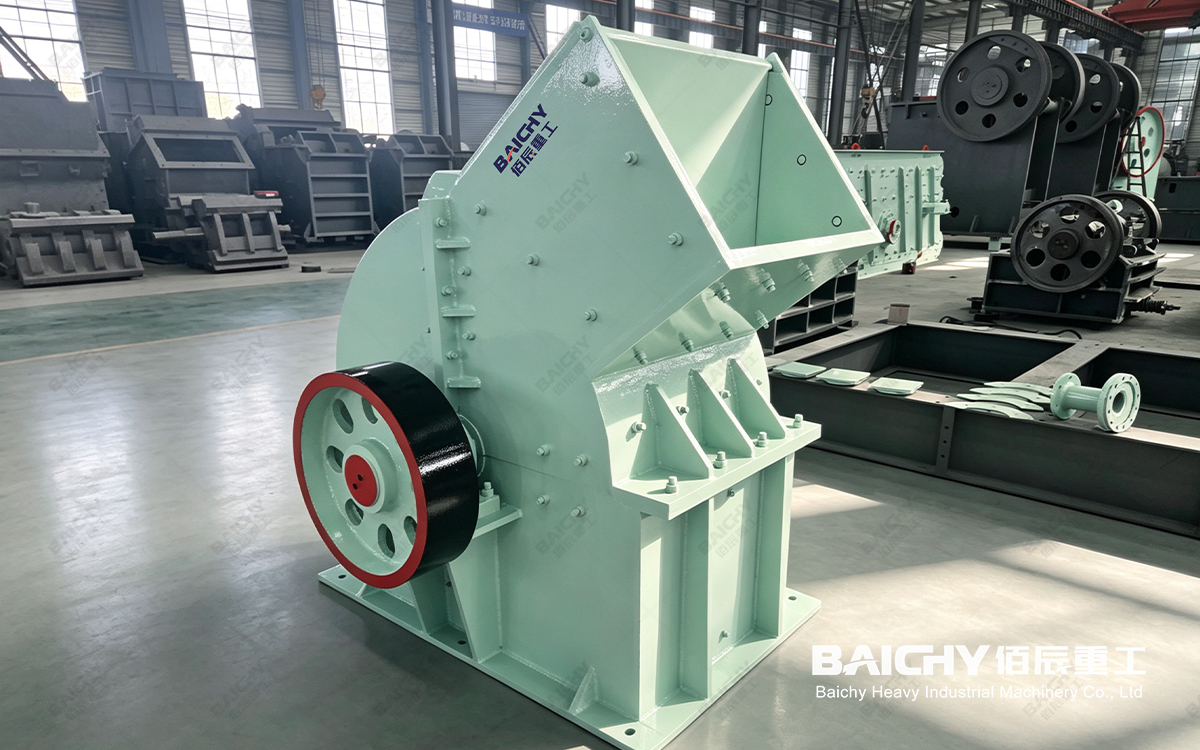
Hammer Rock Crusher
• PC Single-stage hammer crusher: Features grate-bar discharge with controllable output size (e.g., 0–15mm, 0–25mm); suitable for production lines with specific finished-product size requirements.
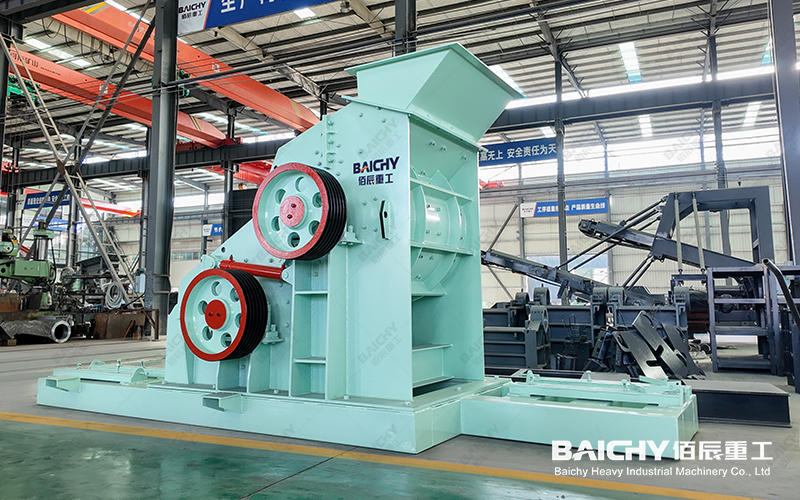
2PC double-stage hammer crusher
• 2PC Two-stage hammer crusher: Features dual rotors in series and a grate-free bottom design; it resists clogging even with moisture content up to 15% and can crush materials like coal gangue and shale to under 3mm in a single pass, directly supporting "crushing-instead-of-grinding" processes.

Hammer Rock Crusher
• PCZ Impact-Hammer Crusher: Features a composite crushing chamber combining hammers and impact plates, balancing high throughput with fine output; ideal for high-capacity medium-to-fine crushing of limestone and dolomite.
Typical Application Scenarios for Hammer Rock Crushers
1. Limestone Quarries and Cement Production Lines
Crushing raw materials for cement plants is a classic application for hammer crushers: limestone is crushed in a single pass to under 75mm and fed directly into the mill, eliminating the need for a secondary crushing stage. For a production line with a daily clinker output of 5,000 tons, this approach saves approximately 15%–20% in equipment and civil engineering costs for the secondary crushing system, while increasing the mill's hourly output by 5%–8%.
2. Coal, Coal Gangue, and Thermal Power Plants
Hammer crushers offer far superior efficiency for coal crushing compared to jaw crushers; due to coal's low hardness and high brittleness, impact crushing consumes less energy and results in minimal over-pulverization. Hammer crushers serve as the primary equipment for fuel crushing in thermal power plants, coal gangue crushing in coal preparation plants, and coal preparation processes in coking plants; the 2PC two-stage hammer crusher can reduce coal gangue to under 3mm in a single pass, making it ready for immediate use in brick or sand making.
3. Gypsum, Shale, and Chemical Raw Materials
For soft to medium-hard materials such as gypsum, shale, phosphate rock, and barite, a single hammer crusher can handle the entire crushing process—from run-of-mine ore to the required mill feed size (0–30mm). With a crushing ratio exceeding 20:1, it serves as the most economical "pre-crushing" solution for grinding systems.
4. Construction Waste and Recycled Aggregates
Pre-sorted demolition concrete fed into a hammer crusher yields recycled aggregates and recycled fines. Compared to mobile combinations of jaw and impact crushers, the stationary hammer crusher solution requires lower investment, making it suitable for high-volume processing at urban solid waste resource recovery centers.
5. Pre-crushing for Mineral Processing and Grinding Systems
Positioned at the upstream end of ore grinding lines (utilizing Raymond mills, ball mills, or vertical mills), a hammer-type rock crusher reduces ore to the required feed size. This directly boosts the mill's hourly output by 10%–15% and significantly lowers the cost of wear on grinding balls and liners—serving as the equipment foundation for the mineral processing philosophy of "crushing instead of grinding" and "more crushing, less grinding."
Key Specifications: PC / 2PC Series Hammer Crushers
The following table lists specifications for Baichen Heavy Industry's mainstream hammer rock crusher models (capacities are rated based on a limestone bulk density of 1.6 t/m³; for hard materials, please apply a conversion factor of 0.6–0.8):
| Model | Rotor Diameter × Length (mm) | Feed Size (mm) | Discharge Size (mm) | Capacity (t/h) | Motor Power (kW) |
|---|---|---|---|---|---|
| PC400×300 | 400×300 | ≤100 | ≤15 | 5–10 | 11 |
| PC600×400 | 600×400 | ≤120 | ≤15 | 15–25 | 22 |
| PC800×600 | 800×600 | ≤150 | ≤15 | 25–40 | 45–55 |
| PC1000×800 | 1000×800 | ≤200 | ≤25 | 40–60 | 75–90 |
| PC1200×1000 | 1200×1000 | ≤250 | ≤25 | 60–90 | 110–132 |
| 2PC1000×1000 | Dual-rotor 1000×1000 | ≤300 | ≤3 (no bottom screen) | 40–80 | 110×2 |
| 2PC1200×1200 | Dual-rotor 1200×1200 | ≤350 | ≤3 (no bottom screen) | 80–120 | 132×2 |
Selection Tips: For feed material with a moisture content exceeding 8%, the 2PC dual-stage hammer crusher is recommended (its bottom-screen-free design prevents clogging); for materials with high clay content, the use of a grizzly screen or a washing stage upstream is recommended.
Five Key Advantages of Hammer Rock Crushers
1. Single-stage crushing: Eliminates the need for secondary crushing investment
Taking a 100 t/h limestone processing line as an example: a traditional two-stage setup (jaw crusher + impact crusher) requires an equipment investment of approximately 600,000–800,000 RMB. In contrast, a single PC1200×1000 hammer crusher can handle the same output requirements for about 400,000–500,000 RMB—saving over 30% on investment costs—while also reducing the need for foundations, electrical control cabinets, and conveyor belts associated with two separate machines.
2. Lowest crushing cost per ton in the industry
Hammer crushers utilize the impact crushing principle, with power consumption of approximately 0.8–1.2 kWh/t—only 60%–80% of the consumption required by the jaw-plus-impact crusher combination (approx. 1.5–2.0 kWh/t). Based on an electricity rate of 0.6 RMB/kWh and an annual output of 500,000 tons, this results in annual electricity savings of approximately 150,000–300,000 RMB.
3. High-chrome alloy hammers: Controllable lifespan and costs
Standard high-chrome hammers offer a service life of approximately 400–600 hours per side when processing limestone; they can be flipped for continued use, and the cost of replacing inpidual worn hammers is low. Dynamic rotor balancing ensures smooth high-speed operation, with overall machine vibration levels maintained at ≤2.5 mm/s.
4. Simple structure and low maintenance requirements
Hammer crushers do not rely on hydraulic systems or complex lubrication circuits. Routine maintenance involves only checking hammer wear, grate bar gaps, and V-belt tension—tasks easily performed by a standard mechanic—resulting in over 60% less downtime for maintenance compared to hydraulic cone crushers.
5. Uniform output with controllable over-crushing rates
By adjusting the gap between the hammers and grate bars as well as the rotor speed, the particle size distribution of the finished product can be precisely controlled. This minimizes material loss caused by over-crushing (excessive fines) and enhances both the market value of the aggregate and the quality of the feed material for downstream grinding mills.
Application Cases
Case 1: Limestone Crushing Line (120 t/h) for a Middle Eastern Cement Group
The client's original plan involved a two-stage crushing process (jaw crusher + impact crusher), which entailed a long civil construction period and exceeded the budget. After switching to a single-stage solution using the PC1200×1000 hammer crusher, limestone with a feed size of ≤250 mm is crushed in a single pass to ≤25 mm and fed directly into the raw meal mill. Equipment investment costs were reduced by 28% compared to the original plan. Post-commissioning, the measured capacity reached 125 t/h—exceeding the design value by 4%—with annual savings of approximately 380,000 RMB in electricity and wear-part costs; the investment payback period was 14 months.
Case 2: Coal Gangue Sand-Making Project in Shanxi (2PC Two-Stage Hammer Crusher)
For coal gangue feed (≤300 mm size, 10%–12% moisture content), a 2PC1200×1200 two-stage hammer crusher is used to crush material to below 3 mm in a single pass; the screenless-bottom design ensures continuous operation without clogging. The finished product is fed directly into the brick-making raw material silo. The measured single-line capacity is 100 t/h. Replacing the original "jaw crusher + double-roll crusher" setup reduced the number of machines from three to one and lowered the cost per ton by 22%, with the full equipment investment recovered within 11 months of commissioning.
Recommended Auxiliary Equipment (Hammer Crusher Production Line Configuration)
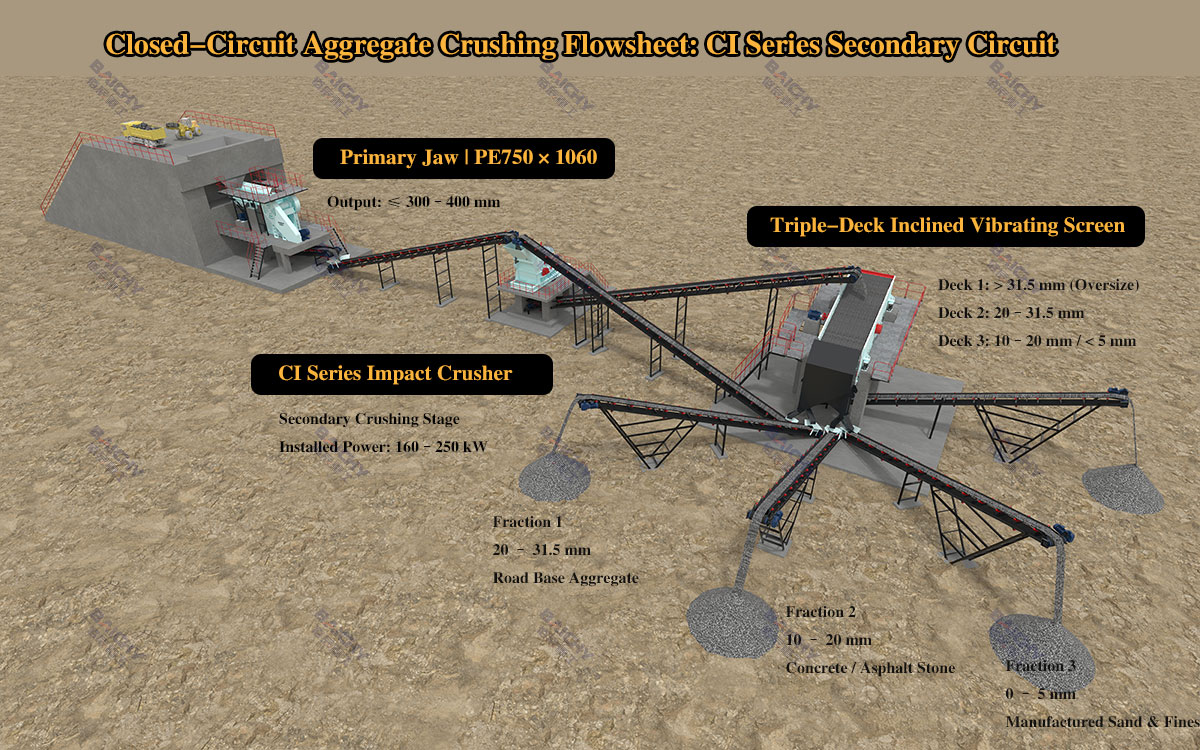
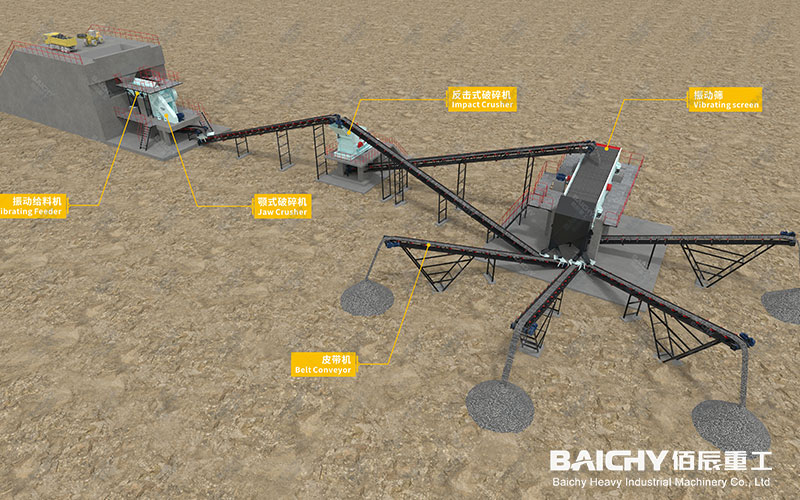
• ZSW Vibrating Feeder: Ensures uniform feeding and buffers material impact, protecting the crushing chamber and hammer heads.
• YK / GTS Circular Vibrating Screen: Performs closed-circuit screening to control product particle size; oversized material is automatically recirculated for re-crushing.
• Belt Conveyor: Connects the feeding, crushing, and screening stages; belt width and speed are selected based on production capacity.
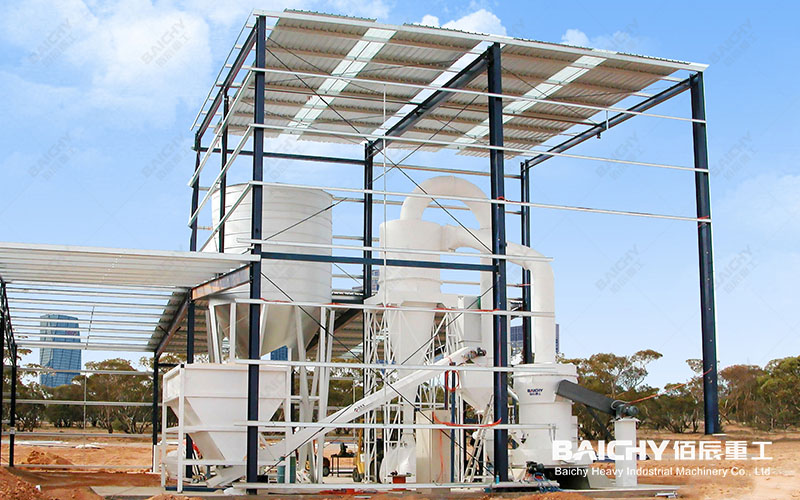
• Raymond Mill / Ball Mill: The hammer crusher's output particle size meets the mill's feed requirements, forming an integrated "crushing and grinding" production line.
• Pulse Bag Dust Collector: Centrally collects dust generated at crushing points to meet local environmental emission standards.
Hammer Rock Crusher: Frequently Asked Questions (FAQ)
Q1: What materials are hammer crushers suitable for? Can they crush granite?
Hammer crushers are suitable for medium-hard to soft, brittle materials (Protodyakonov hardness f ≤ 8), such as limestone, dolomite, coal, coal gangue, gypsum, shale, and phosphate rock. They are not recommended for hard rocks like granite or basalt (f = 12–18); hard rock accelerates hammer wear and drives up the cost per ton. Jaw crushers or cone crushers should be used for such materials. If a hammer crusher must be used for hard rock, high-manganese steel hammers should be selected, and the user must accept higher wear-part costs.
Q2: What is the difference between a hammer crusher and an impact crusher? How do I choose?
Both utilize impact crushing but differ in structure: Hammer crushers feature hammers mounted directly on the rotor and use bottom grate bars to control discharge size; they offer a high reduction ratio (up to 20:1) and are ideal for single-stage crushing (taking in large blocks and outputting fine material). Impact crushers rely on repeated collisions between blow bars and impact plates; they produce superior particle shapes and are typically used for secondary crushing and shaping. Selection guide: Choose a hammer crusher if you need single-stage reduction to below 25mm for medium-hard, brittle material; choose an impact crusher if high-quality aggregate shape (e.g., for concrete) is required.
Q3: What is the service life of the hammers? Is replacement expensive?
Taking limestone processing as an example, a high-chrome hammer has a single-side lifespan of approximately 400–600 hours and can be flipped over for use on the other side; actual lifespan depends on material abrasiveness, moisture content, and rotor speed settings. The cost of replacing a full set of hammers accounts for about 2%–4% of the equipment's total price, translating to just 0.05–0.15 RMB per ton of material processed. Hammer lifespan can be extended by 20%–30% by controlling feed size and preventing tramp iron from entering the machine. We recommend installing an iron remover and a grizzly screen upstream of the crusher; these are the most cost-effective protective measures.
Baichy Heavy Industry
Baichy Heavy Industry is a high-tech mining equipment company integrating R&D, manufacturing, sales, and after-sales service. Focusing on crushing, grinding, and mineral processing equipment, we provide professional solutions to our customers. We are ISO9001:2015 、certified, and our products include mobile crushing palnts, crawler crushing plant, construction waste crushing plants, jaw crushers, sand making machines, cone crushers, fine crushers, grinding mills, ball mills, etc., all with reliable performance to meet diverse project needs.
Baichy Heavy Industry – Your Trusted Partner
To ensure optimal performance of your equipment, Baichy Heavy Industry offers:
- Professional on-site installation guidance
- Comprehensive operator training
- 24/7 technical support & maintenance services
Our complete after-sales service system guarantees long-term, stable operation of your machinery with minimal downtime.
Protect Your Rights – Only Use Official Channels
To avoid scams and ensure authentic support, contact us exclusively through:
• Official Website: www.baichychina.com
• WhatsApp: +8615093222637
• Email: [email protected]
Your satisfaction is our priority – expect prompt, professional service every time.
(Note: Beware of unauthorized third parties claiming to represent Baichy. Always verify through official contacts.)