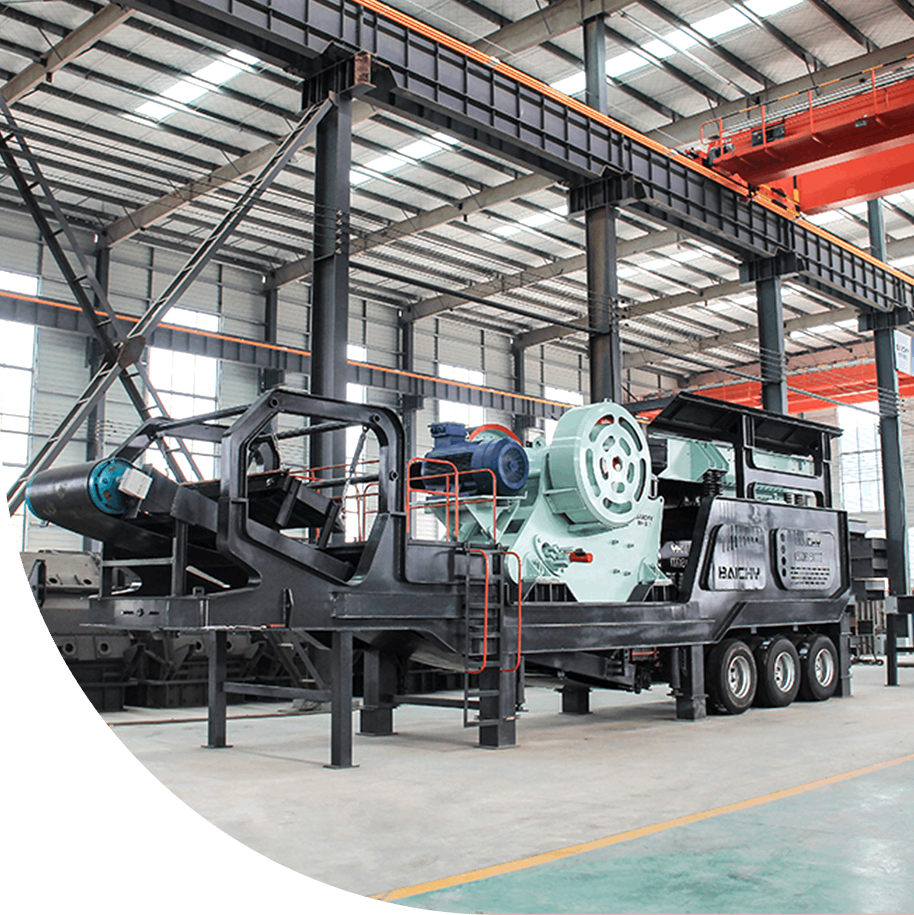

I. Basic Material Parameters
| Parameter | Coke (Metallurgical/Chemical) | Reference: Limestone |
| Compressive Strength | 10–30 MPa | 80–140 MPa |
| Mohs Hardness | 3-4 | 3-4 |
| Bulk Density | 0.5–0.9 t/m³ | 1.5–1.7 t/m³ |
| Material Characteristics | Brittle, porous, prone to pulverization | Moderate hardness, tough |
Key Selection Conclusion: The bulk density of coke is only 40%–55% that of limestone; therefore, the nominal capacity of any crusher (rated based on limestone) must be adjusted. Actual capacity for 50 tph of coke ≈ Nominal crusher capacity × 0.45–0.55. Thus, a model with a nominal capacity of over 90–110 tph is required to ensure sufficient engineering margin.
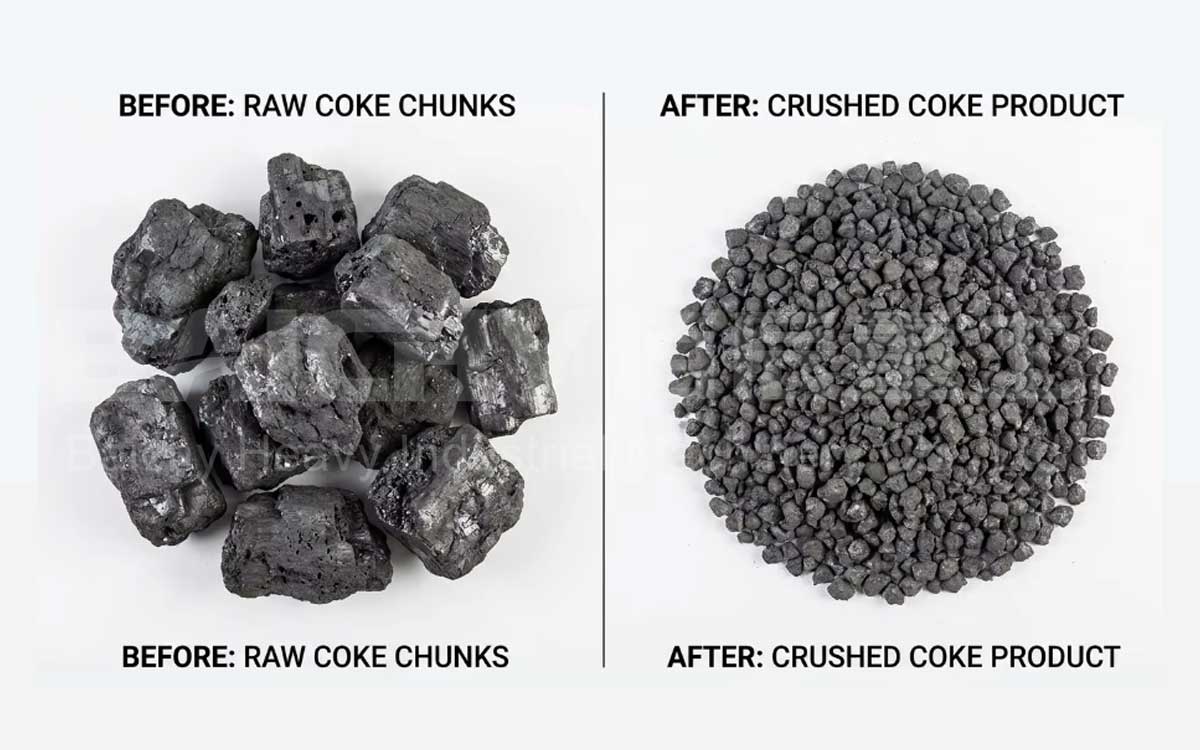
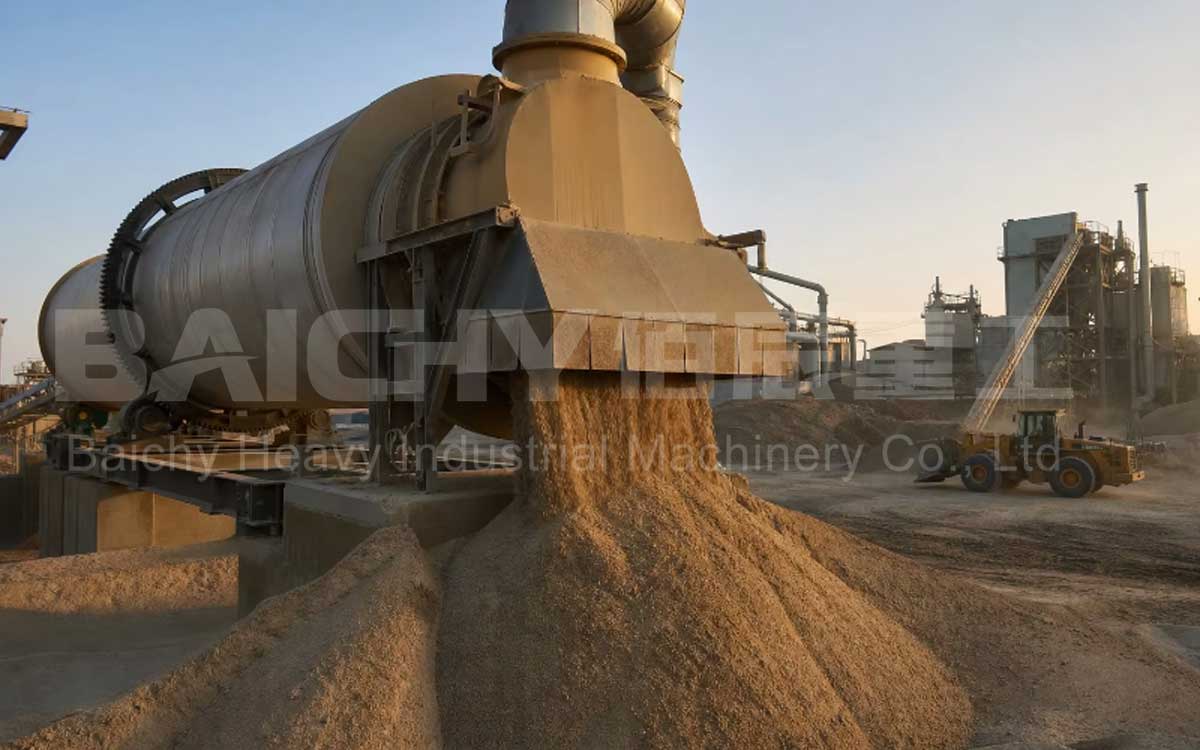
BEFORE RAW COKE CHUNKS and AFTER CRUSHED COKE PRODUCT
II. Comparison of Three Options
Option A: PE Jaw Crusher (Compression Crushing)
Principle: Compressive force is applied to the material between a moving jaw plate and a stationary jaw plate; the material is progressively crushed within the crushing chamber and discharged through the outlet.
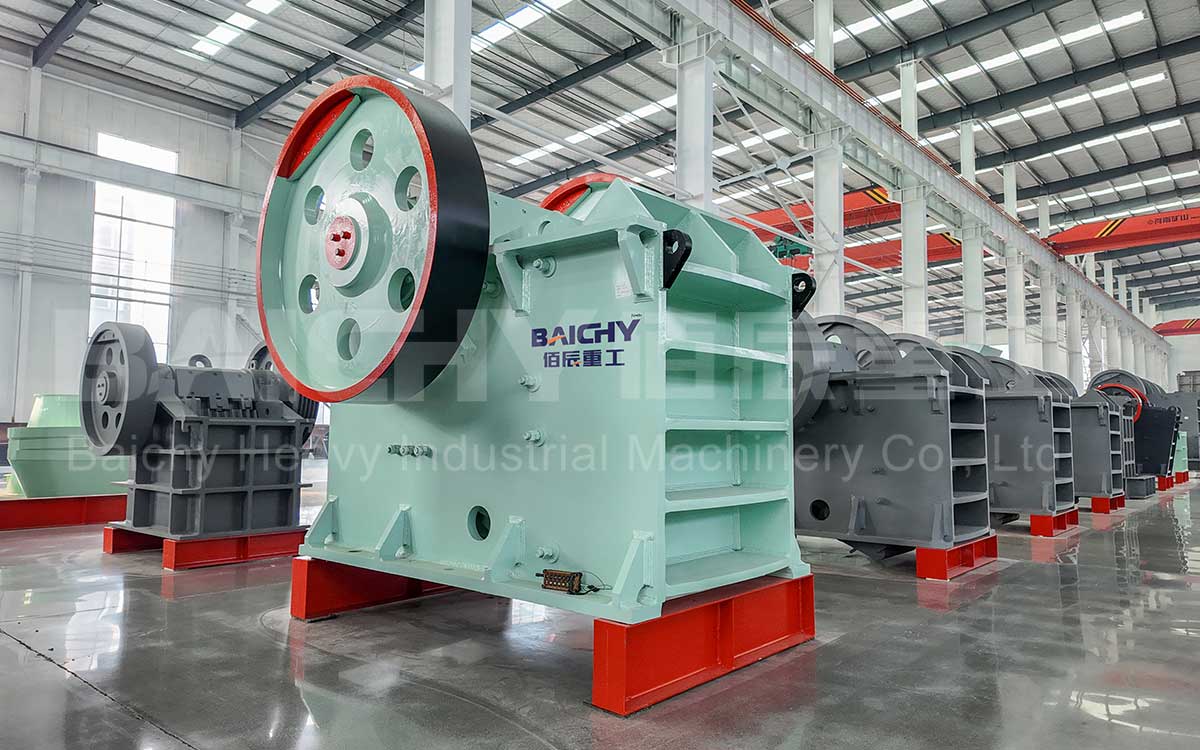
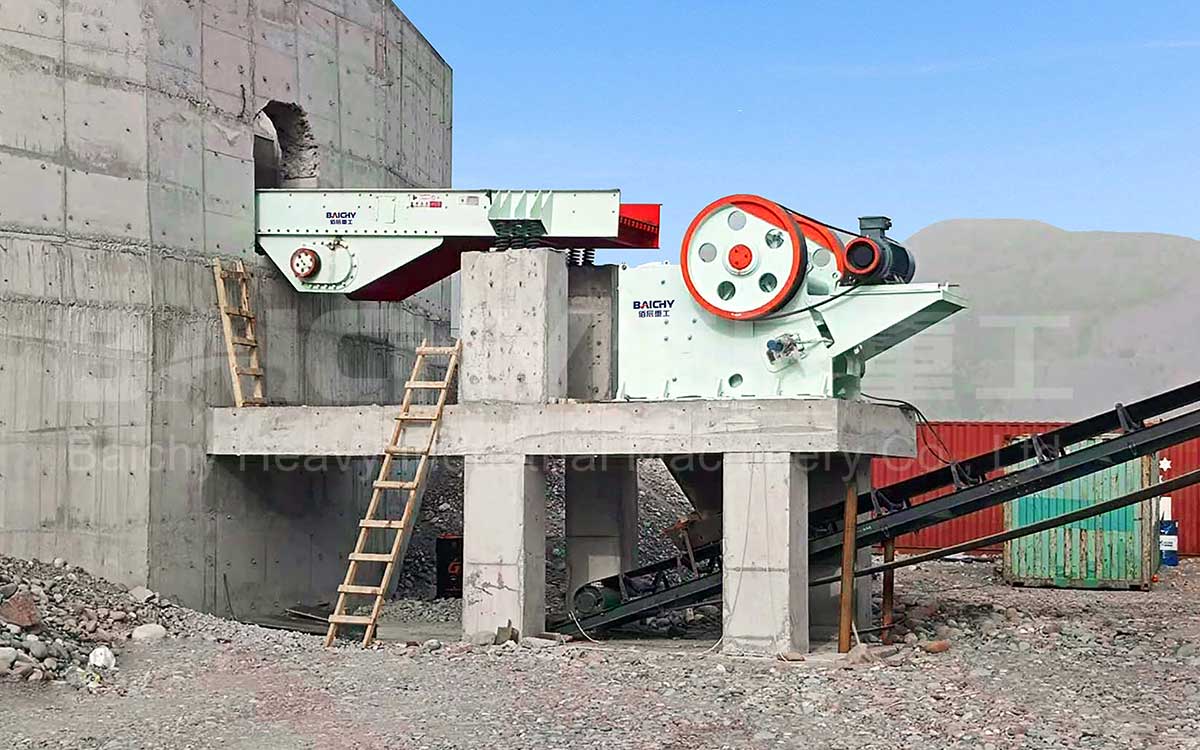
PE Jaw Crusher (Compression Crushing)
| Model | Feed Opening (mm) | Max. Feed Size (mm) | Discharge Range (mm) | Nominal Capacity (t/h) | Coke-Equivalent Capacity (t/h) | Motor Power (kW) |
| PE-500×750 | 500×750 | 425 | 50–100 | 50–100 | 22–55 | 55 |
| PE-600×900 | 600×900 | 500 | 65–160 | 60–160 | 30–88 | 55–75 |
| PE-750×1060 | 750×1060 | 630 | 80–140 | 110–320 | 50–176 | 90–110 |
Advantages:
• Simple structure, low maintenance costs, and long service life for jaw plates
• High adaptability to raw material size; capable of processing coke containing small amounts of foreign matter
• Baichy PE series represents a mature, flagship model
Disadvantages:
• Moderate crushing ratio (4–6): secondary crushing may be required after primary crushing
• Coke is brittle: compression crushing generates a certain amount of fines
• Wide particle size distribution in the discharge
<<Detailed specifications of the jaw crusher>>
Option B: PC Hammer Crusher
Principle: High-speed rotating hammers impact and shatter the material; material meeting the required size passes through the grate bars for discharge.
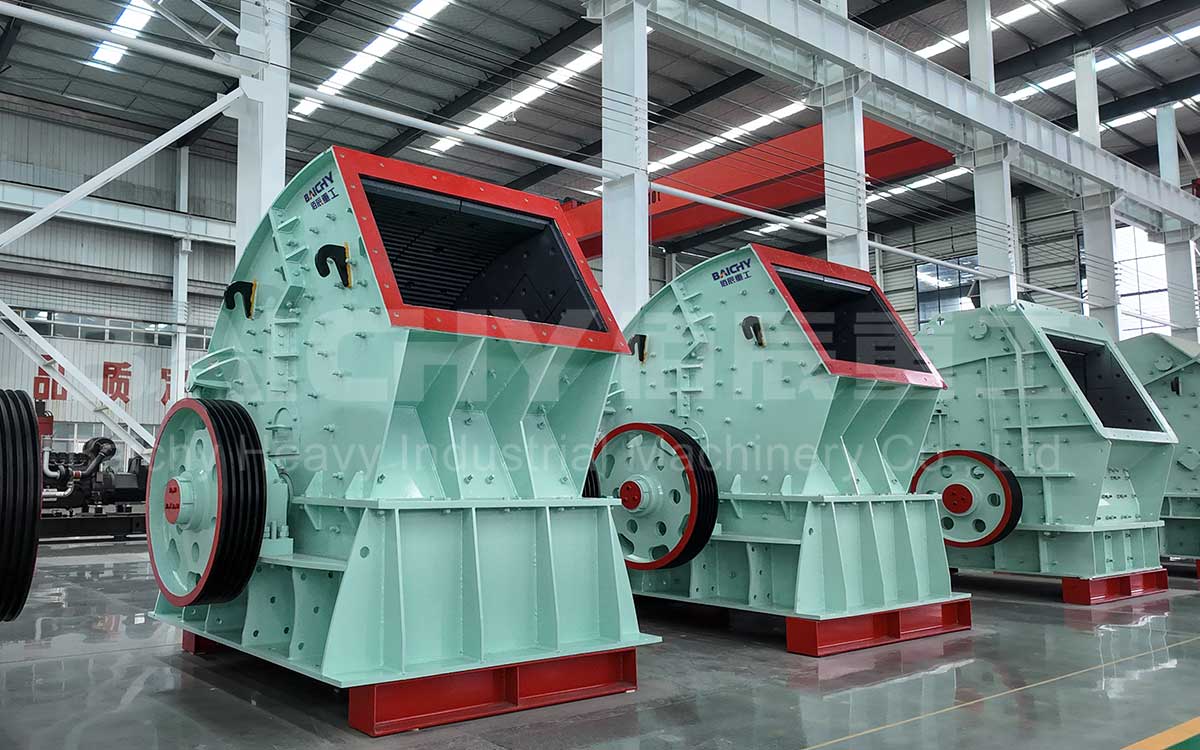
Heavy Hammer Crusher
| Model | Rotor Specs (mm) | Max. Feed Size (mm) | Discharge Size (mm) | Nominal Capacity (t/h) | Coke-Equivalent Capacity (t/h) | Motor Power (kW) |
| PC-800×600 | Φ800×600 | ≤200 | ≤25 | 18–40 | 8–22 | 55 |
| PC-1000×800 | Φ1000×800 | ≤300 | ≤30 | 25–60 | 12–33 | 90 |
| PC-1200×1000 | Φ1200×1000 | ≤350 | ≤35 | 40–80 | 18–44 | 132 |
Advantages:
• High reduction ratio (up to 15–25); capable of producing the final product in a single crushing stage
• Suitable for brittle materials; high crushing efficiency
• Lower equipment investment cost
Disadvantages:
• Rapid hammer wear and frequent replacement (abrasiveness of coke requires assessment)
• High generation of fines; unsuitable for applications with strict particle size requirements
• Nominal capacity is relatively low; handling 50 tph of coke requires a larger model (PC-1200×1000 or above)
<<Detailed specifications for the heavy-duty hammer crusher>>
Option C: 2PGC Double-Toothed Roll Crusher (Shearing + Compression Crushing) ⭐ Industry Preferred
Principle: Two counter-rotating toothed rolls simultaneously apply shearing and compressive forces to the material, forcing discharge.
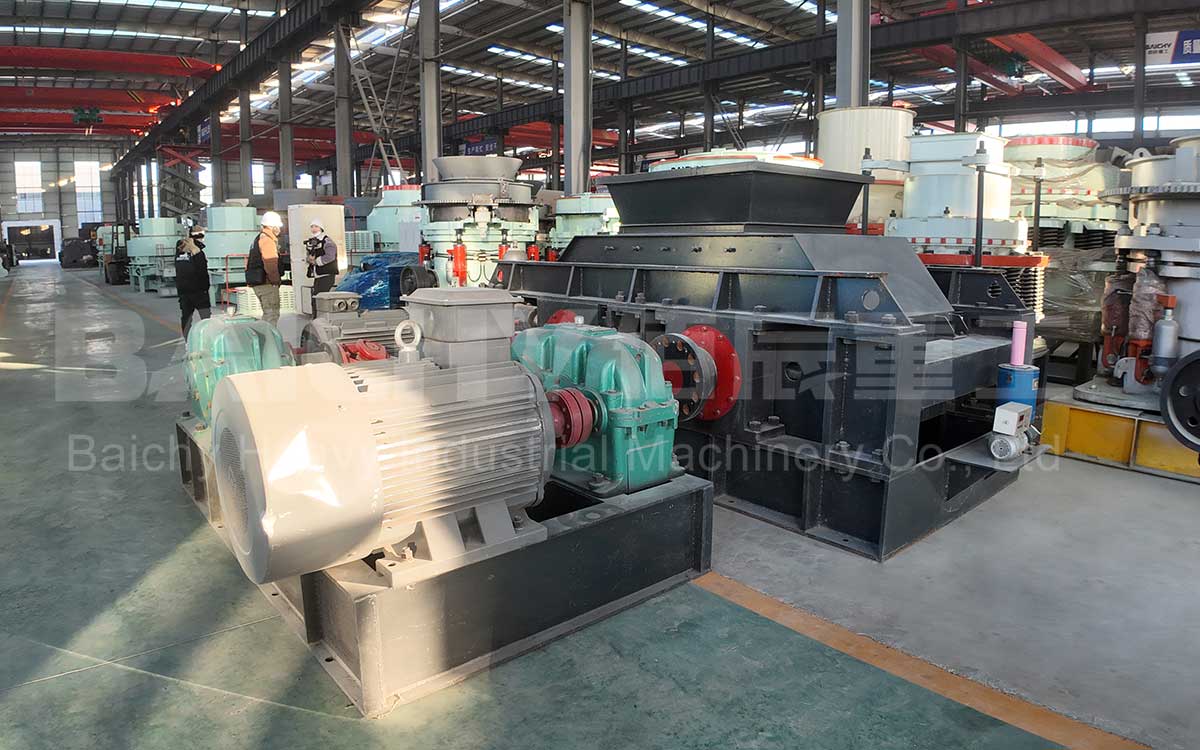
2PGC Double-Toothed Roll Crusher (Shearing + Compression Crushing)
| Model | Roll Diameter × Length (mm) | Max. Feed Size (mm) | Discharge Size (mm) | Nominal Capacity (t/h) | Coke-Equivalent Capacity (t/h) | Motor Power (kW) |
| 2PGC-600×750 | Φ600×750 | 300–400 | 20–80 (Adjustable) | 30–60 | 18–36 | 2×18.5 |
| 2PGC-800×1000 | Φ800×1000 | 400–500 | 20–100 (Adjustable) | 60–120 | 36–66 | 2×30 |
| 2PGC-1000×1000 | Φ1000×1000 | 500–600 | 25–120 (Adjustable) | 80–150 | 44–83 | 2×45 |
Advantages:
• Industry-standard solution for coke crushing; specifically designed for brittle materials like coal and coke
• Combined shearing and crushing action; extremely low fines generation and high yield of properly sized particles
• Customizable tooth profiles; precise control over discharge particle size
• Wear-resistant roll shells; long maintenance intervals
Disadvantages:
• Requires pre-screening or primary crushing for oversized feed (>500mm)
• Higher initial investment cost compared to jaw crushers
• Sensitive to ferrous impurities; requires the use of an iron remover
<<Detailed specifications for the double-roll crusher>>
III. Comparative Summary
| Dimension | PE-600×900 Jaw Crusher | PC Hammer Crusher | 2PGC-800×1000 Double-Toothed Roll Crusher |
| Suitability for 50 tph Coke | ★★★ Adequate | ★★ Undersized | ★★★★★ Optimal |
| Fines Generation Control | ★★★ Moderate | ★★ High | ★★★★★ Extremely Low |
| Discharge Size Control | ★★★ | ★★ | ★★★★★ |
| Wear Part Lifespan | ★★★★ | ★★ | ★★★★ |
| Equipment Investment | ★★★ | ★★★★ | ★★★ |
| O&M Complexity | ★★★★★ | ★★★ | ★★★★ |
IV. Recommended Solution
Primary Recommendation: 2PGC-800×1000 Double-Toothed Roll Crusher
Reasons for Recommendation:
• Best Industry Fit: The double-toothed roll crusher is the industry-standard choice for coarse and medium crushing of coke and coal. Given that chemical-grade coke has a compressive strength of only 10–30 MPa, using a toothed roll shearing mechanism maximizes the yield of properly sized particles and prevents value loss caused by excessive pulverization.
• Ample Capacity: Nominal capacity is 60–120 t/h; adjusting for the low bulk density of coke, the actual capacity is 36–66 t/h, meeting the 50 tph design requirement with a margin of approximately 30%.
• Controllable Particle Size: The discharge opening is adjustable between 20 mm and 100 mm; by adjusting the roll gap, the output size can be precisely matched to the feed requirements of downstream processes (such as calcium carbide furnaces, blast furnaces, or calcination units).
• Low Lifecycle Cost: Although the initial purchase price is slightly higher than that of a comparable jaw crusher, the low pulverization rate ensures a high yield of usable product and minimal waste. Additionally, the wear-resistant roll shells have a long service life, resulting in a superior total operating cost (OPEX) profile.
Recommended Alternative Solution: PE-600×900 Jaw Crusher + PF Impact Crusher (Secondary Stage)
If the site conditions do not support the procurement of a double-toothed roll crusher, or if greater operational flexibility is required, a two-stage crushing solution may be adopted:
• Coarse Crushing: PE-600×900 Jaw Crusher (Coke capacity: 30–88 t/h)
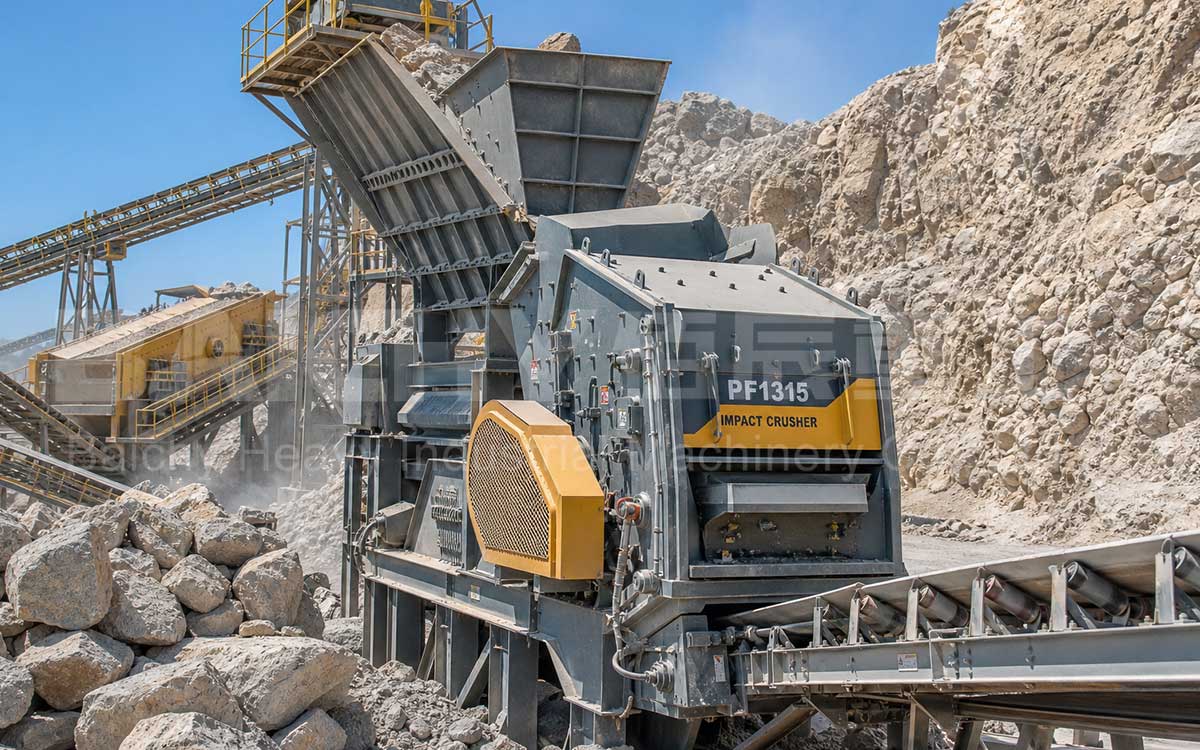
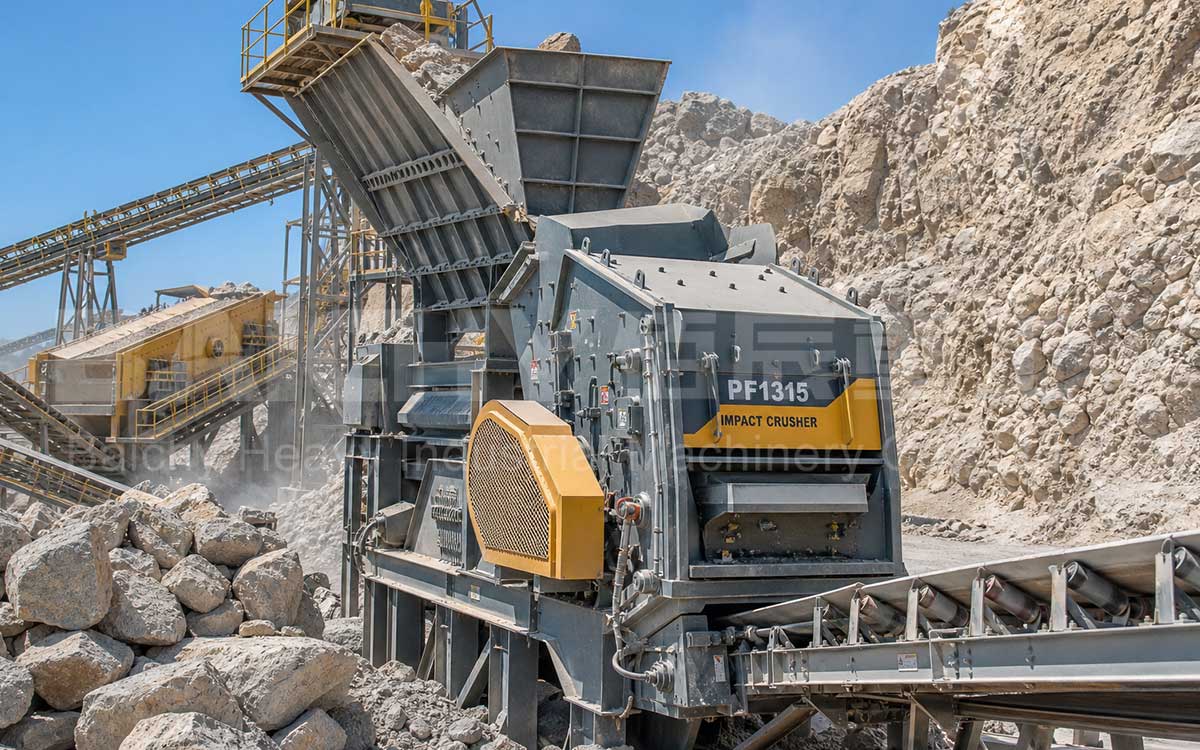
• Medium Crushing: PF-1007 Impact Crusher (for further particle sizing)
This solution involves moderate investment and is suitable for composite production lines that process both coke and other ores.
V. Auxiliary Equipment Recommendations
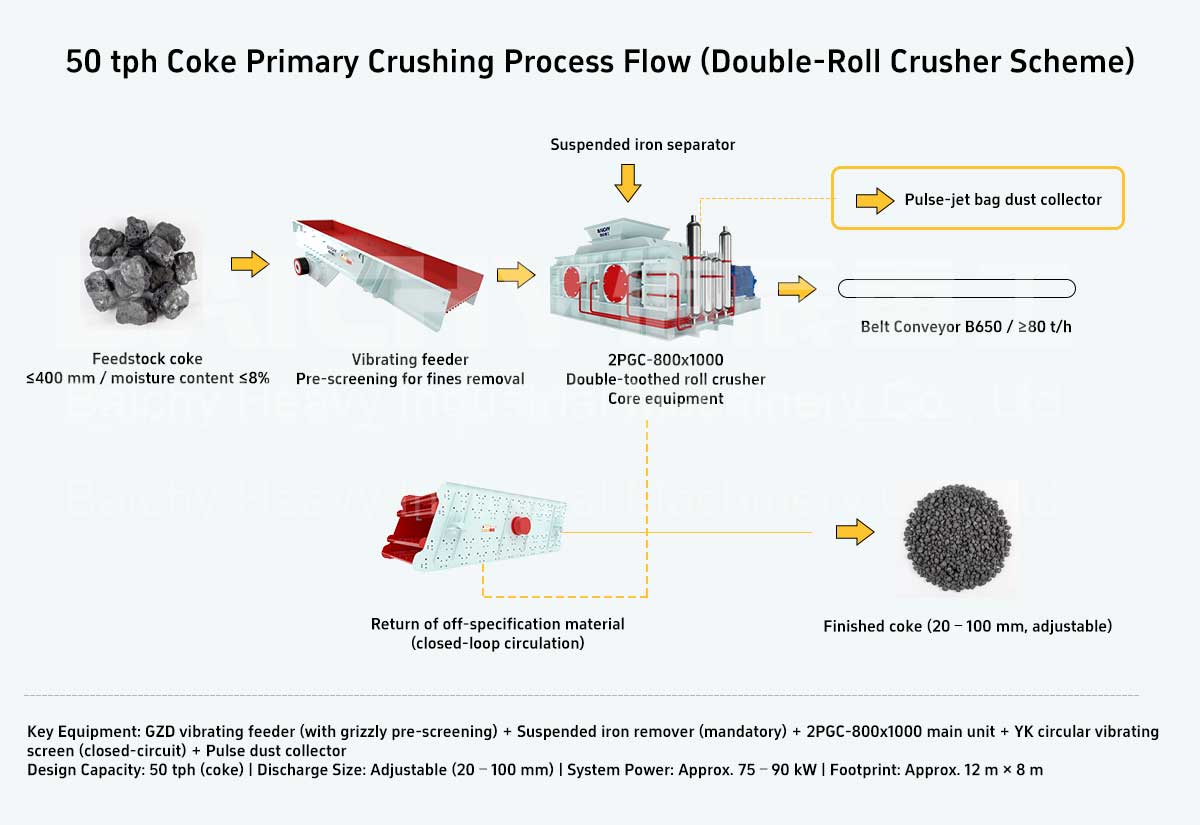
50 tph Coke Primary Crushing Process Flow (Double-Roll Crusher Scheme)
| Auxiliary Equipment | Recommended Configuration | Remarks |
| Feeder | GZD vibrating feeder; belt width matched to crusher inlet | Includes grizzly bars for pre-screening to remove fines |
| Iron Remover | Suspended permanent magnet or electromagnetic iron remover | Essential due to potential iron contaminants in the coke |
| Belt Conveyor | B650–B800; capacity ≥80 t/h | For upstream and downstream material transfer |
| Dust Removal System | Pulse-jet bag filter | Essential for environmental compliance due to high dust generation during coke crushing |
| Screening Equipment | YK series circular vibrating screen | Closed-loop control; oversized material returned for re-crushing |
VI. Risk Warnings
1. Coke Moisture Content: If moisture exceeds 8%, the toothed roll crusher may experience roller sticking; consider installing roller scrapers or a pre-drying process.
2. Maximum Feed Size: If the feed occasionally contains oversized lumps (>400 mm), it is recommended to install a grizzly screen upstream of the feeder or add a simple jaw crusher for pre-crushing.
3. Coke Source Variations: Petroleum coke is harder and more abrasive than metallurgical coke; wear-resistant material grades must be adjusted accordingly (e.g., using Mn18Cr2 or hard-faced wear-resistant roller shells).
Need a customized coke crushing solution?
Baichy Heavy Industry offers end-to-end coke and coal crushing and screening solutions with capacities ranging from 50 to 500 tph, featuring customizable tooth profiles, 3D process flow designs, and full lifecycle cost analysis.
Contact Baichy Heavy Industry to receive a tailored equipment selection plan and a quote.
WhatsApp OnlineVII. Frequently Asked Questions (FAQ)
Q1: Should I use a double-toothed roll crusher or a jaw crusher for primary coke crushing? Which is more cost-effective?
The double-toothed roll crusher (2PGC series) is the preferred choice in the coke industry. The reason is simple: coke is a brittle material. Jaw crushers rely on "compression," which tends to crush coke into powder—and excess powder represents a direct financial loss. Double-toothed roll crushers utilize a combination of "shearing and compression," preserving particle integrity and resulting in an over-pulverization rate more than 40% lower than that of jaw crushers. Although the initial purchase cost is 15%–20% higher than a jaw crusher of equivalent capacity, the difference in product yield usually allows for a return on investment within 8–12 months. If your budget is strictly limited, a PE-600×900 jaw crusher can handle primary crushing, but it is recommended to pair it with a secondary impact crusher for sizing; otherwise, the high rate of fines in the finished product will become a major headache.
Q2: Coke has only half the bulk density of limestone; how do I calculate the actual throughput for a 50 tph requirement?
All crusher capacities are rated based on limestone (density approx. 1.6 t/m³). Since coke has a bulk density of 0.5–0.9 t/m³, the actual throughput is calculated as: Rated Capacity × 0.45–0.55. In other words, to achieve an actual coke throughput of 50 tph, the crusher's rated capacity must be at least 90–110 tph. Never place an order based solely on the nameplate data; this is the most common pitfall in equipment selection.
Q3: What is the approximate over-pulverization rate when using a 2PGC-800×1000 double-toothed roll crusher for coke?
With normal moisture content (≤8%) and an appropriate tooth profile configuration, the over-pulverization rate can be controlled within the 8%–12% range. In contrast, hammer crushers typically produce 20%–30% fines, while jaw crushers produce 15%–20%. This is why coking plants and calcium carbide plants almost exclusively use toothed roll crushers—an extra 1% of fines translates to a 1% direct economic loss, which adds up to a significant amount over the course of a month.
Q4: Will the double-toothed roll crusher experience material sticking to the rolls when the coke has a high moisture content?
There is indeed a risk of material sticking to the rolls when the moisture content exceeds 8%. The solution involves two steps: first, equipping the machine with a standard scraper assembly to continuously remove material adhering to the roll surfaces; second, if the coke consistently has high moisture content (e.g., during monsoon or rainy seasons), it is recommended to install a simple hot-air drying channel at the feed inlet or to modify the tooth design by increasing the tooth spacing and optimizing the self-cleaning angle. Baili Heavy Industry can customize the tooth profile based on your specific coke moisture content before shipment.
Q5: What is the actual hourly throughput of the PE-600×900 jaw crusher when processing coke?
The nominal capacity of the PE-600×900 is 60–160 t/h, but the actual throughput when processing coke is approximately 30–88 t/h. While a target capacity of 50 t/h falls within this range, the discharge opening setting must be between 80 mm and 120 mm—resulting in a relatively large output particle size. If downstream processes require a furnace feed size of less than 50 mm, a secondary crushing stage is mandatory. Therefore, using the PE-600×900 alone as a "single-stage" solution is generally not practical for coke applications.
Q6: What is the service life of the double-toothed roll crusher's tooth caps, and how long does the machine need to be shut down for replacement?
The service life of the wear-resistant tooth caps depends on the abrasiveness of the coke. When processing standard metallurgical coke, a set of tooth caps lasts 8–12 months (based on 12 hours of daily operation); for petroleum coke, which is more abrasive, the lifespan is approximately 4–6 months. Baili Heavy Industry utilizes a bolted segmental design; replacing a single tooth cap takes about 15 minutes, and replacing a full set for the entire machine takes no more than 4 hours—without the need to hoist out the crushing rolls.
Q7: What auxiliary equipment is required for a complete 50 t/h coke primary crushing system?
A complete primary coke crushing line requires at least five types of equipment:
| No. | Equipment | Recommended Model | Function |
| 1 | Vibrating Feeder | GZD Series (belt-width matched) | Uniform feeding + pre-screening (fines removal) |
| 2 | Iron Remover | Suspended permanent magnet/electromagnet | Removing tramp iron from the coke |
| 3 | Primary Crusher | 2PGC-800×1000 or PE-600×900 | Core crushing |
| 4 | Belt Conveyor | B650/B800, ≥80 t/h | Material transfer |
| 5 | Pulse-jet Bag Dust Collector | Model selected based on airflow | Dust collection; environmental compliance |
If there are strict requirements for the finished particle size, a circular vibrating screen (YK Series) should be added to create a closed-loop circuit, where oversized (non-compliant) material is returned to the crusher for re-crushing.
Q8: What is the difference in lifecycle costs between a double-toothed roll crusher and a jaw crusher?
Calculations based on a throughput of 50 tph of coke, operating 12 hours a day for 300 days a year:
| Cost Item | 2PGC-800×1000 | PE-600×900 |
| Equipment Purchase (10,000 RMB) | Approx. 18–22 | Approx. 12–15 |
| Annual Wear Parts Cost (10,000 RMB) | Approx. 2–3 | Approx. 1.5–2 |
| Annual Electricity Cost (10,000 RMB) | Approx. 9–11 | Approx. 10–12 |
| Annual Fines Loss (10,000 RMB) | Approx. 3–5 | Approx. 8–12 |
| Annual Total OPEX (10,000 RMB) | Approx. 14–19 | Approx. 20–26 |
The investment for the double-toothed roll crusher is 60,000–70,000 RMB higher, but the annual operating cost is 60,000–70,000 RMB lower. In other words, the investment pays for itself within a year, resulting in net savings every year thereafter. The financial logic is very clear for coke processing enterprises.