
If your sand and gravel production line faces rejection due to excessive moisture content, a rotary drying system is the only solution capable of boosting capacity to over 100 tons per hour without increasing the number of equipment units.
The cost of moisture in sand and gravel isn't just about the drying process itself; it results in financial losses across three areas: inflated transport tonnage (freight costs are calculated based on wet weight), compromised concrete strength (inaccurate water-cement ratios), and material caking/clogging in storage silos (incurring manual cleaning costs and downtime losses). The core value of a rotary drying system lies not merely in its drying capability, but in how it outperforms multiple small dryers running in parallel—surpassing them in single-unit capacity, thermal efficiency, and maintenance costs to deliver a superior total cost of ownership.
This article is not a product catalog. It addresses four key purchasing decisions: Under what operating conditions is a drying system essential? What size system is required? How should the heat source be selected? What is the total lifecycle cost?
Industry Context: The Gap Between Aggregate Volume and Drying Technology
The National Stone, Sand & Gravel Association (NSSGA) represents 90% of U.S. crushed stone production and 70% of sand and gravel production, with member companies generating nearly $40 billion in annual sales. According to the U.S. Geological Survey (USGS) *Mineral Commodity Summaries 2025*, U.S. construction sand and gravel production reached 890 million tons in 2024. Of this, 42% (approximately 370 million tons) was used as concrete aggregate—the largest downstream market for drying systems.
Yet, less than 15% of this 890-million-ton volume undergoes a drying process. Most sand and gravel enters concrete batching plants in its natural, moist state; fluctuations in moisture content lead to inaccurate water-cement ratios, representing the single largest controllable variable affecting concrete strength consistency. As the market share of moisture-sensitive products—such as dry-mix mortar, high-quality concrete for pipe piles, and epoxy flooring aggregates—continues to rise, drying has shifted from an "optional step" to a "quality imperative."
In short: the sand and gravel industry does not lack production volume—U.S. per capita consumption is 3.3 tons annually (NSSGA data)—but it does lack the capability to deliver low-moisture material through industrialized, replicable processes. Rotary drying systems bridge this gap.
1. Which types of sand require drying? — Criteria based on operating conditions
| Sand Type | Typical Initial Moisture Content | Necessity of Drying | Typical Downstream Applications |
| Washed river sand | 15–25% | Essential | Dry-mixed mortar, epoxy flooring aggregate, golf course bunker sand |
| Washed manufactured sand | 12–20% | Essential | Concrete batching plants, pipe piles, railway ballast bedding layers |
| Quartz sand (post-acid washing) | 8–15% | Essential | Glass raw materials, foundry sand, high-purity quartz sand for photovoltaics |
| Sea sand (desalinated) | 10–18% | Essential | Construction sand (subject to meeting chloride ion standards) |
| Silica sand (water-processed) | 15–22% | Essential | Petroleum fracturing proppants, precision casting |
| Naturally air-dried sand | 3–6% | Depends on downstream requirements | Ordinary concrete (drying not required if moisture content meets the national standard of ≤5%) |
Decision Logic: Not all sand requires drying. The drying process is essential only when customer contracts explicitly mandate a moisture content of ≤2% or when downstream processes cannot tolerate fluctuations in humidity. Installing a drying line without careful planning adds $0.8–3 per ton in fuel costs; if the market refuses to absorb this expense, it becomes a pure loss.
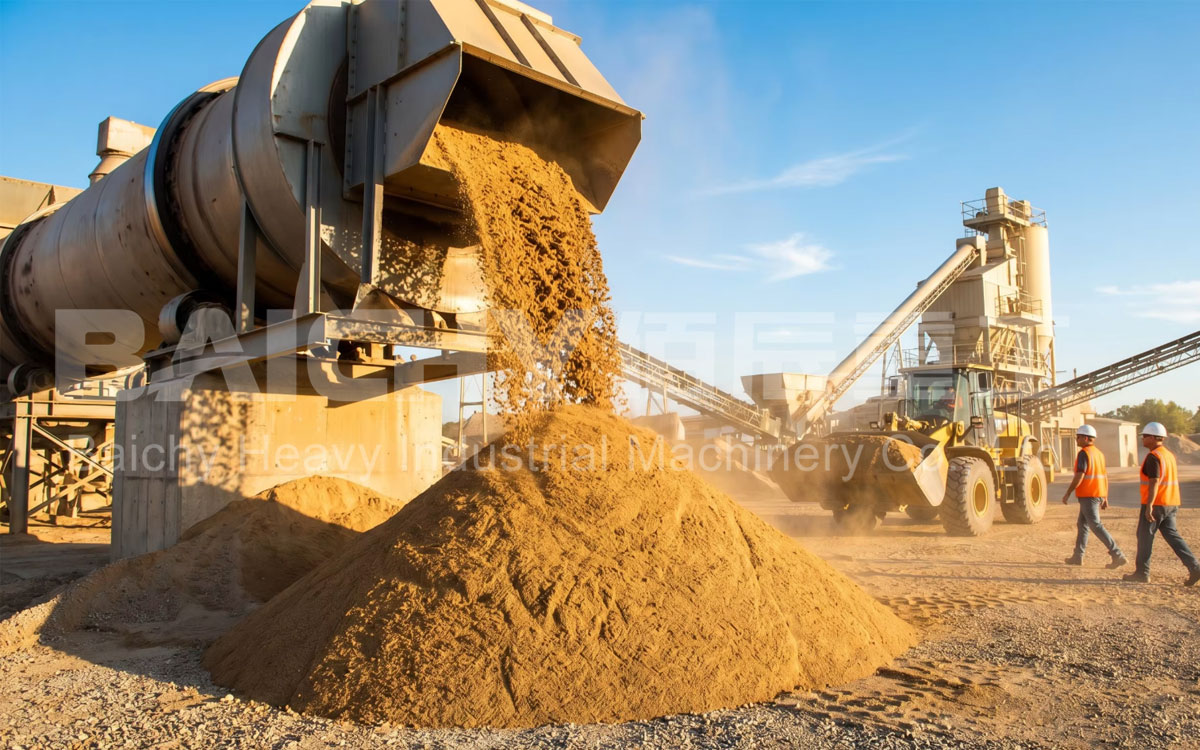
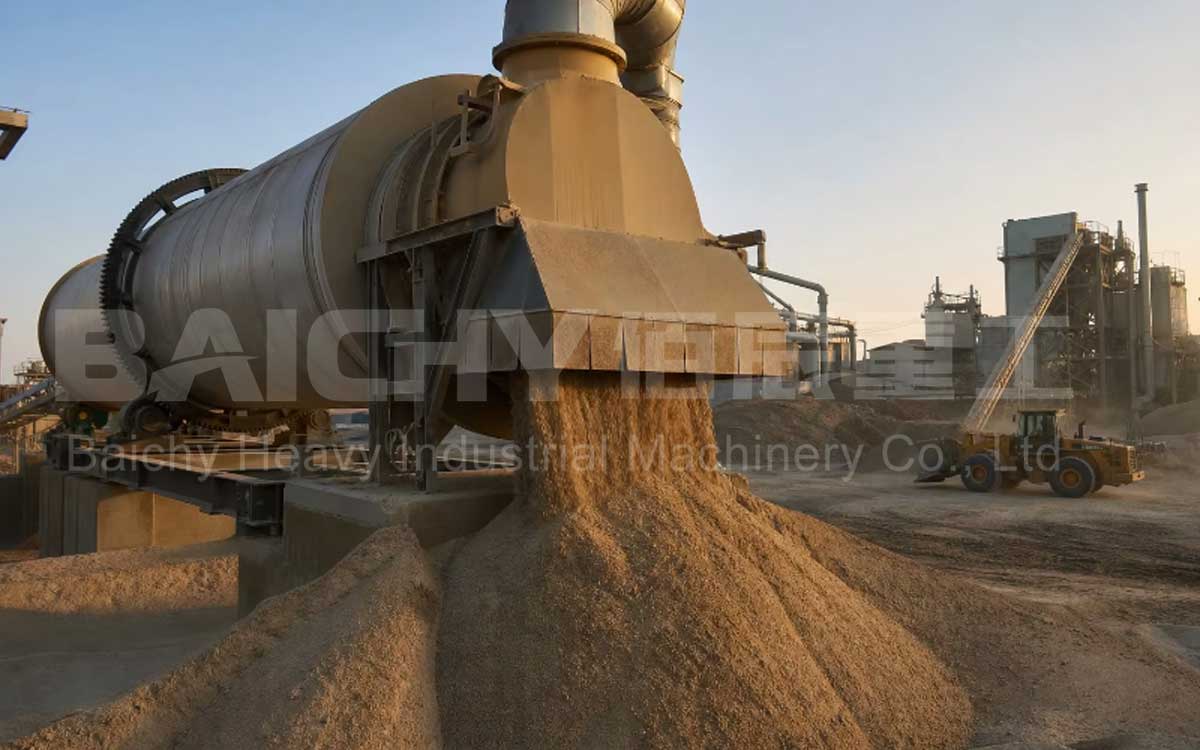
Dried finished sand with a moisture content of less than 0.5% is discharged from the discharge outlet.
2. Why choose a rotary dryer? — A comparison of four drying solutions
| Drying Method | Max. Single-Unit Capacity | Suitable Particle Size | Thermal Efficiency | Investment Intensity | Drawbacks |
| Rotary Drum Dryer | 200 t/h | 0–30 mm | 60–80% | Medium | Large footprint; high initial investment |
| Fluidized Bed Dryer | 50 t/h | 0–5 mm | 50–70% | High | Particle size fluctuations cause fluidization failure; air nozzles prone to clogging |
| Belt Dryer | 10 t/h | 0–50 mm | 40–55% | Low | Low capacity ceiling; mesh belt lifespan of 2–3 years |
| Vertical Dryer | 30 t/h | 0–15 mm | 45–60% | Medium | Material sticking and bridging; frequent unclogging required; unsuitable for high-moisture feed |
For aggregate production lines with a daily output exceeding 1,000 tons, the rotary dryer is the only solution that does not require multiple units operating in parallel. A single φ3.0 × 20m rotary dryer consumes 15–20% less fuel than four 25 t/h fluidized bed dryers running in parallel, and reduces the required workforce from four operators to one.
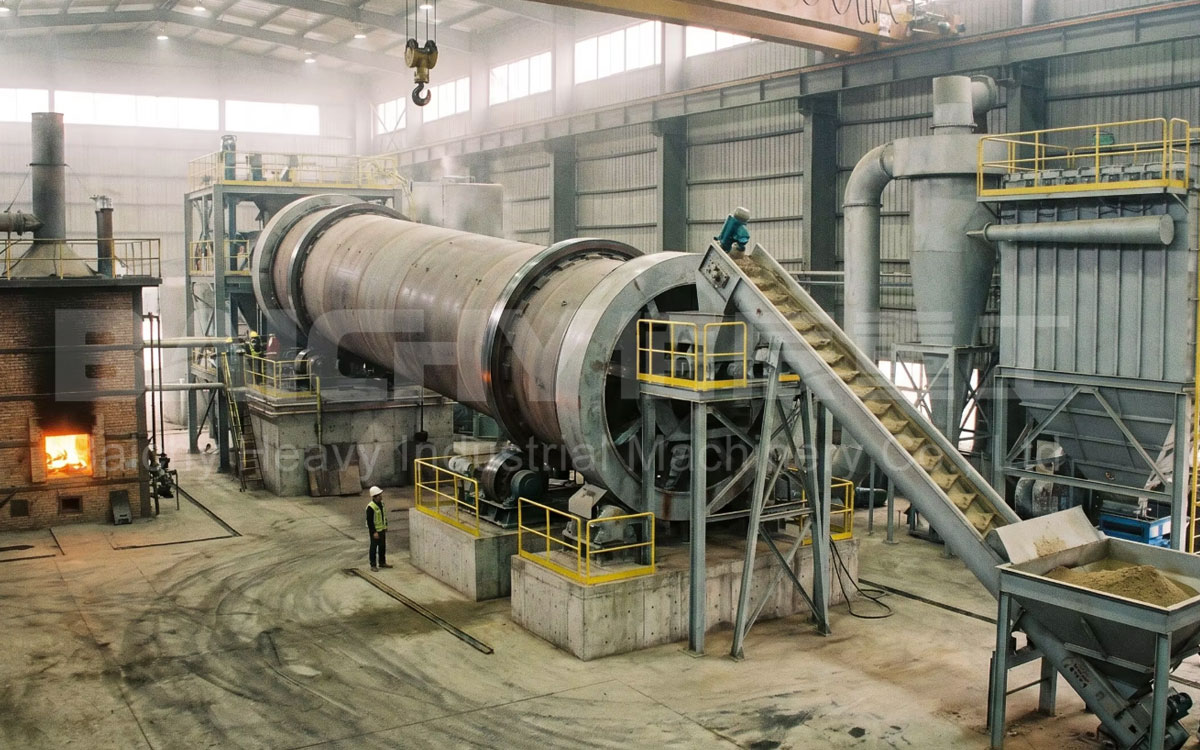
Panoramic view of the sand and gravel rotary drying system plant
3. Key Parameters of the Sand/Gravel Rotary Drying System
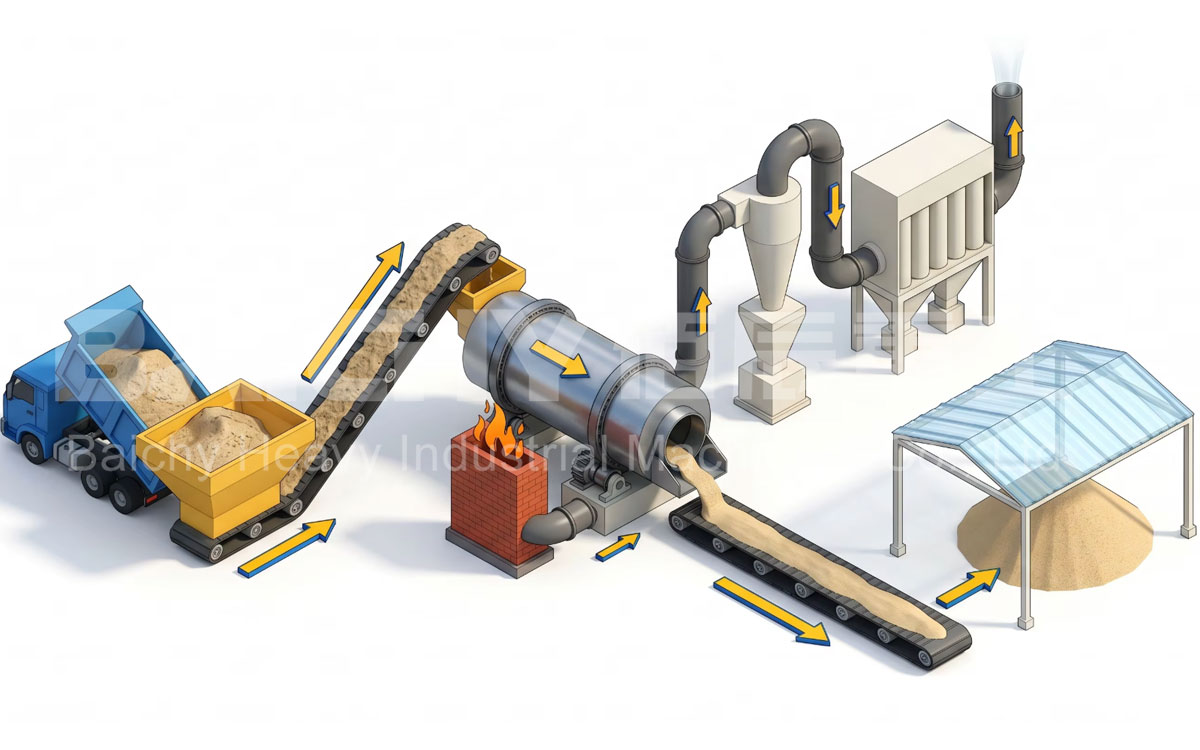
3D Process Flow Diagram of the Sand and Gravel Rotary Drying System
3.1 Main Unit Specifications vs. Capacity
| Model Specification | Wet Sand Capacity (10% → 0.5% Moisture) | Wet Sand Capacity (20% → 0.5% Moisture) | Motor Power | Footprint (incl. hot air furnace & dust collector) |
| φ1.5 × 12 m | 8–15 t/h | 5–8 t/h | 15 kW | ~120 m² |
| φ2.0 × 16 m | 20–35 t/h | 12–20 t/h | 22 kW | ~180 m² |
| φ2.4 × 18 m | 35–55 t/h | 22–35 t/h | 37 kW | ~240 m² |
| φ2.8 × 20 m | 55–85 t/h | 35–55 t/h | 55 kW | ~300 m² |
| φ3.0 × 22 m | 70–110 t/h | 45–70 t/h | 75 kW | ~360 m² |
| φ3.6 × 25 m | 120–200 t/h | 80–130 t/h | 132kW | ~460 m² |
Note: Capacities in the table above are based on quartz sand (loose bulk density ~1.6 t/m³), initial moisture content of 10–20%, target moisture content <0.5%, inlet air temperature of 600–700°C, and counter-current operation. Actual capacity varies depending on sand type, particle size distribution, moisture content, and heat source type. Baichy offers free material drying tests, providing moisture curves and specification recommendations within 5 working days.
3.2 Key Operating Parameters
| Parameter | Value Range | Impact on Product Quality |
| Drum Rotation Speed | 2–8 rpm (VFD adjustable) | Speed ↑ → Material curtain density ↑ → Heat exchange rate ↑; but residence time ↓ |
| Drum Inclination Angle | 2–5° | Angle ↑ → Material flow rate ↑ → Production capacity ↑; but residence time ↓ |
| Inlet Air Temperature | 400–800°C | Temperature ↑ → Evaporation rate ↑; excessive heat causes thermal cracking (risk of quartz crystal phase transition >870°C) |
| Outlet Air Temperature | 80–150°C | <80°C: Risk of condensation and bag blinding; >150°C: Excessive heat loss |
| Material Residence Time | 15–40 minutes | Adjusted based on initial and target moisture content; high-moisture feed requires longer residence time |
| Internal Air Velocity | 2–5 m/s | >5 m/s: Fine sand (<0.5 mm) is drawn into the dust collection system, reducing product yield |
4. Co-current vs. Counter-current: Why does the sand and gravel industry choose counter-current?
| Comparison Dimension | Co-current (Same direction) | Counter-current (Opposite direction) |
| Material contact at high-temp end | Wettest material | Driest material |
| Discharge Temperature | Lower (60–80°C) | Higher (90–120°C) |
| Thermal Efficiency | 55–65% | 65–80% |
| Suitable Materials | Heat-sensitive materials (fertilizers, distillers' grains, biomass) | Sand, gravel, mineral powder (high-temp resistant materials) |
| Sand & Gravel Industry Recommendation | ❌ | ✅ |
Sand and gravel materials are not heat-sensitive (the softening points of granite, quartz sand, and basalt are all above 1000°C); therefore, counter-current operation is chosen to achieve maximum thermal efficiency. Fuel costs represent the single largest expense over the drying system's lifecycle; a 15% difference in thermal efficiency means burning 15% more coal or natural gas annually.
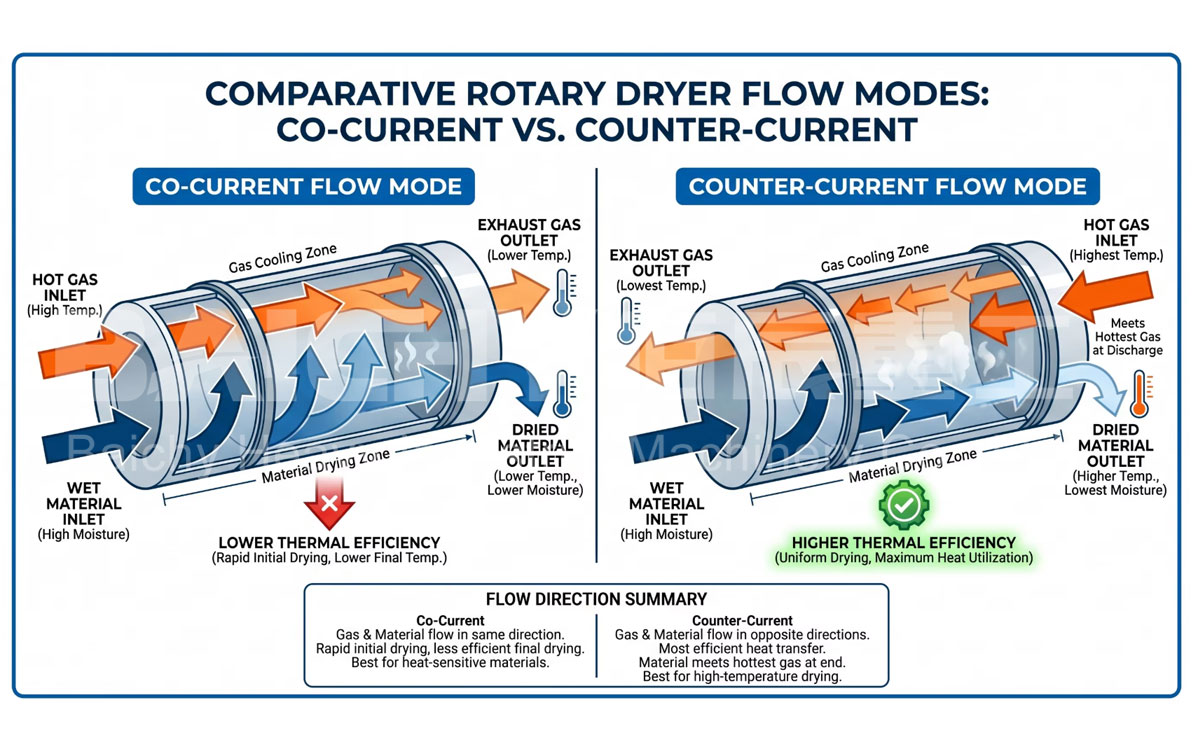
Schematic diagram comparing co-current and counter-current flow in a rotary dryer.
5. Heat Source Options: Choose one based on local energy prices
| Heat Source Type | Fuel Cost per Ton of Sand (Ref.) | Heating Speed | Temp. Control Precision | Suitable Scenarios |
| Coal-fired hot air furnace | $0.5–1.2 | Slow (30–60 min to reach temp.) | Low (±50°C) | Coal-producing regions; lenient environmental regulations |
| Natural gas burner | $0.8–2.0 | Fast (5–10 min to reach temp.) | High (±10°C) | Areas with pipeline gas access; strict emission standards |
| Biomass pellet furnace | $0.4–1.0 | Slow (20–40 min to reach temp.) | Medium (±30°C) | Agricultural regions; need for carbon neutrality certification |
| Heavy oil/Diesel | $1.5–3.0 | Fast (10–15 min to reach temp.) | Medium (±20°C) | Areas lacking coal/gas pipelines; remote mining sites |
Decision-making process:
1. Obtain local prices for coal (/t), natural gas (/t or /m³), and electricity ($/kWh)
2. Calculate fuel cost per ton of water evaporated
3. Add environmental compliance costs (investment in desulfurization/denitrification equipment + O&M)
4. The option with the lowest total cost of ownership is the optimal choice
Baichy is not tied to any single heat source. We configure the most cost-effective combustion system for delivery based on your local energy prices and environmental standards.
6. Emissions and Dust Removal: Standard Configuration + Upgrade Path
| Dust Removal Stage | Equipment | Collection Efficiency | Outlet Concentration |
| Stage 1 | Cyclone Dust Collector | ≥90% (coarse particles) | 1–5 g/Nm³ |
| Stage 2 | Pulse-Jet Baghouse | ≥99% (fine particles) | <50 mg/Nm³ |
| Stage 3 (Optional) | Wet Scrubber | ≥95% (ultrafine particles + acidic gases) | <30 mg/Nm³ |
• Standard aggregate drying: Cyclone + Baghouse configuration meets emission standards in most regions.
• EU/North American markets (requiring <20 mg/Nm³): Add a wet scrubber.
• Coal-fired option: Add an FGD (Flue Gas Desulfurization) system; this must be clearly specified during the quotation stage.
7. Total Lifecycle Cost:
Why is the inpidual equipment cost higher, yet the total cost of ownership lower?
| Cost Item | Rotary Drying System | Fluidized Bed (4 units in parallel) | Notes |
| Equipment Investment | $80,000–$400,000 | $120,000–$350,000 | Rotary dryer has high initial cost but requires no parallel units |
| Annual Fuel Cost (100 t/h, Natural Gas) | $250,000–$400,000 | $300,000–$480,000 | Thermal efficiency difference of 15%; fuel cost difference >15% |
| Annual Electricity Cost (100 t/h) | $30,000–$50,000 | $45,000–$70,000 | Power consumption of 4 fans > 1 large fan |
| Number of Operators | 1 person/shift | 2–3 people/shift | Higher level of automation |
| Annual Wear Part Replacement | $5,000–$15,000 | $10,000–$25,000 | Lifting flights vs. air caps + mesh belt |
| Scheduled Downtime | 3–5 days/year | 7–12 days/year | Fluidized bed requires frequent unclogging |
| Design Lifespan | 25+ years | 10–15 years | Q245R boiler steel shell vs. stainless steel mesh belt |
Over a 20-year lifecycle, the total cost of ownership per ton of sand for a single φ2.8m rotary dryer is 25–35% lower than that of four fluidized bed units in parallel. The savings come not from the equipment cost itself, but from fuel, labor, and downtime losses.
8. Design Highlights for Sand and Gravel Applications
8.1 Lifting Flight Geometry: Combination of L-shaped and curved designs
With standard straight lifting flights, wet sand (moisture content >15%) tends to adhere to the flights, causing material buildup ("wall sticking") and a continuous decline in the density of the material curtain. The rotary dryer for sand and gravel features a three-section lifting flight design: L-shaped (feed section) + parabolic curved (middle section) + straight-blade (discharge section):
• L-shaped feed section: Increases initial contact area, prevents material adhesion/buildup, and rapidly breaks up wet material clumps.
• Curved middle section: Creates a uniform material curtain, maximizing high-temperature gas penetration efficiency.
• Straight-blade discharge section: Lowers the drop height, reducing dust loss from dried sand.
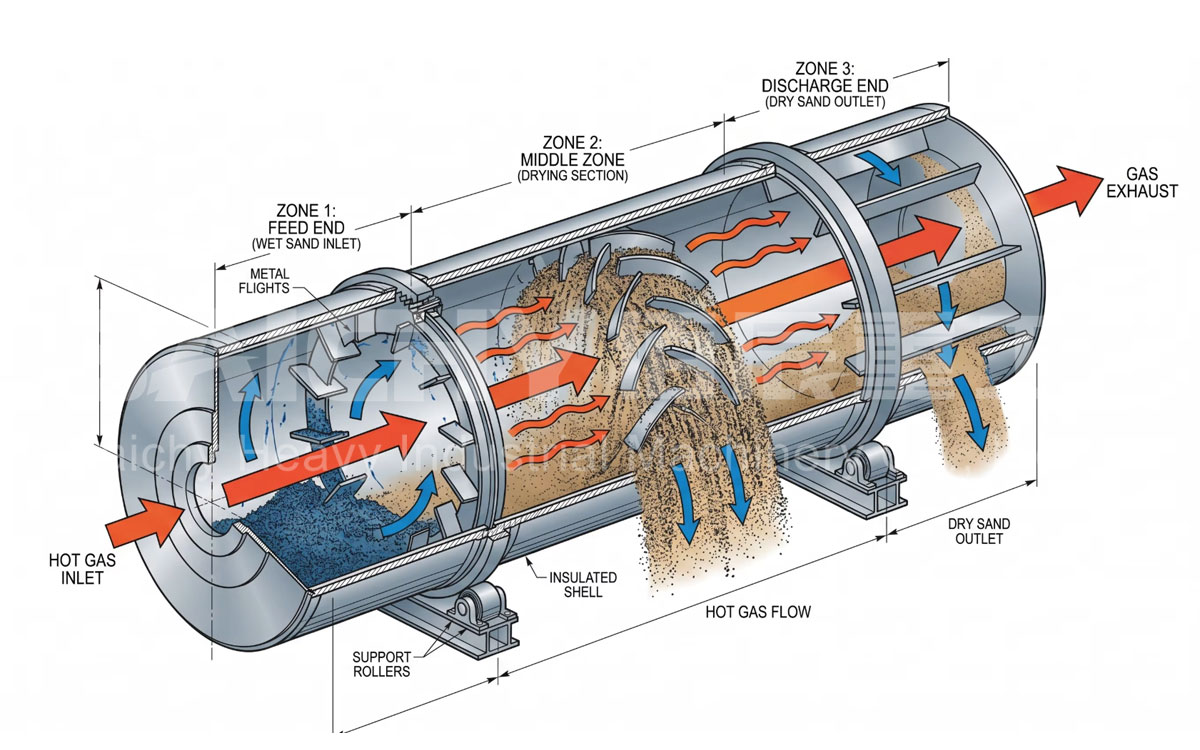
Schematic diagram comparing co-current and counter-current flow in a rotary dryer.
8.2 Triple-pass structure (optional for high-moisture applications)
For river or sea sand with an initial moisture content >18%, a triple-pass structure is recommended: drying in the outer shell → drying in the middle shell → discharge from the inner shell. Thermal efficiency can exceed 80%; the footprint is reduced by 40% for the same production capacity, and fuel costs are further lowered by 10–15%.
8.3 Wear-resistant lining
Sand and gravel are more abrasive than mineral powders or fertilizers. Replaceable wear-resistant liners (high-chrome cast iron or ceramic composite plates) are installed in the feed section and lifting flight zones to protect the dryer shell from direct wear. The liners are designed for sectional bolted attachment, allowing inpidual sections to be replaced within 2–4 hours.
9. Troubleshooting / FAQs
Q1: What size rotary dryer is needed to dry wet sand from 20% moisture content down to 0.5%?
Taking a capacity of 50 t/h (wet basis) as an example: the water evaporation rate is approximately 9.8 t/h. Recommended specifications are φ2.8 × 20 m or φ3.0 × 22 m, utilizing counter-current operation with an inlet gas temperature of 600–700°C. Final specifications must be determined based on actual material sample testing—even with quartz sand, the drying rates for 0–3 mm fine sand and 3–20 mm coarse sand differ by more than 30%.
Q2: What is the approximate coal consumption of the rotary dryer?
Taking a φ2.4 × 18 m dryer processing 50 t/h of wet sand (reducing moisture from 20% to 0.5%) as an example: the evaporation rate is approximately 9.8 t/h. With a standard coal calorific value of 7,000 kcal/kg and a system thermal efficiency of 70%, the standard coal consumption is about 120–140 kg per tonne of water evaporated. This translates to a coal consumption of approximately 24–28 kg per tonne of sand. Actual figures vary based on coal quality, operational proficiency, and ambient temperature.
Q3: Can sand dried in a rotary dryer be used directly for dry-mixed mortar?
Yes. The moisture content of the discharged sand can be stably controlled at ≤0.5%, meeting the standards for dry-mixed mortar sand (JG/T 521-2017 requires moisture content ≤0.5%). The discharge temperature ranges from 90–120°C; the sand requires natural cooling or the addition of a cooling drum to bring the temperature down to ≤50°C before entering the finished product silo. Baichy offers an integrated drying and cooling system.
Q4: Are rotary dryers and rotary kilns the same thing?
No. Rotary dryers operate at 150–800°C and perform only physical dehydration. Rotary kilns operate at 800–1450°C and facilitate chemical transformations (calcination, sintering, pyrolysis). While the drum exteriors look similar, the refractory lining, burner design, and process control systems are completely different. Dryers do not require refractory brick linings.
Q5: How long does it take to install the drying system?
For a standard rotary drying system (dryer, hot blast stove, dust collector, conveying system, and electrical controls), the period from equipment delivery to commissioning and discharge is 30–60 days, depending on the progress of on-site foundation construction. Baichy dispatches two installation guidance engineers to oversee drum assembly, drive mechanism adjustment, electrical system integration, and operator training.
Q6: Will fine sand (<0.5 mm) be carried away by the hot air?
When the airflow velocity inside the drying drum is maintained at 2–4 m/s, the terminal settling velocity of particles larger than 0.5 mm exceeds the gas velocity, preventing them from being carried into the dust collection system. A certain proportion (approximately 3–8%) of fine particles in the 0.1–0.5 mm range is extracted; these are recovered using a combination of cyclone and baghouse dust collectors. If the fine sand is a marketable product rather than waste, it can be blended back into the final product or collected and utilized separately.
Q7: Can the drying process be performed using only coal, without natural gas?
Yes. Coal-fired hot air furnaces are the most common configuration in the sand and aggregate drying industry. Baichy’s standard coal-fired hot air furnace setup includes a chain grate stoker, a multi-tube cyclone dust collector, and a flue gas settling chamber. When paired with a baghouse dust collector and an optional FGD (flue gas desulfurization) system, it meets emission standards in China and most regions of Southeast Asia. While natural gas systems offer advantages in temperature control precision and environmental compliance, they are not the only option.
Q8: How do I determine the specifications I need?
Send the following five parameters to Baichy to receive specification recommendations and a budgetary quote within five working days:
① Sand type and source (river sand, manufactured sand, quartz sand, or sea sand);
② Initial moisture content (based on actual sampling);
③ Target moisture content;
④ Hourly processing capacity (wet basis);
⑤ Available heat source type and local energy prices.