
Complete 150-200 tph wheeled mobile crushing plant line
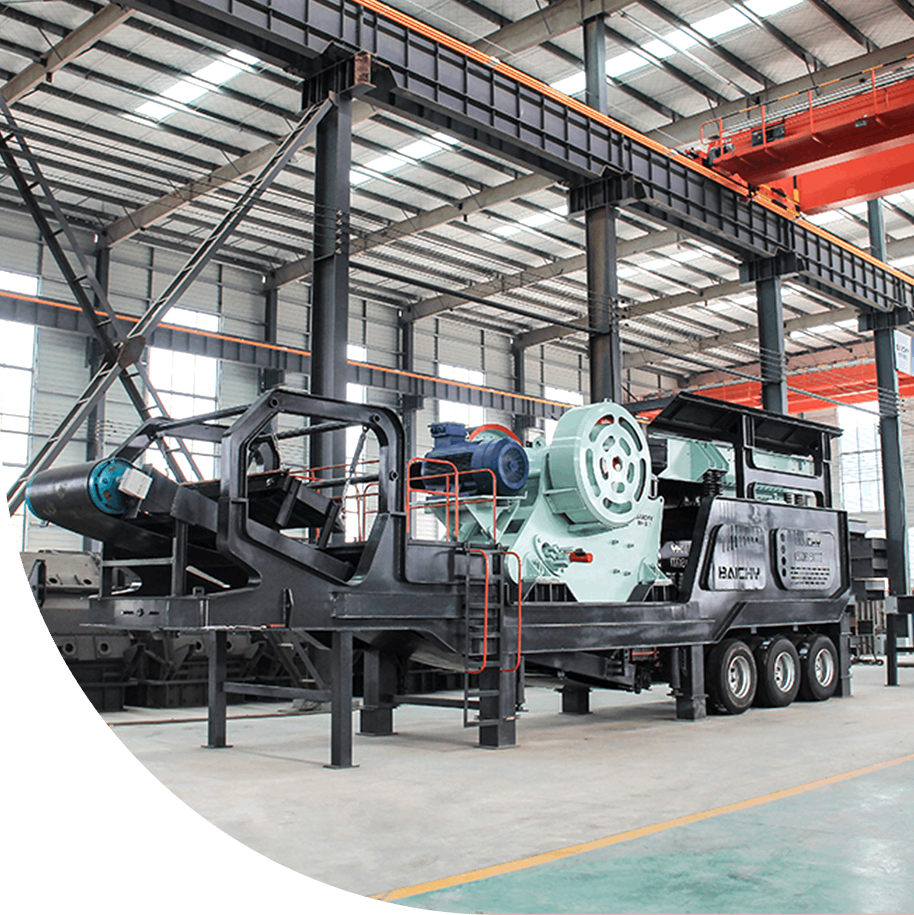
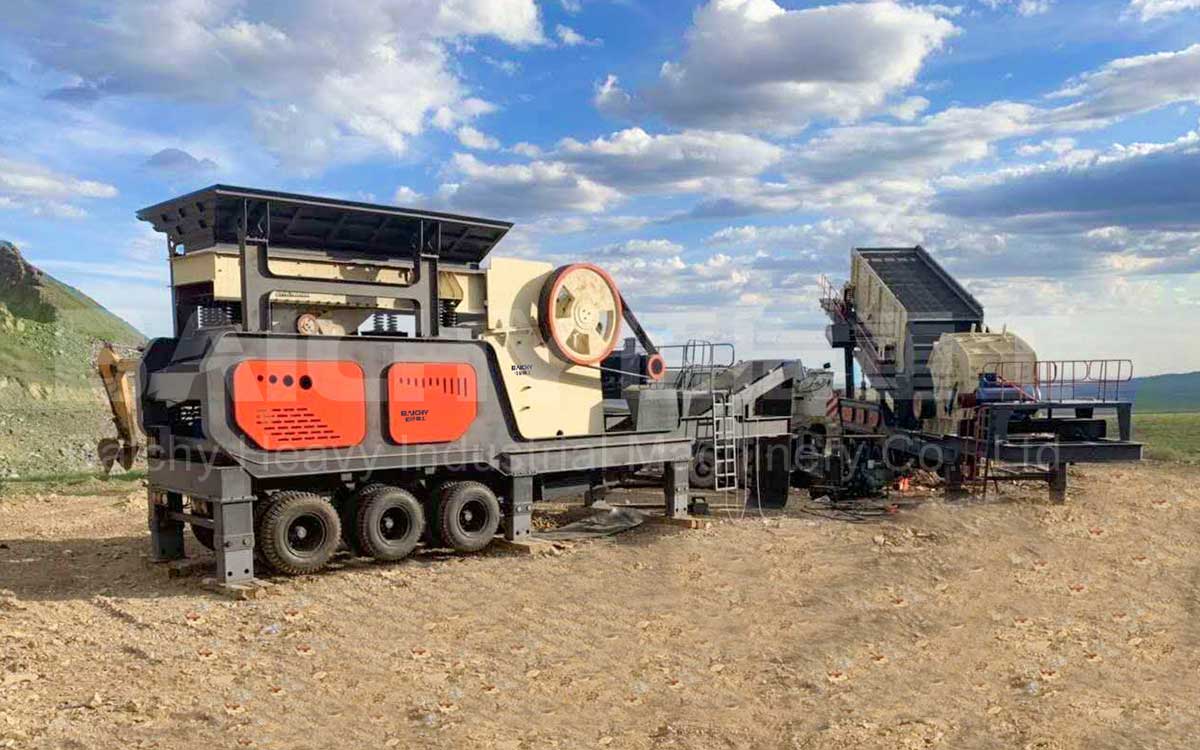
The wheeled mobile crushing station (with an hourly capacity of 150–200 tons) represents the highest ROI equipment configuration for small-to-medium-sized aggregate yards, linear infrastructure projects, and temporary crushing operations. By replacing concrete foundations and cranes with tires and a towing pin, it slashes installation time from 15 days to just 2 hours and keeps the comprehensive cost per ton between ¥2.8 and ¥3.5. For sites requiring rotation across more than three work zones or projects lasting under 24 months, the wheeled solution offers a payback period 6–10 months shorter than that of a stationary production line.
I. Pain Point Analysis: Three Major Constraints of Stationary Lines in Mobile Operations
1. Infrastructure Costs Drain Cash Flow — A 150 tph stationary crushing line requires concrete foundation pouring, steel structure platforms, and embedded anchor bolts, entailing an investment of ¥250,000–400,000 and a construction period of 15–30 days. These investments yield zero residual value upon project completion.
2. Relocation Means Downtime — Moving a stationary line involves equipment disassembly, new foundation work, and re-installation/commissioning, resulting in 10–20 days of lost productivity per move.
3. Mismatch Between Approval Timelines and Startup — The approval schedules for mining licenses and environmental impact assessments often fail to align with the construction window; stationary lines may sit idle immediately after completion, incurring massive capital tie-up costs.
II. Translating Specifications into Profit
The core logic of the wheeled mobile crushing station is not merely "mobility," but the elimination of reliance on fixed infrastructure.
Towed Chassis — Features a standard towing pin interface; a 50-ton class semi-truck tractor is all that is needed for road transport. No disassembly is required for on-site relocation, allowing for positioning in just 2 hours.
| User Concerns | Conventional Perception | Actual Performance of Wheeled Solutions |
| "Mobile crushers surely have low output" | Wheeled ≈ Low output | YDPZ-150 combined station measured at 160–210 tph (granite); capacity deviation <5% compared to fixed lines of the same specification |
| "Tire chassis can't handle heavy equipment" | Tire chassis = Lightweight | 3-axle/4-axle heavy-duty chassis; 16t load per axle line; accommodates PE750×1060 main crusher (total unit weight 38t) |
| "Mobile station output particle size is unstable" | Mobile = Simple = Poor precision | Double-deck circular vibrating screen + impact crusher closed-loop combination; finished product shape identical to fixed lines |
Three main crusher combinations covering mainstream operating conditions:
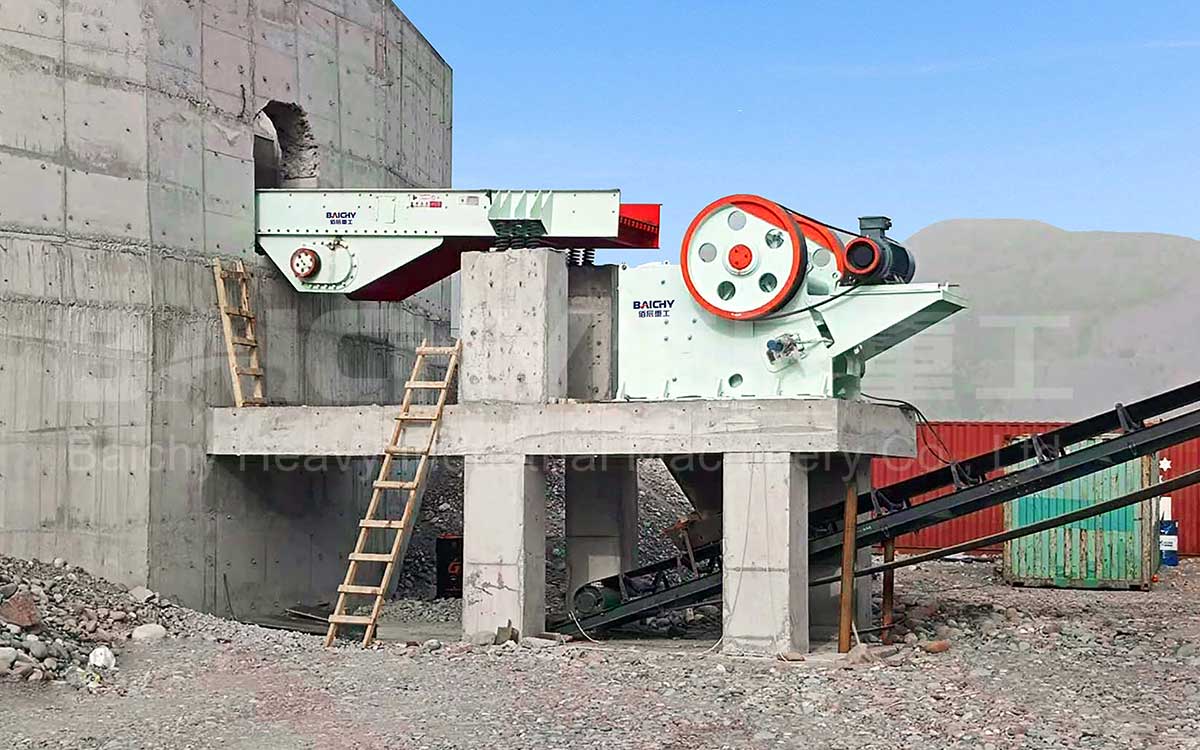
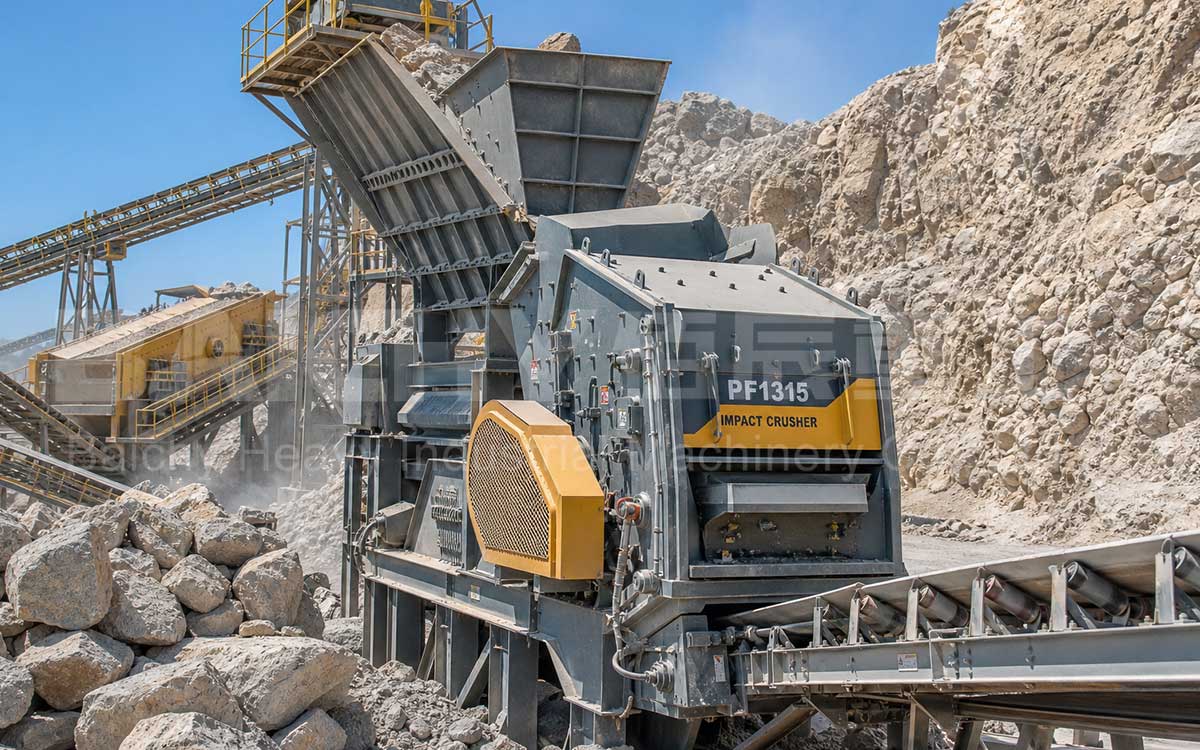
• Hard rock (granite/basalt/river pebble) → PE750×1060 Jaw Crusher + PF1315 Impact Crusher + 3YK2160 Vibrating Screen
• Medium-hard rock (limestone/bluestone/dolomite) → PE750×1060 Jaw Crusher + PF1214 Impact Crusher + 3YK1860 Vibrating Screen
• Construction waste (concrete blocks/brick-concrete) → Standalone PF1315 Impact Crusher + Iron Remover + 2YK1860 Vibrating Screen
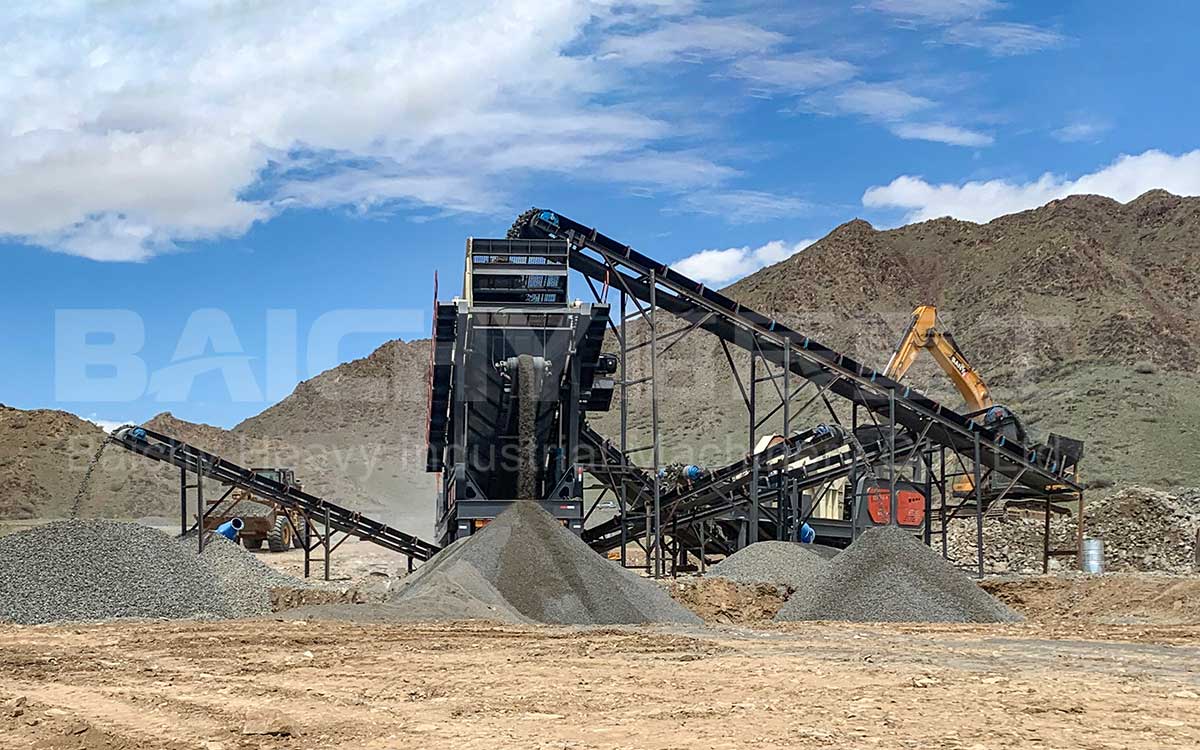
complete crushing line
III. Core Parameter Table
The following is the standard configuration for a wheeled mobile crushing station with an hourly output of 150–200 tons (granite application):
| Equipment Unit | Main Crusher Model | Quantity | Power (kW) | Feed Size (mm) | Output Size (mm) | Single-Unit Capacity (t/h) | Total Unit Weight (t) |
| Wheeled Mobile Jaw Crushing Station | PE750×1060 | 1 | 110 | ≤630 | 80-140 | 110-180 | 38 |
| Wheeled Mobile Impact Crushing Station | PF1315 | 1 | 220 | ≤350 | 5-40 | Adjustable | 35 |
| Wheeled mobile screening station | 3YK2160 | 1 | 30 | ≤200 | 0-5/5-20/20-40 | 150-220 | 22 |
| Total for the entire line | - | 3 | 360 | ≤630 | 0-5 / 5-20 / 20-40 | 150-200 | 95 |
Note: The data above are measured values based on granite processing conditions (hardness f=12-15, bulk density 1.8 t/m³). Processing capacity may increase by 10-15% when handling limestone; when processing river pebbles (high silica content), the service life of impact crusher blow bars is reduced by approximately 30%, so stocking spare blow bars is recommended.
Quick calculation of operating costs (Unit: CNY/ton):
| Cost Item | Consumption | Unit Price | Cost per Ton |
| Electricity consumption | 2.1 kWh/t | ¥0.8/kWh | ¥1.68 |
| Jaw plate wear | 0.002 sets/t | ¥18,000/set | ¥0.36 |
| Blow bar wear | 0.0015 sets/t | ¥26,000/set | ¥0.39 |
| Screen mesh wear | 0.0003 sheets/t | ¥5,000/sheet| | ¥0.15 |
| Labor (2 persons/shift) | - | - | ¥0.40 |
| Total cost per ton | - | - | ¥2.98 |
IV. Selection Recommendations and Pitfall Avoidance Guide
When should you choose a wheeled plant, and when should you choose a stationary plant?
| Operating Condition | Recommended Solution | Rationale |
| Project duration <18 months | ✅ Wheeled | Fixed-line infrastructure costs cannot be amortized |
| Site with ≥3 work zones | ✅ Wheeled | Relocation costs determine economic viability |
| Project duration >3 years, single site | Fixed-type | Lower cost-per-ton for long-term fixed-line operation |
| Feed size >700mm | Assessment required | Exceeds PE750×1060 limits; requires a grizzly screen or an upgrade to PE900×1200 |
| Strict requirement: <5% fines in finished product | Add sand washing | A wheeled sand-washing unit can be attached to the discharge end of the wheeled screening station |
3 Common Pitfalls:
⑴ Oversized feed blocks — The PE750×1060 inlet measures 750×1060mm, but the maximum allowable feed edge length is only 630mm. Blasting fragmentation must be controlled or a grizzly screen installed on-site; otherwise, material jams will cause the main crusher to stop.
⑵ Overlooking conveyor matching — Transfer conveyors between wheeled stations are not standard equipment; 10–15m mobile conveyors (Baichy B650×12m recommended) are required on-site to prevent material transfer gaps.
⑶ Power supply requirements — Total line power is 360kW, requiring a 400kVA transformer or a diesel generator set >350kW. Temporary sites often fail to operate at full capacity due to insufficient generator power.
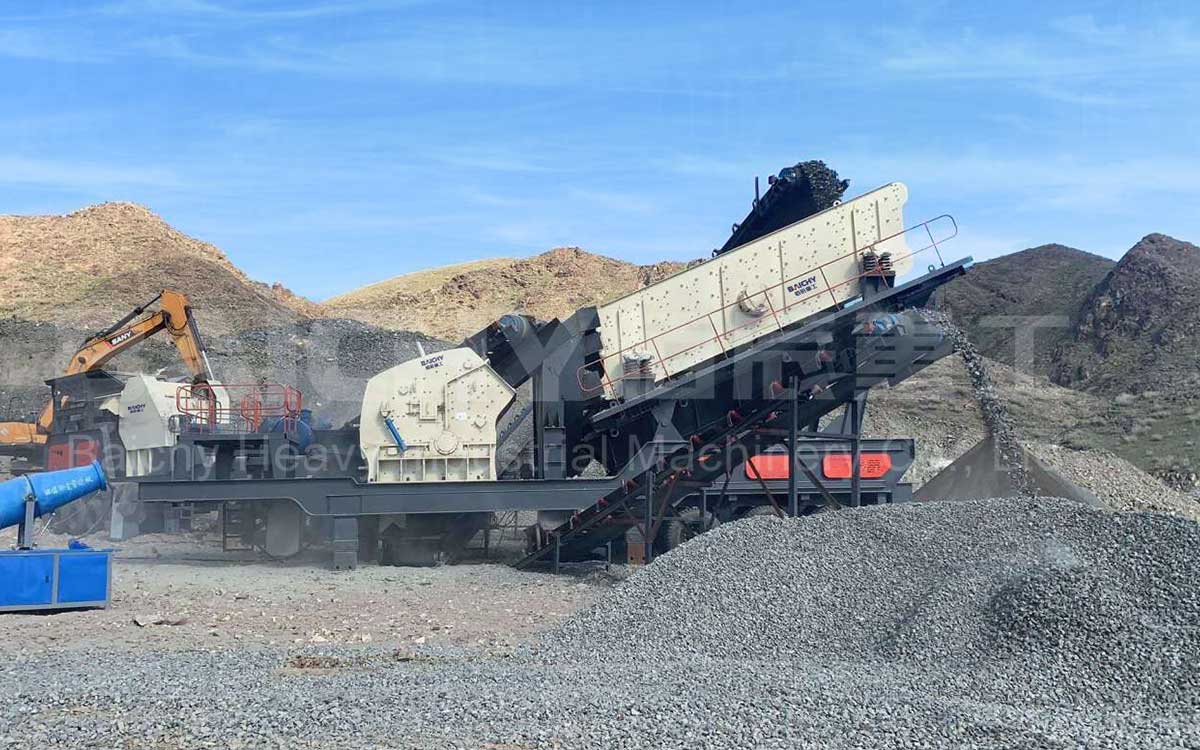
wheeled mobile impact crusher
V. FAQ
Q1: Can the output of a wheeled mobile crushing station really match that of a fixed line?
Yes. The main crushers used in wheeled stations are the same models as those in fixed lines (e.g., PE750×1060, PF1315), featuring identical crushing chamber designs. Differences in output capacity primarily stem from feeding continuity; when equipped with a hopper and vibrating feeder (standard GZD1100×4200), the feed rate matches that of a fixed line. In a granite project in Lishui, Zhejiang, the YDPZ-150 mobile combination unit achieved an average daily output of 172 tph over 30 consecutive days—a deviation of only 3.4% compared to the 178 tph output of a stationary plant of the same specifications.
Q2: What is the service life of the wheeled chassis? Do the tires need regular replacement?
The chassis features a heavy-duty 3-axle or 4-axle leaf spring suspension system and 12.00R20 off-road tires; its design service life matches that of the main equipment (≥8 years). The tires are used only for short-distance site transfers (≤40 km/h; 6–12 transfers per year), resulting in minimal wear. In practice, the primary maintenance requirements involve the pneumatic braking system and suspension leaf spring pins/bushings (grease lubrication recommended every 3 months), rather than the tires themselves.
Q3: Can the wheeled mobile station be used for wet processing (dust suppression spraying, wet screening, or sand washing)?
Yes. The wheeled screening station can be equipped with a dust suppression spray system (0.5–1.0 MPa water pressure), and a wheeled sand washer (XSD3016) can be attached at the discharge end to form an integrated "crushing-screening-washing" wheeled production line. The only requirement is upgrading the electrical protection rating to IP54 or higher to prevent water mist from entering the control cabinet.
Q4: How long does it take from placing an order to commencing production?
The delivery cycle for a standard YDPZ combination (jaw crusher + impact crusher + screening station) is 25–35 days (including main unit assembly, chassis welding, and electrical commissioning). Once on-site, the process—involving towing into position, connecting power, no-load testing, and feeding material—takes just 4–6 hours. Compared to the 15–30 day cycle required for foundation curing and installation/commissioning of a stationary plant, this allows production to start more than 20 days earlier.
Q5: Can your wheeled stations be exported? Do the transport dimensions exceed standard limits?
Yes, they can be exported. In its transport configuration, a single YDPZ wheeled substation measures within 13.5m × 3.0m × 4.2m, making it suitable for shipment via standard 40HQ container frames or Ro-Ro (Roll-on/Roll-off) vessels. These units have been exported to over 15 countries, including the Philippines, Kenya, Mexico, and Chile. We recommend providing details regarding the destination port and road width restrictions in advance, as we offer customized solutions to reduce the unit's width (which can be compressed to a minimum of 2.8m).