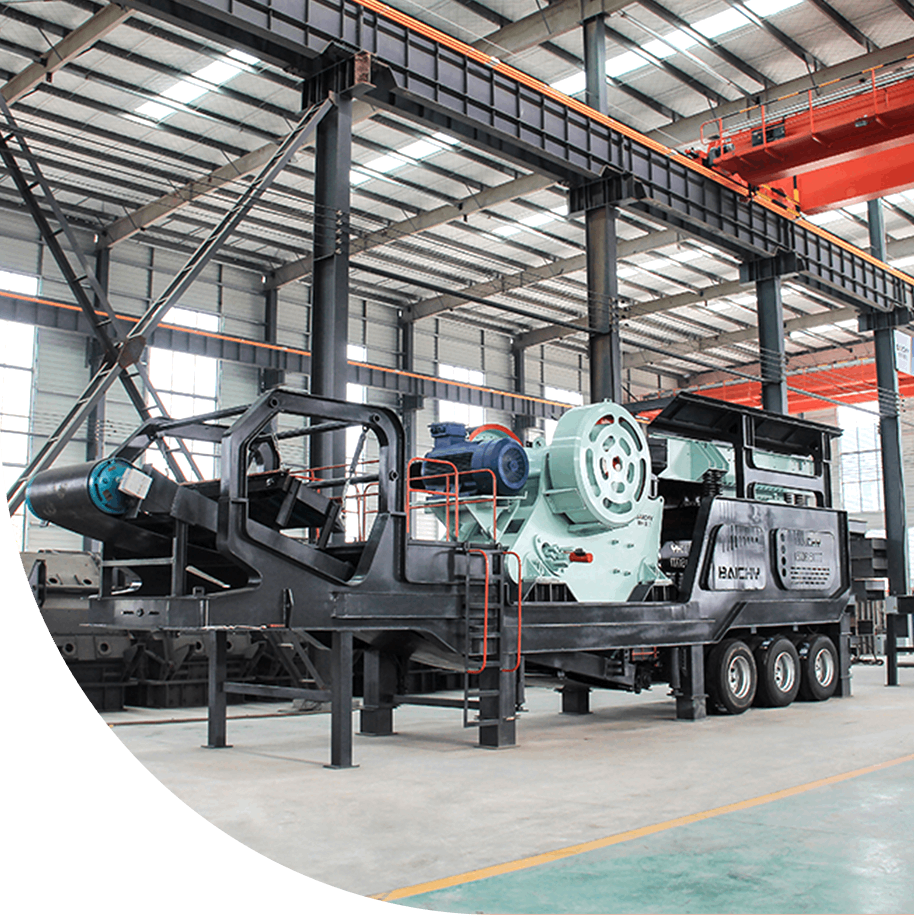

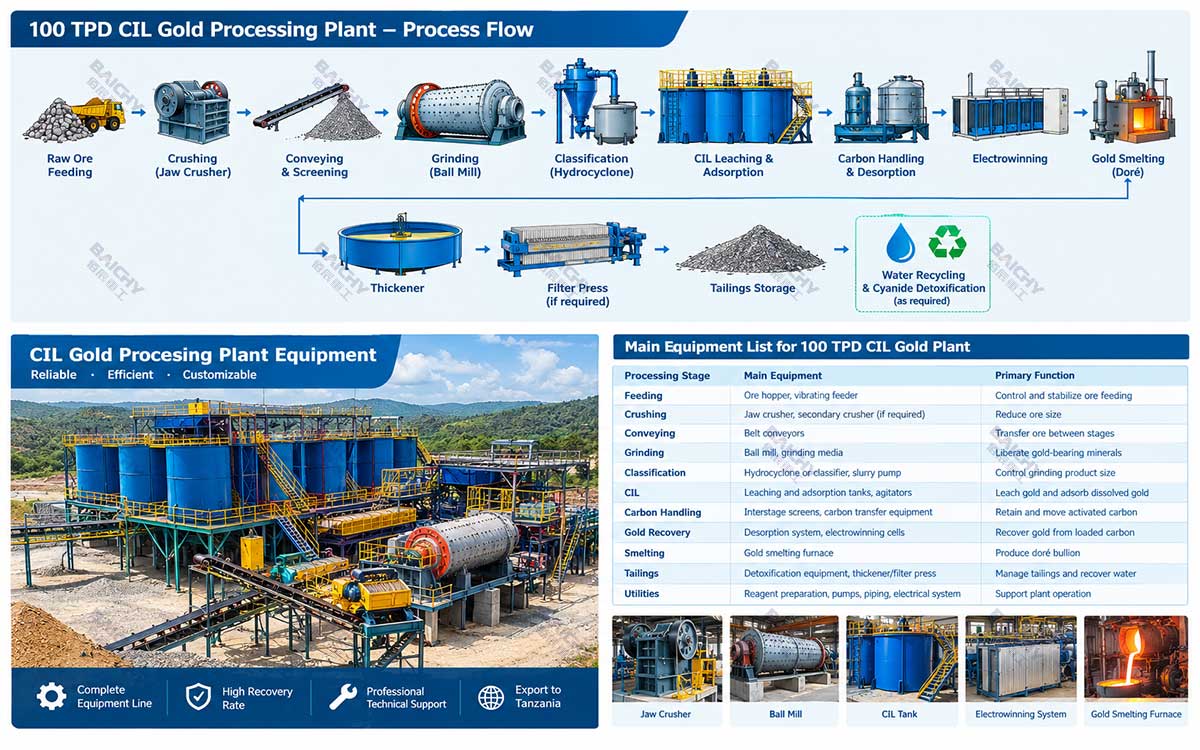
100 TPD CIL Gold Plant Equipment for Tanzania
Planning a gold processing plant in Tanzania? If your target capacity is 100 tons of gold ore per day, selecting the right equipment and processing technology is essential for building an efficient and reliable operation.
A Carbon-in-Leach (CIL) gold processing plant is a widely used option for recovering gold from suitable ores. It combines gold leaching and activated carbon adsorption in the same series of tanks, allowing dissolved gold to be adsorbed onto activated carbon during the leaching process.
However, a successful 100 TPD gold processing plant requires more than a set of CIL tanks. The complete system may include ore feeding, crushing, grinding, classification, leaching and adsorption, gold recovery, and tailings treatment equipment.
For mining projects in Tanzania, equipment selection should also consider ore characteristics, local power and water supplies, transportation, installation conditions, and environmental requirements.
This guide introduces the main equipment required for a 100 TPD CIL gold processing plant, explains the typical process flow, and outlines the key factors that influence equipment selection and project investment.
1. How Does a 100 TPD CIL Gold Processing Plant Work?
A 100 TPD plant is designed to process approximately 100 metric tons of ore per day under the specified operating conditions. If the plant operates for 24 hours daily, its average throughput is approximately 4.17 tons per hour. Actual equipment capacity must account for operating hours, maintenance downtime, and process requirements.
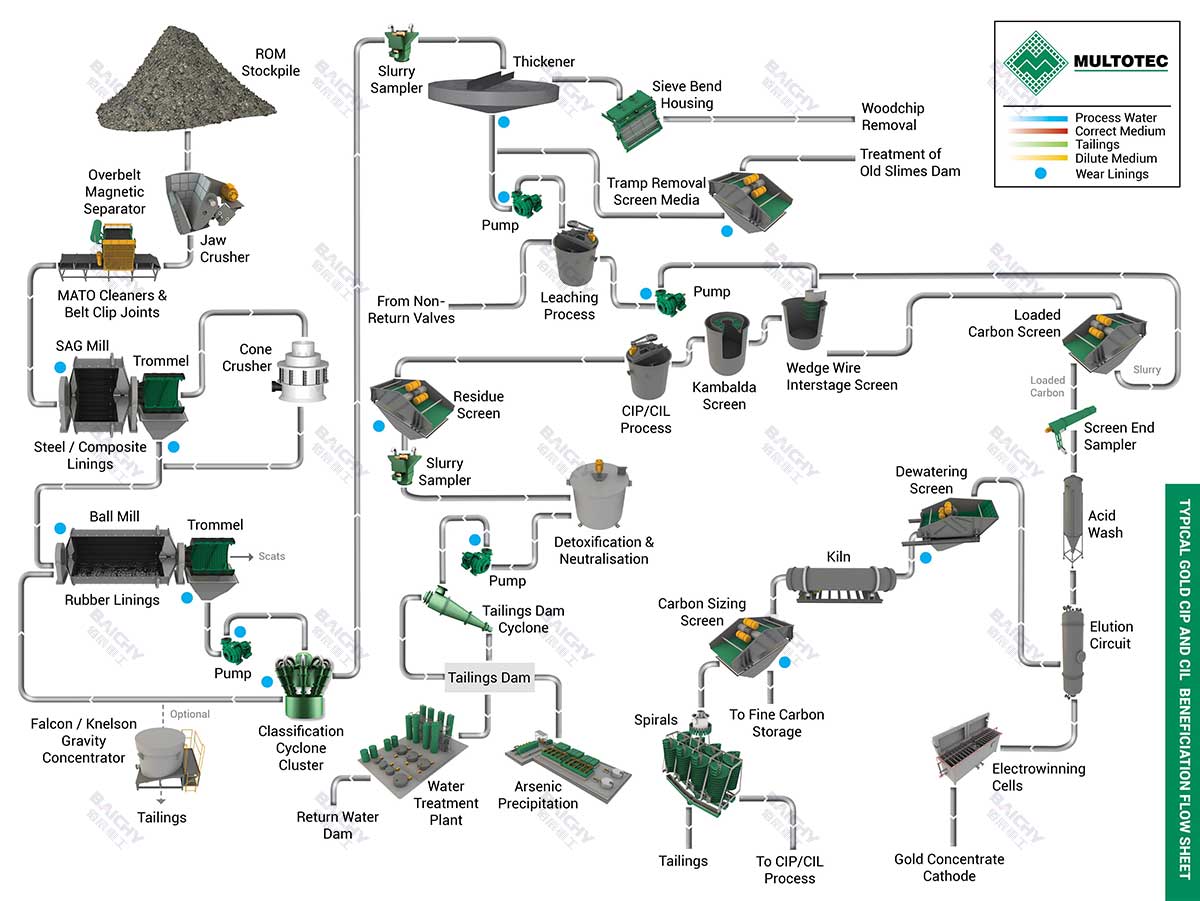
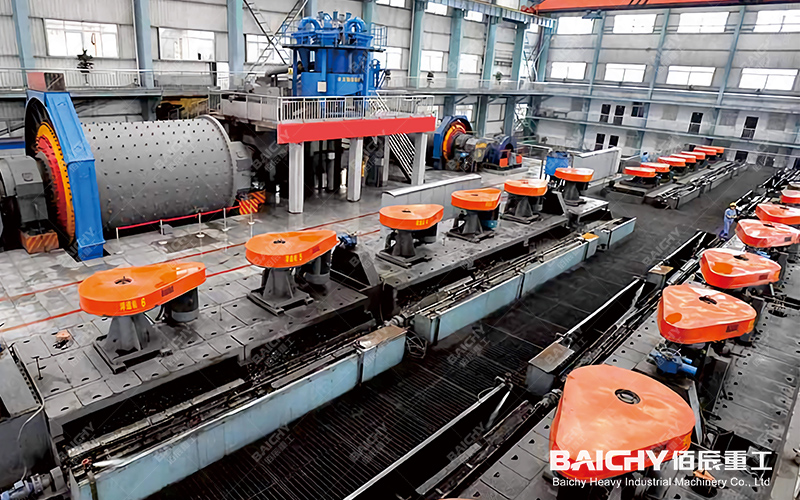
CIL-Leaching-and-Gold-Recovery-Process
The typical CIL process includes the following stages:
Raw Ore Feeding → Crushing → Grinding and Classification → CIL Leaching and Adsorption → Gold Desorption and Electrowinning → Smelting
Tailings treatment, cyanide detoxification where required, and process water recycling are also important parts of the overall plant design.
Crushing and Grinding
Run-of-mine ore is fed into a hopper and delivered to a jaw crusher. Depending on the feed size and required product size, a secondary crusher and screening system may be added.
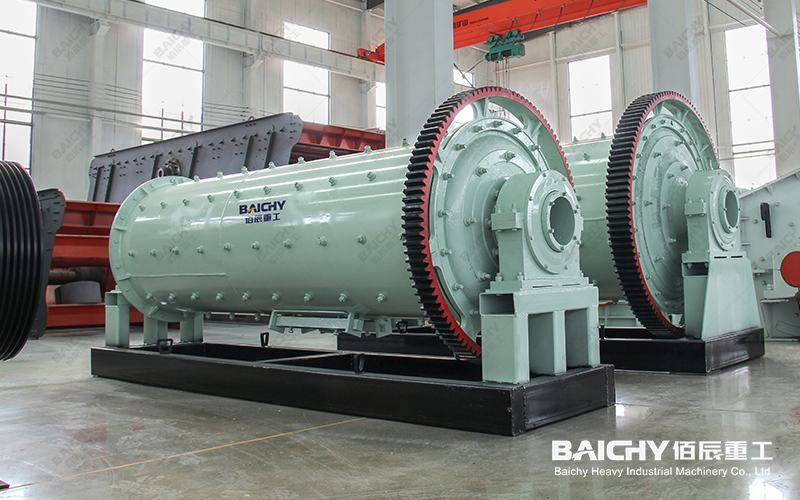
The crushed ore then enters a ball mill and classification circuit. Grinding liberates gold particles from the surrounding minerals, preparing the material for subsequent leaching.
The required grinding fineness depends on gold liberation characteristics and metallurgical test results. Grinding too coarsely may limit recovery, while excessive grinding can increase energy consumption and operating costs.
CIL Leaching and Adsorption
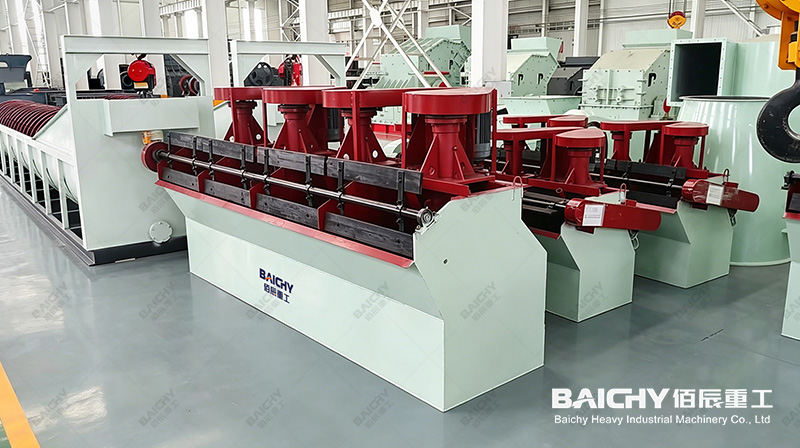
After grinding, the ore is mixed with water to form a slurry. The slurry enters a series of CIL tanks, where suitable leaching reagents dissolve the gold and activated carbon adsorbs the dissolved gold from the pulp.
Tank volume, agitation, aeration, slurry density, residence time, and carbon management must be evaluated during process design.
Gold Recovery and Tailings Treatment
Gold-loaded carbon is transferred to a desorption and electrowinning system. The recovered gold-bearing material is subsequently processed and smelted into doré, subject to the selected plant configuration.
Meanwhile, the tailings stream is managed through the appropriate detoxification, thickening, filtration, water recycling, and disposal arrangements.
2. Complete Equipment List for a 100 TPD CIL Gold Plant
The following table provides a preliminary equipment framework for a 100 TPD gold processing project in Tanzania. Final models and quantities should be confirmed after process design and equipment sizing.
| Processing Stage | Main Equipment | Primary Function |
|---|---|---|
| Feeding | Ore hopper, vibrating feeder | Control and stabilize ore feeding |
| Crushing | Jaw crusher, secondary crusher if required | Reduce ore size |
| Conveying | Belt conveyors | Transfer ore between processing stages |
| Grinding | Ball mill, grinding media | Liberate gold-bearing minerals |
| Classification | Hydrocyclone or spiral classifier, slurry pump | Control grinding product size |
| CIL | Leaching and adsorption tanks, agitators | Leach gold and adsorb dissolved gold |
| Carbon Handling | Interstage screens, carbon transfer equipment | Retain and move activated carbon |
| Gold Recovery | Desorption system, electrowinning cells | Recover gold from loaded carbon |
| Smelting | Gold smelting furnace | Produce doré bullion |
| Tailings | Detoxification equipment, thickener or filter press if required | Manage tailings and recover water |
| Utilities | Reagent preparation, pumps, piping, electrical control system | Support plant operation |
Not every project requires the same equipment configuration. For example, a secondary crusher may be unnecessary when the primary crushing circuit already achieves the required feed size. A gravity separation stage may also be considered if testing identifies a meaningful amount of recoverable free gold.
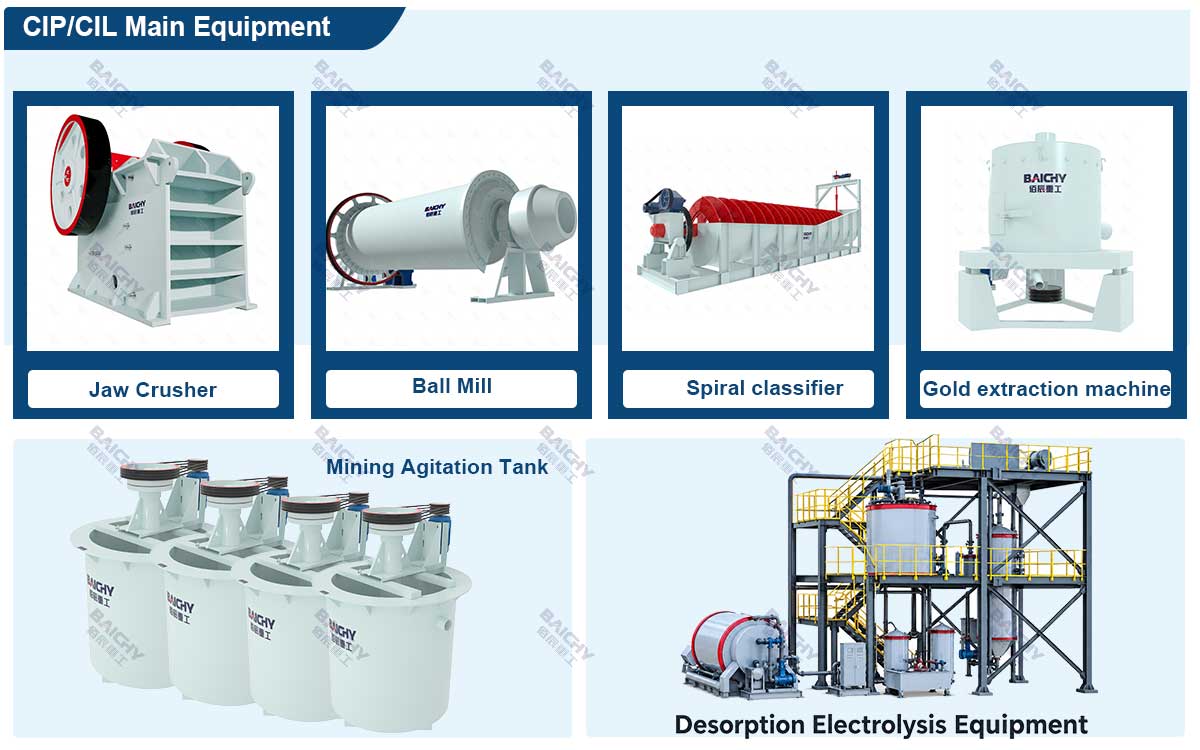
CIL-Gold-Plant-Equipment-List
A detailed equipment list should specify the model, quantity, motor power, design capacity, material of construction, and supply scope for each item.
3. How to Select the Right Equipment for a 100 TPD CIL Plant
Consider Gold Ore Characteristics
Ore characteristics are among the most important factors in plant design. Gold grade alone cannot determine whether CIL is suitable.
Important parameters include:
• Ore hardness and abrasiveness
• Gold particle size and liberation characteristics
• Mineral composition and the presence of sulfides
• Clay content and potential processing difficulties
• Gold leaching kinetics and reagent consumption
• Potential preg-robbing or refractory characteristics
Laboratory testing and, where appropriate, mineralogical analysis and metallurgical testing help determine whether conventional CIL is suitable or whether pretreatment or additional recovery stages are necessary.
Calculate Grinding and CIL Capacity
The ball mill must provide the required grinding performance at the target throughput. The classification system must work with the mill to maintain the desired particle size.
CIL tank capacity is determined by slurry flow, solids concentration, required leaching and adsorption residence time, and process test results. Therefore, the number and dimensions of CIL tanks should not be selected based on daily tonnage alone.
Plan for Tanzanian Site Conditions
For a project in Tanzania, consider the following practical factors:
• Availability and reliability of electricity and process water
• Road access and transport arrangements for heavy equipment
• Site elevation, climate, and foundation conditions
• Availability of local maintenance personnel and spare parts
• Applicable mining, environmental, occupational safety, and cyanide management requirements
These considerations can affect equipment specifications, layout, supporting infrastructure, and the total project budget.
4. How Much Does a 100 TPD CIL Gold Processing Plant Cost?
The cost of a 100 TPD CIL gold processing plant depends on the selected process, equipment specifications, site conditions, and project supply scope. A reliable quotation should be based on a defined technical configuration rather than processing capacity alone.
The main cost factors include:
Equipment supply: Crushers, ball mills, CIL tanks, pumps, gold recovery systems, electrical equipment, and auxiliary machinery.
Ore treatment requirements: Harder or more complex ores may require additional grinding capacity, pretreatment, or specialized process equipment.
Gold recovery and tailings systems: Desorption and electrowinning, smelting, cyanide detoxification, filtration, and water recycling can contribute significantly to project costs.
Installation and infrastructure: Foundations, steel structures, piping, electrical installation, water supply, and site preparation may be excluded from an equipment-only quotation.
Transportation and commissioning: Export packing, shipping to Tanzania, inland transportation, installation guidance, commissioning, and training should be clearly defined in the commercial offer.
When comparing suppliers, confirm whether the quotation covers equipment only, a complete processing line, or a broader engineering and construction package. This makes different proposals easier to compare and reduces the risk of overlooking essential project costs.
5. Customized CIL Gold Processing Solutions for Tanzania
A customized plant solution helps align equipment selection with the ore properties, production target, and site requirements of the project.
Depending on the supplier's capabilities and agreed scope, technical support may include:
• Preliminary process evaluation and flow sheet development
• Equipment selection and manufacturing
• General arrangement and plant layout drawings
• Equipment documentation and installation guidance
• Export packing and shipping coordination
• Commissioning support, operator training, and spare parts planning
For a 100 TPD project, the objective is to create a balanced production line in which crushing, grinding, leaching, gold recovery, and tailings management work together effectively.
Rather than choosing equipment solely by price, evaluate processing performance, maintainability, energy consumption, wear parts, technical support, and compatibility across the complete system.
6. What Information Is Needed for a 100 TPD CIL Plant Quotation?
To prepare a practical equipment proposal for your Tanzanian gold project, provide as much of the following information as possible:
Processing capacity: Confirm the target of 100 tons per day and planned operating hours.
Ore analysis: Share available gold assay results and mineralogical reports.
Ore properties: Provide feed size, hardness information, and any existing grinding test results.
Metallurgical performance: Share leaching test results, expected recovery targets, and reagent consumption data if available.
Project scope: Specify whether you need inpidual machines, a complete equipment line, or engineering and installation support.
Site conditions: Identify the project location, available power and water, and current construction status.
Budget and schedule: Indicate the anticipated investment range and target commissioning date.
If some information is not yet available, you can still begin with the known capacity, ore type, and preliminary project requirements. Additional testing may be needed before final equipment selection and performance commitments.
Frequently Asked Questions
1. What equipment is required for a 100 TPD CIL gold processing plant?
A typical plant includes feeding and crushing equipment, a ball mill, classification equipment, CIL tanks, agitators, carbon screens, gold desorption and electrowinning equipment, a smelting furnace, and supporting tailings and water management systems. The final configuration depends on ore characteristics and test results.
2. Is CIL suitable for every type of gold ore?
No. CIL is suitable for ores that respond appropriately to the selected leaching and adsorption process. Refractory minerals, preg-robbing materials, and other metallurgical challenges may require pretreatment or a different flowsheet. Ore testing is recommended before finalizing the process.
3. How many CIL tanks are needed for a 100 TPD plant?
There is no universal number. Tank quantity and volume depend on slurry flow, solids concentration, residence time, leaching kinetics, and the required adsorption performance. The appropriate configuration should be calculated during process design.
4. How much does a 100 TPD CIL gold processing plant cost?
The total investment varies with equipment specifications, ore treatment requirements, gold recovery systems, tailings facilities, civil works, transportation, and installation. Request an itemized quotation that clearly distinguishes equipment costs from other project expenses.
5. Can you supply a 100 TPD CIL gold processing plant to Tanzania?
Equipment supply to Tanzania can be discussed based on the supplier's export capabilities and the project's requirements. Confirm the available equipment scope, shipping arrangements, technical documentation, installation support, and spare parts provisions when requesting a quotation.
Get a Customized Quote for Your 100 TPD CIL Gold Processing Plant
Are you planning to develop a 100 TPD gold processing plant in Tanzania?
Our team can help evaluate your project requirements and identify a suitable equipment configuration based on your ore characteristics, target throughput, and site conditions.
Contact us with your available ore analysis, project location, and equipment requirements to discuss a preliminary process flow, equipment list, and quotation.
Start planning your gold processing project today. Request a customized CIL plant proposal for your Tanzania project.
Baichy Heavy Industry
Baichy Heavy Industry is a high-tech mining equipment company integrating R&D, manufacturing, sales, and after-sales service. Focusing on crushing, grinding, and mineral processing equipment, we provide professional solutions to our customers. We are ISO9001:2015 Certified, and our products include mobile crushing palnts, crawler crushing plant, construction waste crushing plants, jaw crushers, sand making machines, cone crushers, fine crushers, grinding mills, ball mills, etc., all with reliable performance to meet diverse project needs.
Baichy Heavy Industry – Your Trusted Partner
To ensure optimal performance of your equipment, Baichy Heavy Industry offers:
- Professional on-site installation guidance
- Comprehensive operator training
- 24/7 technical support & maintenance services
Our complete after-sales service system guarantees long-term, stable operation of your machinery with minimal downtime.
Protect Your Rights – Only Use Official Channels
To avoid scams and ensure authentic support, contact us exclusively through:
• Official Website: www.baichychina.com
• WhatsApp: +8615093222637
• Email: [email protected]
Your satisfaction is our priority – expect prompt, professional service every time.
(Note: Beware of unauthorized third parties claiming to represent Baichy. Always verify through official contacts.)