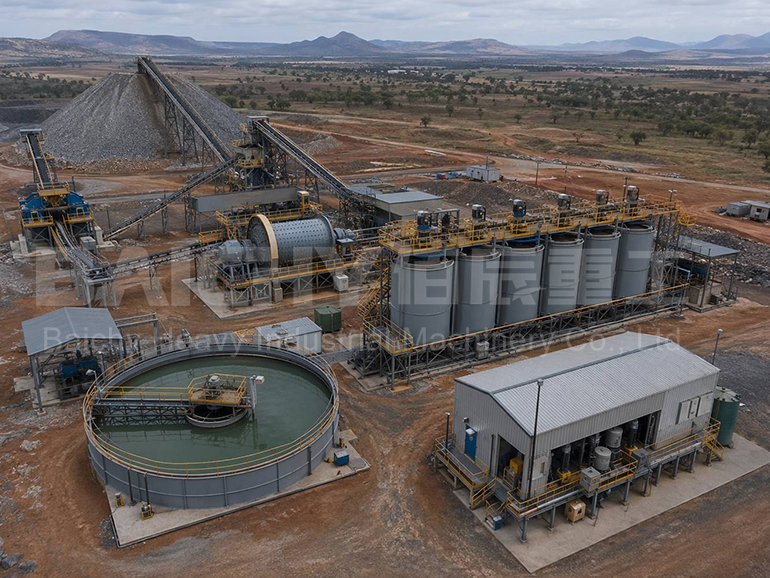
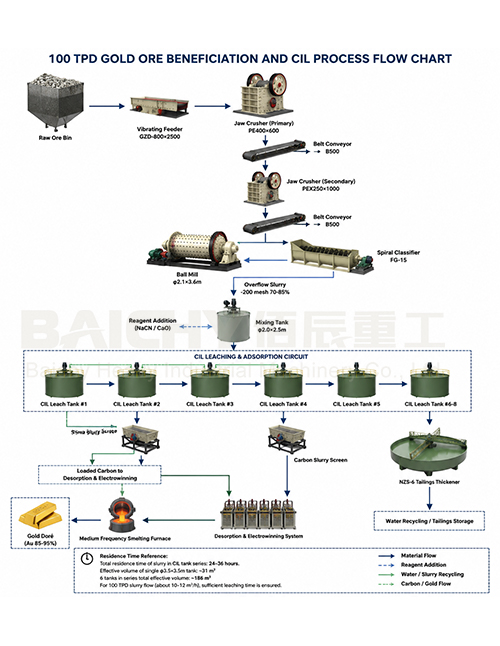
For the majority of small-to-medium-sized gold mines in South Africa—whether processing primary quartz vein ore or tailings—the Carbon-in-Leach (CIL) process offers the best cost-performance ratio. Compared to the traditional Carbon-in-Pulp (CIP) process, CIL combines leaching and adsorption within a single tank, reducing equipment requirements by approximately 15–20% and providing superior mitigation against the "preg-robbing" effect caused by carbonaceous ores.
Core Equipment Configuration List
The following outlines the standard configuration for a 100 TPD CIL/CIP gold processing line. Final specifications should be fine-tuned based on the results of ore beneficiation tests (covering hardness, particle size, mineral dissemination characteristics, and leachability).
1 Crushing Circuit
| No. |
Equipment Name |
Model/Specification |
Qty |
Power (kW) |
Remarks |
| 1 |
Vibrating Feeder |
GZD-800×2500 |
1 |
2×1.5 |
Includes grizzly bar pre-screening |
| 2 |
Jaw Crusher |
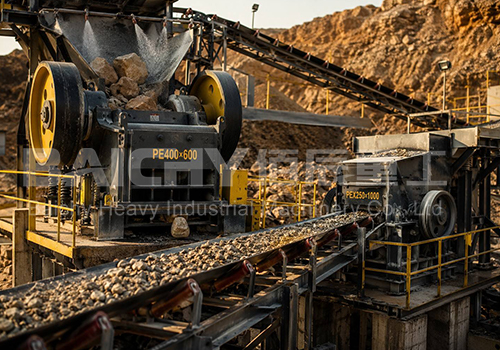
PE400×600 |
1 |
30 |
Primary crushing; feed size ≤340mm; discharge 40–100mm |
| 3 |
Fine Jaw Crusher |
PEX250×1000 |
1 |
30 |
Fine crushing; discharge 15–50mm |
| 4 |
Belt Conveyor |
B500/B650 |
3–4 units |
- |
Connects processing stages |
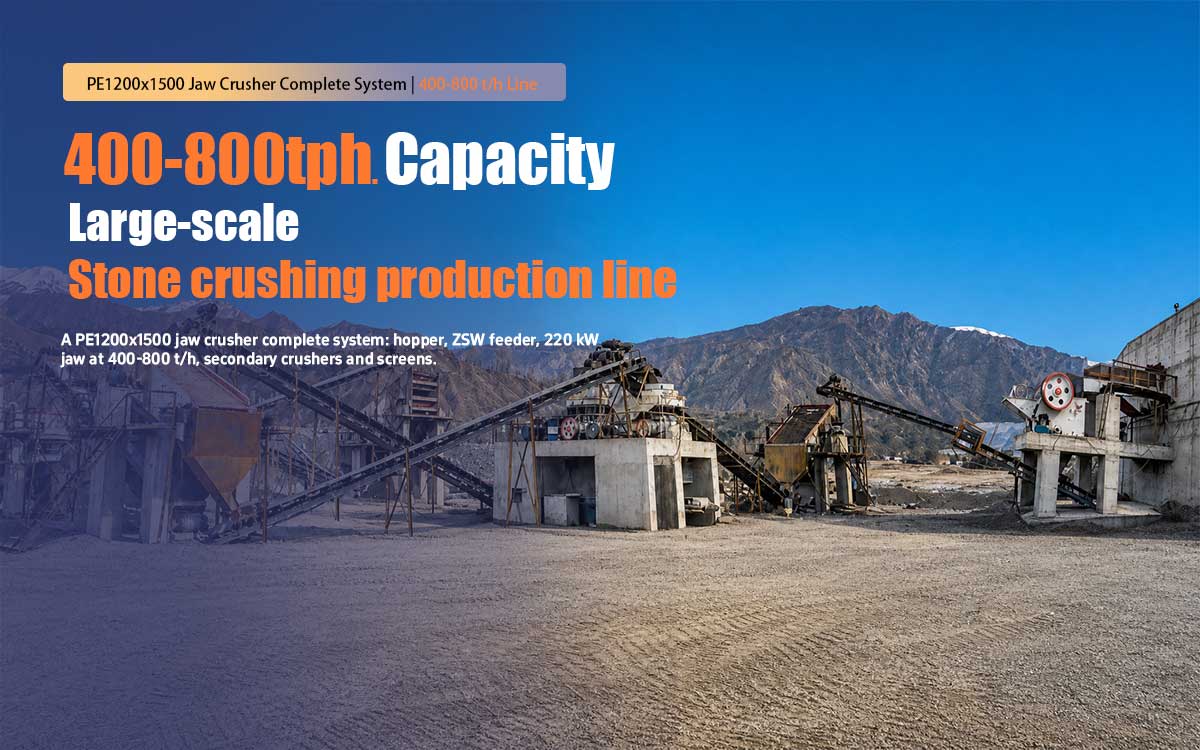
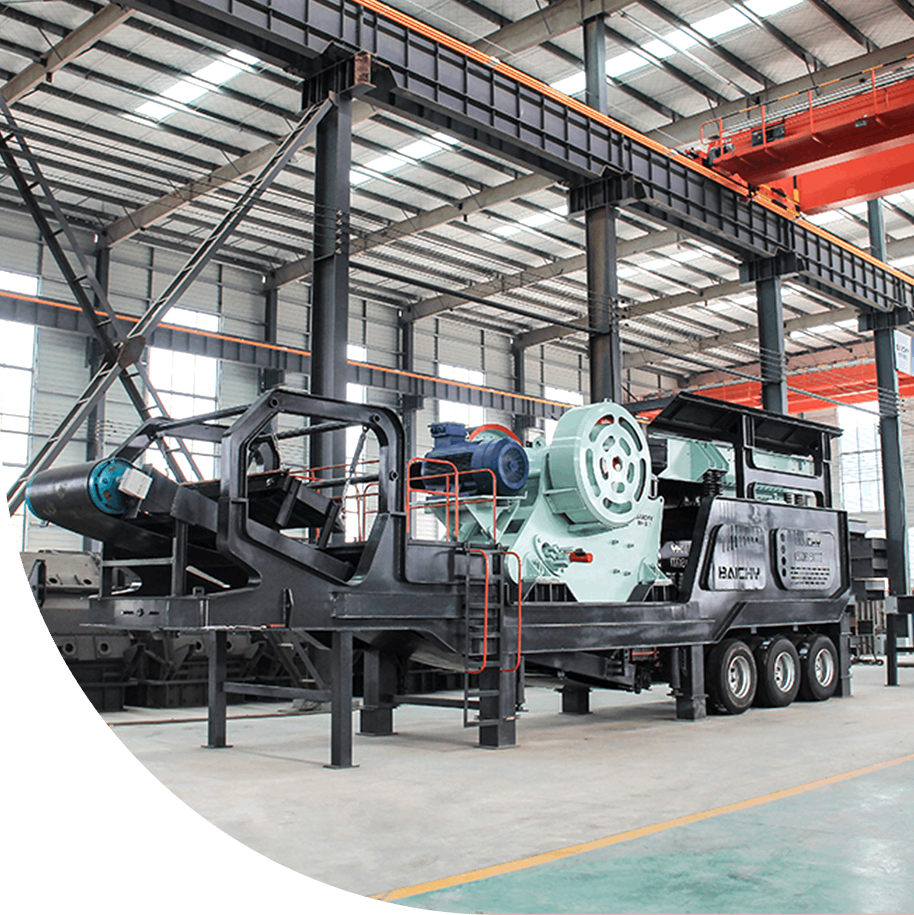
Two-stage open-circuit crushing; capable of reducing run-of-mine ore (max. 340mm) to a mill feed size of 15–50mm. When processing medium-hardness gold ore, the PE400×600 crusher achieves an actual capacity of 16–40 tph—far exceeding the 5–8 tph crushing requirement of a 100 TPD processing plant.
2 Grinding & Classification Section
| No. |
Equipment Name |
Model/Specification |
Quantity |
Power (kW) |
Remarks |
| 5 |
Ball Mill |
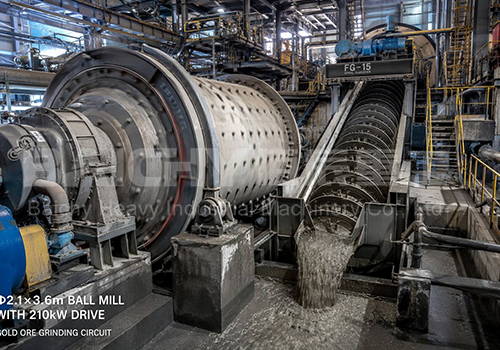
φ2.1×3.6m |
1 |
210 |
Effective volume ~10.5 m³; grinding media charge ~19 t |
| 6 |
Spiral Classifier |
FG-15 (φ1500) |
1 |
7.5 |
Overflow fineness: 70–85% passing -200 mesh |
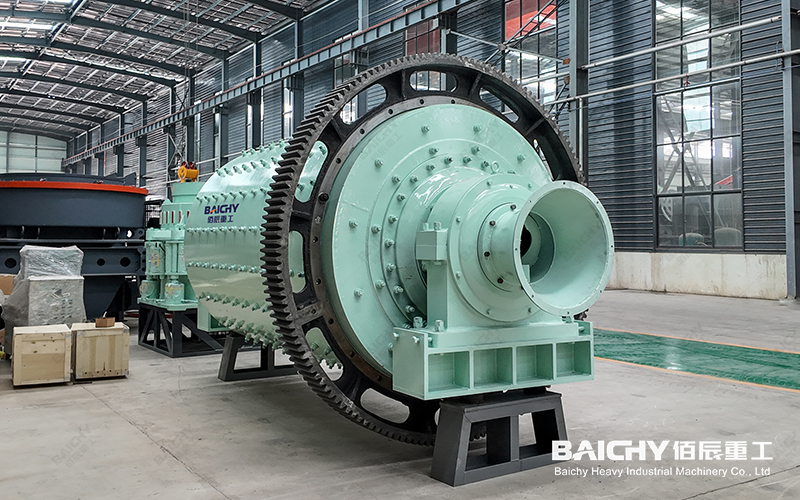
The φ2.1×3.6m ball mill has a processing capacity of approximately 6–12 tph for medium-hardness gold ore at a grinding fineness of 70–80% passing -200 mesh. For a 100 TPD plant (based on 16–20 hours of effective daily operation), a single unit is sufficient to meet the entire capacity requirement. Compared to the φ1.8×3.0m ball mill, the initial investment increases by only about 15%, yet capacity rises by over 50%—eliminating the need to replace the mill if you plan to expand production to 150–200 TPD in the future.
3 Leaching & Adsorption Section
| No. |
Equipment Name |
Model/Specification |
Qty |
Power (kW) |
Remarks |
| 7 |
Slurry Agitation Tank |
φ2.0×2.5m |
1 |
5.5 |
Slurry conditioning; reagent mixing |
| 8 |
CIL Leaching & Adsorption Tank |
φ3.5×3.5m |
6–8 |
7.5 × (6–8) |
Dual-impeller agitation; cyanide leaching + activated carbon adsorption |
| 9 |
Carbon-Slurry Separation Screen |
- |
2 |
2.2 |
Linear vibration; retains activated carbon particles |
| 10 |
Reagent Dosing System |
- |
1 |
- |
Metered dosing of sodium cyanide, lime, and activated carbon |
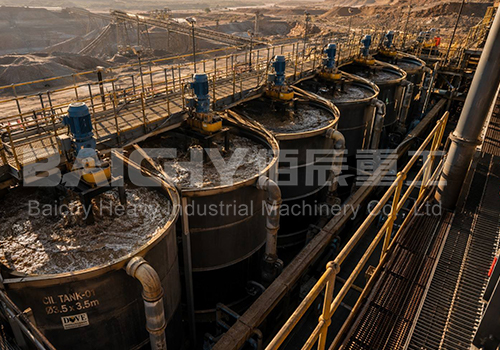
This section demonstrates the core advantage of the CIL process: leaching and adsorption occur within the same tank. Compared to the traditional CIP (Carbon-in-Pulp) method, this eliminates 2–3 independent adsorption tanks, reduces equipment investment by approximately 15–20%, and lowers sodium cyanide consumption by 8–12%. The series configuration of 6–8 tanks ensures a total leaching residence time of 24–36 hours, a prerequisite for high recovery rates.
4 Desorption, Electrowinning & Smelting Section
| No. |
Equipment Name |
Model/Specification |
Qty |
Power (kW) |
Remarks |
| 11 |
Gold-Loaded Carbon Desorption & Electrowinning System |
- |
1 |
~50 |
Includes desorption column, electrowinning cell, and heating/circulation system |
| 12 |
Medium-Frequency Smelting Furnace |
- |
1 |
15 |
Smelts electrowinning gold sludge into doré bars |
| 13 |
Tailings Thickener |
NZS-6 (φ6m) |
1 |
3 |
Tailings thickening; water recycling |
The desorption and electrowinning system serves as the "monetization terminal" for the entire processing plant. Gold-loaded carbon typically contains 3–8 kg/t of gold; following high-temperature, high-pressure desorption and electrowinning, the resulting gold sludge is smelted to produce doré bars with a purity of 85–95%. Tailings thickeners can achieve a process water recovery rate of 70–80%, significantly reducing water costs in arid South African provinces such as the Northern Cape.