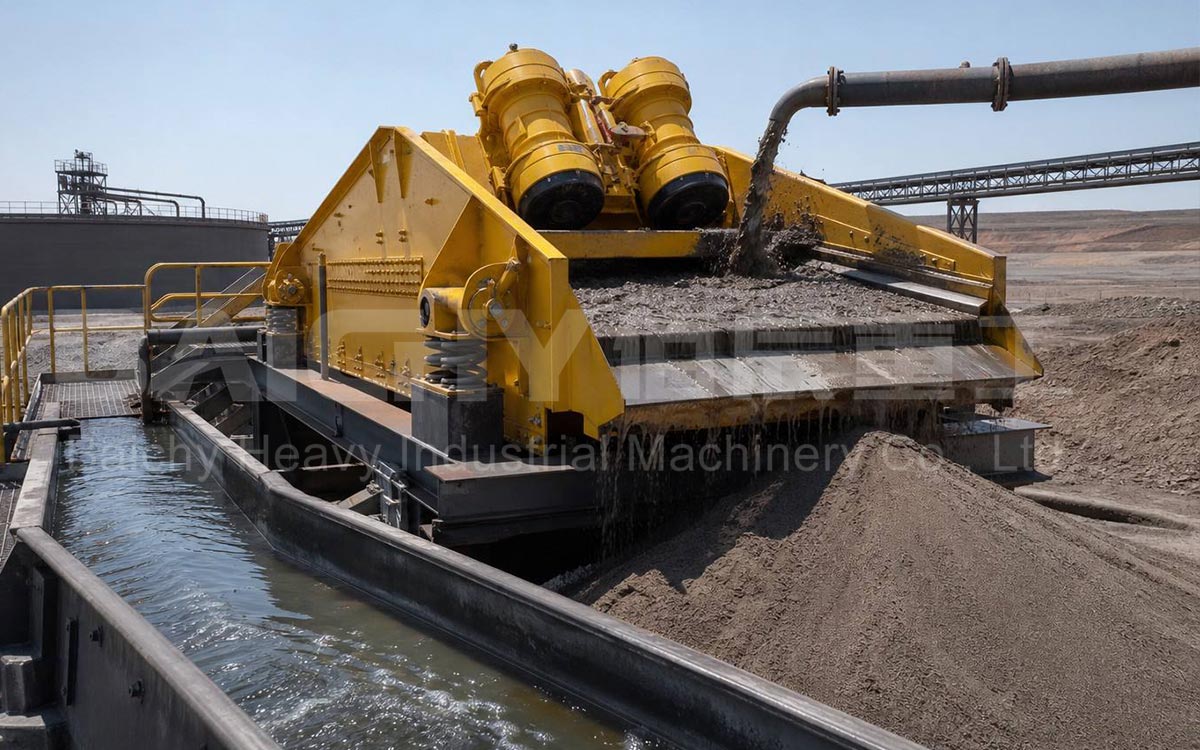
Dewatering Screen for Coal, Slurry and Sand
A dewatering screen for coal slurry and sand removes free water from wet solids through high-frequency vibration on an inclined deck. One ZSD unit covers 30-250 t/h at 1.9-15 kW, taking washed sand from 20%-30% moisture down to 5%-8%, coal slime to 12%-15%, and mineral tailings slurry to 15%-20%.
What Materials Can a Dewatering Screen Dewater?
A ZSD dewatering screen takes any wet solid below its 10 mm feed limit: coal slime, mineral tailings and flotation concentrates, washed sand and gravel. Aperture and deck angle change with the material; the frame and drive do not.
Coal slime. Fine coal arrives from the washing circuit at 30%-50% moisture, with particles typically below 0.5 mm. A polyurethane deck at high frequency cuts that to 12%-15%, dry enough to blend with coarse product.
Tailings and concentrate slurry. A slurry dewatering screen takes tailings at 60%-80% moisture with solids below 5 mm and discharges a 15%-20% cake that can be dry-stacked. Concentrates from magnetic separation or flotation run a finer 0.15-0.5 mm aperture.
Washed sand and gravel. A sand and gravel dewatering screen takes washer discharge at 20%-30% moisture and drops it to 5%-8%, with no dripping during truck loading. Paired with a hydrocyclone, the same screen recovers over 95% of the 0.075-2 mm fraction.
ZSD Dewatering Screen Models and Specifications
The ZSD range runs from ZSD1230 at 30-80 t/h and 1.9 kW to ZSD3048 at 200-250 t/h and 15 kW. All ten models accept feed up to 10 mm.
| Model | Motor Power (kW) | Capacity (t/h) | Feeder Size (mm) | Screen Plate Size (mm) | Screen Area (㎡) | Overall Dimension (mm) |
|---|---|---|---|---|---|---|
| ZSD1230 | 1.9 | 30–80 | ≤10 | 1200×3000 | 3.6 | 3085×1590×1439 |
| ZSD1236 | 2.2 | 30–80 | ≤10 | 1200×3600 | 4.32 | 3677×1590×1600 |
| ZSD1530 | 2.2 | 80–120 | ≤10 | 1500×3000 | 4.5 | 3075×2491×1601 |
| ZSD1536 | 3 | 80–120 | ≤10 | 1500×3600 | 5.4 | 3200×2491×1802 |
| ZSD1836 | 7.5 | 100–140 | ≤10 | 1800×3600 | 6.48 | 3758×3075×1988 |
| ZSD1842 | 7.5 | 100–140 | ≤10 | 1800×4200 | 7.56 | 4368×3075×2000 |
| ZSD1848 | 7.5 | 100–140 | ≤10 | 1800×4800 | 8.64 | 4791×3065×1959 |
| ZSD2442 | 11 | 140–180 | ≤10 | 2400×4200 | 10.1 | 4403×3737×1931 |
| ZSD2448 | 11 | 140–180 | ≤10 | 2400×4800 | 11.52 | 5008×3737×1977 |
| ZSD3048 | 15 | 200–250 | ≤10 | 3000×4800 | 14.4 | 4959×4518×2218 |
Source: the dewatering vibrating screen data sheet. *The output will vary according to different materials, feed particle size and other factors
Moisture Target and Screen Aperture by Material
Moisture target and aperture are set by the material, not by the tonnage. The four duty classes publish the following figures.
| Material | Feed moisture | Discharge moisture | Screen aperture |
|---|---|---|---|
| Coal slime | 30%–50% | 12%–15% | 0.1–0.5 mm |
| Mineral tailings slurry | 60%–80% | 15%–20% | 0.3–1.0 mm |
| Flotation or magnetic concentrate | — | — | 0.15–0.5 mm |
| Washed sand and gravel | 20%–30% | 5%–8% | — |
A dash means no figure is published; nothing has been estimated. Aperture drives recovery, so a plant chasing fine coal sets a tighter deck than one chasing dry-stack tonnage.
Why Does the Deck Run Uphill?
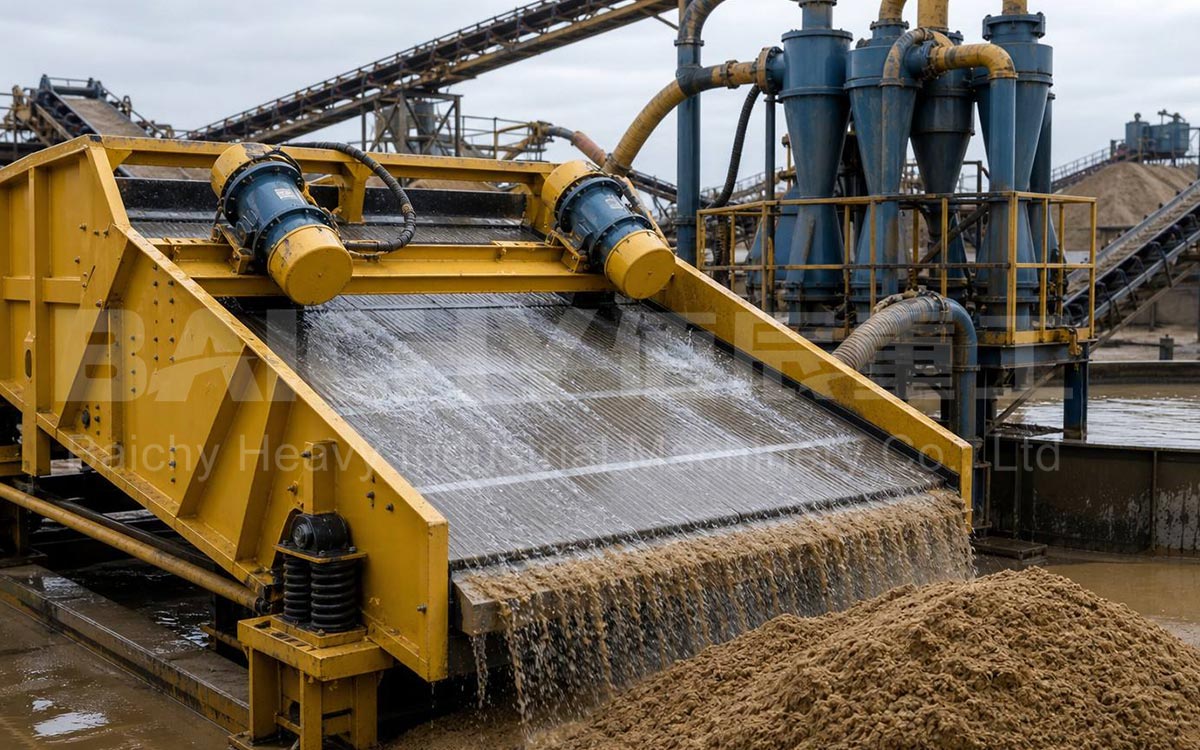
coal slime dewatering screen
A coal slime deck is inclined 3-5 degrees uphill so that solids climb the incline while water drains through the mesh, building a filter cake that traps particles finer than the aperture. A high-frequency dewatering screen runs above 1,500 RPM: two counter-rotating motors cancel lateral force and combine perpendicular force into a linear stroke.
That cake is the recovery mechanism: it acts as an additional filtering medium, which is how a coal slime dewatering screen recovers up to 95% of solids. Polyurethane panels are specified over stainless steel for wear resistance and less blinding, with apertures from 0.1 mm to 0.5 mm. Water passing the deck is collected in an underflow hopper for clarification or reuse.
How Do You Match a Dewatering Screen to Line Throughput?
Size the screen to line throughput × 1.2 as a safety factor, then derate if the raw material carries high silt or clay. One published configuration pairs a 100 tph sand-making line's 3XL1115 screw sand washer with a TS1836 dewatering screen.
Silt and clay raise slurry viscosity and blind the mesh, so the safety factor is applied before selection. A sand washing and dewatering integrated equipment set replaces the washer-plus-screen pair where the layout is tight.
Where a drier product is required, thermal drying follows: a sand rotary dryer for washed sand and gravel, a sludge dryer for thickened slurry.
Dewatering Screen FAQ
1. What moisture level can a dewatering screen reach?
It depends on the material: washed sand and gravel leave at 5%-8% moisture, coal slime at 12%-15%, and mineral tailings filter cake at 15%-20%. Feed moisture runs from 20%-30% for washer discharge to 60%-80% for tailings slurry.
2. What is the maximum feed size and capacity of a ZSD dewatering screen?
All ten ZSD models accept feed up to 10 mm. Capacity spans 30-250 t/h across the range, from ZSD1230 at 30-80 t/h and 1.9 kW to ZSD3048 at 200-250 t/h and 15 kW.
3. Can the same dewatering screen handle coal slime and sand?
Yes. The frame, vibrating motors and spring isolation are common; only the screen aperture and deck angle change. Coal slime runs 0.1-0.5 mm apertures, mineral tailings 0.3-1.0 mm, and concentrates 0.15-0.5 mm.
4. How does a dewatering screen compare with a centrifuge or a filter press?
A centrifuge reaches a slightly lower moisture level through higher g-force, but costs more to buy, install and maintain and draws more power per ton. A filter press produces a cake often below 10% moisture, but it works in batches needing automated valving between cycles. A dewatering screen runs continuously at a lower cost per ton.
5. How much fine sand can a dewatering screen recover?
Fitted with a hydrocyclone, a dewatering screen recovers over 95% of the 0.075-2 mm fraction that would otherwise flow to the settling pond, filling the 0.15-0.3 mm gradation gap in the ASTM C33 and GB/T 14684 curves.
Baichy Heavy Industry
Baichy Heavy Industry is a high-tech mining equipment company integrating R&D, manufacturing, sales, and after-sales service. Focusing on crushing, grinding, and mineral processing equipment, we provide professional solutions to our customers. We are ISO9001:2015 、certified, and our products include mobile crushing palnts, crawler crushing plant, construction waste crushing plants, jaw crushers, sand making machines, cone crushers, fine crushers, grinding mills, ball mills, etc., all with reliable performance to meet diverse project needs.
Baichy Heavy Industry – Your Trusted Partner
To ensure optimal performance of your equipment, Baichy Heavy Industry offers:
- Professional on-site installation guidance
- Comprehensive operator training
- 24/7 technical support & maintenance services
Our complete after-sales service system guarantees long-term, stable operation of your machinery with minimal downtime.
Protect Your Rights – Only Use Official Channels
To avoid scams and ensure authentic support, contact us exclusively through:
• Official Website: www.baichychina.com
• WhatsApp: +8615093222637
• Email: [email protected]
Your satisfaction is our priority – expect prompt, professional service every time.
(Note: Beware of unauthorized third parties claiming to represent Baichy. Always verify through official contacts.)