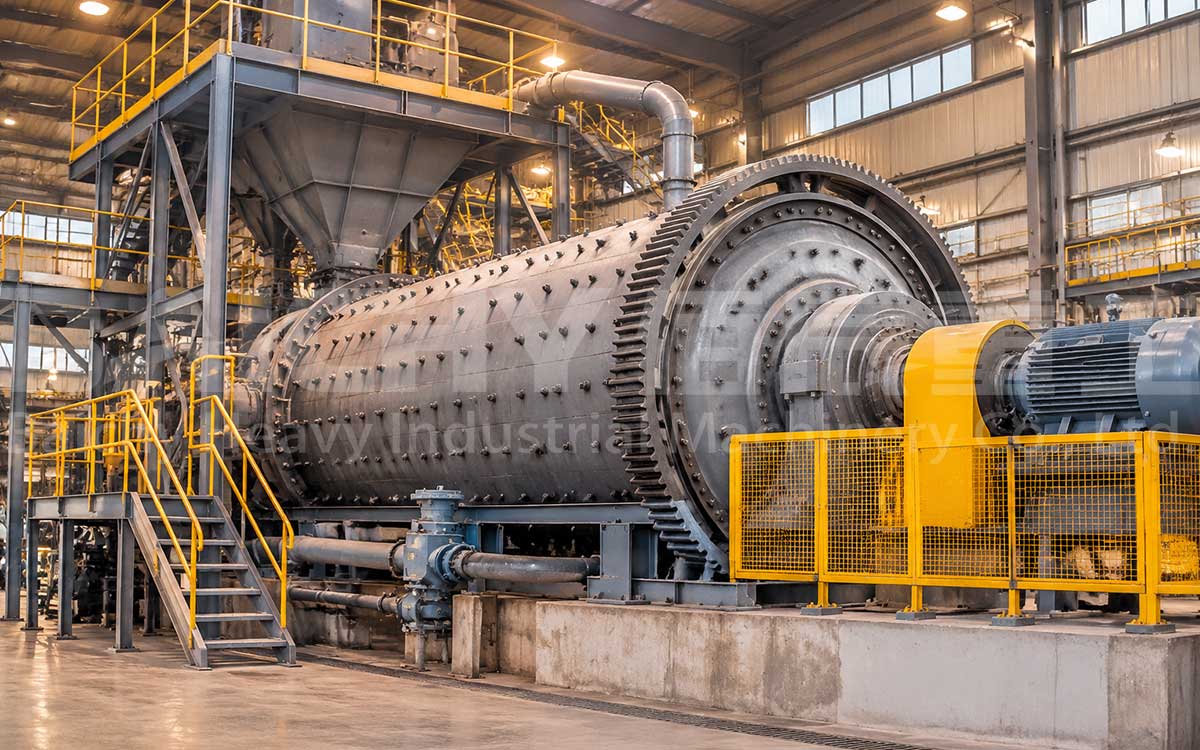

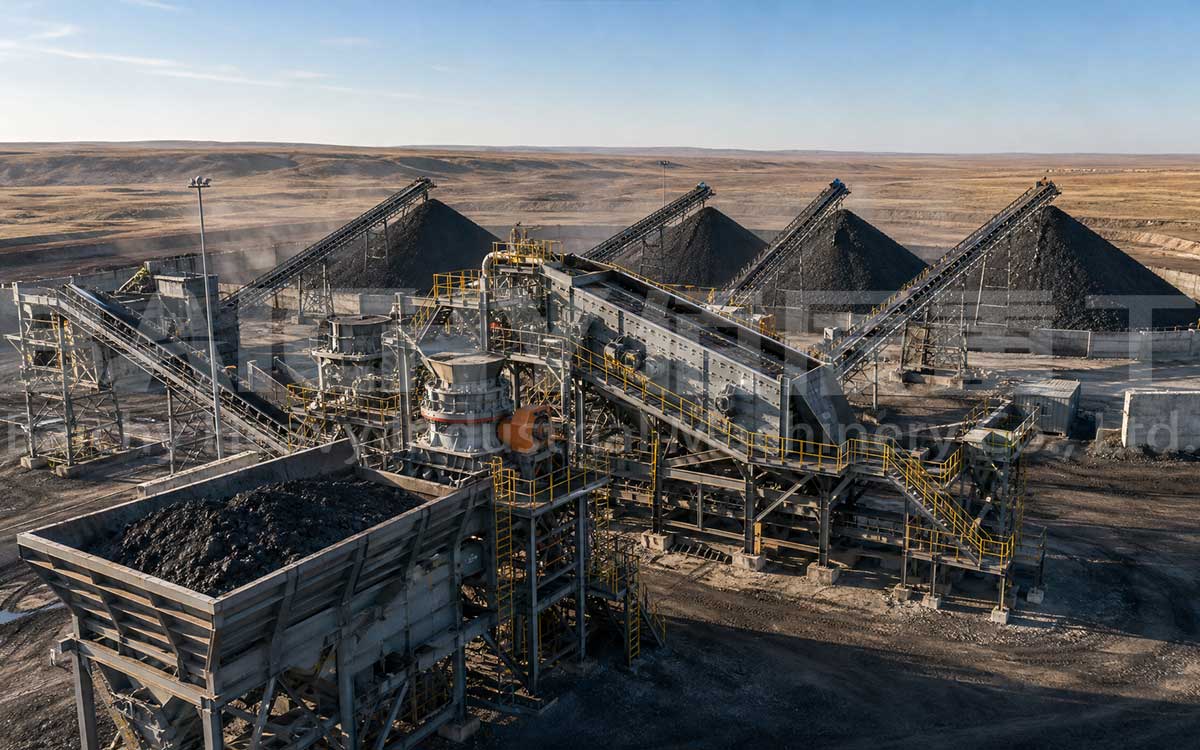
150 TPH coal crushing plant
A practical solution for four saleable coal sizes
A Kazakhstan coal operation may not need a larger plant—it may need a more controllable one. At 150 tons per hour, producing four final sizes requires coordinated feeding, crushing, screening, recirculation and stockpiling. A single crusher cannot solve this requirement.
The proposed modular plant controls material from the receiving hopper to each finished-product conveyor, bunker or loading point. It focuses on stable feeding, accurate separation and cold-weather readiness. Final selection should follow confirmation of coal data, product specifications and site conditions.
Why four products require an integrated design?
Four fractions require multiple screening cuts and discharge routes. Insufficient screen area can increase near-size material, while poor transfer-point design can cause products to mix.
The process should begin with product specifications rather than a preferred crusher model. The customer should define the lower and upper size limits of every product, expected production ratios and permitted oversize or fines. These values determine the screen decks, screen area, conveyor layout and recirculation load.
Recommended process flow
Receiving and feeding: Run-of-mine coal enters a hopper. A feeder regulates flow and reduces surges. A grizzly or scalping section may remove natural fines or occasional oversize lumps.
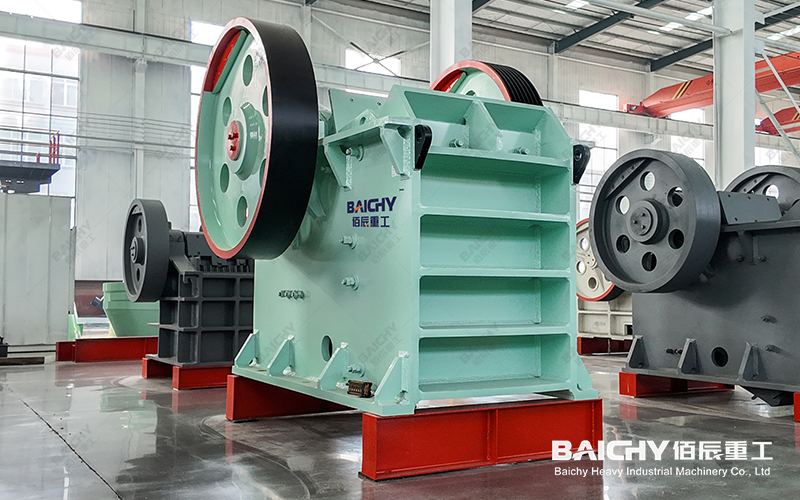
Size reduction: The jaw crusher reduces the largest lumps to a size suitable for classification. Selection depends on feed top size, moisture, hardness, abrasiveness and target product range.
Multi-deck screening: A multi-deck vibrating screen separates coal into four target ranges. Screen media should match moisture, stickiness and wear conditions. Wet or sticky coal may require anti-blinding measures.
Recirculation and handling: Oversize can return to a secondary crushing stage or closed circuit. Each accepted fraction goes to a dedicated conveyor, bunker, stockpile or loading route. Chutes and transfer points should prevent cross-contamination.
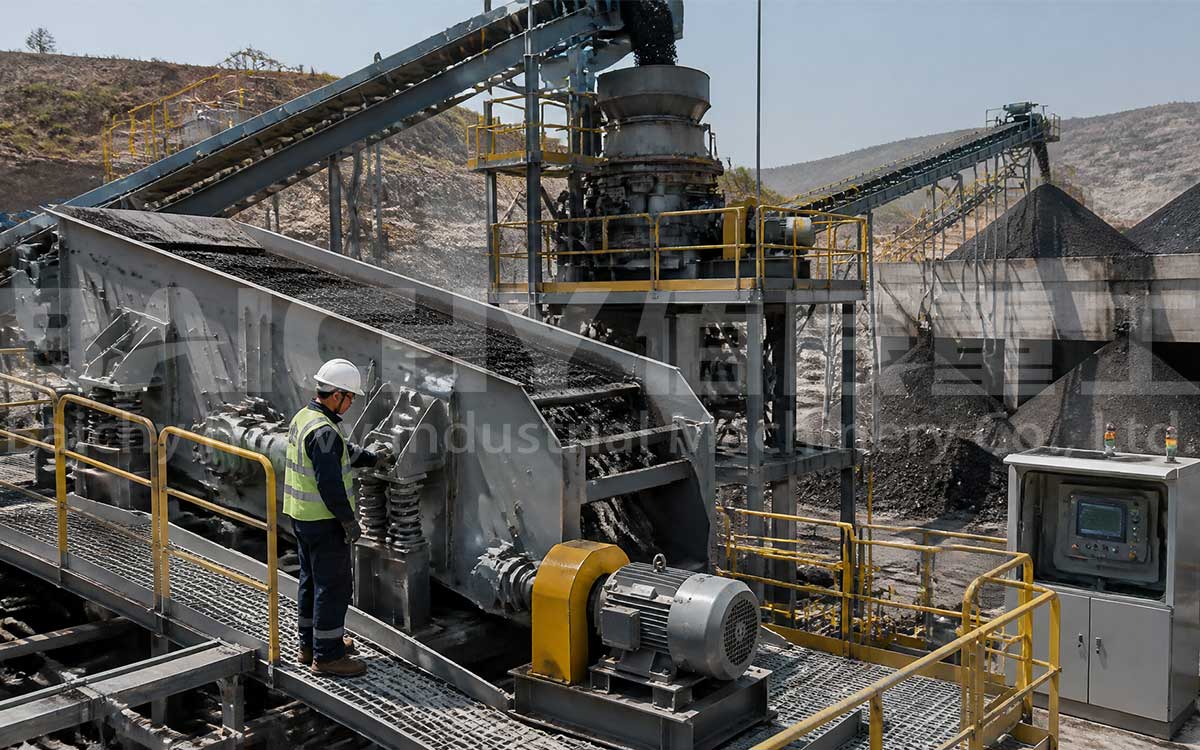
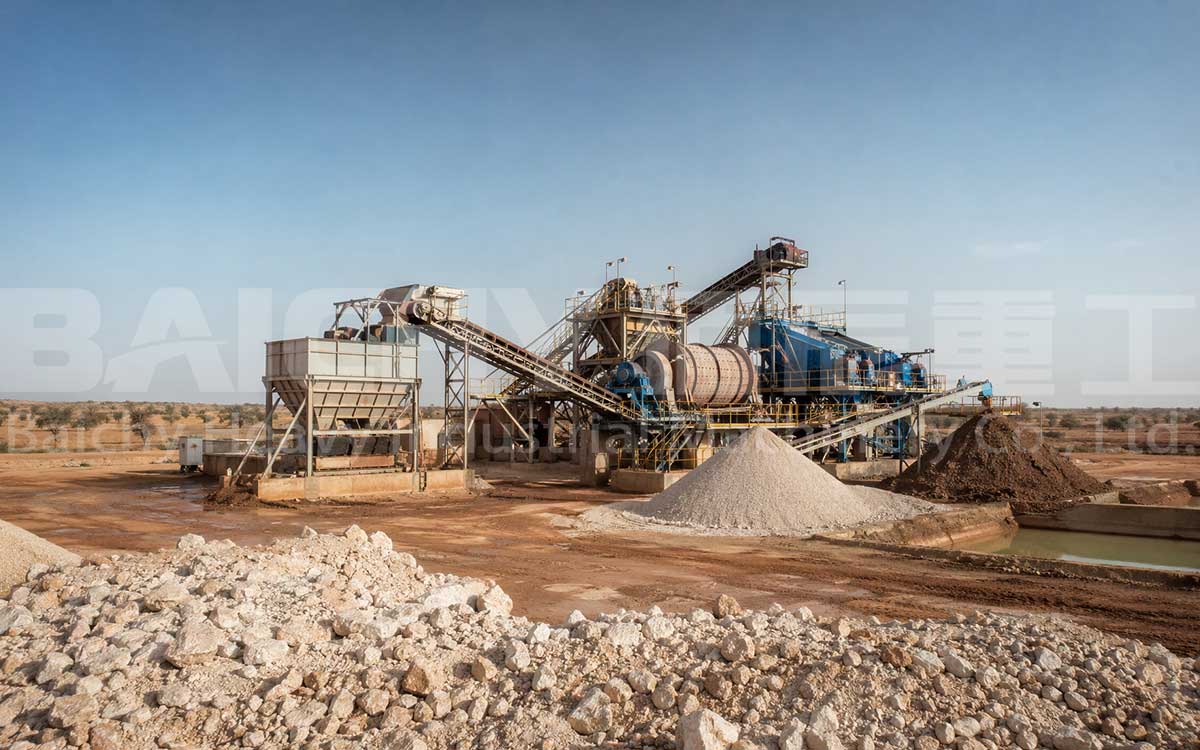
coal crushing and screening plant
Conceptual equipment arrangement
This table is a planning framework, not a final performance guarantee.
| Process section | Function | Key question |
|---|---|---|
| Hopper and feeder | Buffer coal and control feed | What are the lump size and surge load? |
| Scalping screen | Remove fines or oversize | Can bypassing fines improve capacity? |
| Primary crusher | Reduce run-of-mine coal | Is feed wet, sticky or frozen? |
| Multi-deck screen | Separate four finished ranges | What are the cut points and ratios? |
| Recirculation circuit | Correct oversize | Is secondary crushing required? |
| Four conveyors | Move products to storage/loading | Must products be stored separately? |
| Dust-control system | Manage transfer-point dust | What site limits apply? |
| PLC and safety system | Coordinate alarms/interlocks | What language is required? |
Designing for Kazakhstan conditions
A Kazakhstan coal project may face seasonal temperature changes, remote locations and long spare-parts lead times. These factors should be considered during concept design.
Cold-weather readiness
The customer should provide the minimum operating temperature and confirm whether the plant will be outdoors or sheltered. Frozen lumps can increase crusher load and block chutes, screens or transfer points, especially at hopper outlets and discharge chutes.
Depending on confirmed conditions, the project may consider enclosed transfer points, insulation, selected heating, low-temperature lubricants and a defined start-up procedure. These are project options, not automatic features of every 150 TPH plant.
Moisture and maintenance
Wet coal can reduce screening efficiency and cause blinding or carryback. The design should use the customer’s moisture range, supported by a representative sample or screening test when necessary. The layout should provide access to screens, crushers, drives, belts and chutes, with separate installation, wear and emergency spare-parts plans.
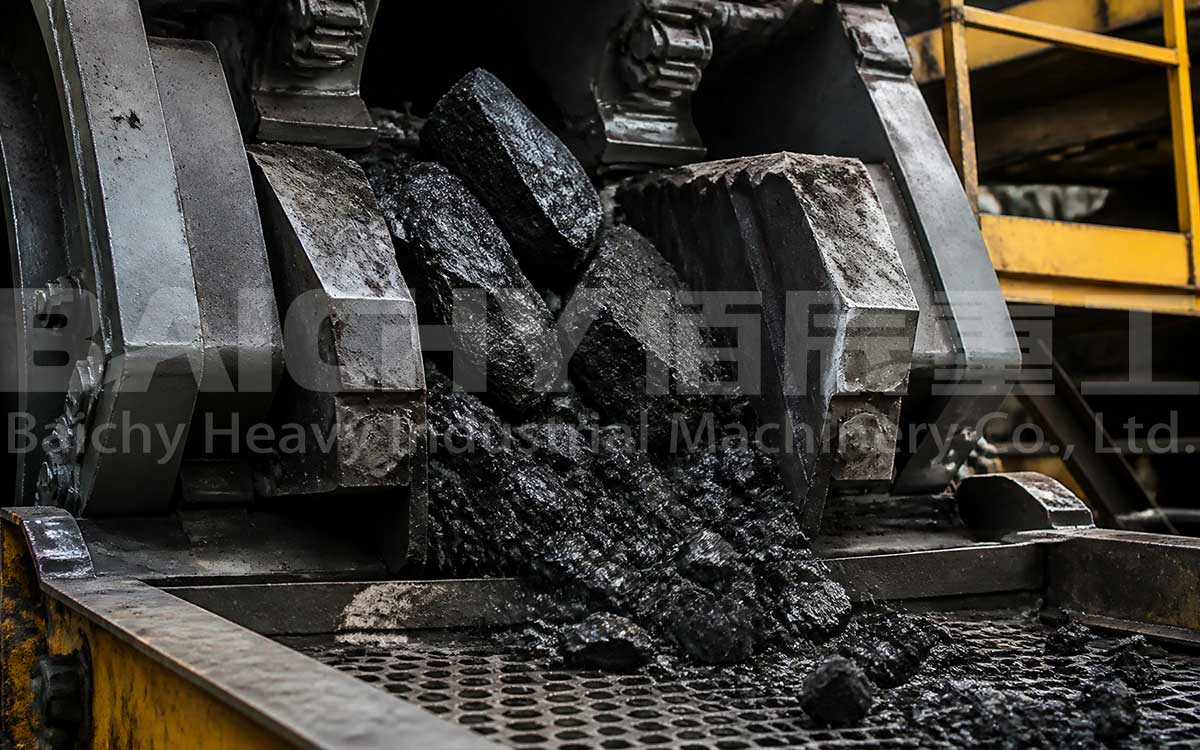
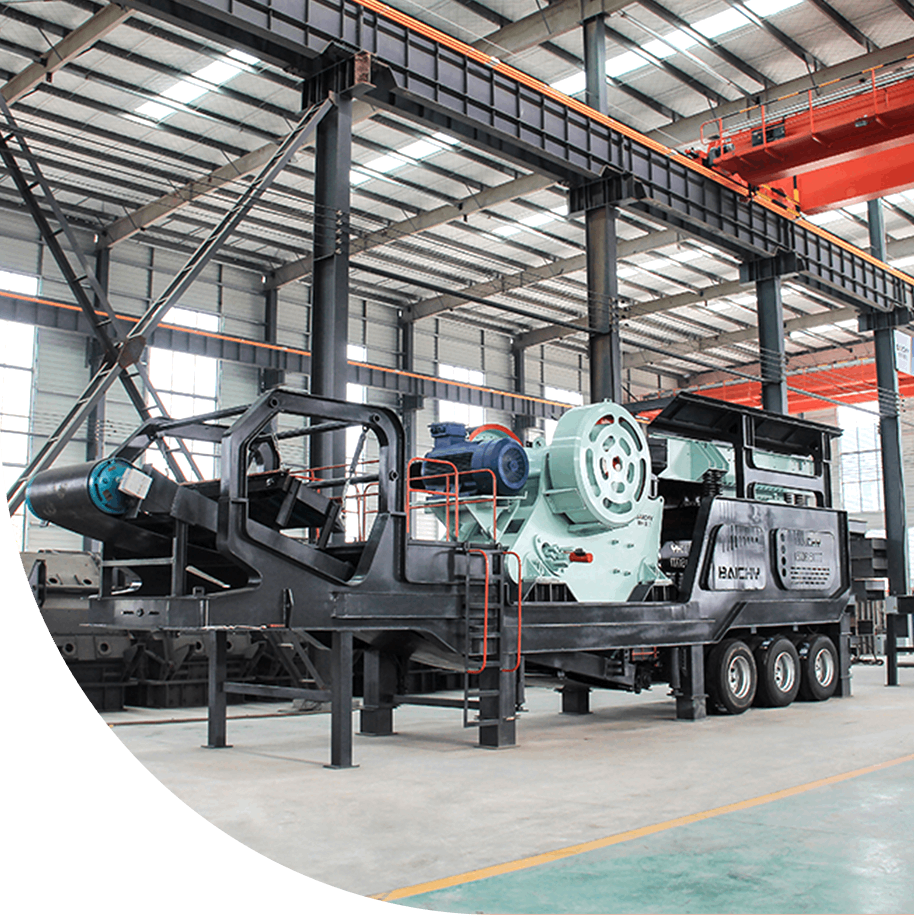
150 TPH coal crushing plant
Protecting the four product streams
The four products should be managed as separate commercial streams. A mass-balance sheet should show feed, finished fractions, fines and recirculation. This clarifies whether 150 TPH means feed throughput or saleable output.
Product quality can be supported by dedicated chutes, separated stockpiles, correct screen loading, sufficient screen area, sampling points and replaceable screen panels. If product sizes change for different customers, confirm the switching frequency before adding adjustable gates or extra storage.
Data required before quotation
The customer should provide coal source and quality range, maximum feed size, moisture and frozen-material conditions, bulk density, four product size ranges, production ratios, permitted fines and oversize, storage or loading requirements, site layout, power data, project location and supply boundary.
With these inputs, the supplier can prepare a preliminary flowsheet, equipment list and budget proposal. Final criteria should be written into the technical specification.
A differentiated supply strategy
Instead of presenting one unexplained equipment price, offer three packages: a basic package with feeder, crusher, screen, conveyors and standard controls; an enhanced winter package with selected dust control, cold-weather features, wear parts, monitoring or training; and an engineering and service package with process design, interface documents, commissioning support, performance testing and training. Each package should list inclusions, exclusions, customer responsibilities and capacity conditions. This shifts the discussion from price alone to production risk and service scope.
Conclusion
A 150 TPH coal crushing and screening plant for four product sizes should be presented as a process solution, not a standalone crusher. The strongest proposal connects product specifications with a clear mass balance, a practical four-way layout and a maintenance plan suited to the local climate.
For a Kazakhstan project, begin with a technical data exchange. Confirm the coal, product cut points, site environment and supply boundary before selecting the final crusher and screen configuration. This reduces the risk of incorrect sizing, product contamination, winter blockages and later commercial changes.
Frequently asked questions
1. Can one 150 TPH plant produce four coal sizes at the same time?
Yes. A properly configured crushing and screening plant can separate coal into four product streams. The arrangement depends on size ranges, product ratios, feed moisture, screen efficiency and whether oversize must return for secondary crushing.
2. Which crusher is best for this coal application?
There is no universal answer before the feed data is confirmed. Selection depends on maximum lump size, coal hardness, abrasiveness, moisture, stickiness and target product size. Capacity alone is not enough.
3. How can the plant handle wet or frozen coal?
The design may include controlled feeding, scalping, suitable screen media, anti-blinding measures, enclosed transfer points and selected cold-weather features. The solution depends on moisture, minimum temperature and frozen-material percentage.
4. Does 150 TPH mean 150 tons of finished product?
Not necessarily. Capacity must be defined as feed throughput, continuous guaranteed capacity or saleable product output. The quotation should state the calculation basis, operating conditions, product split and recirculation load.
5. What information is needed for a reliable quotation?
The key inputs are feed top size, moisture, bulk density, abrasiveness, four product ranges, product ratios, site conditions, power, storage requirements and supply boundary. A representative sample helps when screening behavior is uncertain.
Baichy Heavy Industry
Baichy Heavy Industry is a high-tech mining equipment company integrating R&D, manufacturing, sales, and after-sales service. Focusing on crushing, grinding, and mineral processing equipment, we provide professional solutions to our customers. We are ISO9001:2015 Certified, and our products include mobile crushing palnts, crawler crushing plant, construction waste crushing plants, jaw crushers, sand making machines, cone crushers, fine crushers, grinding mills, ball mills, etc., all with reliable performance to meet diverse project needs.
Baichy Heavy Industry – Your Trusted Partner
To ensure optimal performance of your equipment, Baichy Heavy Industry offers:
- Professional on-site installation guidance
- Comprehensive operator training
- 24/7 technical support & maintenance services
Our complete after-sales service system guarantees long-term, stable operation of your machinery with minimal downtime.
Protect Your Rights – Only Use Official Channels
To avoid scams and ensure authentic support, contact us exclusively through:
• Official Website: www.baichychina.com
• WhatsApp: +8615093222637
• Email: [email protected]
Your satisfaction is our priority – expect prompt, professional service every time.
(Note: Beware of unauthorized third parties claiming to represent Baichy. Always verify through official contacts.)