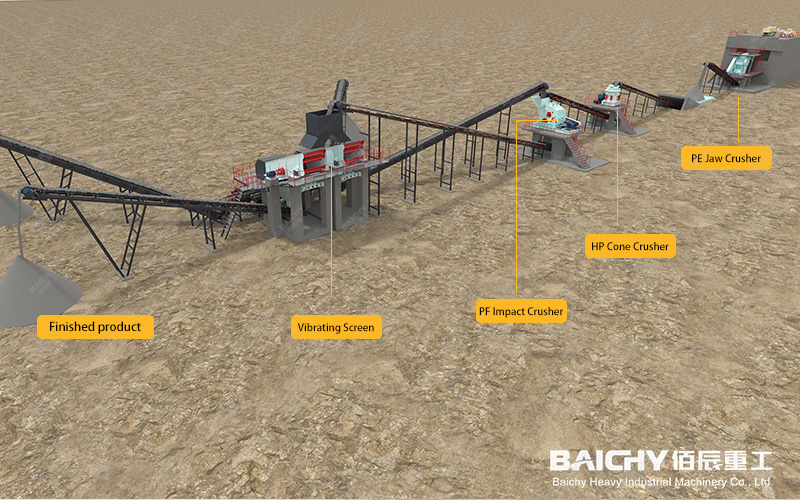
There is a single piding line when selecting secondary crushing equipment: material hardness and abrasiveness. For hard, highly abrasive materials like granite, basalt, and iron ore, cone crushers utilizing inter-particle (lamination) crushing are the choice; for medium-hard, brittle, and low-abrasion materials like limestone, concrete rubble, and asphalt, impact crushers are preferred.
Criterion 1: Establish the line based on hardness and abrasiveness before discussing price.
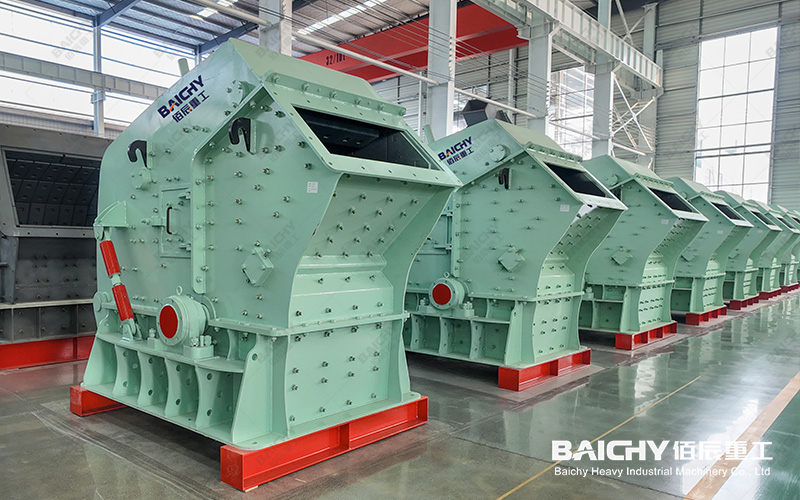
Impact Crusher
Impact crushers operate using impact energy, causing material to fracture along natural cleavage planes; the resulting product is largely cubical with significantly reduced flaky or elongated particle content. They excel at processing limestone, concrete rubble, and asphalt (materials of low-to-medium hardness). The trade-off lies in wear parts: blow bars bear the direct impact, so highly abrasive materials drastically shorten their service life.
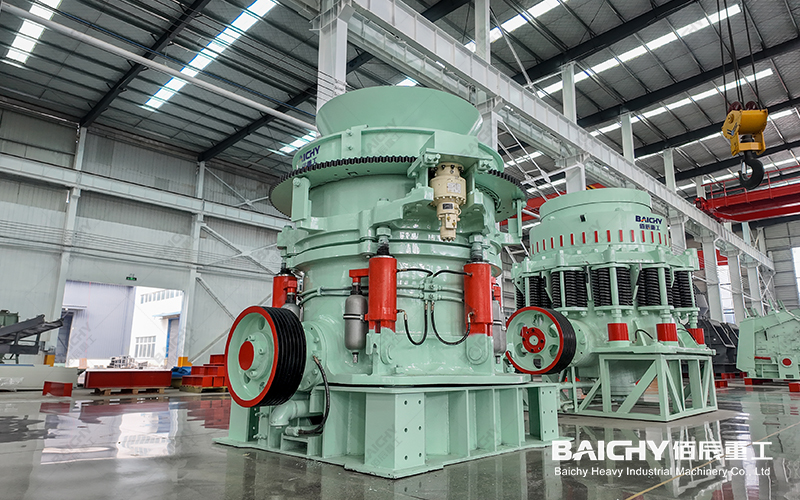
Hydraulic Cone Crusher
Cone crushers employ inter-particle crushing, where material is repeatedly squeezed and ground between the moving and stationary cones within the crushing chamber. They are better suited for hard, abrasive materials like granite and basalt, offering superior wear resistance and longer service life—though the trade-off may be a slightly higher content of flaky or elongated particles in the final product. If one selects a model based solely on price, the initial savings are often offset by the cost of replacing blow bars and liners within the first year of operation.
Criterion 2: The maximum feed opening size for secondary crushing equipment is determined by the actual discharge from the primary crusher.
The feed size must accommodate the actual discharge from the primary jaw crusher, not merely the nominal values listed in product brochures. The maximum feed size specified in technical data sheets is a strict limit: regarding cone crushers, the PYD-1200 spring cone crusher accepts only 50mm, the CS220 (coarse crushing chamber) accepts up to 235mm, and the HP500 (extra-coarse chamber) accepts up to 270mm. Impact crushers offer larger feed openings; for instance, the PFW-1515 European-style impact crusher is rated for a maximum feed size of ≤600mm. At the other end lies the discharge opening, where control methods differ: for cone crushers, the discharge opening is adjustable within a specific range (e.g., 3–15 mm for the PYD-1200, or a minimum of 25 mm for the HP300 in the "extra-coarse" cavity configuration), whereas the output particle size of an impact crusher is regulated by adjusting the gap between the impact plates and the blow bars. The lower the setting within this range, the closer the secondary crushing output is to the final product specification—thereby lightening the load on the tertiary crushing stage—but the trade-off is a reduced capacity to accept large feed material; this represents an irreversible design choice.
Consider two real-world configuration benchmarks: a 100–120 t/h diabase line might pair a PE600×900 jaw crusher with a CS110 or PYB1200 cone crusher, followed by a 4YK1860 vibrating screen; a 200–300 t/h basalt line might pair a C110 jaw crusher with a PFW1320 impact crusher and a 4YK2470 screen. In both secondary crushing scenarios, the distinction lies not in the production capacity figures, but in the requirements for the finished product.
Criterion 3: Tramp iron protection method—determining the frequency of unplanned downtime
The entry of iron objects into the crushing chamber is not an anomaly; it is a routine occurrence. Manufacturer specifications clearly outline the differences in tramp iron protection: spring-type cone crushers rely on heavy-duty spring assemblies surrounding the frame—when a foreign object enters, the immense crushing force compresses the springs, lifting the moving cone and widening the discharge opening; once the object is expelled, the moving cone automatically resets under spring pressure. In contrast, multi-cylinder hydraulic cone crushers utilize a dual-acting hydraulic release system; upon encountering tramp iron, the hydraulic system automatically releases pressure to allow passage and resets after the object is expelled, eliminating the maintenance downtime required by spring-type models. Single-cylinder hydraulic models operate similarly: when uncrushable material enters, system pressure rises, the hydraulic cylinder automatically relieves pressure to create clearance, and the system resets—all without requiring a shutdown.
A single shutdown for clearing obstructions halts the entire conveyor belt system. Money saved during the initial equipment selection phase is often consumed by the costs associated with months of accumulated downtime.
Criterion 4: Chamber type determines output characteristics; feeding method determines production capacity.
The chamber type dictates the particle size distribution. Spring cone crushers offer three types: Standard (medium crushing), Medium (medium-fine crushing), and Short-head (fine or ultra-fine crushing); Symons crushers are similarly categorized into Standard, Medium, and Short-head types. Multi-cylinder hydraulic crushers offer five settings—extra-coarse, coarse, medium, fine, and extra-fine—while single-cylinder hydraulic models feature five settings ranging from Standard to Extra-coarse chambers. Switching between these on the same main unit is achieved by changing the liners: settings closer to the "coarse" end feature larger feed openings and higher throughput, while those closer to the "fine" end yield finer output. Selecting a Short-head chamber effectively performs the fine-crushing stage earlier in the process, but this necessitates a corresponding reduction in maximum feed size—the fact that the PYD-1200 has a maximum feed size of only 50mm is a direct result of this logic.
Production capacity, however, is not determined solely by the chamber type. Multi-cylinder hydraulic cone crushers require "choke feeding" (or full-cavity feeding)—meaning the material level must rise above the distribution plate and be evenly centered; otherwise, uneven liner wear occurs. Similarly, Symons crushers rely on choke feeding to achieve an inter-particle crushing (lamination) effect. The capacity ranges listed in specification charts are contingent upon specific feeding conditions; they are not inherent to the machine upon purchase.
Impact crushers play an additional role here: they also function as aggregate shapers. They can reshape stones with poor particle shapes discharged from cone crushers, thereby enabling a single machine to serve multiple purposes.
Criterion 5: Do not use cone crushers for wet, sticky materials.
This is a hard constraint. Official specifications clearly state that wet, sticky materials are highly prone to clogging the lower section of the crushing chamber (the parallel zone) and the discharge opening. This leads to a sharp drop in output and equipment overload, often necessitating frequent shutdowns for cleaning. Jaw crushers, gyratory crushers, or roll crushers are the preferred choices for handling such materials. Hydraulic cone crushers also have a specific moisture threshold: a feed moisture content exceeding 5% can trigger vibration and noise issues.
Moisture content is not an adjustable parameter but a prerequisite for equipment selection. For projects involving material sources with high moisture or clay content, the pool of suitable secondary crushing equipment changes entirely.
| Model | Structure & Cavity Type | Max. Feed Size (mm) | Discharge Opening (mm) | Capacity (t/h) | Installed Power (kW) | Secondary Crushing Application |
|---|---|---|---|---|---|---|
| PYB-1200 | Spring Cone Crusher - Standard (Medium Crushing) | 145 | 20–50 | 110–200 | 110 | Medium crushing of medium-hard materials; budget-conscious choice |
| PYD-1200 | Spring Cone Crusher - Short-head (Fine Crushing) | 50 | 3–15 | 18–105 | 110 | Fine crushing or sand making; requires pre-crushed feed |
| CS75 | Symons Cone Crusher - Coarse Crushing Cavity | 150 | 25–38 | 59–163 | 75 | Small-to-medium capacity secondary crushing of hard rock |
| CS220 | Symons Cone Crusher - Coarse Crushing Cavity | 235 | 30–60 | 210–530 | 220 | Medium-to-high capacity secondary crushing of hard rock |
| CH430 | Single-cylinder Hydraulic Cone Crusher - Extra-coarse Cavity | 185 | 13–38 | 69–208 | 160 | Moderate crushing requirements; easy maintenance |
| CH660 | Single-cylinder Hydraulic Cone Crusher - Extra-coarse Cavity | 321 | 16–51 | 177–662 | 315 | Large feed size; highly abrasive materials |
| HP300 | Multi-cylinder Hydraulic Cone Crusher - Extra-coarse Cavity | 190 | Min. Discharge Opening: 25 | 220–445 | 220 | High hardness/abrasiveness; strict particle shape requirements |
| HP500 | Multi-cylinder Hydraulic Cone Crusher - Extra-coarse Cavity | 270 | Min. Discharge Opening: 38 | 425–795 | 400 | High-capacity secondary crushing of hard rock |
| PFW-1515 | European-style Impact Crusher - Three-chamber | ≤600 | Adjusted via impact plate gap | 200–400 | 280 | Medium-hard, brittle materials; particle shape shaping |
| PFW-1520 | European-style Impact Crusher (3-chamber) | ≤700 | Adjusted via impact plate clearance | 300–450 | 355 | High capacity for medium-hard materials; dual-purpose machine |
Note: Values in this table are taken from the technical specifications on the official product webpage. Processing capacities are manufacturer-rated values; actual figures should be recalculated based on on-site material testing if material hardness, feed size, or moisture content deviate from rated conditions. For the HP series, the value represents the minimum discharge opening, whereas for other cone crushers, it indicates the adjustment range. For the PFW series, output particle size is regulated by the clearance between impact plates and blow bars; the official website does not specify a range.
VI. FAQ: Common Questions About Secondary Crushing Equipment
Q1: Should I choose a cone crusher or an impact crusher for secondary crushing?
It depends on material hardness and abrasiveness. Choose a cone crusher for hard, highly abrasive materials like granite, basalt, and iron ore; inter-particle (lamination) crushing offers superior wear resistance and longer service life. Choose an impact crusher for medium-hard, brittle, and low-abrasion materials like limestone, concrete blocks, and asphalt; impact crushing breaks material along natural cleavage planes, resulting in better particle shape, though blow bars wear out relatively quickly.
Q2: What is the main difference between spring cone crushers and hydraulic cone crushers?
The method of tramp iron protection. Spring models rely on spring compression to widen the discharge opening and allow the foreign object to pass, automatically resetting afterward. Hydraulic models use hydraulic cylinders to automatically relieve pressure and create clearance, resetting automatically without requiring a shutdown for clearing. Official specifications clarify: spring cone crushers require a shutdown and manual clearing after a tramp iron incident, whereas multi-cylinder hydraulic cone crushers can automatically release the object, clear the crushing chamber, and quickly resume production.
Q3: Can cone crushers process wet, sticky materials?
No, they are unsuitable. Wet, sticky materials easily clog the lower part of the crushing chamber (parallel zone) and the discharge opening, causing a sharp drop in output and equipment overload. Official recommendations suggest using jaw crushers, gyratory crushers, or roll crushers for wet, sticky materials. Additionally, a feed moisture content exceeding 5% can also cause vibration and noise in hydraulic cone crushers.
Q4: How should the crushing chamber type be selected for secondary crushing equipment?
The chamber type determines the particle size output. Spring cone crushers come in Standard (medium crushing), Medium (medium-fine crushing), and Short-head (fine or ultra-fine crushing) types; Symons crushers are categorized into Standard, Medium, and Short-head types; multi-cylinder hydraulic crushers offer five types: Extra-coarse, Coarse, Medium, Fine, and Extra-fine; and single-cylinder hydraulic crushers feature five standard chamber configurations ranging from Standard to Extra-coarse. Chambers designed for coarser output have larger feed openings and higher processing capacities, while those for finer output yield smaller particles; the chamber type can be switched on the same main unit simply by changing the liners.
Q5: How do the processing capacities of the HP300 and PFW-1515 compare, given that both are secondary crushers?
Official specifications list the HP300 (Extra-coarse chamber) at 220–445 t/h with 220 kW installed power (max. feed size: 190 mm), while the PFW-1515 is rated at 200–400 t/h with 280 kW installed power (max. feed size: ≤600 mm). Although their capacity ranges overlap, they differ in feed opening size and material suitability: the HP300 handles harder and finer feed material, whereas the PFW-1515 can process medium-hard, brittle material up to 600 mm in size. Selection should not be based solely on capacity figures; one must also consider feed lump size, material hardness, and requirements for the final product's particle shape.
Baichy Heavy Industry
Baichy Heavy Industry is a high-tech mining equipment company integrating R&D, manufacturing, sales, and after-sales service. Focusing on crushing, grinding, and mineral processing equipment, we provide professional solutions to our customers. We are ISO9001:2015 、certified, and our products include mobile crushing palnts, crawler crushing plant, construction waste crushing plants, jaw crushers, sand making machines, cone crushers, fine crushers, grinding mills, ball mills, etc., all with reliable performance to meet diverse project needs.
Baichy Heavy Industry – Your Trusted Partner
To ensure optimal performance of your equipment, Baichy Heavy Industry offers:
- Professional on-site installation guidance
- Comprehensive operator training
- 24/7 technical support & maintenance services
Our complete after-sales service system guarantees long-term, stable operation of your machinery with minimal downtime.
Protect Your Rights – Only Use Official Channels
To avoid scams and ensure authentic support, contact us exclusively through:
• Official Website: www.baichychina.com
• WhatsApp: +8615093222637
• Email: [email protected]
Your satisfaction is our priority – expect prompt, professional service every time.
(Note: Beware of unauthorized third parties claiming to represent Baichy. Always verify through official contacts.)