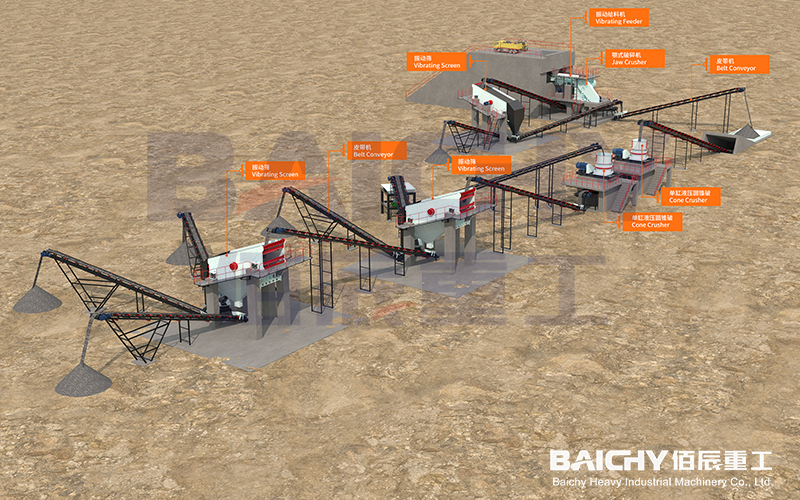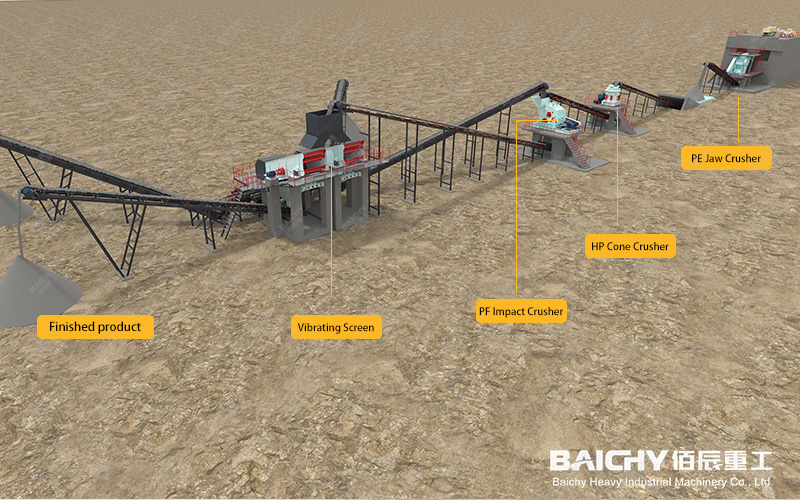

Screening Production Line
The success or failure of a four-grade aggregate screening production line depends 80% on the screening process rather than the crusher. The reason is compelling: an *n*-deck screen yields at most *n* oversize products plus one undersize product. To simultaneously produce four grades—0–5mm, 5–10mm, 10–20mm, and 20–31.5mm—the screen must have four decks. If one deck is missing, the fourth grade can only be obtained through secondary handling, ultimately driving up the cost per ton.
I. Four-grade material requires a 4-deck screen, not a 3-deck screen plus secondary handling
The number of decks in a crushed stone screening line corresponds to the number of finished product grades it produces. Standard YK circular vibrating screens are rated for 2–4 decks: the first deck cuts the upper limit, the second, third, and fourth decks make successive cuts, and the material passing through the final deck constitutes the finest grade. The value of a multi-deck vibrating screen lies not in the sheer volume of material screened, but in completing the screening process in a single pass.
An easily overlooked fact: for a screen surface of the same 6000×1800mm size, the rated capacity for both the 3YK1860 and 4YK1860 models is 65–586 t/h, while their motor powers are 22kW and 30kW, respectively. Spending an extra 8kW to obtain an additional product grade does not increase total tonnage—processing capacity is determined by screen dimensions and amplitude, and screening efficiency depends on operating conditions, neither of which is affected by the number of decks. Therefore, adding a deck is always more cost-effective than installing an additional screening stage: the former involves an incremental power increase of 8kW, whereas the latter incurs the recurring power consumption of an entire conveyor system.
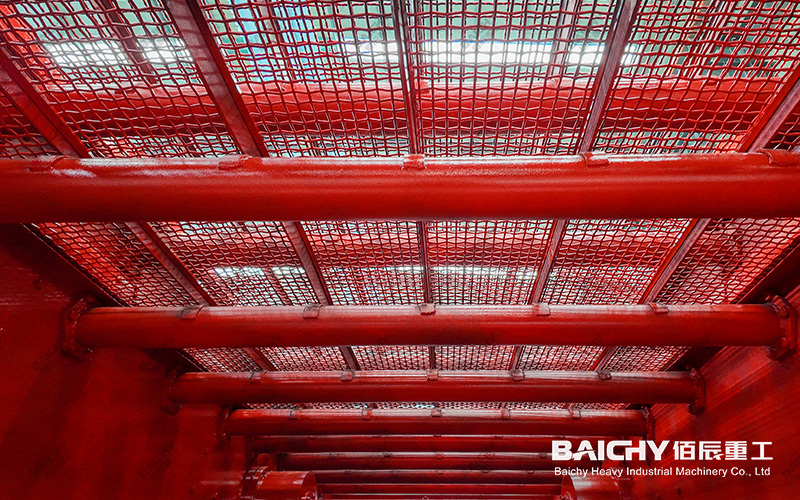
Vibrating screen mesh
II. 0–5mm material
While the four "cuts" performed by a multi-deck vibrating screen have clearly defined roles, the difficulty involved in each varies significantly. The 31.5mm and 20mm cuts are coarse separations; because the particle sizes differ substantially from the aperture sizes, the probability of passing through is high and the load on the screen surface is light—these two cuts rarely fail. The real challenges lie in the lower two cuts.
The 10mm cut represents a narrow size range. Only a single screen layer separates the 5–10mm and 10–20mm fractions; if material from one grade mixes into the other, the batch is rendered useless. Ready-mix concrete plants are extremely sensitive to the particle size distribution of these two grades, and any deviation in aggregate gradation results in rejected loads.
The 5mm size is a critical threshold. Particles close to the screen aperture size bounce repeatedly across the screen surface, competing for effective screening area. When moisture content rises, the 5mm mesh tends to blind (clog), causing fine materials to agglomerate at the critical aperture and leading to a precipitous drop in screening efficiency. While the manufacturer rates the circular vibrating screen's efficiency at over 90%, this assumes normal operating conditions—excluding wet, sticky, or high-clay feedstocks.
If this specific screen layer is inaccurate, the aggregate gradation across the entire production line will yield two off-spec products simultaneously: coarse particles contaminating the 0–5mm fraction, and sand contaminating the 5–10mm fraction.
A dual-strategy approach is required for screening media: use polyurethane screens for dry processing (the manufacturer offers woven wire, perforated plate, and polyurethane options, with service lives ranging from 3 to 12 months); switch immediately to wet processing when feedstock moisture or clay content is high, utilizing an integrated sand washing and dewatering machine (rated capacity: 50–300 t/h; post-dewatering moisture content: ≤15%). Set the screen deck inclination angle between 15° and 25°, as recommended in the manufacturer's
III. Screen Configuration and Material Flow for Finished Product Grades 3 and 4
The relationship between the four aggregate grades and the deck positions of the multi-layer vibrating screen is shown in the table below:
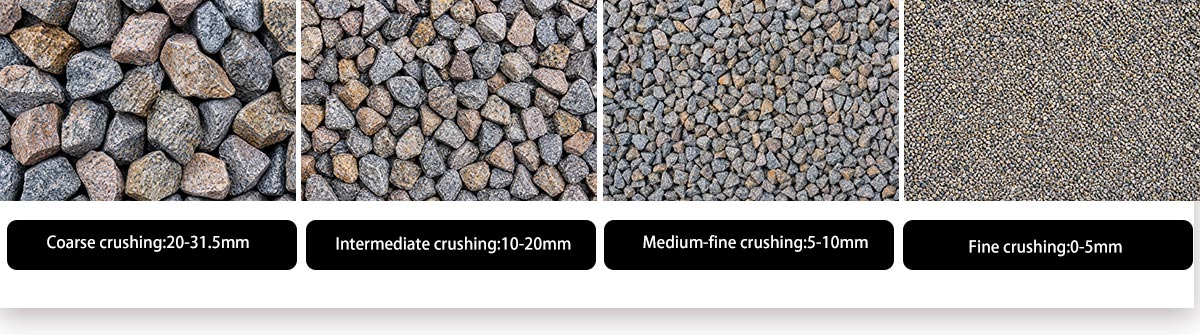
Grading of four aggregate fractions (0–5, 5–10, 10–20, and 20–31.5 mm)
| Finished Product Grade | Screen Aperture (mm) | Deck Position | Material Flow | Success/Failure Criteria for This Grade |
|---|---|---|---|---|
| 20–31.5 mm | 31.5 (1st deck) | Retained on 2nd deck | Direct discharge | Upper limit determined by secondary crusher's closed-side setting; failure to screen out results in the entire batch becoming oversize return material. |
| 10–20 mm | 20 (2nd deck) | Retained on 3rd deck | Direct discharge | Shares throughput with the 20–31.5 mm grade via the 2nd deck; both grades must be calculated simultaneously. |
| 5–10 mm | 10 (3rd deck) | Retained on 4th deck | Direct discharge | A narrow intermediate grade; contamination by return material renders the batch unusable. |
| 0–5 mm | 5 (4th deck) | Passed through 4th deck | Direct discharge; sent to sand washing/dewatering if wet processing | Closest to the critical aperture size; high moisture content causes screen blinding. |
| >31.5 mm (Oversize) | — | Retained on 1st deck | Returned for re-crushing (closed circuit) | Failure to close the circuit results in oversize material contaminating the finished product. |
Note: Aperture sizes are configured based on the upper limit of each grade; specific dimensions are confirmed by engineers after trial screening, accounting for source rock lithology and moisture content. Production capacity is rated for medium-hardness aggregate; calculations are adjusted based on on-site trial screening data if moisture or silt content deviates from rated conditions.
IV. Screen Selection Based on "Feed-to-Screen" Volume, Not Finished Product Volume
A common error in selecting equipment for crushed stone screening lines is equating finished product volume directly with the screen's processing capacity. The true load on the screen is the "feed-to-screen" volume—the total material entering the screen (including return material)—rather than the final volume of finished product loaded for transport.
There is only one chain of criteria: Total finished product volume → Add oversize return material → Add water volume (for wet processing) → Determine feed-to-screen volume → Select model based on the median range of the screen's rated capacity. If the wrong screening machine model is selected, the product size distribution across the entire screening line will inevitably deviate from specifications.
How is the material recirculation volume estimated? Official specifications claim a screening efficiency of over 90% for circular vibrating screens; based on the calculation 1 − 0.90 = 0.10, theoretically, about 10% of the qualified material fraction is carried into the oversize stream and returned to the crusher along with the recirculating load. This is the source of the circulating load: it is not a malfunction but an inherent cost of the screening process—yet it must be factored into the selection of conveyor belts and secondary crushers. This article does not introduce specific recirculation coefficients; actual values should be determined through on-site test screening.
V. Different approaches for the two ends of the size range
20–31.5 mm relies on crushing; 0–5 mm relies on recovery.
The strategies for the two ends of a four-fraction screening line differ completely.
1. The upper limit of the 20–31.5 mm fraction is determined by the crusher's cavity profile, not the screen itself. The screen is responsible for "separation," not "creation." If the secondary crusher's closed-side setting (CSS) is too wide, oversized material will carry all the way to the top screen deck and become recirculating material, effectively doubling the circulating load. The upper size fraction must be determined in conjunction with the secondary crusher's CSS—a fact illustrated by the configuration differences between an 80–150 t/h line (PE600×900 + 3YK1860; products: 5–10, 10–20, 16–31.5 mm) and a 150–200 t/h line (PE750×1060 + 4YK2160): when the production capacity tier changes, both the number of screen decks and the screen width must be adjusted accordingly.
2. The cost associated with the 0–5 mm fraction lies not in the screen itself, but in the "lost sand." In wet processing, fine sand is carried away by the water; failing to recover it is tantamount to washing money down the drain. Fine sand recovery machine specifications: Capable of recovering particles larger than 0.075 mm, with an optimal recovery range of 0.15–0.6 mm. It achieves a recovery rate of 85–95%, reduces material loss to under 5%, and enables a water recycling rate exceeding 95%; its processing capacity should exceed the sand washer's output by 20–30%. Whether the aggregate gradation meets standards often hinges on the recovery rate at this stage.
Enclosure and dust suppression are the minimum compliance requirements for a four-grade production line. The YK series circular vibrating screen features a fully enclosed structure to prevent dust leakage and operates at noise levels below 85 decibels. Failure to enclose multiple transfer points often leads to rejection during environmental compliance inspections.
VI. FAQ: Common questions regarding four-grade aggregate screening lines
Q1: How many screen decks are needed to simultaneously produce four grades of material (0–5, 5–10, 10–20, and 20–31.5 mm)?
Four decks. An *n*-deck screen produces *n* "oversize" (retained) products plus one "undersize" (passed) product: the first deck cuts at the 31.5 mm upper limit, while the second, third, and fourth decks cut at 20 mm, 10 mm, and 5 mm, respectively. Omitting a deck means losing a grade; the missing grade can only be recovered through secondary handling.
Q2: What is the difference in output between the 3YK1860 and 4YK1860 models, given there is only a one-deck difference?
According to official specifications, both models share the same production capacity range (65–586 t/h); the difference lies in motor power (22 kW vs. 30 kW). An extra deck yields an additional product grade, not an increase in total tonnage.
Q3: At what level of moisture or clay content is wet screening mandatory?
Wet screening should be adopted when 5 mm screen meshes begin to blind (clog) and the gradation or moisture content of the finished sand becomes uncontrollable. This involves using an integrated sand washing and dewatering machine, which offers a processing capacity of 50–300 t/h and reduces post-dewatering moisture content to ≤15%. The specific switch-over point should be determined based on test screening data from the material source, rather than estimated using rule-of-thumb values.
Q4: What does a screening efficiency of 90% mean?
It means that, theoretically, approximately 10% of the material within the target size range (1 − 0.90 = 0.10) will be carried over into the oversize return stream, becoming part of the circulating load. This portion must be factored into calculations for the total feed rate to the screen and the sizing of the secondary crusher; calculations should not be based solely on the final product output.
Q5: How can fine sand loss be controlled when processing the fourth-grade material via the wet method?
Use a fine sand recovery unit for classified recovery: this system can recover particles larger than 0.075 mm (ideally 0.15–0.6 mm) with a recovery rate of 85–95%, keeping losses below 5%. The processing capacity of the recovery unit should exceed the sand washer's output by 20–30%.
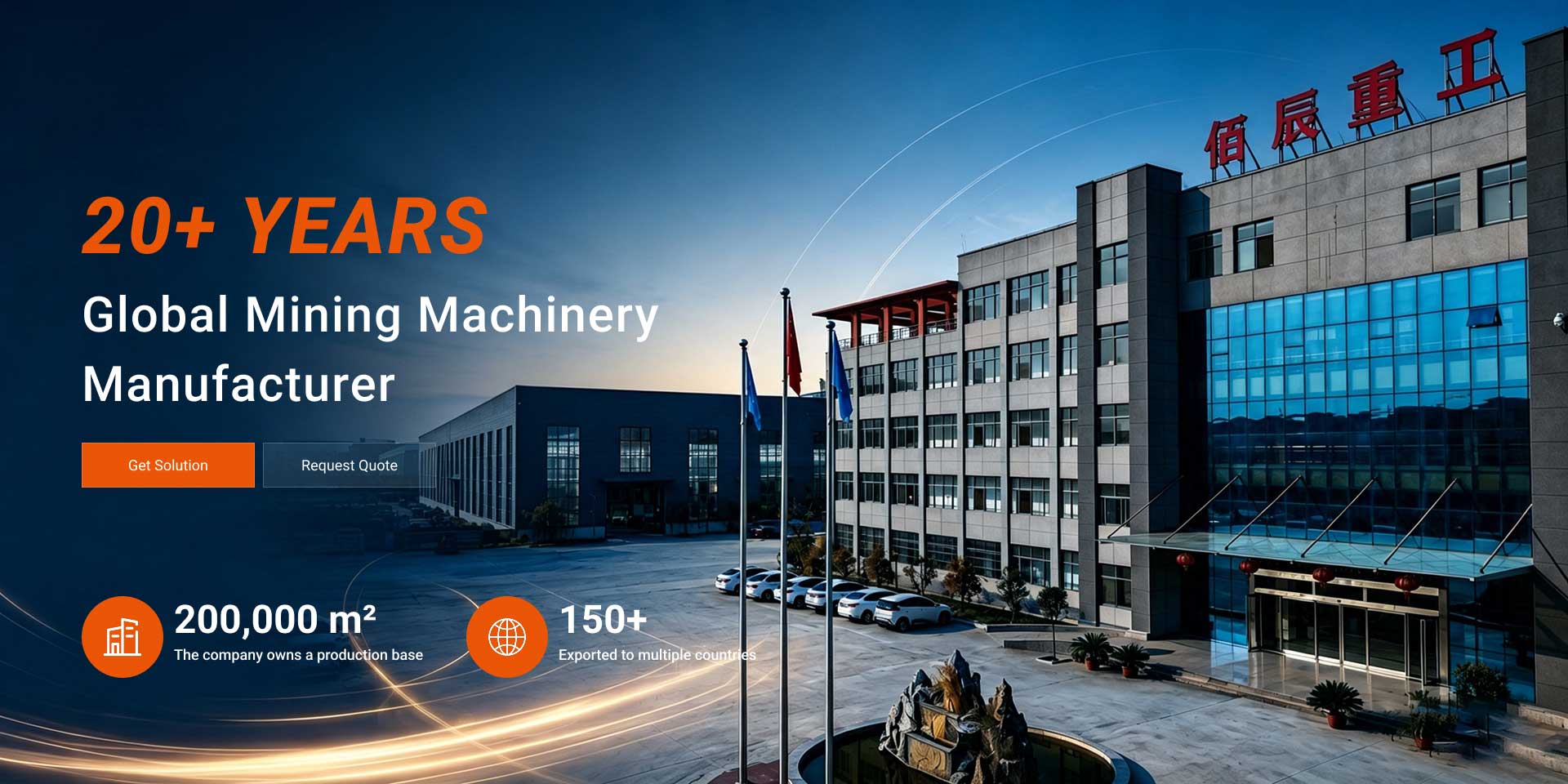
Baichy Heavy Industry
Baichy Heavy Industry is a high-tech mining equipment company integrating R&D, manufacturing, sales, and after-sales service. Focusing on crushing, grinding, and mineral processing equipment, we provide professional solutions to our customers. We are ISO9001:2015 、certified, and our products include mobile crushing palnts, crawler crushing plant, construction waste crushing plants, jaw crushers, sand making machines, cone crushers, fine crushers, grinding mills, ball mills, etc., all with reliable performance to meet diverse project needs.
Baichy Heavy Industry – Your Trusted Partner
To ensure optimal performance of your equipment, Baichy Heavy Industry offers:
- Professional on-site installation guidance
- Comprehensive operator training
- 24/7 technical support & maintenance services
Our complete after-sales service system guarantees long-term, stable operation of your machinery with minimal downtime.
Protect Your Rights – Only Use Official Channels
To avoid scams and ensure authentic support, contact us exclusively through:
• Official Website: www.baichychina.com
• WhatsApp: +8615093222637
• Email: [email protected]
Your satisfaction is our priority – expect prompt, professional service every time.
(Note: Beware of unauthorized third parties claiming to represent Baichy. Always verify through official contacts.)