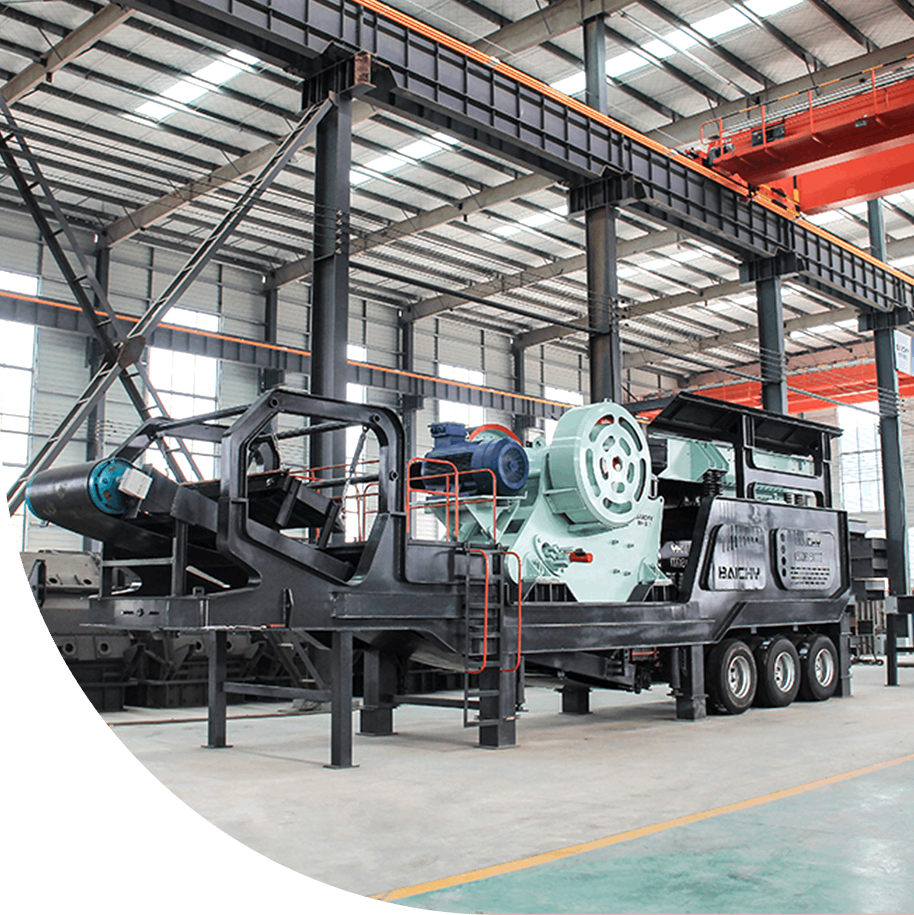

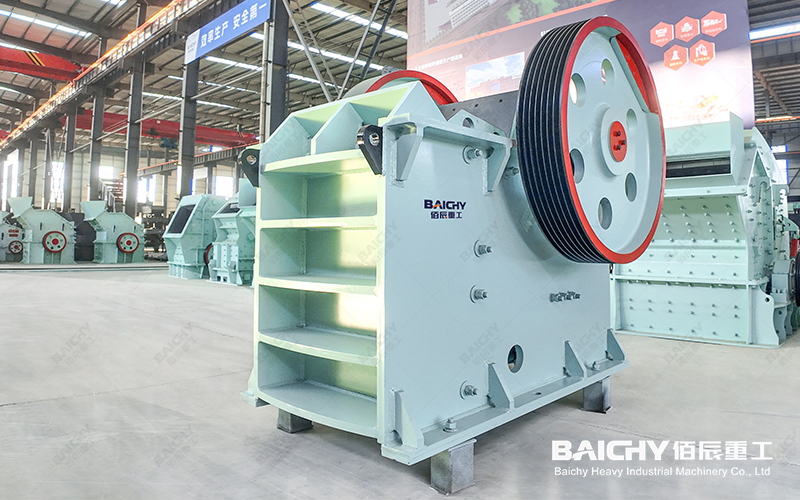
PE600x900 Jaw Crusher
Can the PE600×900 jaw crusher handle an output of 150 tons per hour? The problem isn't the machine itself, but rather the mistake of "blindly copying a soft-rock processing line configuration." The official rating is 90–180 t/h; 150 t/h falls in the upper-middle range (specifically at the two-thirds mark). While there is some capacity headroom, there isn't enough margin to treat the lower limit loosely. The real risk lies in basing output calculations solely on the discharge opening setting: choose the wrong setting, and the production line will fail to meet output targets on the very day of acceptance.
Baichy's own product classification confirms this: the PE600×900 is paired with 80–150 t/h lines, whereas 150–200 t/h lines step up to the PE750×1060. The 150 t/h figure sits right at the boundary between these two categories.
I. Why does the output of the same machine vary twofold?
The official website lists two figures for this machine: a discharge opening adjustment range of 60–125 mm and a production capacity of 90–180 t/h. The span of both ranges is nearly identical (ratios of ~2.08 and 2.00, respectively). This indicates that the 90–180 t/h range is not a fixed specification but a function of the discharge opening size. A machine set to a 60 mm opening operates very differently from one set to 125 mm—effectively making them two different machines.
The capacity listed in the parameter table is a nominal rating, whereas the figure achieved on-site is the actual measured output; the gap between the two is determined by the discharge opening, feed gradation, and material strength. Before using a capacity figure for a price quote, the discharge opening setting must be determined first.
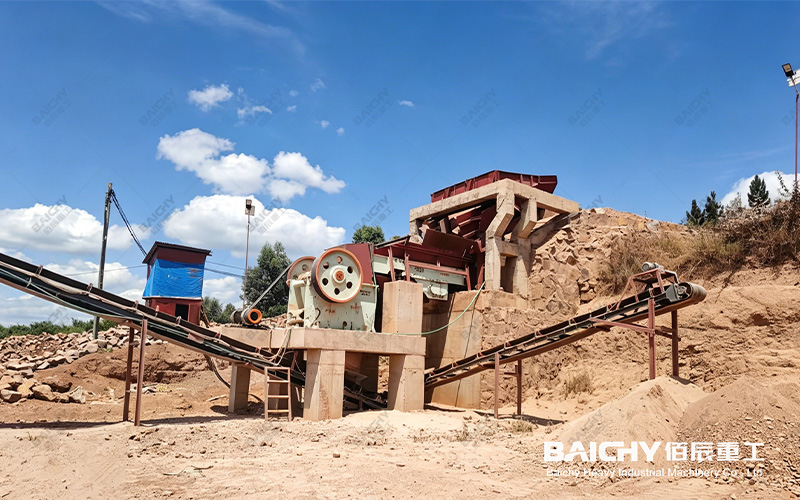
69 Jaw Crusher Crushing Production Line in Rwanda
II. Crushing granite, river pebbles, and basalt: each presents unique bottlenecks
Granite: The official website specifies that this model is suitable for crushing ores and rocks with a compressive strength of 147–245 MPa. Jaw crushers should be used solely for primary (coarse) crushing; do not aim for an excessive reduction ratio—secondary and subsequent crushing stages should utilize cone crushers that employ inter-particle (layer) crushing. Using impact crushers for granite results in significantly higher wear costs.
River pebbles: Their smooth surfaces offer few grip points for jaw plates, making it difficult to maintain stable throughput compared to angular materials; furthermore, natural river pebbles often contain clay and have high moisture content, necessitating a pre-screening stage at the feed end. Baichy’s standard 300–350 t/h river pebble sand-making line utilizes a C110 jaw crusher paired with a CS220 cone crusher.
Basalt: Among the three materials, basalt is the most abrasive, making jaw plates a major consumable expense. Recommended strategies include using reversible jaw plates and high-manganese steel materials to amortize the cost of inpidual plate replacements. Baichy offers two configurations for basalt lines: a 200–300 t/h line featuring a PFW1320 impact crusher, and an 800–300 t/h line combining an HPC500 cone crusher with a PFW1515 impact crusher. The choice depends on the required product gradation and the budget for wear-related costs, rather than a rigid rule that "hard rock requires a cone crusher."
All three materials share the characteristics of high hardness and the need to avoid excessive reduction ratios; however, they differ in abrasiveness and clay content. These factors dictate the budget for wear parts and the necessity of pre-screening, rather than determining whether or not a jaw crusher should be used.
III. PE600×900 Technical Specifications
| Model | Feed Opening Size (mm) | Max. Feed Size (mm) | Discharge Opening Adjustment Range (mm) | Production Capacity (t/h) | Motor Power (kW) | Overall Dimensions (mm) |
|---|---|---|---|---|---|---|
| PE500×750 | 500×750 | 425 | 50–100 | 40–130 | 45 | 2150×1900×1950 |
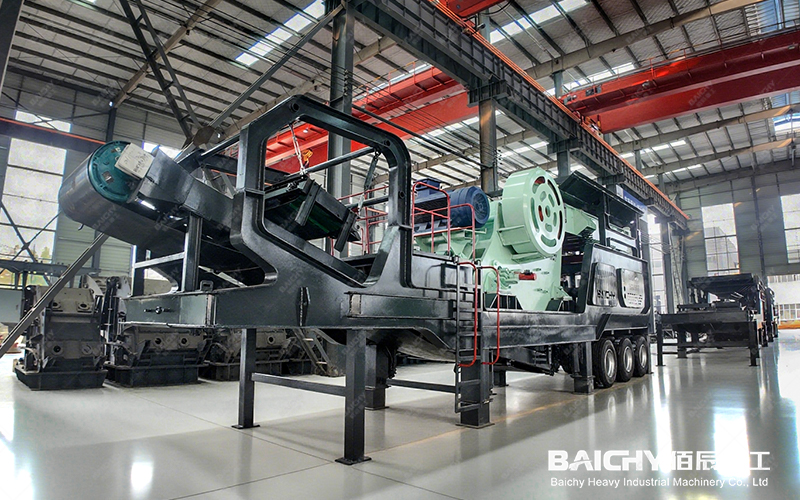
| PE600×900 | 600×900 | 500 | 60–125 | 90–180 | 55 | 2500×2010×2350 |
| PE750×1060 | 750×1060 | 630 | 60–150 | 110–380 | 110 | 2630×2310×3110 |
Note: Values are taken from the specification table on the Baichy official website's PE jaw crusher product page; the original note states, "Output varies depending on factors such as material type and feed particle size." This text does not cite any unpublished hard-rock conversion factors; actual output should be based on on-site trial run data.
IV. How to Configure a 150 t/h Production Line: Only One Criterion Matters
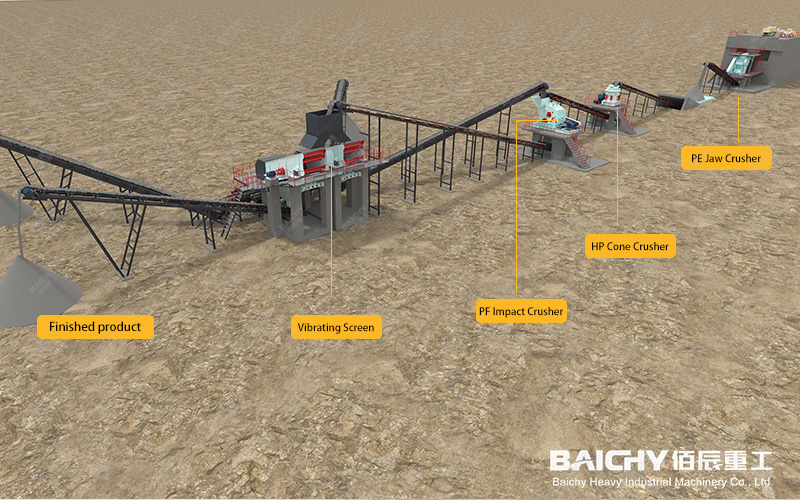
The 150 t/h figure represents the output of the primary crushing stage and the input for the secondary stage; the secondary stage must be selected based on a throughput of 150 t/h, rather than the final finished product volume.
The engineering implication of this criterion is: set the primary crusher for a coarser output, ensure the secondary crusher operates at full capacity, and use screening to manage the final product distribution. By producing a coarser output in the primary stage, the material bed thickness required for inter-particle (lamination) crushing in the secondary stage is achieved; if the secondary crusher model is undersized, the output of the entire production line will be bottlenecked.
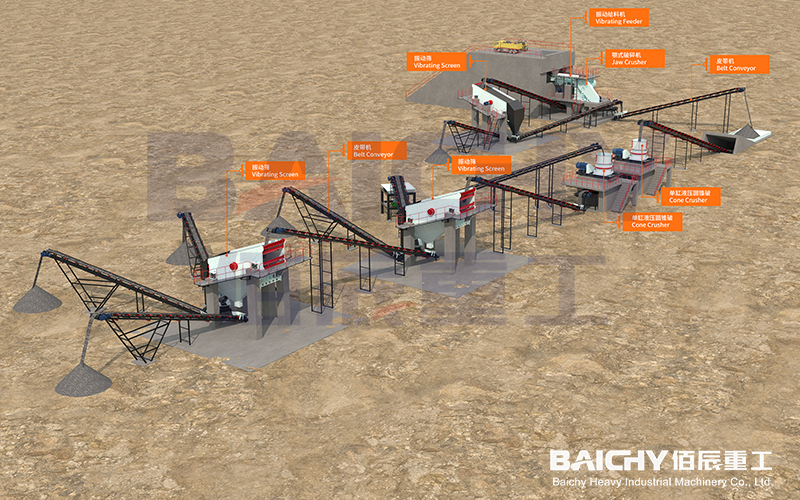
• Feeding: 100–120 t/h lines are equipped with the 9638 feeder; 150–250 t/h lines use the 1142 feeder. For the 150 t/h capacity—falling between these two ranges—calculations should be based on peak throughput.
• Primary Crushing: PE600×900; maximum feed size of 500 mm; discharge opening set to the wider end of the 60–125 mm range (leaving the task of size separation to the screening stage).
• Secondary Crushing: Refer to Baichy’s existing line designs, such as the 100–120 t/h diabase line (using CS110 or PYB1200 cone crushers) or the 300–350 t/h river pebble line (using CS220 cone crushers). The specific model for a 150 t/h line must be calculated by engineers based on material strength and the required product gradation.
• Screening: 4YK1860 for 100–120 t/h lines; 3YK1860 for 80–150 t/h crushed stone lines; 4YK2470 for 150–250 t/h lines. Screen deck load calculations must account for the total feed volume, including recirculated material.
V. Three Pitfalls to Avoid When Selecting Jaw Crushers
1. Don't sacrifice performance for output by manipulating the discharge opening. Narrowing the opening to 60 mm to increase the yield of fines causes both production capacity and jaw plate lifespan to drop; furthermore, the secondary crushing stage loses inter-particle (lamination) crushing efficiency because the feed material is too fine.
2. Don't copy configurations designed for soft rock. A 100–120 t/h limestone line might use a PF1214 impact crusher, but using that same model for granite results in exorbitant wear-part costs; for hard rock applications, refer to the diabase line configuration instead.
3. For 150 t/h lines, include a contingency plan for capacity scaling (stepping up or down). For Baichy's own 150–250 t/h granite processing lines, the primary crushing stage utilizes the PE750×1060 paired with the HP300. If the target product gradation is on the finer side, or if the raw material lump size frequently approaches the 500mm upper limit, opting directly for the PE750×1060 (rated at 110–380 t/h, 110 kW) is more cost-effective than using a PE600×900 jaw crusher and adding a secondary crushing stage.
VI. FAQ: Common questions regarding the PE600×900 jaw crusher achieving 150 t/h
Q1: Is an hourly output of 150 t/h considered "running at full capacity" for the PE600×900 jaw crusher when processing granite?
It falls into the upper-middle range of its capacity. The official rating is 90–180 t/h; 150 t/h sits at the two-thirds mark ((150−90)&pide;(180−90)≈0.67). To maintain this output steadily, the discharge opening needs to be set toward the wider end of the 60–125mm range.
Q2: Why is it harder to consistently achieve rated output when crushing river pebbles compared to granite?
River pebbles have smooth surfaces and offer fewer "bite points" for the jaw plates, making it difficult to stabilize throughput at a given discharge setting. Additionally, natural river pebbles often have higher clay and moisture content, requiring pre-screening at the feed end.
Q3: For the secondary crushing stage of basalt, should one choose an impact crusher or a cone crusher?
Both approaches are viable. Baichy’s 200–300 t/h basalt lines use the PFW1320 impact crusher, while the 800 t/h lines combine the HPC500 cone crusher with the PFW1515 impact crusher. The choice depends on product gradation requirements and the budget regarding material abrasiveness.
Q4: The PE600×900 jaw crusher has a maximum feed size of 500mm; can it accept 550mm raw material?
It is not recommended. The maximum feed size is a strict limit; exceeding it can cause material blockages and overload the toggle plate. The product specifications clearly state that the toggle plate doubles as a safety mechanism—acting like a shear pin—designed to break first when encountering uncrushable material, thereby protecting the main unit.
Q5: When should one skip directly to the PE750×1060 model when selecting a jaw crusher?
Opt for the PE750×1060 (rated at 110–380 t/h, 110 kW) if you require long-term stable operation at a capacity of 150 t/h, need a finer product gradation, or if the raw material lump size frequently approaches the 500 mm upper limit.
Baichy Heavy Industry
Baichy Heavy Industry is a high-tech mining equipment company integrating R&D, manufacturing, sales, and after-sales service. Focusing on crushing, grinding, and mineral processing equipment, we provide professional solutions to our customers. We are ISO9001:2015 、certified, and our products include mobile crushing palnts, crawler crushing plant, construction waste crushing plants, jaw crushers, sand making machines, cone crushers, fine crushers, grinding mills, ball mills, etc., all with reliable performance to meet diverse project needs.
Baichy Heavy Industry – Your Trusted Partner
To ensure optimal performance of your equipment, Baichy Heavy Industry offers:
- Professional on-site installation guidance
- Comprehensive operator training
- 24/7 technical support & maintenance services
Our complete after-sales service system guarantees long-term, stable operation of your machinery with minimal downtime.
Protect Your Rights – Only Use Official Channels
To avoid scams and ensure authentic support, contact us exclusively through:
• Official Website: www.baichychina.com
• WhatsApp: +8615093222637
• Email: [email protected]
Your satisfaction is our priority – expect prompt, professional service every time.
(Note: Beware of unauthorized third parties claiming to represent Baichy. Always verify through official contacts.)