
 \
\
40 t/h crushing and screening production line
For a 40 t/h crushing and screening production line, the models of the two main machines are not selected based simply on the "40 t/h" figure: the primary crusher is chosen based on the maximum feed size of the raw ore, while the secondary crusher is selected based on the material's abrasiveness. For limestone or dolomite with a maximum feed size of ≤340 mm, the PE400×600 jaw crusher(inlet 400×600 mm; rated capacity 16–60 t/h; 30 kW) is the economical choice. However, if the material switches to hard rock like granite or basalt, the same machine's capacity—originally rated for limestone at a bulk density of 1.6 t/m³—drops to just 16–35 t/h, causing a shortfall against the 40 t/h target; consequently, the primary crusher must be upgraded to a PE500×750 model. The same logic applies to the secondary stage: a PEX250×1000 fine jaw crusher suffices for medium-soft rock, whereas hard rock requires a cone crusher with a 900 mm head diameter. Furthermore, due to the closed-circuit return of oversize material, the secondary crusher and screen must actually handle a throughput of 47 t/h rather than 40 t/h. The difference in investment costs for such small-scale production lines largely hinges on these equipment selection decisions.
I. Three ways to calculate "40 t/h"
Nameplate rating, actual operational capacity, and throughput
In procurement documents, the "40 t/h" rating for a crushing and screening line can refer to three completely different concepts:
• Nameplate rating: Capacity figures in crusher brochures are based on medium-hard limestone with a bulk density of approximately 1.6 t/m³.
• Actual operational capacity: This requires applying a multiplier of 0.75–0.85 for hard rock and 0.85–0.95 for medium-soft rock.
• Throughput: In a closed-circuit screening setup, oversize material retained on the screen is returned to the secondary crusher for further processing. With an oversize rate of 15%, the secondary crusher and screen must actually handle a load of 40 &pide; 0.85 ≈ 47 t/h. Disputes regarding the 40 t/h capacity tier most frequently arise when the initial rated figure is the only one discussed, yet the actual output fails to match the third figure (the verified capacity) during acceptance testing. Acceptance criteria should be anchored to the actual measured output over a continuous period of operation.
II. Primary Crusher Selection
Base the choice on maximum raw ore lump size, not just the 40 t/h capacity rating.
The width of the jaw crusher's feed opening must be at least 1.18 times the maximum raw ore lump size (calculated as: max lump size &pide; 0.85). If this ratio is insufficient, large lumps will cause bridging at the feed opening—a scenario characterized by the equipment functioning correctly but failing to achieve the target output.
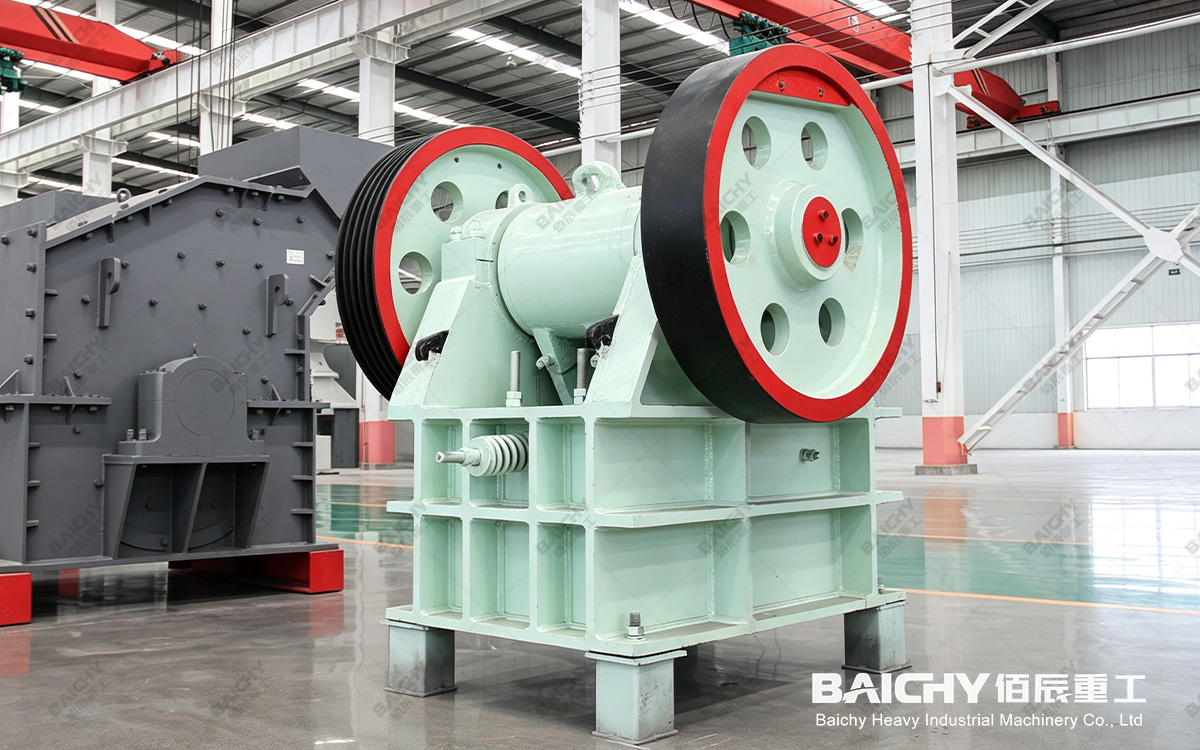
PE400x600 Jaw Crusher
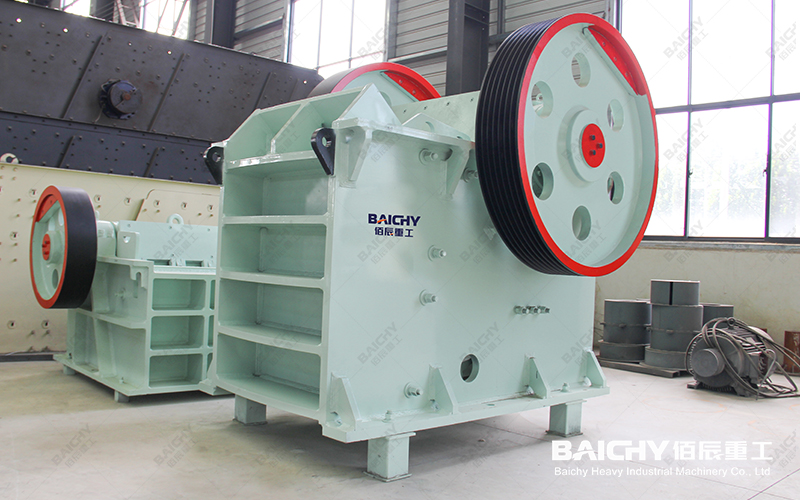
PE500x750 Jaw Crusher
| Model | Feed Opening (mm) | Max Feed Size (mm) | Rated Capacity (t/h) | Motor (kW) | Position within the 40 t/h Tier |
|---|---|---|---|---|---|
| PE400×600 Jaw Crusher | 400×600 | ≤340 | 16–60 | 30 | Mid-range for limestone; 16–35 t/h for hard rock (under-capacity) |
| PE500×750 Jaw Crusher | 500×750 | ≤425 | 50–100 | 55 | 40–80 t/h for hard rock; 40 t/h falls at the lower end of the range, allowing for full-shift operation |
If the raw ore is ≤340 mm and relatively soft, the PE400×600 jaw crusher is the most economical choice for this tier; the unit has a net weight of approximately 6.5 tons, and a single 20GP container can accommodate the main components of the entire processing line (including the feeder, vibrating screen, and conveyor), making logistics costs a major advantage. However, if the raw ore exceeds 340 mm, or if the material is granite or basalt, one must step up to the PE500×750 jaw crusher; attempting to force the smaller model to handle such material results in drastically reduced jaw plate lifespan and frequent bridging at the feed opening. The discharge opening should ideally be set between 40 mm and 60 mm to allow sufficient reduction ratio for the secondary crushing stage.
III. Two-Stage Crushing Split
Abrasiveness Determines Machine Type; Throughput Determines Specifications
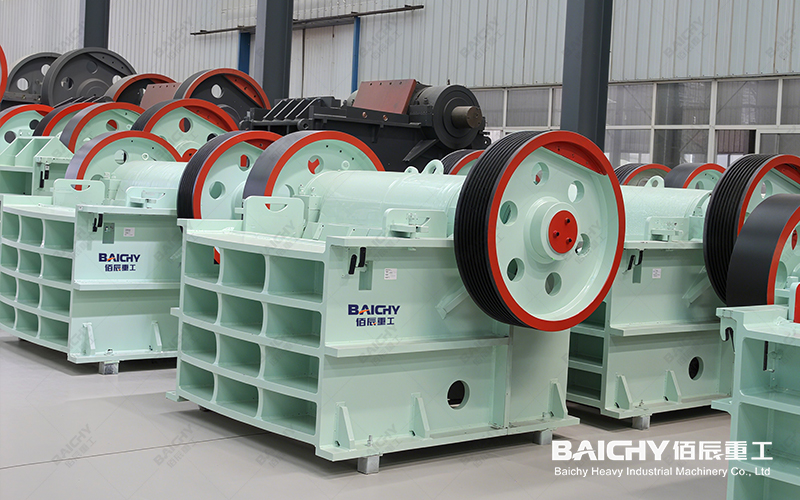
PEX250x1000 Fine Jaw Crusher
| Dimension | Medium-Soft Rock Branch | Hard Rock Branch |
|---|---|---|
| Suitable Materials | Limestone, dolomite, shale (compressive strength ≤150 MPa; low abrasiveness) | Granite, basalt, river pebbles, iron ore (compressive strength 150–350 MPa) |
| Recommended Model | PEX250×1000 Fine Jaw Crusher | Cone crusher, 900mm mantle diameter class (PYB900 or CS75) |
| Key Parameters | Compression crushing, 30 kW | PYB900: Discharge opening 15–50mm, rated 20–50 t/h, 55 kW; CS75: CSS 13–38mm, rated 59–163 t/h, 75 kW |
| Handling 47 t/h Throughput | Upper limit is the target; little margin for error | PYB900 converts to 16–40 t/h (insufficient); only CS75 suffices |
There is a frequently overlooked calculation here: The PYB900 is rated at 20–50 t/h, which appears to cover a 47 t/h throughput. However, when adjusted from limestone (1.6 t/m³ bulk density) to hard rock, the capacity drops to 16–40 t/h—falling short of the required throughput. For a hard rock secondary crushing stage requiring 40 t/h output, one cannot simply select the PYB900 based on that "40-ton" figure; instead, the CS75 must be selected to handle the 47 t/h throughput. This is not a matter of being conservative in equipment selection; it is an inevitable requirement of a closed-circuit process.
For the 40 t/h capacity range, a three-stage crushing setup (jaw crusher + cone crusher + sand-making machine) is not recommended. The installed power and footprint of a three-stage system would drive up the cost per ton by more than 30%, and a 40 t/h operation cannot amortize these costs effectively. To produce 0–5mm manufactured sand, the correct approach is to equip the secondary crushing stage with a short-head crusher or add a fine-crushing unit, rather than adding another full crushing stage.
IV. Overall Line Configuration and Parameters
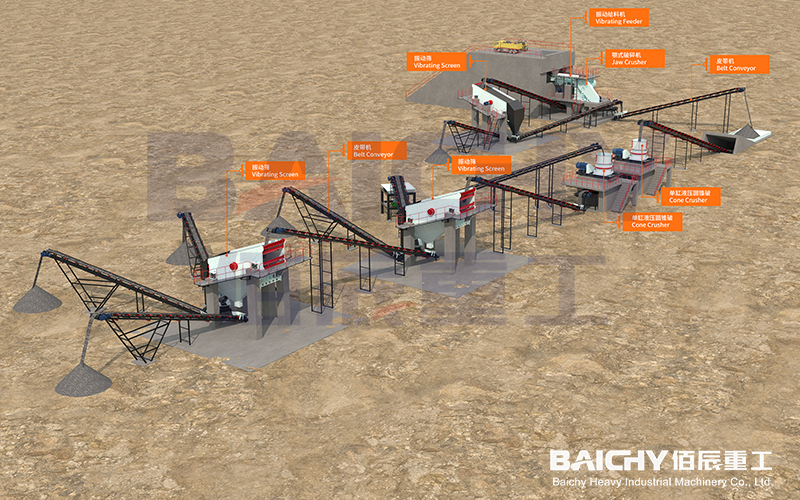
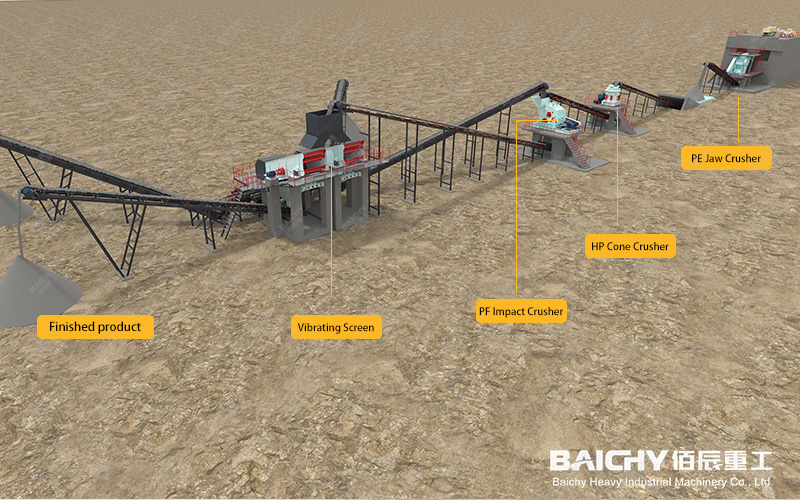
Process flow for a 40 t/h crushing and screening production line (Scheme A, medium-soft rock): Raw ore hopper → ZSW380×95 feeder (grizzly bar pre-screening; fines and soil bypassed to a separate stockpile) → PE400×600 primary crushing to 40–60mm → PEX250×1000 fine crushing → 3YK1545 triple-deck circular vibrating screen for classification → material >20mm (oversize) returned to the secondary stage via a return conveyor, forming a closed-circuit loop. The following is the equipment list for this crushing and screening production line:
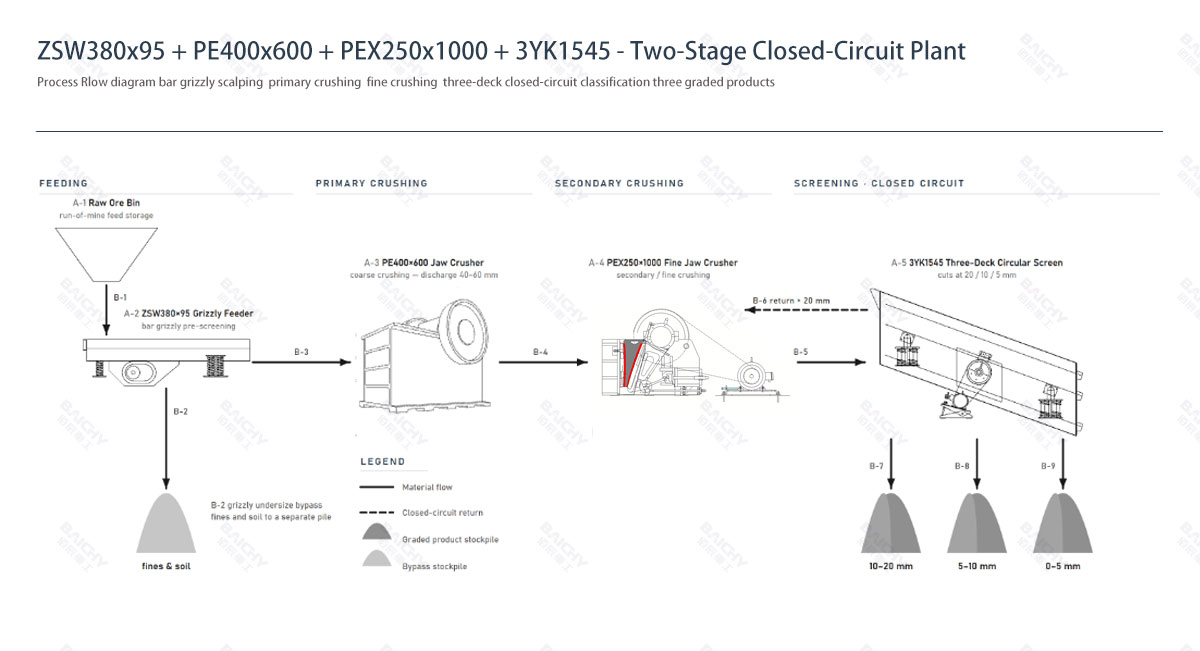
40 tph Crushing and Screening Production Line
| Process | Equipment | Option A (Medium-Soft Rock) | Option B (Hard Rock) | Key Parameters | Power |
|---|---|---|---|---|---|
| Feeding | Vibrating Feeder | ZSW380×95 (or GZD850×3000) | Same as left | Trough 3800×950mm; Max feed 500mm; Capacity 60–100 t/h; Grizzly bar spacing 50–80mm | 11 kW |
| Primary Crushing | Jaw Crusher | PE400×600 | PE500×750 | A: 400×600mm, discharge opening 40–100mm; B: 500×750mm, max feed ≤425mm, discharge opening 50–100mm | 30 / 55 kW |
| Secondary Crushing | Fine Crushing Equipment | PEX250×1000 Fine Jaw Crusher | CS75 Cone Crusher | A: Compression crushing; B: Cone base diameter 900mm, max feed 100–115mm, CSS 13–38mm, rated capacity 59–163 t/h | 30 / 75 kW |
| Screening | Three-deck Circular Vibrating Screen | 3YK1545 | 3YK1545 | Screen surface 1500×4500mm (single deck 6.75 m²); Interchangeable mesh (20 / 6 / 3mm) | 15 kW |
| Conveying | Belt Conveyor | B650 / B500 | B650 / B500 | Main material flow B650; Return material & finished product B500 | Approx. 11 kW |
| Environmental Protection | Pulse Bag Dust Collector | DMC Series | Same as left | Specification selected based on number of dust emission points | Approx. 5.5 kW |
Installed Power & Footprint: Option A approx. 100–110 kW, Option B approx. 165–180 kW; Footprint approx. 150–250 m² (excluding the finished product stockpile area). Motors are customized for local power specifications (380/400/440V, 50/60Hz).
Product fractions: 0–5 mm manufactured sand / 5–10 mm fine aggregate / 10–20 mm coarse aggregate / >20 mm oversize (recirculating load).
V. Three Hidden Bottlenecks in Screening and Closed-Circuit Operation
Bottleneck 1: Sizing screen decks based on total throughput rather than finished product output. Standard engineering practice uses a ratio of 0.8–1.2 m² of screen area per 10 t/h of feed; a throughput of 47 t/h corresponds to 3.8–5.6 m². A 3YK1545 screen offers 6.75 m² per deck, which is sufficient coverage—but load calculations must be performed for each deck inpidually. One cannot simply look at the top deck; lower decks are often the actual bottlenecks.
Bottleneck 2: Number of decks determines the number of product fractions. The number of product fractions in a 40 t/h crushing and screening line is directly determined by the number of screen decks: a three-deck screen yields four output streams (0–5 / 5–10 / 10–20 mm products + >20 mm oversize). To add a 20–31.5 mm fraction, a four-deck screen is required; simply changing the mesh size will not solve the issue.
Bottleneck 3: Selecting the recirculating conveyor belt width based on 30%–50% of the feed rate. Many configurations are selected based on a 15% oversize rate, causing the belt to become a system-wide bottleneck immediately upon commissioning. Since the oversize rate fluctuates with the raw material gradation, the recirculating conveyor belt should be sized based on the upper limit of this rate.
VI. FAQ
Q1: Does the 40 t/h rating for the crushing and screening line refer to nominal capacity or actual operational capacity?
A1: The nominal value is calibrated based on medium-hard limestone (density approx. 1.6 t/m³). Actual production capacity is determined by applying a coefficient of 0.85–0.95 for medium-soft rock or 0.75–0.85 for hard rock to the nominal rating; this figure also fluctuates based on raw material gradation, moisture content, and the desired product structure. A 10%–15% margin should be factored into nominal values, and acceptance should be based on measured continuous hourly output rather than nameplate specifications.
Q2: Should I choose the PE400×600 or the PE500×750 for primary crushing?
A2: It depends on two factors: the maximum feed size and material hardness. If the raw material is ≤340 mm and consists of limestone or dolomite, choose the PE400×600 jaw crusher (rated 16–60 t/h, 30 kW) for the lowest investment and logistics costs. If the raw material exceeds 340 mm, or consists of granite or basalt, you must choose the PE500×750 jaw crusher (rated 50–100 t/h, 55 kW); the PE400×600’s capacity drops to 16–35 t/h when processing hard rock, making it incapable of meeting a 40 t/h target.
Q3: For a 40 t/h hard rock operation, should the secondary crusher be a PYB900 or a CS75?
A3: Calculations should be based on closed-circuit throughput, not just final product output. With an oversize rate of 15%, the required throughput is 47 t/h. The PYB900 is rated for 20–50 t/h, but its capacity drops to 16–40 t/h for hard rock, failing to handle the 47 t/h requirement; the CS75 (CSS 13–38 mm, rated 59–163 t/h) provides the necessary margin to handle fluctuations in material hardness. For medium-soft rock, a PEX250×1000 fine jaw crusher can be used instead, offering lower investment costs.
Q4: How much screen surface area is required for a 40 t/h crushing and screening line?
A4: Based on an estimate of 0.8–1.2 m² of screen surface area per 10 t/h of feed, a throughput of 47 t/h requires 3.8–5.6 m². The 3YK1545 model (1500×4500 mm screen surface, three decks) offers 6.75 m² per deck, which provides sufficient coverage. However, the load must be verified for each deck inpidually—the lower deck is often the actual bottleneck for capacity.
Q5: If we want to expand to 80 t/h in the future, what provisions should be made now?
A5: You only need to make three specific provisions; there is no need to spend extra money right now:
① Design the jaw crusher foundation to accommodate a PE600×900 model;
② Reserve a foundation spot and electrical control circuit for a second crusher at the secondary crushing stage;
③ Reserve space and conveyor connection points in the screening building for the future installation of a second circular vibrating screen. Do not select a conveyor belt width that is right at the limit; choose a B650 belt to allow for potential speed increases.
Baichy Heavy Industry
Baichy Heavy Industry is a high-tech mining equipment company integrating R&D, manufacturing, sales, and after-sales service. Focusing on crushing, grinding, and mineral processing equipment, we provide professional solutions to our customers. We are ISO9001:2015 、certified, and our products include mobile crushing palnts, crawler crushing plant, construction waste crushing plants, jaw crushers, sand making machines, cone crushers, fine crushers, grinding mills, ball mills, etc., all with reliable performance to meet diverse project needs.
Baichy Heavy Industry – Your Trusted Partner
To ensure optimal performance of your equipment, Baichy Heavy Industry offers:
- Professional on-site installation guidance
- Comprehensive operator training
- 24/7 technical support & maintenance services
Our complete after-sales service system guarantees long-term, stable operation of your machinery with minimal downtime.
Protect Your Rights – Only Use Official Channels
To avoid scams and ensure authentic support, contact us exclusively through:
• Official Website: www.baichychina.com
• WhatsApp: +8615093222637
• Email: [email protected]
Your satisfaction is our priority – expect prompt, professional service every time.
(Note: Beware of unauthorized third parties claiming to represent Baichy. Always verify through official contacts.)