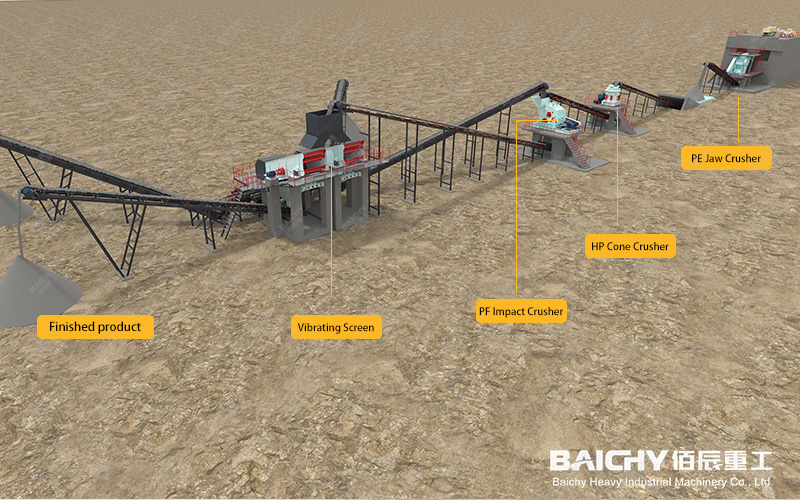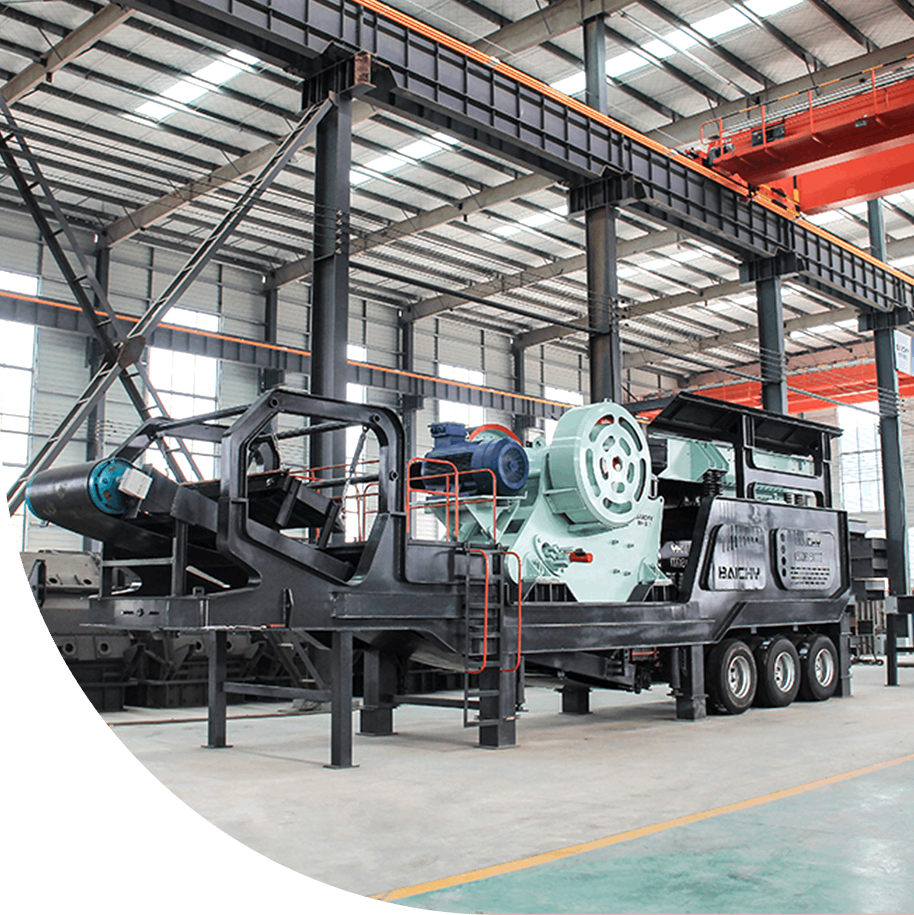

For an 80 t/h basalt sand-making production line, selecting a high-efficiency fine crusher (PCX series) for the sand-making stage offers the most cost-effective and streamlined solution. With a crushing ratio of 25–30, it combines the traditional "secondary crushing + sand making" stages into a single step, eliminating the need for a cone crusher, a material return conveyor, and a surge bin, thereby reducing equipment investment costs by 35%–50%. However, there is a strict prerequisite: the measured uniaxial compressive strength of the basalt at the site must be ≤200 MPa. If this limit is exceeded, a VSI sand maker (rock-on-rock impact) or a fine-crushing cone crusher should be selected instead.
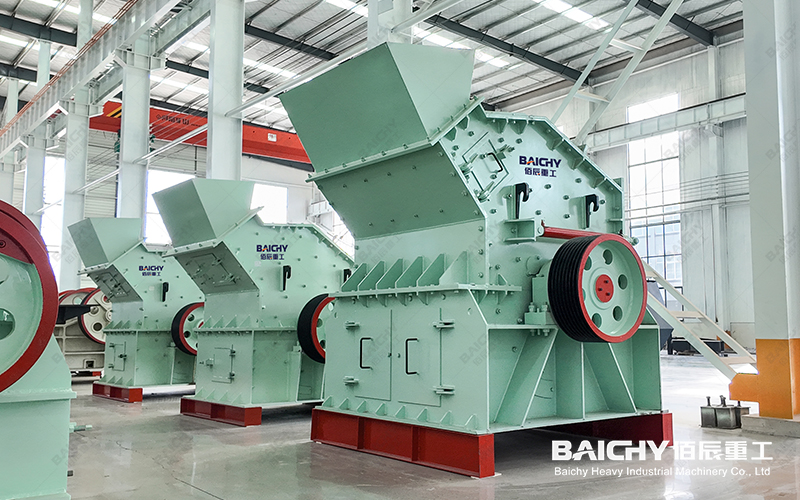
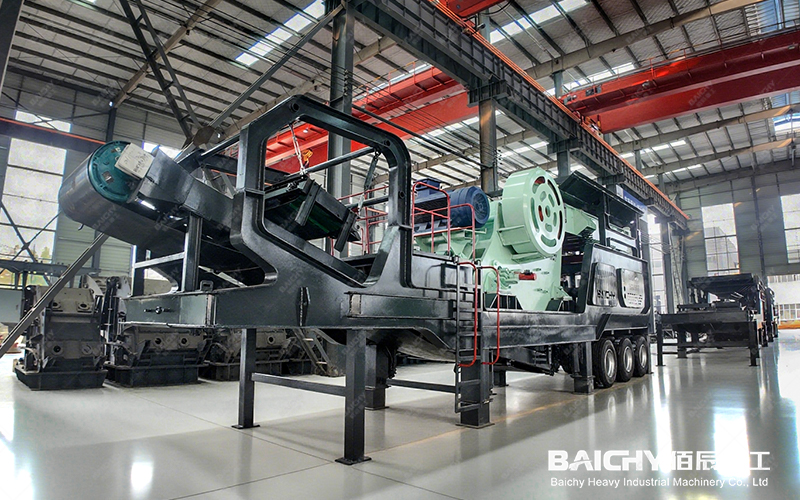
High-efficiency Fine Crusher
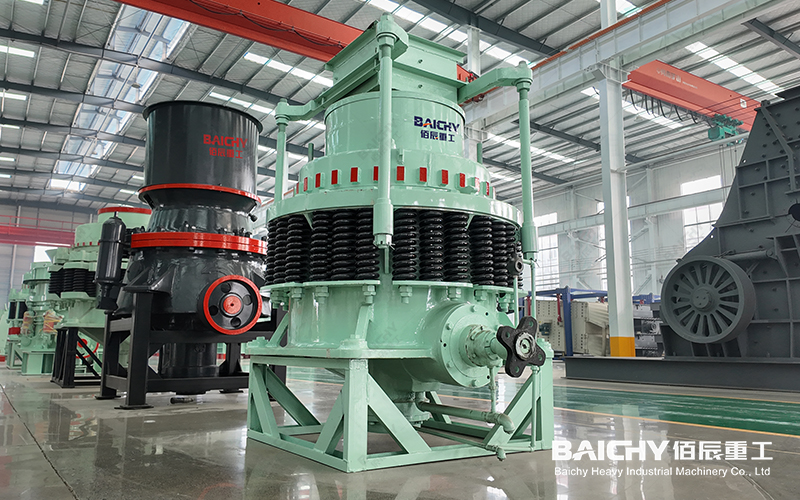
Fine Crushing - spring cone crusher
I. The Challenges of Basalt: Abrasiveness, Not Hardness, Dictates Equipment Selection
The challenges associated with an 80 t/h basalt sand-making line stem from two key characteristics of the material—a basic volcanic extrusive rock with a Mohs hardness of 6–7 and an SiO₂ content of 45%–52%:
1. Wide range of uniaxial compressive strength: Dense basalt can reach 200–350 MPa, while vesicular or weathered basalt typically falls within the 100–200 MPa range. Measured values can vary by as much as 100% between different extraction zones within the same quarry.
2. High abrasiveness and sharp angularity: Wear part consumption—rather than electricity costs—represents the primary operating expense in this type of application.
Consequently, the capacity of a basalt production line must be adjusted based on material properties; nominal ratings based on limestone cannot be used for direct quoting. Baichy Heavy Industry’s internal conversion standard calculates basalt capacity at 0.7 times the nominal limestone capacity. This explains why many configurations "rated at 120 t/h" often achieve only 80 t/h in actual field operation.
II. Why Choose a High-Efficiency Fine Crusher for the Sand-Making Stage?
High-efficiency fine crushers (PCX series) were originally designed for fine crushing in the coal and building materials industries but have recently seen widespread adoption in hard-rock sand-making lines. For an 80 t/h basalt sand-making production line, there are five reasons to select this specific equipment for the sand-making stage:
1. High reduction ratio (25–30): It combines two stages into one. Material discharged from the primary jaw crusher feeds directly into the high-efficiency fine crusher for single-pass shaping, eliminating the intermediate secondary crushing stage. Equipment investment costs are 35%–50% lower than traditional multi-stage processes, with corresponding reductions in power distribution, civil engineering, and maintenance labor.
2. High yield of fine product: 85%–90% of the output is ≤3 mm. The fineness modulus is adjustable between 2.3 and 3.0 (falling within the medium sand range), complying with the GB/T 14684 standard for construction sand.
3. Low rotational speed and multiple crushing chambers: The equipment's linear speed is 20%–25% lower than conventional impact crushers. Inside the chamber, material undergoes a combination of hammer strikes, impacts against impact plates, and grinding against screen plates. This "grinding-while-crushing" action—as opposed to simple "impact-shattering"—is gentler on hard, brittle materials, resulting in cubic particles with minimal flaky or elongated shapes.
4. Low energy consumption: For the same output, motor power requirements are 30%–50% lower than conventional crushers. In an 80 t/h line, the 200 kW main sand-making unit eliminates the no-load and transmission losses associated with an extra machine required in a "cone crusher + sand maker" two-stage setup.
5. Easy maintenance: Hammers are made of multi-element high-chromium alloy and can be rotated for extended use; screen plates and liners feature modular replacement. In regions with long lead times for spare parts (often 4–8 weeks for sea freight), this translates directly into higher operational uptime.
III. Configuration for 80 t/h Basalt Sand-Making Production Line
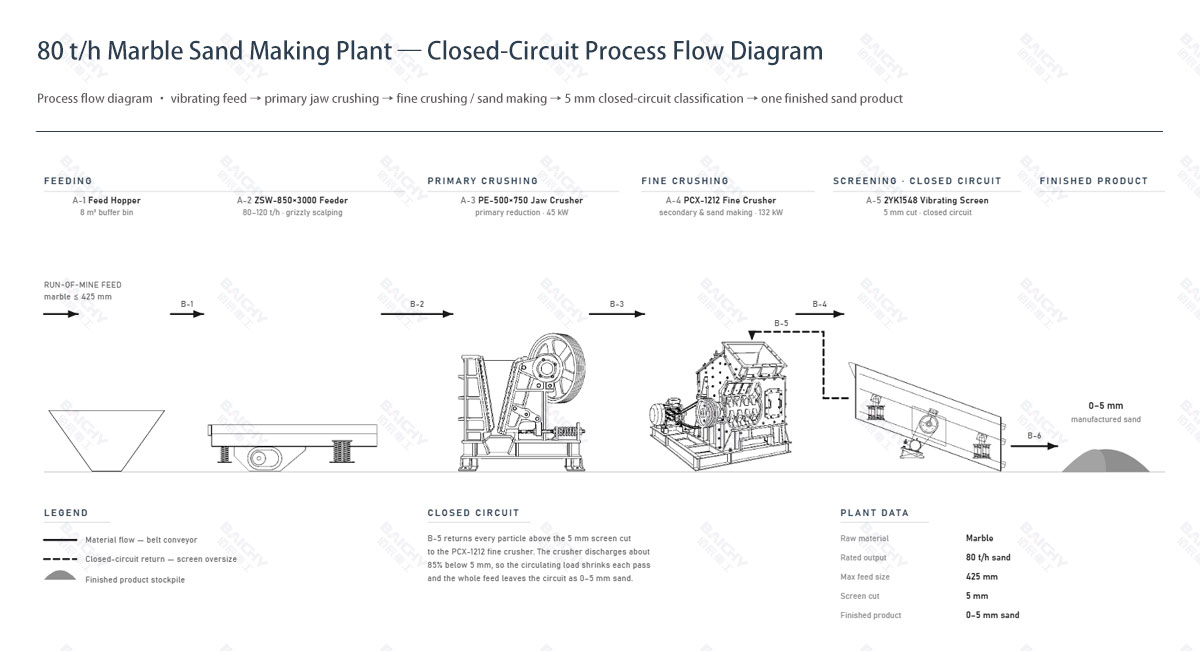
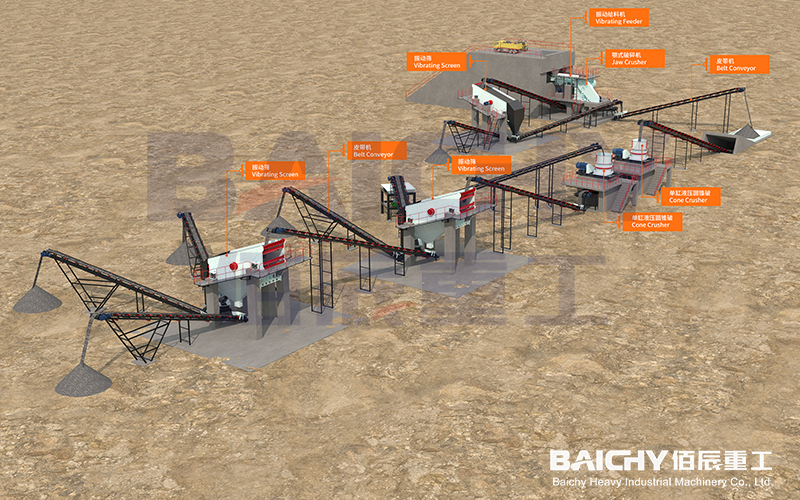
80 tph Basalt Sand-Making Production Line
| Process | Equipment | Selection Recommendation | Key Parameters | Notes |
|---|---|---|---|---|
| Feeding | Vibrating Feeder | ZSW Series (380×96 model) | Feeding capacity ≥120 t/h | Equipped with grizzly screen for soil pre-screening; iron remover required |
| Primary Crushing | Jaw Crusher | PE600×900 | Nominal 90–180 t/h; adjusted for basalt (0.7 factor) → 63–126 t/h | Discharge opening fixed at ≤190mm to feed the fine crusher |
| Fine Crushing & Sand Making | High-Efficiency Fine Crusher | PCX1414 (Main) / PCX1212 (Backup) | PCX1414: 200kW; ≤5mm fraction 85%; nominal 100–150 t/h | Single-pass shaping on main line; see Option B for backup line |
| Screening | Circular Vibrating Screen | 3YK Triple-deck (1860 model) | Grading: 0–5 / 5–10 / 10–20mm | Oversize material returned to fine crusher in closed-loop circuit |
| Sand Washing (Optional) | Wheel-bucket Sand Washer + Fine Sand Recovery Unit | XSD Series + Recovery Unit | Required if silt content is high | Dual control of stone powder and silt content |
| Dust Removal | Pulse Bag-type Dust Collector | Configured based on number of crushing points | — | Fully enclosed conveyor galleries |
Estimated total installed power: approx. 300–330 kW; footprint: approx. 250–350 m². Finished sand yield with this configuration is approx. 60%–70% (estimated value, subject to discharge opening and screen mesh adjustments); the remainder consists of 5–10mm and 10–20mm byproduct aggregates.
Option A (Recommended; shortest process flow): PE600×900 Jaw Crusher → PCX1414 High-Efficiency Fine Crusher → 3YK Vibrating Screen (closed-circuit) → Sand Washing.
Option B (Ensures stable output; includes an extra stage): PE600×900 Jaw Crusher → Spring/Multi-cylinder Cone Crusher (secondary crushing to ≤40mm) → PCX1212 High-Efficiency Fine Crusher → Screening → Sand Washing.
Option B includes an additional secondary crusher, but it reduces the feed size for the fine crusher to below 40mm and results in a more stable production curve; if the basalt at the site is particularly dense (compressive strength around 180 MPa), Option B is the preferred choice.
IV. PCX High-Efficiency Fine Crusher Core Specifications Table
| Model | Feed Opening Size (mm) | Max. Feed Size (mm) | Discharge Size | Cement Clinker (t/h) | Limestone (t/h) | Motor Power (kW) |
|---|---|---|---|---|---|---|
| PCX0804 | 500×400 | ≤120 | ≤3 (85%) | 20–30 | 35–45 | 45 |
| PCX0806 | 600×500 | ≤180 | ≤3 (85%) | 35–40 | 45–55 | 55 |
| PCX0808 | 800×500 | ≤180 | ≤3 (85%) | 35–40 | 55–65 | 55 |
| PCX1010 | 1000×560 | ≤180 | ≤3 (85%) | 45–55 | 65–75 | 75 |
| PCX1212 | 1100×650 | ≤180 | ≤5 (85%) | 90–100 | 100–110 | 132 |
| PCX1414 | 1300×780 | ≤190 | ≤5 (85%) | 100–150 | 100–150 | 200 |
| PCX1616 | 1600×930 | ≤190 | ≤5 (85%) | 170–210 | 190–250 | 250 |
| PCX1818 | 1800×1000 | ≤190 | ≤5 (85%) | 250–270 | 280–310 | 315 |
Capacities in the table are based on cement clinker/limestone and fluctuate with feed particle size and moisture content; for basalt processing, please apply a 0.7 conversion factor when selecting the model—therefore, for an 80 t/h basalt line, the main machine falls into the... Select the PCX1414 (adjusted capacity: 70–105 t/h) rather than the PCX1212 (adjusted capacity: 70–77 t/h, with no margin for error).
V. Selection Parameters and Three Pitfalls to Avoid
Parameter 1: 200 MPa is the red line. For an 80 t/h basalt sand-making line using a high-efficiency fine crusher as the primary unit, the first hurdle is compressive strength. The equipment is suitable for hard, brittle materials with a compressive strength ≤200 MPa (e.g., basalt, river pebbles, granite, hard limestone). Before investment, samples must be tested for uniaxial compressive strength and Abrasivity Index (AI). If measured values exceed 200 MPa, switch to a VSI sand-making machine ("rock-on-rock" configuration) or a fine-crushing cone crusher.
Parameter 2: Feed particle size must be strictly controlled. A high reduction ratio does not mean there is no upper limit on feed size; the maximum feed opening size is only ≤180–190 mm. Failure to lock the jaw crusher's discharge opening, allowing oversized material to enter, is the primary cause of abnormal hammer wear and chamber clogging. Solution: Implement dual controls using a grizzly screen and a feed-limiting plate, and weld the jaw crusher's discharge opening at the calibrated setting.
Parameter 3: Calculate hammer lifespan based on actual operating conditions, not limestone benchmarks. Publicly available data often cites a hammer lifespan of 3,000–4,000 hours, but that applies to limestone operations. Basalt is more abrasive; a conversion factor of 0.4–0.6 is recommended, resulting in an estimated lifespan of 1,200–2,400 hours. For the initial order, stock two sets of high-chromium hammers and one set of screen plates to cover the first six months of operation. An upstream iron remover is standard equipment, not an optional extra.
VI. FAQ (Frequently Asked Questions)
Q1: Can a high-efficiency fine crusher really crush basalt?
Yes, but it depends on compressive strength. High-efficiency fine crushers are suitable for hard, brittle materials with a compressive strength not exceeding 200 MPa; basalt falls within this applicable range. Practical operation requires three additional conditions: using wear-resistant materials (such as high-chromium alloy Cr26) for the hammer heads, controlling the feed particle size to 60–80 mm, and reducing the main shaft speed to 80%–90% of the rated value. If the measured compressive strength of the basalt on-site exceeds 200 MPa, a VSI sand-making machine or a fine-crushing cone crusher should be used instead.
Q2: What equipment is needed for an 80 t/h basalt sand-making production line?
Six core components: ZSW series vibrating feeder + PE600×900 jaw crusher (primary crushing to ≤190 mm) + PCX1414 high-efficiency fine crusher (single-stage sand making) + 3YK triple-deck circular vibrating screen (oversize material returned for closed-circuit processing) + wheel-bucket sand washer and fine sand recovery machine (optional) + pulse bag dust collector; supported by belt conveyors and iron removers.
Q3: How do I choose between a high-efficiency fine crusher and a VSI sand-making machine for basalt?
The choice depends on compressive strength and the target product. Choose the high-efficiency fine crusher if the compressive strength is ≤200 MPa, the primary product is 0–5 mm manufactured sand, and the goal is to minimize the number of main machines and shorten the process flow. Choose the VSI sand-making machine (rock-on-rock crushing chamber) if the compressive strength exceeds 200 MPa, the material is highly abrasive, and the requirement is for high-grade commercial concrete sand with a needle-and-flake content of <5%. These machines are not direct substitutes for one another: high-efficiency fine crushers suit smaller lines with tight budgets, while VSI machines suit medium-to-large lines that prioritize particle shape and equipment longevity.
Q4: How often should hammer heads be replaced when processing basalt?
Publicly available data citing a hammer head lifespan of approximately 3,000–4,000 hours refers to limestone processing conditions. Basalt is more abrasive; applying a conversion factor of 0.4–0.6 results in an estimated lifespan of 1,200–2,400 hours, or roughly 4–8 months (based on 10 hours of daily operation). For the initial order, it is recommended to stock two sets of hammerheads and one set of screen plates, rotating their use to ensure even wear.
Q5: Does the manufactured sand produced by this line meet the GB/T 14684 standard?
The fineness modulus is adjustable within the 2.3–3.0 range, falling into the medium sand category. The output undergoes "stone-on-stone" composite crushing, resulting in cubic particles with minimal flaky or elongated shapes; the gradation can be precisely controlled through screen configuration. Silt content is managed during the sand washing stage, while stone powder content is regulated via screening and air separation. Note: For projects with high silt content or strict requirements regarding stone powder levels, a combination of a wheel-bucket sand washer and a fine sand recovery unit is essential; otherwise, the product may fail final acceptance despite meeting gradation specifications.
Baichy Heavy Industry
Baichy Heavy Industry is a high-tech mining equipment company integrating R&D, manufacturing, sales, and after-sales service. Focusing on crushing, grinding, and mineral processing equipment, we provide professional solutions to our customers. We are ISO9001:2015 、certified, and our products include mobile crushing palnts, crawler crushing plant, construction waste crushing plants, jaw crushers, sand making machines, cone crushers, fine crushers, grinding mills, ball mills, etc., all with reliable performance to meet diverse project needs.
Baichy Heavy Industry – Your Trusted Partner
To ensure optimal performance of your equipment, Baichy Heavy Industry offers:
- Professional on-site installation guidance
- Comprehensive operator training
- 24/7 technical support & maintenance services
Our complete after-sales service system guarantees long-term, stable operation of your machinery with minimal downtime.
Protect Your Rights – Only Use Official Channels
To avoid scams and ensure authentic support, contact us exclusively through:
• Official Website: www.baichychina.com
• WhatsApp: +8615093222637
• Email: [email protected]
Your satisfaction is our priority – expect prompt, professional service every time.
(Note: Beware of unauthorized third parties claiming to represent Baichy. Always verify through official contacts.)