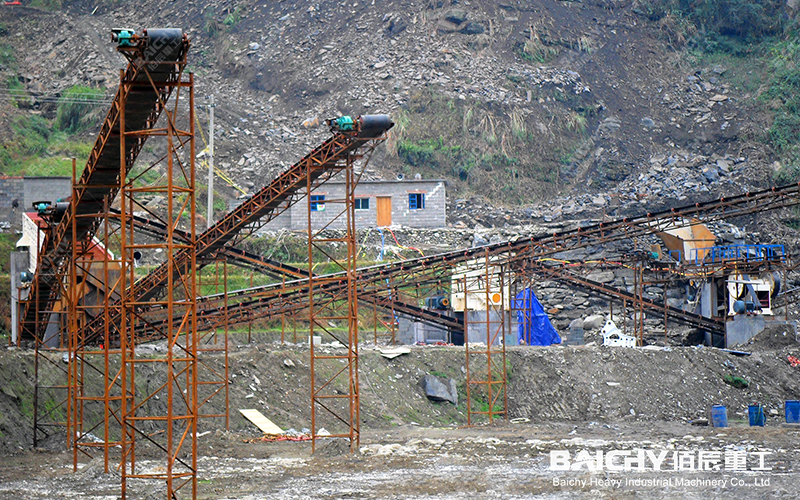
40–60 t/h Crushing Production Line Equipment
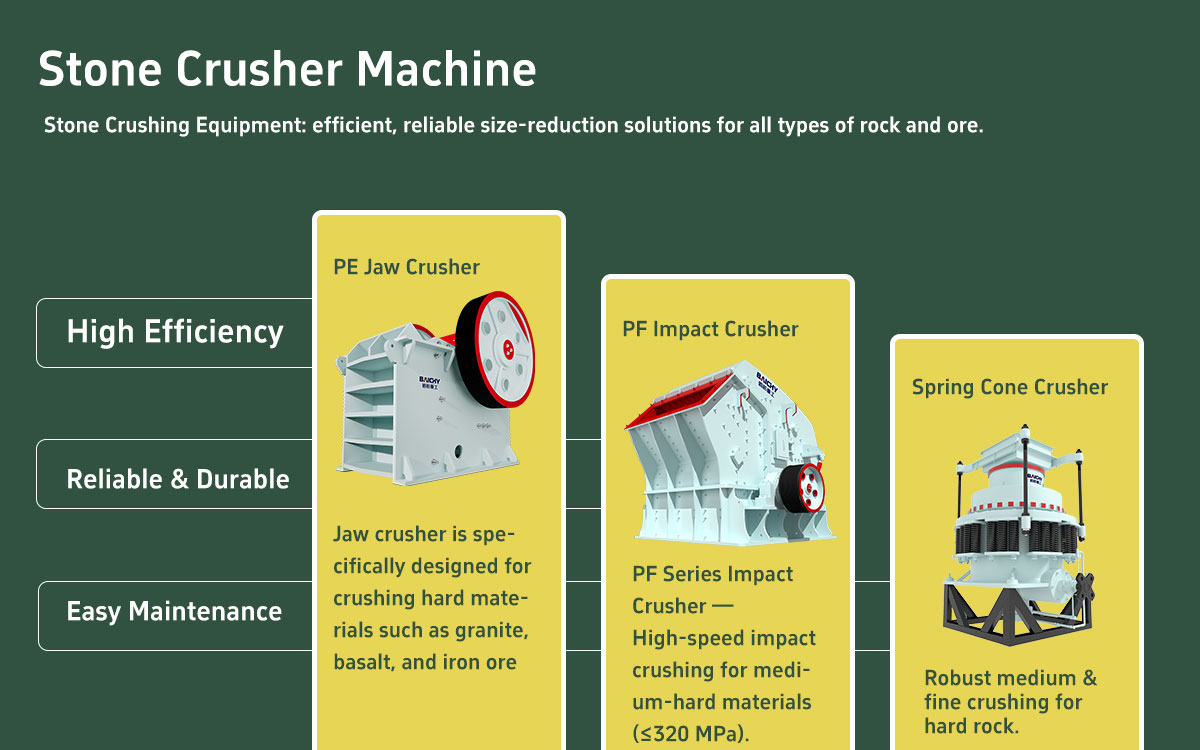
There is no single equipment list that covers the entire 40–60 tph range; the configuration must be split into two distinct setups: the 40 tph tier uses a PE400×600 jaw crusher, while the 60 tph tier upgrades to a PE500×750 jaw crusher. The piding line is determined not by tonnage, but by the feed opening size and operational headroom. The standard configuration listed on the official website for the 40–60 tph category—comprising a ZSW650×2500 feeder, PE400×600 jaw crusher, PF1007 impact crusher (or PEX250×1000 fine jaw crusher), YK1237 vibrating screen, and belt conveyors in a two-stage crushing circuit with oversize recirculation—is an economical solution for processing limestone at 40–50 tph. However, pushing the target to 60 tph creates bottlenecks across three stages simultaneously: the primary crusher loses all operational headroom, the throughput requirement for the secondary stage rises to 70 tph, and the YK1237’s 4.44 m² single-deck screening area falls below the minimum load requirement.
I. 40–60 tph is a capacity tier, not the capacity of a single machine
When a customer requests equipment for a "40–60 tph crushing line," they are actually seeking one of three things: a setup covering the entire range, a configuration based on the upper limit, or a system that runs at the lower limit initially but allows for future expansion—each requiring a different equipment list. The most common source of disputes in this category is the misconception that the capacity range of a single machine applies to the entire production line. The line's total capacity is dictated by its most constrained component—whether it is the feeder, primary crusher, secondary crusher, screen, or recirculation conveyor. If any single component is configured for the lower end of its range, the entire line is limited to that lower output. Errors in equipment selection for small-scale crushing lines often stem from this oversight.
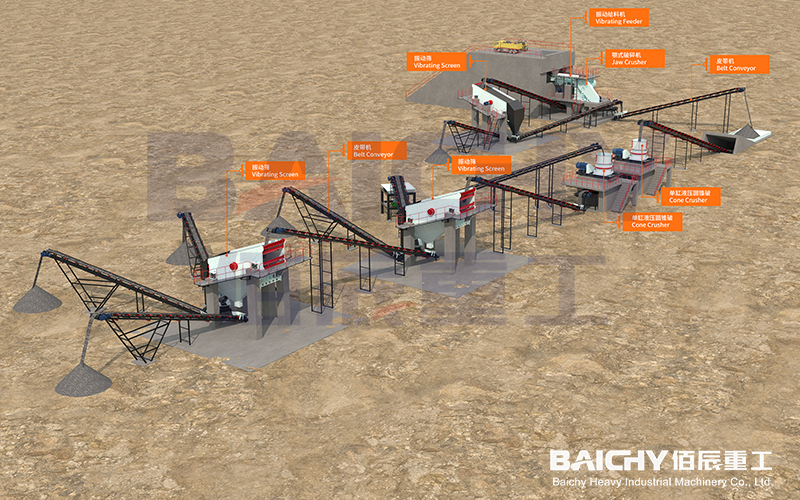
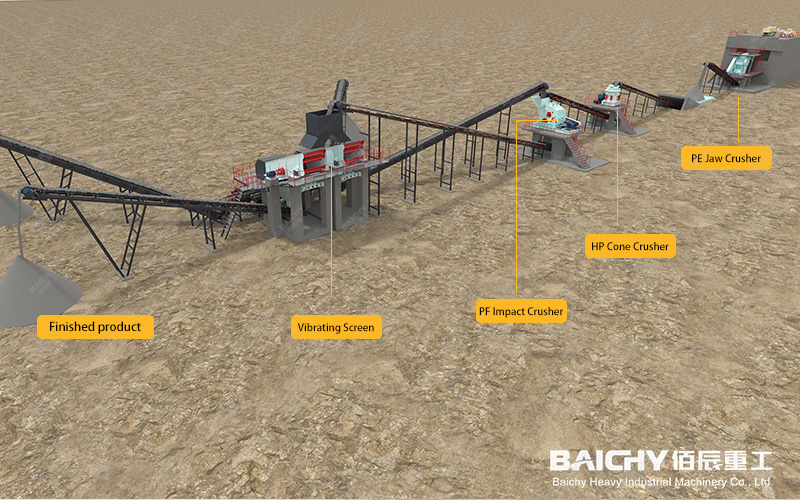
40-60tph Crushing Plant equipment
II. Primary crushing: The constraint is the feed opening, not the tonnage
The maximum feed size for the jaw crusher must be greater than or equal to the raw ore's maximum lump size pided by 0.85. Maximum feed sizes specified on the official website: 350 mm for the PE400×600 and 425 mm for the PE500×750 (refer to the specifications table for other parameters).
A frequently overlooked mismatch: The upstream ZSW650×2500 feeder has a maximum feed size of 560 mm, which is significantly larger than the PE400×600's 350 mm limit. Material that the feeder can handle but the jaw crusher cannot leads to bridging at the feed inlet and production bottlenecks. Raw ore lump size must be strictly capped at 350 mm; if the size consistently exceeds 350 mm, the PE500×750 must be selected for primary crushing. A discharge opening setting of 40–60 mm is recommended.
III. Secondary crushing equipment selection is based on throughput, not finished product output.
In a closed-circuit system, oversize material retained on the screen is returned to the secondary crusher. With an oversize rate of 15%, a finished product output of 40 t/h corresponds to a throughput of approximately 47 t/h, while 60 t/h corresponds to about 70 t/h—these figures serve as the basis for selecting the secondary crusher and screen.
For medium-soft rock (limestone, dolomite, shale): The PF1007 impact crusher (Φ1000×700; max feed 250 mm; 10–60 t/h; 45 kW) covers the 40 t/h capacity tier, whereas the 60 t/h tier requires the PF1010 (Φ1000×1050; max feed 300 mm; 50–90 t/h; 55 kW). If switching to the PEX250×1000 (15–52 t/h), the 40 t/h tier is sufficient, but the 60 t/h tier is tight.
For hard rock (granite, basalt, river pebbles): A cone crusher must be selected for the secondary crushing stage. The CS75 (medium-crush cavity) features a 900mm head diameter, a CSS of 13–38mm, a maximum feed size of 85mm, a rated capacity of 45–91 t/h, and 75 kW of power; it operates within the 47–70 t/h throughput range.
IV. Screening and Conveying: Two Underestimated Stages
Screen surface area should be sized based on throughput, not finished product output—this is where equipment selection for 40–60 t/h crushing lines most often goes wrong. Standard engineering practice uses a ratio of 0.8–1.2 m² of screen surface per 10 t/h of feed:
For a throughput of 47 t/h, 3.76–5.64 m² is required: The 3YK1237 (single-deck area of 4.44 m²) exceeds the lower limit but falls short of the conservative estimate; while it suffices for the 40 t/h class based on the lower limit, it lacks a safety margin when calculated at the 1.2 m²/10 t/h rate.
For a throughput of 70 t/h, 5.60–8.40 m² is required: The 3YK1237’s 4.44 m² falls below the minimum requirement and is insufficient. The 3YK1548 (4800×1500mm; single-deck area 7.2 m²; capacity 30–275 t/h) covers the lower end of the range, but if clay or moisture content is high, upgrading to the 8 m² class (3YK1848) is recommended.
Screen capacity is calculated based on three decks (the official website lists "YK1237" without specifying the number of decks). The number of decks determines the number of product size fractions: a three-deck screen yields three product fractions plus one oversize return stream; adding another fraction requires adding a deck. Return conveyor belt width is selected based on throughput; however, while most configurations are sized for a 15% oversize rate, actual rates often fluctuate between 30% and 50% after commissioning, causing the return belt to immediately become a bottleneck for the entire line.
V. Equipment List for 40–60 t/h Crushing Production Line
Two material processing routes are presented in parallel; rated capacities are based on medium-hard limestone; for hard rock applications, apply a conversion factor of 0.75–0.85:
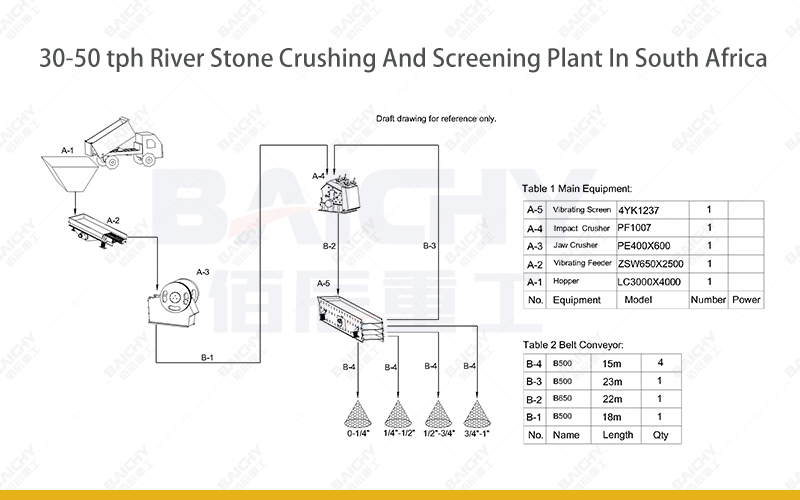
40–60 t/h Crushing Production Line Equipment
| Process | Equipment | 40 t/h Tier | 60 t/h Tier | Key Parameters | Power |
|---|---|---|---|---|---|
| Feeding | Vibrating Feeder | ZSW650×2500 | ZSW650×2500 | Trough 650×2500mm; Max feed 560mm; Capacity 50–80 t/h; Grizzly bars allow pre-screening/bypass of fines and raw soil | 5.5 kW |
| Primary Crushing | Jaw Crusher | PE400×600 | PE500×750 | PE400×600: 400×600mm, max feed 350mm, discharge opening 40–90mm, rated 15–60 t/h | PE500×750: 500×750mm, max feed 425mm, discharge opening 50–100mm, rated 40–130 t/h | 30 / 45 kW |
| Secondary Crushing | Medium-soft rock: Impact Crusher Hard rock: Cone Crusher |
PF1007 | PF1010 / CS75 | PF1007: Φ1000×700, max feed 250mm, 10–60 t/h; PF1010: Φ1000×1050, max feed 300mm, 50–90 t/h; CS75: Cone diameter 900mm, medium-crushing cavity (CSS 13–38mm), max feed 85mm, 45–91 t/h | 45 / 55 / 75 kW |
| Screening | 3-Deck Circular Vibrating Screen | 3YK1237 | 3YK1548 | 3YK1237: 3700×1200mm, single-deck area 4.44 m², 30–100 t/h; 3YK1548: 4800×1500mm, single-deck area 7.2 m², 30–275 t/h; screen mesh changed according to product size specifications | 11 / 18.5 kW |
| Conveying | Belt conveyor | B500 / B650 | B650 | Main material flow: B650; recirculating material and finished product: B500–B650; recirculating belt width sized for 30%–50% of throughput | Approx. 11–15 kW |
| Environmental Protection | Pulse-jet bag dust collector | DMC Series | DMC Series | Specifications selected based on the number of dust-generating points (crushing, screening, transfer) | Approx. 5.5 kW |
The sequence of models corresponds directly to the power ratings: Primary crushing 30 / 45 kW; secondary crushing 45 / 55 / 75 kW; screening 11 / 18.5 kW.
Installed power and footprint (calculated based on upper limits; footprint and power for conveying/dust collection are estimates): 40-ton class: approx. 105–115 kW; 60-ton class (soft rock configuration): approx. 140–150 kW; 60-ton class (hard rock configuration): approx. 160–170 kW. Footprint: approx. 150–250 m² (excluding finished product stockpile area); motors customized for local voltage (380 / 400 / 440V) and frequency (50 / 60Hz). Standard product sizes: 0–6 / 6–12 / 12–25mm; screen mesh can be changed to meet local standards.
Three-stage crushing is not recommended for this capacity class. For a 40–60 t/h plant, the installation, foundation, and footprint costs for a tertiary crushing stage cannot be easily amortized; industry experience shows that the cost per ton would rise by over 30%. To produce 0–5 mm manufactured sand, the correct approach is to switch the secondary crusher to a "short-head" cavity configuration or add a dedicated fine-crushing unit.
VI. FAQ
Q1: In the equipment list for a 40–60 t/h crushing line, which items must be sized for the upper limit of 60 t/h?
A1: Three areas:
① Secondary crusher and vibrating screen—due to the closed-circuit return of oversize material, they must handle a throughput of 70 t/h, not just the 60 t/h finished product output;
② Return conveyor belt width—sized to accommodate 30%–50% of the feed rate;
③ Electrical control and dust removal systems—sized based on the maximum number of dust-generating points. While primary crushing can be determined by specific material characteristics, all stages from secondary crushing onwards must be sized for the upper limit.
Q2: Should the primary crusher be a PE400×600 or a PE500×750 model?
A2: It depends on the maximum lump size and hardness of the raw ore. If the raw ore is ≤350 mm and the material is limestone or dolomite, the PE400×600 jaw crusher (rated at 15–60 t/h) is the economical choice. If the raw ore consistently exceeds 350 mm or the material is granite or basalt, the PE500×750 jaw crusher (max. feed 425 mm, rated at 40–130 t/h) is required. Note: Even if the upstream feeder accepts a maximum feed size of 560 mm, this cannot be used to determine the primary crusher's capacity.
Q3: Should the secondary crusher be an impact crusher or a cone crusher?
A3: It depends on the abrasiveness of the material. For medium-soft rocks like limestone, dolomite, and shale, use the PF1010 impact crusher (max. feed 300mm, 50–90 t/h); it offers good particle shape and low investment costs. For hard rocks like granite, basalt, and river pebbles, the CS75 cone crusher (cone diameter 900mm, CSS 13–38mm) is mandatory—when processing hard rock, the service life of impact crusher blow bars is far shorter than that of cone crusher liners.
Q4: Is the YK1237 vibrating screen sufficient for a 60 t/h capacity?
A4: No, it is not. A finished product output of 60 t/h with a 15% oversize rate corresponds to a total throughput of 70 t/h, requiring a screening area of 5.60–8.40 m²; the 3YK1237 offers a single-deck area of 4.44 m², which falls below the minimum requirement. For this capacity range, the 3YK1548 (single-deck area 7.2 m², 30–275 t/h) should be selected. The 3YK1237 is suitable for the 40 t/h range (requiring 3.76–5.64 m²) but leaves no margin for excess capacity.
Q5: What provisions should be made for a future expansion to 100 t/h?
A5: Focus on three areas:
① Design the primary crushing foundation to accommodate the dimensions of a PE600×900 crusher;
② For the secondary crushing stage, reserve a foundation spot and an electrical control circuit for a second crusher;
③ In the screening building, reserve space and conveyor connection points for the installation of a second vibrating screen. Do not select a conveyor belt width that is at the absolute limit; use a B650 belt to allow for potential speed increases.
Baichy Heavy Industry
Baichy Heavy Industry is a high-tech mining equipment company integrating R&D, manufacturing, sales, and after-sales service. Focusing on crushing, grinding, and mineral processing equipment, we provide professional solutions to our customers. We are ISO9001:2015 、certified, and our products include mobile crushing palnts, crawler crushing plant, construction waste crushing plants, jaw crushers, sand making machines, cone crushers, fine crushers, grinding mills, ball mills, etc., all with reliable performance to meet diverse project needs.
Baichy Heavy Industry – Your Trusted Partner
To ensure optimal performance of your equipment, Baichy Heavy Industry offers:
- Professional on-site installation guidance
- Comprehensive operator training
- 24/7 technical support & maintenance services
Our complete after-sales service system guarantees long-term, stable operation of your machinery with minimal downtime.
Protect Your Rights – Only Use Official Channels
To avoid scams and ensure authentic support, contact us exclusively through:
• Official Website: www.baichychina.com
• WhatsApp: +8615093222637
• Email: [email protected]
Your satisfaction is our priority – expect prompt, professional service every time.
(Note: Beware of unauthorized third parties claiming to represent Baichy. Always verify through official contacts.)