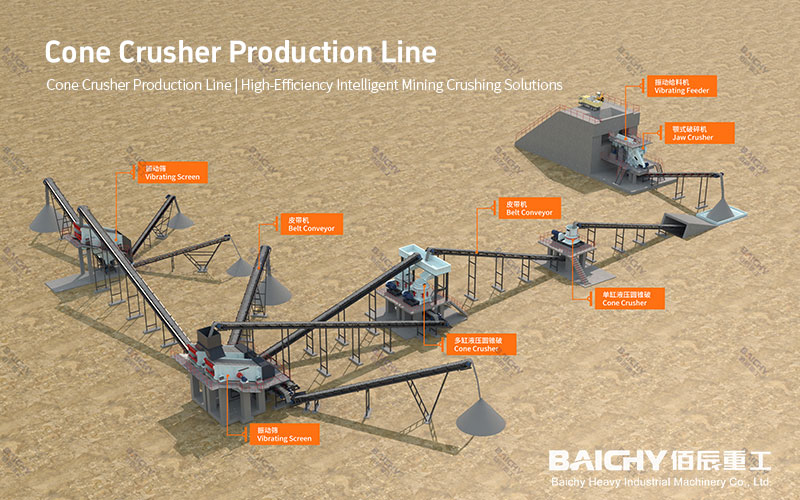
Cone Crusher Production Line — Three-Stage Crushing Production Line
In the production of sand and gravel aggregates, as well as in mining and quarrying operations, the tertiary crusher plays a pivotal role in the final stage of material size reduction. As the "final link" in a multi-stage crushing process, it directly determines the particle size, shape, and overall quality of the finished product. This article provides a detailed breakdown: What exactly is a tertiary crusher? How does it work? And what core functions does it perform within a complete crushing workflow?
Tertiary Crushers: The "Finishing" Stage of the Crushing Process
In a typical "three-stage, closed-circuit" crushing process, the primary (coarse crushing), secondary (intermediate crushing), and tertiary (fine crushing) stages constitute the core components. Situated at the end of the workflow, the tertiary crusher is tasked with taking materials that have passed through the first two stages—but whose particle size still fails to meet final product specifications (typically under 40mm)—and further reducing them to the target specifications (e.g., 0–5mm, 5–10mm, 10–20mm, etc.).
Its function is not merely to "make things smaller," but—more critically—to "shape" the material. By employing specific crushing principles, it effectively improves the particle shape of the finished aggregates (yielding a high cubic content) and reduces the proportion of flaky and needle-like particles, thereby enhancing the product's added value and market competitiveness.
Key Application Scenarios: Which Industries Rely on It?
The application of tertiary crushers is highly concentrated in production sectors that impose strict requirements on the particle size and shape of the finished product:
1. High-Quality Sand and Gravel Aggregate Production: This is the primary application scenario. It is used to produce the high-standard crushed stone and manufactured sand required for commercial concrete; the resulting aggregates feature excellent particle shapes and serve as the cornerstone of high-quality concrete.
2. Fine Crushing Prior to Metal Ore Beneficiation: Before the ore beneficiation process begins, the crusher reduces the ore to a finer particle size (e.g., -10mm or smaller). This creates the necessary conditions for subsequent grinding operations, enabling a "more crushing, less grinding" strategy that conserves energy and reduces consumption.
3. Building Materials and Non-Metallic Mineral Processing: It is utilized to process materials such as limestone, dolomite, and quartzite, producing various specifications of stone aggregates for construction as well as powdered raw materials for industrial use. Whether for large-scale mining projects or small-to-medium-sized sand and aggregate crushing lines, whenever there are stringent requirements regarding the fineness of the finished product, a tertiary crusher serves as an indispensable and critical component.
Common Types of Tertiary Crushers: A Comparison of Advantages and Selection Guide
The primary types of equipment commonly utilized for tertiary crushing are listed below; each possesses its own specific application scenarios and distinct advantages.
| Equipment Type | Working Principle | Key Advantages | Applicable Materials | Typical Discharge Size |
| Cone Crusher (Multi-cylinder/Full-hydraulic) | Laminated Crushing | Stable operation, long service life for wear parts, high production capacity, high proportion of fine-grained output. | Medium-to-high hardness rocks (granite, basalt, river pebbles, etc.) | 5–40 mm (Adjustable) |
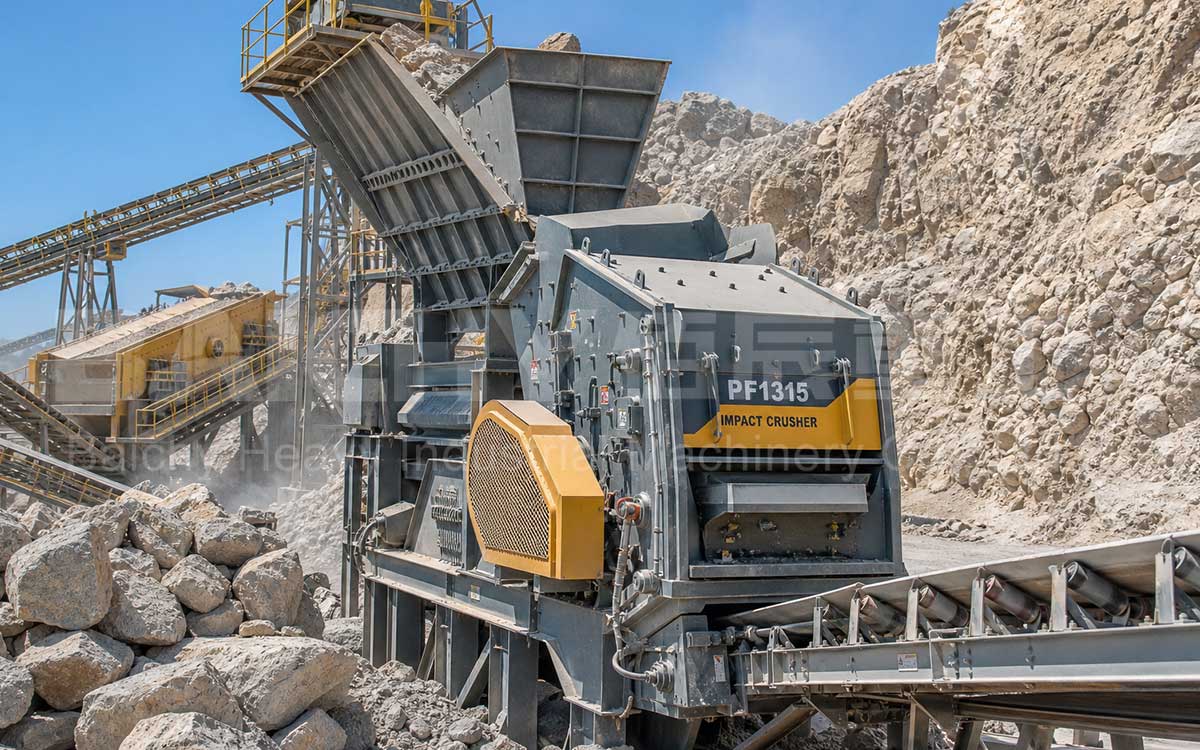
| Impact Crusher (Vertical Shaft Sand Maker) | "Stone-on-Stone" or "Stone-on-Iron" | Excellent particle shape (predominantly cubical), combines both crushing and shaping functions, ideal for sand production. | Medium-to-high hardness rocks; particularly suitable for sand making and shaping. | 0–5 mm (Sand), 5–10 mm |
| High-Efficiency Fine Crusher | Hammering & Impact Crushing | Simple structure, low investment cost, fine discharge size, suitable for small-to-medium-sized production lines. | Medium-to-low hardness rocks (limestone, shale, etc.) | 0–10 mm (Adjustable) |
| High-Pressure Grinding Roll (HPGR) | High-Pressure Bed Crushing | Significant energy-saving effects, minimal over-crushing, concentrated product particle size distribution. | Materials of medium hardness or lower; widely used for the fine crushing of slag and cement clinker. | High proportion of 0–5 mm output |
Selection Recommendations:
• For superior particle shape and sand production: The Impact Crusher is the preferred choice.
• For processing high-hardness materials while prioritizing stability and high output: The Multi-cylinder Hydraulic Cone Crusher is a reliable option.
• For medium-hardness materials with a limited investment budget: The High-Efficiency Fine Crusher is a viable consideration.
• For extremely stringent requirements regarding energy efficiency and specific particle size distribution: The High-Pressure Grinding Roll (HPGR) should be evaluated.
Success Story: Value Enhancement Through Tertiary Crushing
Case Study: A Large-Scale Granite Aggregate Project in East China
• Challenge: The original production line utilized a two-stage crushing process. Consequently, the content of needle-like and flaky particles in the finished product exceeded acceptable limits (>15%), and the particle shape of the 5–10 mm aggregate fraction was poor, resulting in a low market selling price.
• Solution: Following the existing two-stage crushing setup, we installed our company's HPY500 multi-cylinder hydraulic cone crusher to serve as the tertiary crusher, complemented by a closed-circuit screening system.
• Results: The content of needle-like and flaky particles in the finished aggregate dropped to below 8%, and the particle shape improved significantly. This elevated the product grade, leading to an approximate 20% increase in the selling price. Furthermore, thanks to the optimized "three-stage, one-closed-circuit" workflow, the system's overall throughput increased by approximately 15%, while the increase in energy consumption was negligible.
Our Recommended Tertiary Crushing Equipment
Based on varying material characteristics and production capacity requirements, we recommend the following flagship products as premium choices for your tertiary crushing needs:
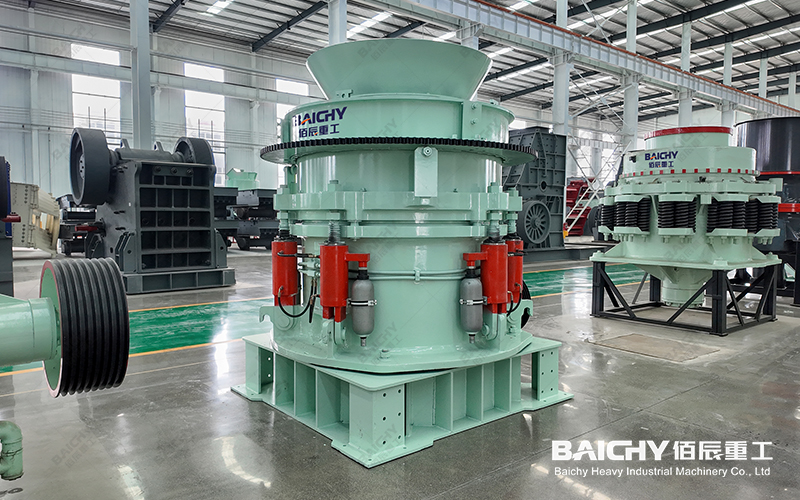
HP Series Multi-Cylinder Hydraulic Cone Crusher
1. HP Series Multi-Cylinder Hydraulic Cone Crusher: Specifically designed for medium, fine, and ultra-fine crushing applications. Utilizing a laminated crushing principle and equipped with a fully automated intelligent control system, it is the ideal choice for processing high-hardness materials, delivering uniform discharge granularity and controllable fine powder content.
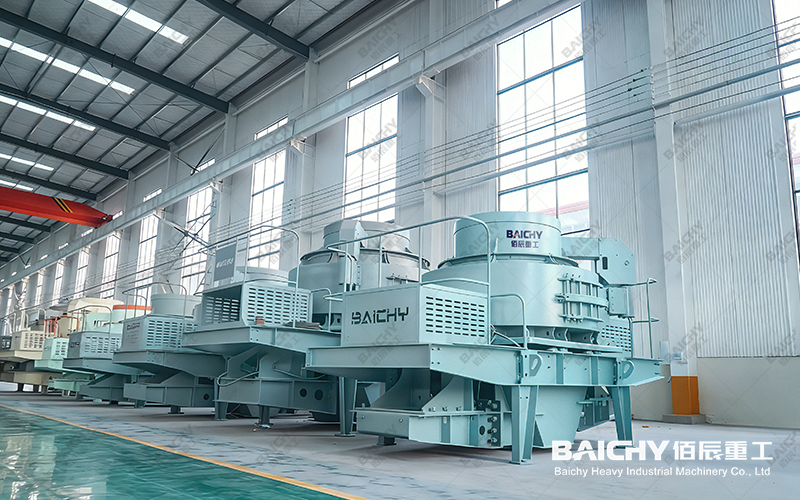
VSI/VSI6X Series Impact Sand Maker
2. VSI/VSI6X Series Impact Sand Maker: Employs a composite crushing mode featuring both "stone-on-stone" and "stone-on-iron" impact mechanisms. It integrates the functions of crushing, shaping, and sand-making into a single unit. The finished product features a particle shape closely resembling natural sand with a continuous gradation—making it the ultimate equipment for producing high-quality manufactured sand and premium aggregates.
3. Single-Stage Fine Crusher: Characterized by a compact structure and a high crushing ratio. It is capable of reducing medium-hardness materials to the required fineness in a single pass, making it an optimal solution for simplifying workflows and reducing capital investment. It is particularly well-suited for the fine crushing of materials such as limestone and marl.
Frequently Asked Questions (FAQ)
Q1: Is a tertiary crushing stage required for every crushing production line?
A: Not necessarily. This depends on the specific granularity requirements for the final product. If the requirements for the finished product's particle size are not particularly strict (for example, if only a 0–40 mm mixed aggregate is required), or if the material itself is inherently brittle, a two-stage crushing process may be sufficient. However, when the objective is to produce high-standard, premium-grade aggregates or manufactured sand in various specifications, incorporating a tertiary crusher becomes the key to achieving both high quality and high economic returns.
Q2: Are tertiary crushers and sand-making machines the same type of equipment?
A: Not exactly. A sand-making machine—typically an impact crusher—is a specific *type* of tertiary crusher, designed exclusively for producing manufactured sand with a grain size of 0–5 mm. However, the concept of a tertiary crusher is broader; it also encompasses equipment such as cone crushers and fine crushers, which are used to produce small-sized crushed stone (e.g., 5–10 mm or 10–20 mm). Sand production is simply one specific objective within the scope of tertiary crushing.
Q3: How is the discharge particle size controlled when operating a tertiary crusher?
A: This is primarily achieved by adjusting the discharge opening (e.g., via the hydraulic motor on a cone crusher), altering the rotor speed or the gap between the impact plates/liners (e.g., on an impact crusher), or by changing the screen plates (e.g., on a fine crusher). Modern, high-end equipment is typically equipped with hydraulic adjustment and automated control systems, allowing for easy remote adjustment from a central control room to ensure consistent and stable output.
Summary
As the "quality gatekeeper" of modern crushing production lines, the value of a tertiary crusher extends far beyond merely "crushing the material one more time." Through precise crushing and particle shaping, it transforms the intermediate products from upstream processes into high-value final commodities, serving as a core technological asset for maximizing both resource efficiency and economic returns. Selecting and applying the appropriate tertiary crusher is a decisive step in constructing a crushing production line that is efficient, energy-saving, and capable of delivering superior quality.