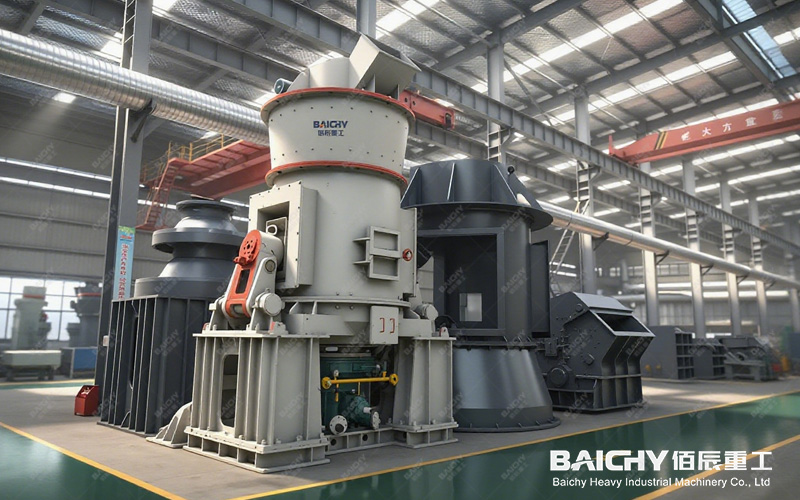
vertical roller mill for raw material
I. Why Raw Material Grinding is the Primary Domain for Vertical Mills: An Industry Cost Analysis
In the electricity consumption structure of cement production, the grinding stage (raw meal + cement) typically accounts for over 60% of a plant's total power usage, with raw meal grinding representing the single largest point of consumption. The specific characteristics of raw material grinding maximize the advantages of vertical mills:
| Operational Characteristics of Raw Material Grinding | Significance for Vertical Mills |
| High material volume (raw meal-to-clinker ratio approx. 1.5–1.7:1) | High single-unit capacity directly dilutes fixed costs per ton |
| Raw material moisture content of 3–15% (limestone, clay, sandstone) | Simultaneous grinding and drying eliminates the need for a dedicated pre-drying line |
| Moderate fineness requirements (10–14% residue on 80 μm sieve) | Operates in the peak efficiency zone for bed grinding; avoids the limitations associated with ultra-fine grinding |
| Abundant waste heat (200–350°C) at the kiln tail | Free hot air supply; drying costs approach zero |
| Continuous production (7,000–8,000 operating hours/year) | Power consumption differences accumulate to millions of dollars over time |
In short: Raw material grinding combines "drying requirements," "high throughput," and "moderate fineness"—a perfect fit for the vertical mill's performance "sweet spot." The inherent weaknesses of vertical mills (handling ultra-fine powders or highly abrasive materials) rarely come into play under these operating conditions. This is not a debate of "advanced vs. traditional" technology, but rather a question of operational suitability.
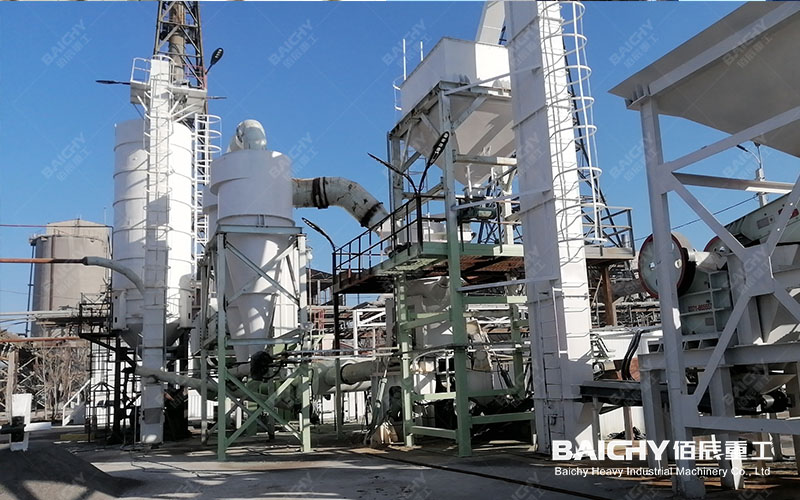
Vertical Mill Site in Russia
II. Pain Point Analysis: Four Hidden Costs of Traditional Ball Mill Systems for Raw Material Grinding
2.1 Electricity consumption is the largest long-term cost.
A typical raw meal ball mill system (including fans and classifiers) consumes 20–24 kWh/t of electricity, whereas a vertical raw mill consumes 14–18 kWh/t. A difference of 6 kWh/t may seem small, but when multiplied by an annual output of 600,000 tons of raw meal and an electricity price of $0.08/kWh, it amounts to $288,000 annually—a figure that rises linearly with electricity prices.
2.2 Moisture content constraints.
Ball milling requires feed moisture <1–2%; wet feed necessitates an external dryer, adding a main machine, a hot-blast stove, and fuel costs. However, raw material silo limestone and clay typically contain 5–15% moisture.
2.3 System footprint and intermediate stages.
A ball mill setup involves a horizontal layout, external separators, and multi-stage bucket elevators; the total line footprint is roughly 1.5–2 times that of a vertical mill system, leading to expanded requirements for factory buildings, conveying systems, and civil works.
2.4 Grinding media replenishment and liner maintenance.
Impact-based grinding causes continuous wear on steel balls and liners; downtime for media replenishment affects operating rates, and wear-related costs rise linearly with production capacity while remaining difficult to predict.
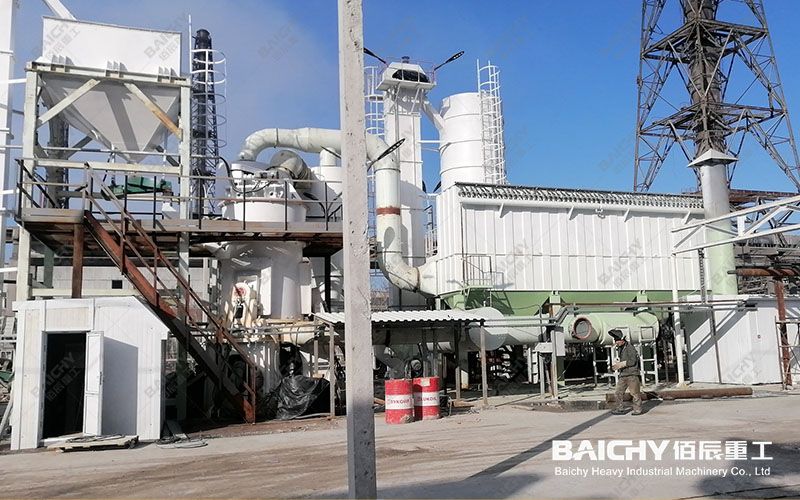
Vertical Mill Site in Russia
III. Parameter Analysis of Vertical Raw Mills
1. System power consumption: 14–18 kWh/t → Annual electricity savings of $200,000–$500,000. Compared to the 20–24 kWh/t required by ball mill systems—based on a raw meal capacity of 50–60 t/h, 8,000 annual operating hours, and an electricity price of $0.08/kWh—annual electricity savings amount to 2.4–4.8 million kWh (approx. $190,000–$380,000). At a capacity of 180–220 t/h (standard for a 2,000 TPD line), annual savings can exceed $600,000. For most projects, this factor alone offsets the price difference of the main equipment.
2. Feed moisture ≤15–20% + kiln tail waste heat → Drying costs approach zero. Materials are dried and ground simultaneously within the mill chamber using hot air, directly utilizing waste heat (200–350°C) from the kiln tail or boiler exhaust. Compared to the "ball mill + external dryer" scheme, this eliminates the investment in the dryer itself, hot-blast stove fuel costs, and the associated conveying system. This is equally applicable to slag and fly ash projects, eliminating the need for pre-drying processes.
3. System footprint is approximately 1/2 to 2/3 that of a ball mill system → Civil engineering investment is reduced by about 30%. Grinding, drying, classifying, and collecting are all performed within a single vertical process flow. For expansion projects with site constraints or facilities in high-land-cost areas, this compact layout translates directly into quantifiable savings on civil works (including steel-structure workshops, foundations, and conveyors).
4. Online variable-frequency classifier → A single production line can supply multiple product grades. For raw meal, fineness can be continuously adjusted during operation within the range of 10–14% residue on an 80 μm sieve; for ground granulated blast-furnace slag (GGBS) projects, fineness can reach 4,000–5,000 cm²/g. Switching products requires no downtime for component changes, resulting in significantly higher line utilization compared to ball mills, which require shutdowns to adjust grinding media gradation.
5. Material-bed grinding with no steel balls → Predictable wear costs and higher operating rates. Grinding occurs via a material cushion between the rollers and the table, eliminating direct metal-to-metal contact. In raw meal applications, the service life of rollers and tables is 6,000–10,000 hours (replacement every 1–1.5 years); there is no downtime for adding grinding media, and the annual operating rate can be 2–4 percentage points higher than that of ball mill systems—translating to an additional 160–320 hours of effective production time per year for a line operating 8,000 hours annually.
6. Single-unit capacity starts at 180–220 t/h (for a 2,000 tpd line) and reaches an upper limit of over 500 t/h → A single line can replace two ball mill lines. Fewer equipment units, reduced electrical and civil infrastructure requirements, and a smaller workforce allow economies of scale to lower fixed costs per ton; simultaneously, this reduces potential points of failure and simplifies spare parts inventory management.
IV. Core Parameters: Typical Selection Ranges for Vertical Raw Material Mills
| Parameter | Typical Range | Notes |
| Single-unit capacity | 50 – 500+ t/h | Standard for 2000 TPD cement lines: 180–220 t/h; slag and pulverized coal capacities are adjusted based on operating conditions |
| Feed particle size | ≤ 50 – 100 mm | Raw meal feed size can be up to ≤80 mm; requires upstream crushing system |
| Feed moisture content | ≤ 15 – 20% | Hot air allows simultaneous grinding and drying; utilizes waste heat from kiln tail/boiler (200–350°C) |
| Product fineness | 10–14% residue on 80 μm sieve | Typical value for raw meal; slag powder: 4000–5000 cm²/g |
| System power consumption | 14 – 18 kWh/t | Includes fans and classification; ball mill systems consume 20–24 kWh/t |
| Roller/table service life | 6000 – 10000 h | Raw meal application; varies based on material abrasiveness |
| System footprint | Approx. 1/2 – 2/3 of ball mill systems | Vertical layout; eliminates external classifiers and multi-stage elevators |
Note: The above figures represent typical industry ranges, not a guarantee for a specific model. Specific models, capacities, and fineness levels are determined by material grinding tests and the signed technical agreement—this is the most critical step in the procurement process for vertical mills.
V. FAQ
Q1: How much electricity does a vertical mill actually save compared to a ball mill when grinding raw materials?
A1: For raw meal grinding, the vertical mill system consumes 14–18 kWh/t, while the ball mill system consumes 20–24 kWh/t, resulting in energy savings of 25–35% (international studies indicate VRM energy savings of up to 30%; source: ScienceDirect industrial comparative studies). Based on a capacity of 180 t/h, 8,000 annual operating hours, and an electricity price of $0.08/kWh, estimated annual electricity cost savings range from $400,000 to $600,000.
Q2: What is the maximum raw material moisture content for direct feeding into a vertical mill?
A2: Generally, if moisture is ≤15–20%, the material can be dried and ground simultaneously. By prioritizing the use of 200–350°C waste heat from the kiln tail, drying costs are virtually zero. Pre-drying is recommended if moisture exceeds this range. In contrast, ball mill systems require feed moisture <1–2%; this capability represents one of the most underrated advantages of vertical mills regarding raw material processing.
Q3: What raw materials can a vertical mill process? What else can it grind besides cement raw meal?
A3: Cement raw meal (the co-grinding of limestone, clay, sandstone, and iron-bearing additives) is the primary application. The same equipment can be switched to process materials of medium hardness or lower, such as slag, fly ash, pulverized coal, gypsum, and phosphate rock. Switching materials requires only adjustments to the classifier speed and hot air parameters; the main mill unit does not need to be changed.
Q4: What size vertical raw mill is required for a 2,000 TPD cement line?
A4: The typical industry configuration is a single mill with a capacity of 180–220 t/h, meeting the raw meal requirements for a daily clinker output of 2,000 tons (considering a raw meal-to-clinker ratio of approximately 1.5–1.7:1 and kiln availability). Specific sizing depends on material testing and the clinker mix design.
Q5: What is the approximate payback period for a vertical raw mill system?
A5: Electricity savings are the primary driver of the payback: for a 180 t/h line, annual electricity savings are estimated at $400,000–$600,000. When combined with avoided investment in separate dryers, civil engineering savings, and increased operational availability, the typical industry payback period is 2–4 years (varying based on electricity prices and raw material conditions). Baichen can provide a comprehensive analysis including CAPEX and OPEX figures.
Q6: Can your company's vertical raw material mill be adapted for 60Hz / 400V / 440V power grids?
A6: Yes. The main motor, fan, classifier, and hydraulic station are custom-manufactured to match local voltage and frequency specifications, thereby avoiding airflow imbalances and reduced production capacity caused by frequency derating. Baichen has a track record of delivering similar grinding projects in South America, the Middle East, and Southeast Asia, and we support remote factory inspections as well as free material grinding tests.