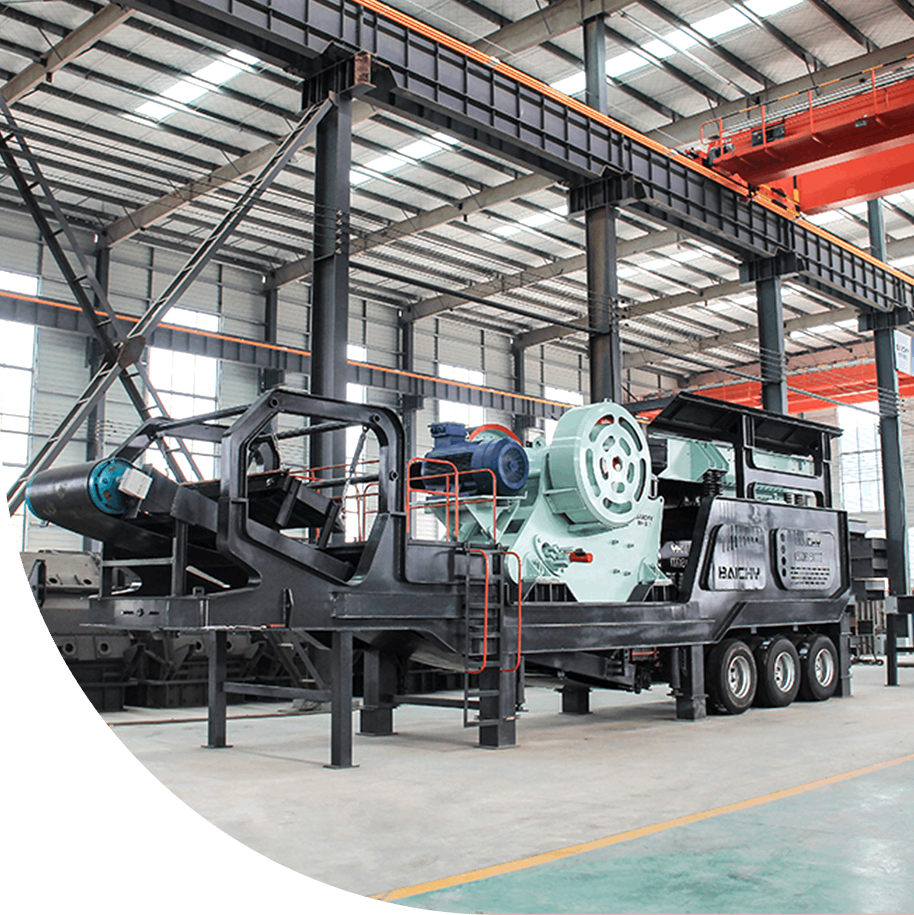


Toothed Roll Crusher
The toothed roll crusher is one of the most cost-effective equipment options for crushing weathered rock (such as weathered granite, basalt, mudstone, and shale). Utilizing a low-speed, high-torque mechanism that combines shearing and crushing actions via dual toothed rolls, it overcomes the clogging and excessive fines generation issues that plague traditional impact crushers when processing materials characterized by high moisture, high clay content, and strong adhesion. A single unit can handle both secondary and tertiary crushing to achieve the desired product size in one pass; furthermore, its overall power consumption and wear-part costs are significantly lower than those of a two-stage "jaw crusher plus impact crusher" setup. If your project relies primarily on weathered rock and aims to produce roadbed fill or manufactured sand, the toothed roll crusher should be your top choice for consideration.
I. Weathered Rock Crushing: An Industry Shift from "Waste" to "Resource"
Weathered rock is the product of long-term physical and chemical weathering. Widely distributed along highways and railways in the hilly and mountainous regions of southern China, it typically has a Mohs hardness of only 3–5 and a compressive strength of 5–40 MPa. Although it appears easy to crush, it has historically been treated as waste material and sent to landfills. However, as the supply of infrastructure aggregates tightens and environmental regulations become stricter, the resource utilization of weathered rock has become a clear trend. Once crushed, it can be used for roadbed filling, graded crushed stone base courses, raw material for manufactured sand, and even aggregate for non-fired bricks—thereby increasing its value per ton several-fold. However, crushing weathered rock presents three major industry-recognized challenges for which standard crushing equipment is often ill-suited:
• High moisture and clay content: Open-pit weathered rock often has a moisture content of 8%–15%, and some weathered granite contains over 20% clay. In impact crushers (such as horizontal shaft impactors or hammer crushers), this material easily causes chamber clogging and material buildup, leading to frequent shutdowns for clearing blockages.
• Excessive fines generation: Due to the low strength of weathered rock, high-speed impact equipment tends to pulverize it into large amounts of fine powder, resulting in low product yields and "excessive stone powder" levels during sand making.
• Unstable particle shape and gradation: Jaw crushers produce flaky, unevenly sized material that struggles to meet roadbed and aggregate gradation specifications; secondary shaping is often required, driving up overall process costs.
II. Working Principle and Core Advantages of the Toothed Roll Crusher
2.1 Working Principle
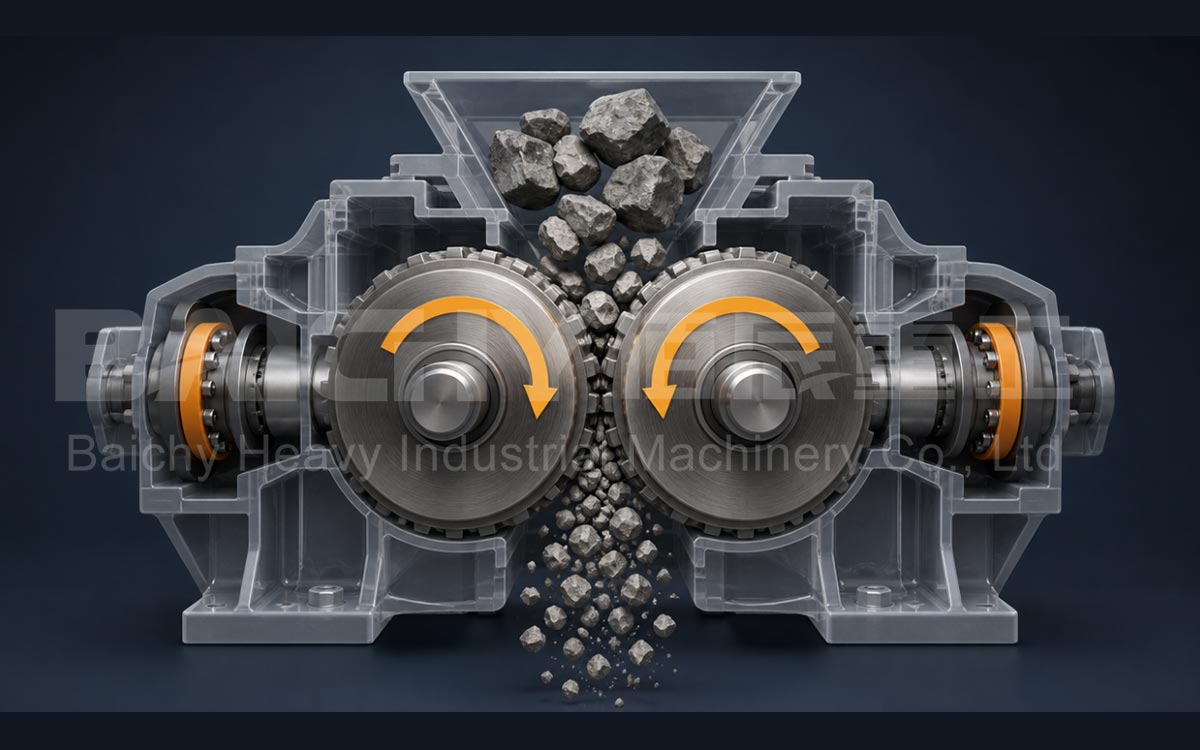
Weathered Rock Crushing
The toothed roll crusher consists of two toothed rolls rotating toward each other at low speeds; the roll surfaces are studded with wear-resistant teeth made of high-manganese steel. As material enters the space between the rolls, it is first "gripped" by the teeth and then crushed through a combination of shearing, splitting, and compression. The finished product falls through the gap between the rolls, with the output particle size determined directly by the width of this gap. Its low-speed, high-torque design renders the equipment largely insensitive to moisture and clay content—this is the fundamental difference distinguishing it from high-speed impact equipment and the key to successfully processing weathered rock.
2.2 Five Core Advantages
| Advantage | Practical Value to Buyers |
|---|---|
| No Clogging with Wet Material | Enables continuous operation with weathered rock containing 8%–15% moisture and over 20% clay; eliminates downtime caused by clogging |
| Single-Stage Processing | Crushing ratio of 4:1–8:1; integrates medium and fine crushing, saving on secondary crusher investment and footprint |
| Low Over-Crushing Rate | Controllable proportion of fine powder; manufactured sand consistently meets stone powder content standards; higher product yield |
| Low Energy Consumption | Low-speed operation; electricity consumption per ton is 30%–50% lower than impact crushers; offers a distinct advantage in markets sensitive to electricity costs |
| Easy Maintenance | Simple structure with few wear parts; worn tooth rollers can be repaired via hardfacing rather than requiring full roller replacement; low spare parts costs |
2.3 Comparative Analysis: Tooth Roller Crusher vs. Jaw Crusher and Impact Crusher
| Comparison Dimension | Tooth Roller Crusher | Jaw Crusher | Impact Crusher |
|---|---|---|---|
| Adaptability to Sticky/Wet Material | ★★★★★ High | ★★★ Moderate | ★★ Poor (prone to clogging) |
| Product Particle Shape | Uniform blocky shape; controllable fines | Tendency towards flaky shapes | Good shape, but high fines content |
| Crushing Ratio | 4:1–8:1 | 3:1–6:1 | >10:1 |
| Single-Stage Medium/Fine Crushing | Yes | No | Yes (but prone to clogging) |
| Energy Consumption per Ton | Low | Medium | Relatively High |
| Maintenance Cost | Low | Medium | High (frequent blow bar replacement) |
Conclusion: For "soft, sticky, and wet" weathered rock, the tooth roller crusher holds a comprehensive advantage in terms of adaptability, cost, and product yield; jaw crushers are better suited for the initial coarse crushing of large materials, while impact crushers are best suited for dry, clean limestone-type materials.
III. Key Specifications of the 2PGC Series Toothed Roll Crusher
The following table outlines the typical configuration for Bacihy Heavy Industry’s 2PGC series double-toothed roll crusher. Processing capacities are rated based on medium-hardness material with a bulk density of approximately 1.5 t/m³:
| Model | Roll Diameter × Length (mm) | Feed Size (mm) | Discharge Size (mm) | Capacity (t/h) | Motor Power (kW) |
|---|---|---|---|---|---|
| 2PGC450×500 | φ450×500 | ≤200 | 25–50 | 10–30 | 2×7.5 |
| 2PGC600×750 | φ600×750 | ≤300 | 30–75 | 20–60 | 2×15 |
| 2PGC900×900 | φ900×900 | ≤500 | 50–150 | 60–120 | 2×30 |
| 2PGC1200×1500 | φ1200×1500 | ≤800 | 75–200 | 150–300 | 2×55 |
Selection Note: Higher moisture or clay content in weathered rock will reduce actual throughput; similarly, adjusting for a finer discharge size will result in a corresponding drop in capacity. It is recommended to use "Nominal Capacity × 0.7–0.85" as a design reference and to rely on material testing or actual manufacturer measurements. Bacihy Heavy Industry supports sample testing to determine the appropriate model based on real data, avoiding inflated capacity claims. Motor voltage (380V/400V/440V/660V) can be customized to meet the grid standards of the project's location.
IV. Typical Application Scenarios
4.1 Highway and Railway Subgrade Fill
Crushed weathered rock (0–100mm graded aggregate) can be used directly for subgrade filling and graded crushed stone base courses. This allows for the use of local materials and significantly reduces the cost of transporting and disposing of excavated waste. The toothed roll crusher’s moisture-resistant characteristics ensure stable output even during rainy season construction, making it a cost-effective choice for highway projects in mountainous regions.
4.2 Manufactured Sand Raw Material Preparation
The "toothed roll crusher + VSI sand-making machine" combination is ideal for producing sand from weathered rock: the toothed roll crusher handles the shaping and pre-crushing of large lumps while minimizing excessive fines generation, leaving the VSI to perform only the final shaping. This setup significantly reduces power consumption compared to a full-process impact crushing line, while ensuring continuous sand gradation and controllable stone powder content.
4.3 Building Material Raw Materials
Crushed weathered rock can serve as aggregate for non-fired bricks, cement admixtures, or raw material for ceramsite. This enables the utilization of solid mine waste in building materials, offering both environmental compliance and economic benefits—making it particularly suitable for building material production lines integrated with mining operations.
4.4 Pre-crushing for Mineral Processing and Chemical Industries
This method is also applicable to the pre-crushing of low-hardness ores (such as bauxite, manganese ore, and bentonite) and chemical raw materials. Toothed roll crushing avoids the loss of metal minerals caused by "sliming" (excessive pulverization into fine mud) and improves recovery rates in subsequent grinding stages.
5. Application Case Studies
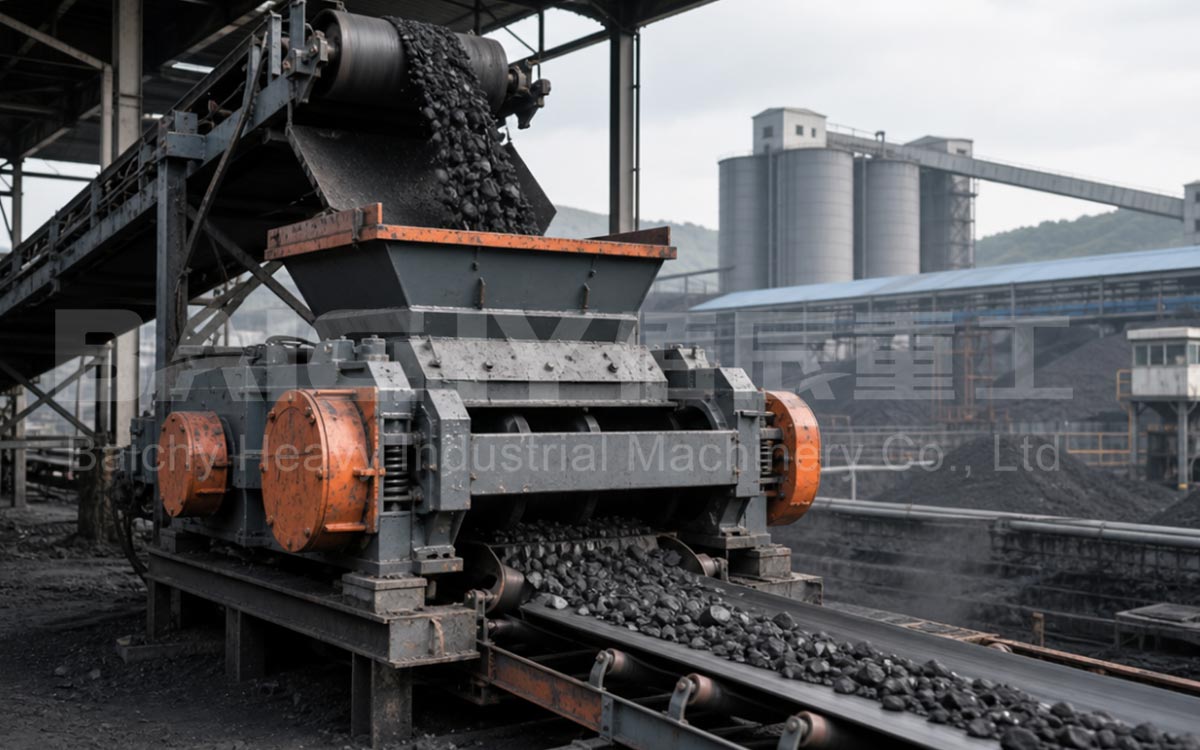
Weathered Rock Sand Making
Case Study 1: Expressway subgrade project in a mountainous region of Southwest China (approx. 200 t/h).
Material: A mixture of weathered mudstone and shale; moisture content 10%–12%; clay content approx. 15%; feed size ≤800 mm. Configuration: ZSW490×110 vibrating feeder + 2PGC1200×1500 toothed roll crusher + YK2460 circular vibrating screen; adjustable output size of 0–100 mm. The system operated continuously during the rainy season without clogging; the compacted product met subgrade fill standards, and power consumption per ton dropped by approximately 40% compared to the original "jaw crusher + impact crusher" setup.
Case Study 2: Weathered granite sand-making project in Southeast Asia (approx. 100 t/h).
Material: Weathered granite with some clay inclusions. Configuration: 2PGC900×900 toothed roll crusher + VSI-9526 sand-making machine + XSD wheel-bucket sand washer + fine sand recovery unit. Shaping at the primary stage of the toothed roll crusher controls the production of fines; the stone powder content in the manufactured sand remains stable below 8%, and the gradation meets the requirements for C30 concrete sand.
(The above is a typical configuration reference based on similar projects, not specific client information; the actual solution requires on-site material testing and production line layout design.)
VI. Recommended Equipment
A complete toothed roll crusher production line typically consists of the following equipment; Bacihy Heavy Industry offers full-package supply and turnkey production line services:
| Equipment | Recommended Model | Function |
|---|---|---|
| Vibrating Feeder | ZSW Series (with grizzly bars) | Uniform feeding; pre-separation of soil/clay |
| Primary Crusher (Optional) | PE Series Jaw Crusher | Processing oversized blocks (>600mm) |
| Toothed Roll Crusher | 2PGC Series | Core medium-to-fine crushing; single-pass shaping |
| Circular Vibrating Screen | YK Series | Grading and screening |
| Sand Making Machine (Optional) | VSI / Double-roll Sand Maker | Shaping of manufactured sand |
| Wheel-bucket Sand Washer | XSD Series | Washing sand and removing clay |
| Fine Sand Recovery Machine | Paired with high-frequency dewatering screen | Recovering fine sand; minimizing loss |
VII. Toothed Roll Crusher FAQ
Q1: What materials are suitable for the toothed roll crusher?
It is primarily designed for materials with low-to-medium hardness that are prone to sticking or high moisture content: weathered rock, mudstone, shale, coal, coke, bauxite, bentonite, and medium-soft limestone; feed size ≤1000mm. For hard materials with a Mohs hardness above 6 (e.g., fresh granite, basalt), a "Jaw Crusher + Cone Crusher" setup is recommended to avoid excessive wear on the teeth.
Q2: Will the toothed roll crusher get clogged when processing high-moisture weathered rock?
No. The toothed roll crusher operates on the principle of low-speed, high-torque shearing and compression. The teeth on the roll surface actively "bite" into the material; there are no dead zones for material accumulation typical of high-speed impact chambers, and the wide discharge opening allows wet material to be discharged smoothly. Continuous operation is possible with weathered rock containing up to 15% moisture and 20% clay; for wetter materials, stable operation can be maintained by utilizing hydraulic roll gap adjustment and variable-frequency feeding.
Q3: How is the output particle size of the toothed roll crusher adjusted? Can it be used directly for sand making?
Output particle size is controlled by adjusting the gap between the two rolls (using shims or hydraulic adjustment); a wider gap results in coarser output. A single unit can produce material in the 0–25 mm range, partially replacing the dedicated sand-making stage. However, if the requirement is for concrete-grade sand with continuous gradation and rounded particle shape, a combination of a "toothed roll crusher + VSI sand-making machine" is recommended to balance production capacity and particle shape.
Baichy Heavy Industry
Baichy Heavy Industry is a high-tech mining equipment company integrating R&D, manufacturing, sales, and after-sales service. Focusing on crushing, grinding, and mineral processing equipment, we provide professional solutions to our customers. We are ISO9001:2015 、certified, and our products include mobile crushing palnts, crawler crushing plant, construction waste crushing plants, jaw crushers, sand making machines, cone crushers, fine crushers, grinding mills, ball mills, etc., all with reliable performance to meet diverse project needs.
Baichy Heavy Industry – Your Trusted Partner
To ensure optimal performance of your equipment, Baichy Heavy Industry offers:
- Professional on-site installation guidance
- Comprehensive operator training
- 24/7 technical support & maintenance services
Our complete after-sales service system guarantees long-term, stable operation of your machinery with minimal downtime.
Protect Your Rights – Only Use Official Channels
To avoid scams and ensure authentic support, contact us exclusively through:
• Official Website: www.baichychina.com
• WhatsApp: +8615093222637
• Email: [email protected]
Your satisfaction is our priority – expect prompt, professional service every time.
(Note: Beware of unauthorized third parties claiming to represent Baichy. Always verify through official contacts.)