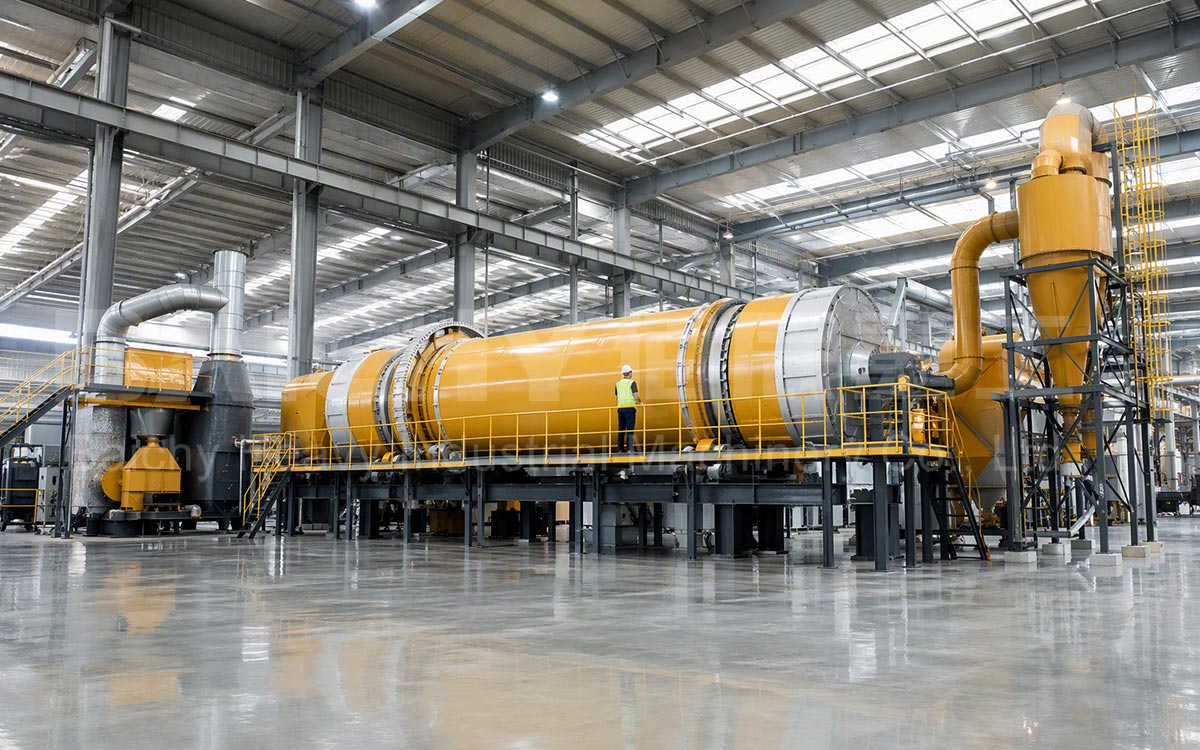
Industrial Sludge Dryers
Industrial sludge is more challenging to dry than municipal sludge. The difficulty lies not merely in the moisture content but in the sludge's "nature"—components such as fibers, oils, heavy metals, chlorine, and sulfur vary by industry. If any specific characteristic is not adequately addressed during the design phase, the industrial sludge dryer will inevitably face operational issues—such as material clogging, corrosion, or failure to meet environmental standards—once put into service. Baichy Heavy Industry utilizes a direct-heating rotary dryer as the core unit, customizing internal structures (for material breakup and back-mixing), corrosion-resistant materials, and explosion-proof interlocks based on specific sludge analysis reports. This enables the stable reduction of sludge moisture content from 75–82% down to 40% (for landfill or building material blending), 30% (for incineration or co-processing in cement kilns), or even below 15% (for RDF fuel or resource recovery). Evaporation loads are calculated based on measured parameters, ensuring full operational capacity is achieved immediately upon startup.
I. Overview: "Identify" the Sludge Before Discussing Drying
While municipal sludge has a relatively uniform composition, the first lesson in selecting an industrial sludge dryer is: what category does your sludge fall into?
| Classification Criteria | Typical Industrial Sludge | Impact on Drying Equipment |
|---|---|---|
| Fibrous | Printing & dyeing, papermaking, leather sludge | Prone to tangling and bridging inside the drum; requires crushing bars and back-mixing internals |
| Inorganic/Heavy Metal | Electroplating, steel pickling sludge | Highly corrosive; requires corrosion-resistant materials and sealed systems |
| Oily/High-Volatility | Oil refining, oil & gas field sludge | Low flash point; requires temperature control, explosion protection, and gas treatment |
| Organic/Putrescible | Food processing, pharmaceutical sludge | Heat-sensitive and prone to charring; requires low-temperature, long-residence-time processes |
The disposal destination determines the target moisture content: 40% for landfill or blending into building materials; 30% for incineration or co-processing in cement kilns; and below 15% for RDF fuel production or precious metal recovery. Dryer Machine specifications are not determined arbitrarily based on "tonnage" alone; rather, they are calculated by working backward from the evaporation load—derived from the difference between initial and target moisture levels. A miscalculation at this stage leads to spiraling fuel costs and equipment investment overruns.
II. Typical Application Scenarios
| Application Scenario | Feed Moisture Content | Target Moisture Content | Drying Objective |
|---|---|---|---|
| Centralized sludge center for printing & dyeing parks | 78%–82% | 40% or ≤15% | Volume reduction for off-site transport; or co-firing/RDF production after drying |
| Paper mill sludge (containing fibers) | 75%–80% | 40%–50% | Solid waste volume reduction; fibrous dried material can be reused as fuel |
| Electroplating/surface treatment sludge | 60%–70% (filter press) | ≤40% | Volume reduction for packaging; lowering unit costs for hazardous waste disposal |
| Refining/oily sludge | 70%–80% | 30%–40% | Demulsification and drying followed by pyrolysis or co-firing |
| Food and pharmaceutical industry sludge | 80%–85% | 60%–65% or 40% | Pre-treatment for composting or volume reduction prior to incineration |
| Centralized drying center for industrial parks | 75%–80% | ≤15% | Fuel conversion (RDF) of mixed sludge from multiple sources |
III. Four Major Operational Challenges: The Distinguishing Factor Between Industrial Sludge Dryers and "Mineral Dryers"
Sticky phase and fiber entanglement: Wet sludge exhibits a paste-like consistency in the 60%–45% moisture range, causing wall adhesion and bridging; fibrous materials also tend to tangle into "cotton-like clumps" inside the drum. For direct-feed dryers, the actual operational capacity in this section is often only 60% of the design value; this material type exhibits the widest gap between nominal and actual capacity.
Corrosive gases and condensates: Sludge containing chlorine or sulfur (e.g., from electroplating or papermaking black liquor) releases corrosive agents during heating, causing rapid failure of standard carbon steel shells and seals.
Low-flashpoint risks in oily materials: Light components in refinery sludge may release flammable vapors in high-temperature zones; hot air temperatures must be regulated based on flashpoint and volatile matter curves.
Dust explosion and heat-induced auto-ignition: Dried sludge contains organic matter; combustible dust can deflagrate upon contact with an open flame. Safety measures—such as oxygen-level interlocks, explosion vents, and explosion-proof electrical components—must be configured in accordance with NFPA 654/GB 15577 standards, and discharge-end temperatures must be controlled to prevent smoldering within the hopper.
Failure to pass any of these four critical checks prevents the system from operating continuously and stably—this is precisely the value proposition of professional industrial sludge dryers.
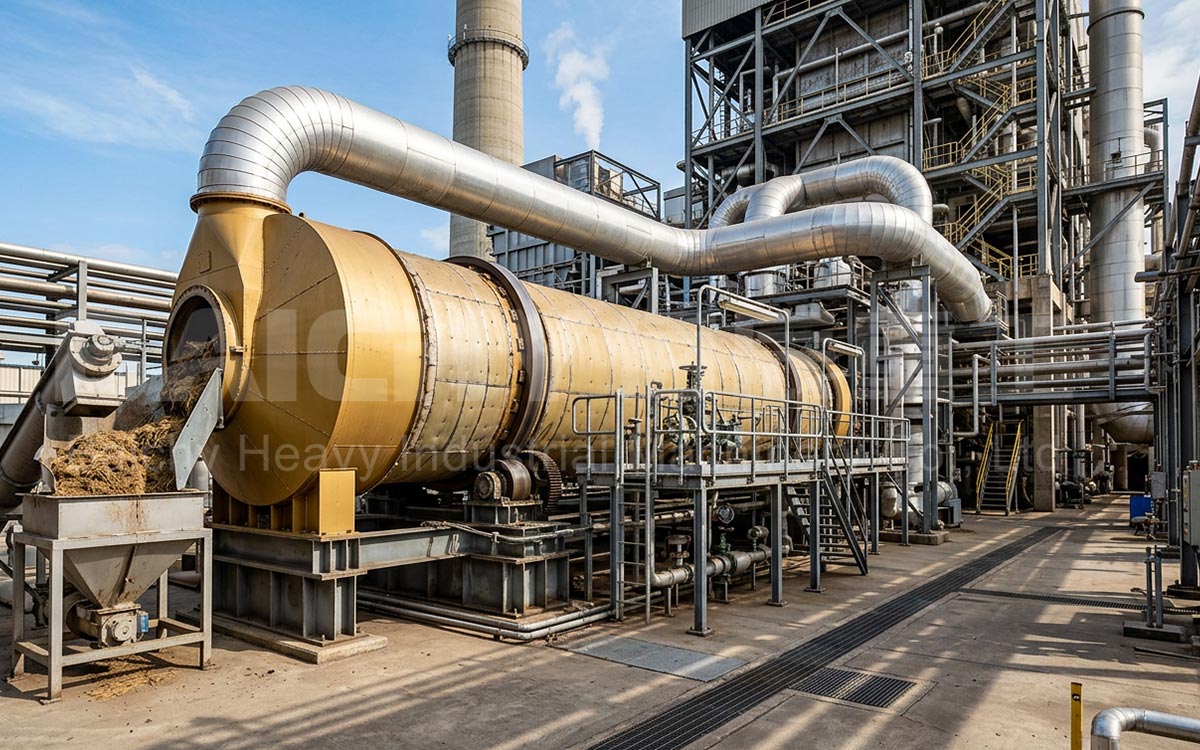
How to Choose an Industrial Sludge Dryer
IV. Core Advantages of Baichy Industrial Sludge Dryers
Customized internal components: A combination of breaking chains, dry material back-mixing, and crushing bars—tailored to laboratory analysis results—overcomes issues with sticky zones and fiber entanglement, ensuring actual capacity meets targets.
Corrosion-resistant material options: The shell, feed end, and seals can be upgraded with corrosion-resistant steel and liners based on chlorine/sulfur content, extending the equipment's service life.
Controllable co-current thermal processing: Hot air temperature is set according to the material's thermal sensitivity; low discharge temperatures prevent charring and smoldering.
Full-line negative-pressure containment: Odors and VOCs are captured and treated in a controlled manner, preventing release into the workshop or atmosphere.
Explosion-proof safety interlocks: Features include oxygen monitoring, temperature gradient interlocks, explosion vents, and explosion-proof electrical components, ensuring complete isolation of open flames from combustible dust.
Modular heat sources: Compatible with natural gas, coal, biomass, steam, and kiln waste heat; systems can be configured based on local energy costs.
Two-stage dust recovery: Cyclone and bag filter combination achieves ≥99% recovery; dry powder is returned to the product stream, minimizing material loss.
V. Technical Parameters for Industrial Sludge Dryer (Baichy Typical Configuration)
The processing capacities listed below are calculated based on two types of feed material: A = material from plate-and-frame filter presses (60%–65% moisture content); B = material from belt/multi-disk screw dewatering units (78%–82% moisture content). Calculations assume a target moisture content of 40%; values for deep drying are adjusted proportionally based on evaporation load, with final specifications subject to actual material drying tests.
| Specifications (Diameter × Length, m) | Evaporation Capacity (t/h) | Throughput A (Filter Press 60%–65%, t/h) | Throughput B (Belt Press 78%–82%, t/h) | Output Moisture Content | Main Motor (kW) | Typical Application |
|---|---|---|---|---|---|---|
| Φ1.5×12 | 1.5–2.2 | 3.5–4.5 | 2–3 | Adjustable (40%/30%/15%) | 15 | Single-plant support; small-scale production line |
| Φ1.8×14 | 2.5–3.3 | 6–7 | 4–5 | Adjustable (40%/30%/15%) | 18.5 | Printing & dyeing/papermaking: single-plant or industrial park support |
| Φ2.0×16 | 3.5–4.7 | 8–10 | 5.5–7 | Adjustable (40%/30%/15%) | 22 | Industrial park centralized drying center |
| Φ2.2×18 | 5–6.6 | 12–15 | 8–10 | Adjustable (40%/30%/15%) | 30 | 100–150 t/d centralized disposal |
| Φ2.4×20 | 6.5–8.5 | 15–19 | 10–13 | Adjustable (40%/30%/15%) | 37 | Large-scale industrial park sludge center |
| Φ2.6×22 | 8.5–11 | 20–25 | 13–16.5 | Adjustable (40%/30%/15%) | 45 | Regional centralized drying base |
Key Points: When the feed material from a filter press has lower moisture content, the dryer's throughput nearly doubles; therefore, dewatering and drying equipment must be evaluated together—comparing the electricity and chemical consumption of the upstream dewatering stage against the fuel costs of the downstream drying stage is essential to identify the lowest total process cost. Regarding deep drying (40% → 15%): the lower the final moisture content, the lower the thermal efficiency and the higher the heat consumption per ton; the decision to target 15% moisture depends on the market price of the resource-recovered product.

Sludge Drying Equipment
VI. Relevant Application Cases
Case A: Centralized sludge treatment center in an East China printing and dyeing industrial park; fiber-rich sludge dried to 40% moisture, achieving a two-thirds volume reduction.
The park aggregates dewatered sludge from over 20 printing and dyeing plants; the sludge contains fibers and processing auxiliaries, with an initial moisture content of 78%–82%, and off-site disposal costs are calculated based on wet tonnage. A complete Baichy drying line (featuring a gas-fired hot air furnace, internal components for breaking and back-mixing, a negative-pressure sealed system, two-stage dust removal, and an odor control tower) utilizing a Φ2.2×18 industrial sludge dryer was selected. The output moisture content stabilized at 38%–42%, reducing the wet sludge mass by approximately two-thirds; this resulted in fewer transport trips and lower disposal fees, while successfully passing environmental compliance inspections. (Client name omitted due to confidentiality agreements.)
Case B: Southeast Asian paper mill; drying papermaking sludge using waste heat from a biomass boiler.
The paper mill operates an existing biomass boiler; the sludge contains short fibers and has a moisture content of approximately 78%, with landfill costs rising annually. A Φ1.8×14 industrial sludge dryer was installed to utilize waste heat from the boiler flue gas, incorporating custom crushing bars to prevent fiber entanglement. The output moisture content is approximately 45%, and the dried material is co-fired in the boiler to recover its calorific value, resulting in savings on both steam and fuel costs. (Client name omitted due to confidentiality agreements.)
Case C: Electroplating industrial park in South China; reducing heavy metal-laden sludge to lower hazardous waste disposal costs.
Electroplating sludge is classified as hazardous waste; disposal fees are high and calculated based on wet weight. Feedstock from plate-and-frame filter presses has a moisture content of approximately 62%. A Φ1.5×12 industrial sludge dryer (featuring corrosion-resistant internals and a sealed conveying system) was installed to dry the sludge to below 38% moisture. This halved the volume of hazardous waste requiring off-site transport and significantly reduced annual disposal fees; the fully sealed drying process complies with regulations governing hazardous waste storage and transfer. (Client name omitted per confidentiality agreement)
VII. Recommended Equipment
The industrial sludge dryer is the core unit of the drying system; a complete configuration following the "Pre-treatment — Drying — Dust Collection — Deodorization — Conveying" workflow is recommended:
| Equipment | Recommended Configuration | Positioning |
|---|---|---|
| Single-drum rotary dryer (Industrial sludge type) | Φ1.5×12 ~ Φ2.6×22 | Core drying unit; internal components customized based on sludge analysis |
| Sludge breaking/shredding & feeding unit | Matched to main unit | Prevents clogging caused by high-viscosity or fibrous materials |
| Gas/Steam/Biomass hot air furnace | Matched to evaporation load | Flexible heat source; supports integration of waste heat from kilns/boilers |
| Cyclone dust collector + Baghouse filter | Recovery rate ≥99% | Dry powder recovery; ensures emissions meet standards |
| Deodorization system (Scrubber/Bio-filter/Activated carbon) | Matched to airflow volume | Controlled treatment of odors and VOCs |
| Enclosed screw/bucket elevator conveyor | Matched to product output | Enclosed conveying of dry material; prevents re-absorption of moisture |
Related reading: Cost analysis of rotary dryers (full lifecycle breakdown of fuel, electricity, and labor costs); explosion-proof safety design for mineral rotary dryers (dust protection and interlocking logic). For equipment selection, please provide details on sludge type, upstream dewatering method, moisture content, disposal destination, and processing capacity; Baichy provides free drying test reports and delivers drying solutions and quotations within 5 working days.
FAQ
Q1: What is the difference between an industrial sludge dryer and a municipal sludge dryer? Can the same unit be used for both?
A: Mechanically, both belong to the rotary dryer family; however, the characteristics of industrial sludge—such as fiber entanglement, corrosiveness (chlorine/sulfur), oily volatile components, and heavy metal content—impose significantly higher requirements regarding internal components, materials of construction, sealing systems, and explosion-proof interlocks compared to municipal sludge. Fibrous materials require breaking rods and back-mixing structures; chlorine/sulfur-containing sludge requires corrosion-resistant materials; and oily sludge requires air temperature control based on flash point constraints. If the feedstock is uniform and its properties are well-defined, a shared processing line can be designed; however, for mixed sources or multi-industry industrial parks, a unified design based on "worst-case operating conditions" is recommended to avoid creating risks—such as material clogging, corrosion, or environmental hazards—simply to save on initial investment.
Q2: Can oily sludge or heavy-metal-laden electroplating sludge be fed directly into an industrial sludge dryer?
A: Yes, but the system must be specifically designed based on laboratory analysis results. For oily sludge, the hot air temperature must be kept below the flash point of light components, and the system must include condensation and gas treatment units; emulsion-breaking pretreatment may also be required. Electroplating sludge contains heavy metals and chlorides, so the dryer must be constructed from corrosion-resistant materials and operate in a fully sealed manner to prevent corrosion-induced leaks and dust emissions; after drying, the material must be packaged and managed in accordance with hazardous waste regulations. For both types of materials, it is recommended to send a 5–10 kg sample for drying tests first, using the measured data curves to determine optimal air temperature, residence time, and safety limits.
Q3: Fibrous sludge from industries like printing, dyeing, and papermaking tends to clog the dryer drum; how is production capacity guaranteed?
A: Fibrous sludge is prone to tangling and bridging in both the high-viscosity and drying zones, often leading to overstated capacity claims for conventional direct-feed dryers. Baichy employs a three-layer safeguard strategy: a breaking/shredding device at the feed inlet controls the wet sludge particle size; custom-designed internal crushing bars and a dry-material back-mixing mechanism ensure the wet sludge is dispersed immediately upon entering the drum; and thermal processing utilizes co-current flow and temperature gradient control to minimize residence time in the paste-like phase. During equipment selection, the evaporation load is verified using "moisture vs. time" curves derived from actual drying tests, and the contractual capacity is guaranteed based on these measured figures, ensuring full production output immediately upon commissioning.
Baichy Heavy Industry
Baichy Heavy Industry is a high-tech mining equipment company integrating R&D, manufacturing, sales, and after-sales service. Focusing on crushing, grinding, and mineral processing equipment, we provide professional solutions to our customers. We are ISO9001:2015 、certified, and our products include mobile crushing palnts, crawler crushing plant, construction waste crushing plants, jaw crushers, sand making machines, cone crushers, fine crushers, grinding mills, ball mills, etc., all with reliable performance to meet diverse project needs.
Baichy Heavy Industry – Your Trusted Partner
To ensure optimal performance of your equipment, Baichy Heavy Industry offers:
- Professional on-site installation guidance
- Comprehensive operator training
- 24/7 technical support & maintenance services
Our complete after-sales service system guarantees long-term, stable operation of your machinery with minimal downtime.
Protect Your Rights – Only Use Official Channels
To avoid scams and ensure authentic support, contact us exclusively through:
• Official Website: www.baichychina.com
• WhatsApp: +8615093222637
• Email: [email protected]
Your satisfaction is our priority – expect prompt, professional service every time.
(Note: Beware of unauthorized third parties claiming to represent Baichy. Always verify through official contacts.)