
Single-Pass Rotary Dryer for Efficient Sludge Drying
Sludge from municipal wastewater treatment plants, industrial processes, paper mills, textile production, food processing, and other operations often contains a large amount of water. This high moisture content makes sludge difficult and expensive to transport, store, burn, compost, or use in construction materials. Mechanical dewatering can remove a significant portion of free water, but it may not reduce moisture sufficiently for the next stage of treatment.
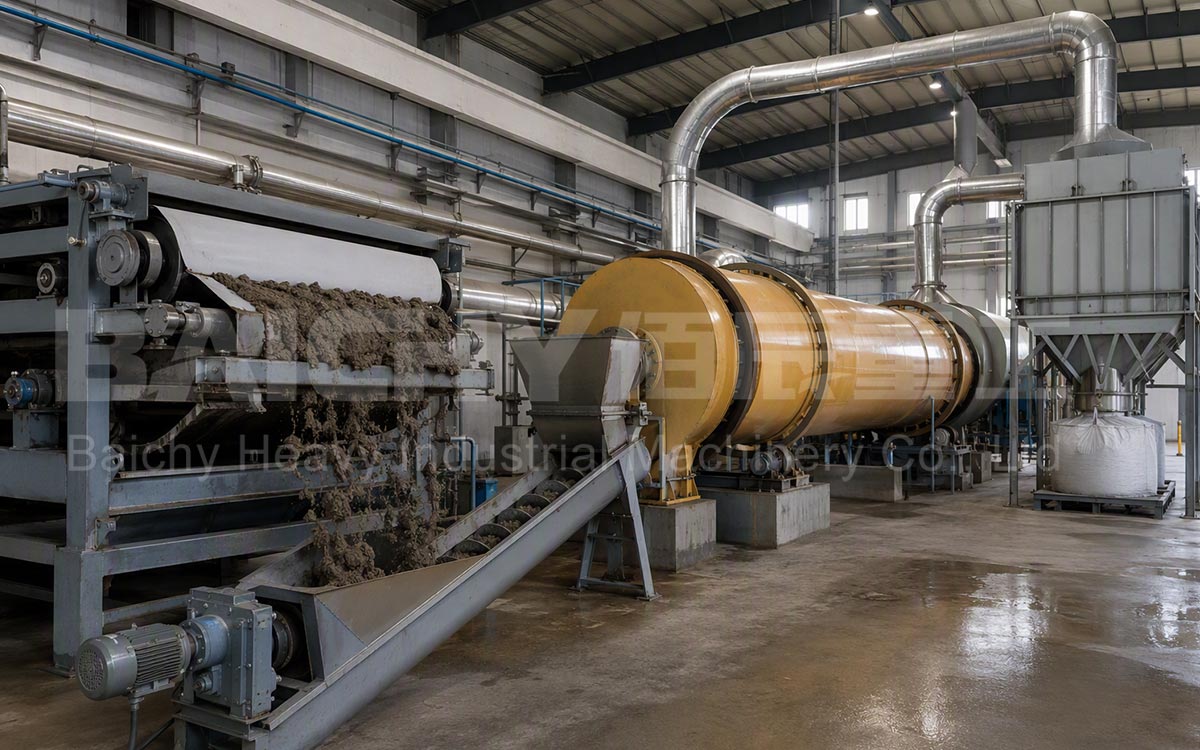
A single-pass rotary dryer offers a continuous thermal drying solution for reducing sludge moisture. In this system, dewatered sludge enters a rotating drum, comes into contact with a controlled flow of hot drying gas, and gradually moves toward the discharge end. During this process, water evaporates and the dried product leaves the machine for cooling, storage, combustion, fertilizer production, or another recovery application.
The correct result depends on more than the dryer itself. Sludge characteristics, feed moisture, target moisture, heat source, exhaust treatment, and operating conditions must all be considered when designing a complete drying line.
What Is a Single-Pass Rotary Dryer?
A single-pass rotary dryer is a cylindrical drying machine in which material travels through the drum once, from the feed end to the discharge end. The drum rotates slowly and is usually installed with a slight inclination. Internal flights, also called lifting or material-lifting plates, raise and scatter the sludge as the drum turns. This increases contact between the wet material and the hot drying gas.
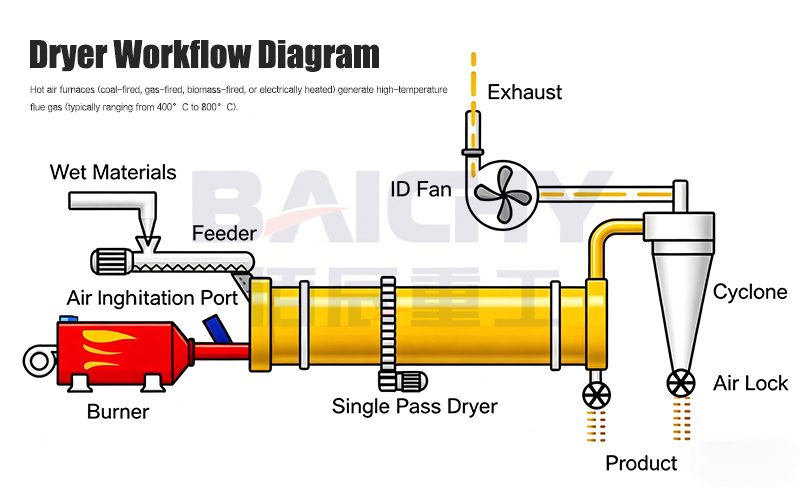
Process Flow and Structural Diagram of a Single-Drum Dryer
The main components normally include:
• Rotating drying drum
• Feed hopper and feeding conveyor
• Hot air furnace or other heat source
• Drive motor, gearbox, riding rings, and support rollers
• Internal lifting flights
• Discharge conveyor or cooling system
• Induced-draft fan
• Cyclone, bag filter, condenser, deodorization unit, or other exhaust equipment
• Temperature, pressure, and safety control system
“Single-pass” describes the material path rather than a fixed equipment size. The required drum diameter, length, residence time, and heat input depend on the feed rate, initial moisture, target moisture, sludge properties, and available heat source.
How Does It Dry Sludge?
1. Feed preparation
Dewatered sludge is delivered to the dryer by a screw conveyor, belt conveyor, pump, or other suitable feeding device. Very sticky sludge may require mixing, shredding, pelletizing, or blending with recycled dry material before entering the drum. These steps help prevent large lumps, unstable feeding, and material buildup at the inlet.
2. Heat and mass transfer
A furnace, steam system, thermal-oil heater, industrial waste-heat system, or another heat source supplies the energy needed to evaporate water. In a direct drying arrangement, hot gas flows through the drum and contacts the sludge. In an indirect arrangement, heat is transferred through a heated surface while the vapor is removed separately. The final choice depends on the sludge composition, emissions requirements, heat source, and product quality targets.
3. Lifting and dispersing
As the drum rotates, the internal flights pick up and release the sludge. This repeated lifting action exposes fresh surfaces to the drying gas and helps distribute the material across the drum cross-section. Good dispersion improves drying uniformity and reduces the chance of wet cores inside large lumps.
4. Moisture removal and discharge
Water evaporates progressively as the sludge passes through the drum. The residence time is controlled by drum length, inclination, rotational speed, feed rate, and gas velocity. At the outlet, the dried sludge is discharged to a cooler, conveyor, storage silo, combustion system, or further processing equipment. Moist exhaust gas is routed to the dust and odor treatment system.
Typical Sludge Drying Process Flow
Dewatered sludge → feed preparation → metering and conveying → single-pass rotary dryer → dried product cooling → dust and odor treatment → storage or final utilization
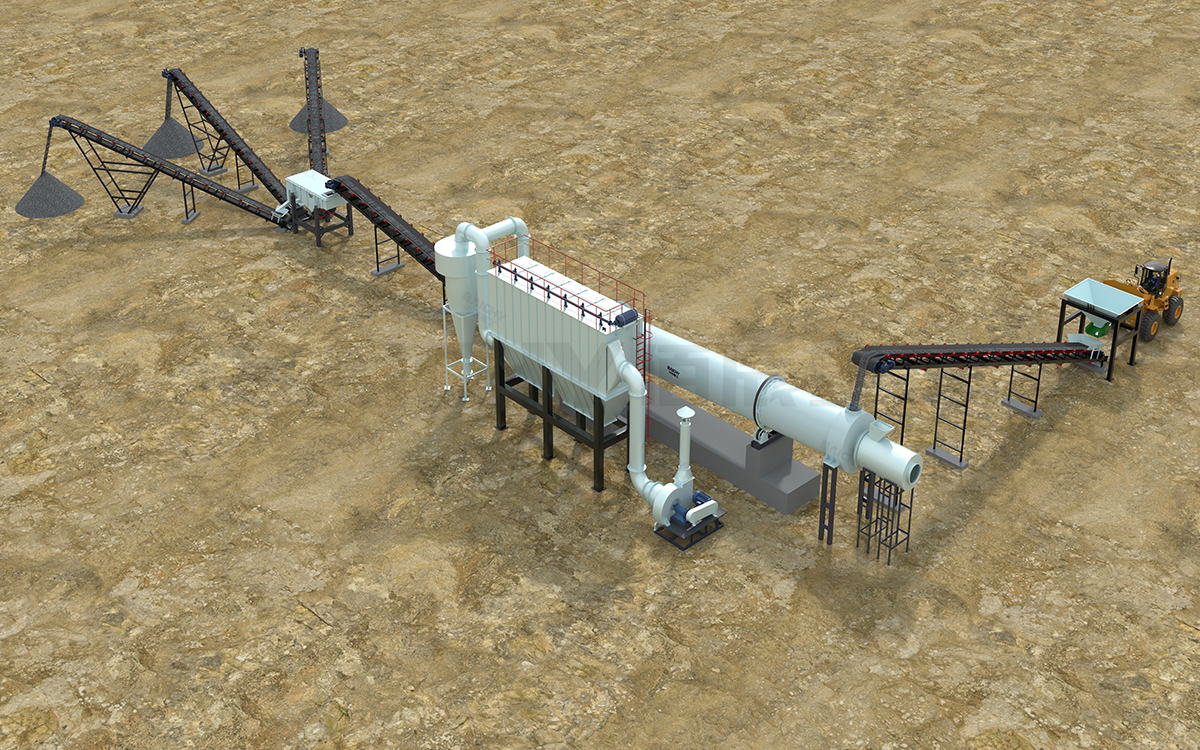
Typical Sludge Drying Process Flow
The front end is especially important. A dryer cannot compensate for inconsistent feeding or poorly prepared sludge. If the feed changes sharply in moisture or texture, the outlet moisture may fluctuate, energy consumption may increase, and deposits may form inside the drum.
A complete system may use a dewatering press, crusher, mixer, dry-return system, hot gas generator, cyclone, baghouse, condenser, deodorization unit, induced-draft fan, and automatic control panel. The exact arrangement should be selected after analyzing the sludge and local environmental requirements.
Why Use a Single-Pass Rotary Dryer for Sludge?
Continuous operation
The equipment supports continuous feeding and discharge, making it suitable for treatment plants that operate for long periods or process large daily volumes. It can also be integrated with conveyors, dewatering equipment, exhaust treatment, and automated controls.
Flexible capacity
Drum dimensions, heat input, air volume, and operating speed can be configured for different throughput requirements. This makes the technology suitable for small industrial lines as well as larger centralized sludge treatment facilities, provided the equipment is correctly sized.
Effective contact between sludge and drying gas
The rotating drum and lifting flights provide repeated mixing and exposure. This is useful when the feed has variable particle sizes or tends to form lumps after dewatering.
Improved downstream handling
Dryer output generally has lower moisture, reduced volume, and better handling characteristics than wet sludge. Depending on its composition and local regulations, the dried material may be prepared for fuel use, incineration, co-processing, fertilizer blending, construction-material applications, or controlled disposal.
Centralized process control
Temperature, negative pressure, feed rate, drum speed, and exhaust flow can be monitored and adjusted. Automation helps operators maintain stable product moisture and respond to changes in the feed.
Key Design Factors
| Design factor | Why it matters | Information required |
|---|---|---|
| Initial moisture | Determines the amount of water to evaporate and the thermal load | Laboratory moisture test and daily variation |
| Target moisture | Influences residence time, heat input, and downstream suitability | Required moisture for storage or final use |
| Sludge type | Affects stickiness, odor, corrosion, and drying behavior | Source, organic content, ash, salts, and contaminants |
| Throughput | Determines drum size, feeding capacity, and auxiliary equipment | Wet sludge tons per hour or per day |
| Heat source | Controls operating cost, emissions, and system layout | Fuel, steam, waste heat, or thermal-oil availability |
| Exhaust treatment | Manages dust, vapor, odor, and compliance requirements | Gas composition, dust load, odor profile, and local limits |
| Safety requirements | Reduces risks associated with heat, dust, and combustible gases | Sludge testing and site-specific risk assessment |
Heat Sources and Exhaust Treatment
Possible heat sources include natural gas, biomass, steam, thermal oil, recovered flue gas, biogas, and industrial waste heat. Selection should consider fuel price and availability, heat stability, operating temperature, maintenance requirements, and emission controls. Waste heat can reduce fuel consumption, but its temperature and availability must be stable enough for the required evaporation duty.
Sludge drying can generate dust, water vapor, odor, and volatile compounds. A typical exhaust line may include a cyclone for coarse particles and a bag filter for finer dust. Depending on the sludge and process temperature, condensers, wet scrubbers, activated carbon, biological deodorization, or thermal treatment may also be required. The system should maintain suitable negative pressure so that dusty or odorous gas does not escape into the work area.
The exhaust system is not an optional accessory. Its design must be based on actual sludge analysis, gas volume, temperature, dust concentration, odor characteristics, and the applicable environmental standard.
How to Select the Right Dryer?
Analyze the sludge first
Before choosing a dryer, test initial moisture, organic matter, ash, particle size, stickiness, corrosivity, odor potential, and any hazardous components. Sludge from different sources can behave very differently even when the moisture content is similar.
Define capacity and product requirements
Specify the wet feed rate, daily operating hours, initial moisture, target moisture, and acceptable variation. Also define whether the dried sludge will be stored, incinerated, used as a fuel, blended into fertilizer, or sent to another process.
Match the heat source to the process
Calculate the approximate evaporation duty and compare it with the available heat supply. A stable heat source is essential for stable product moisture. Where possible, evaluate heat recovery from exhaust gas, flue gas, or another plant process.
Plan for sticky material
High-moisture sludge may adhere to flights, the drum wall, chutes, and conveyors. Anti-buildup measures may include feed conditioning, recycled dry solids, improved flight design, cleaning access, and operating controls that avoid excessive feed surges.
Confirm the design through testing
A pilot or laboratory drying test can help establish the appropriate inlet temperature, gas flow, residence time, feed preparation method, outlet moisture, and energy demand. Testing is particularly valuable for mixed industrial sludge or material with uncertain composition.
Operation and Maintenance Recommendations
Stable operation begins with stable feeding. Operators should avoid sudden changes in feed rate and should monitor the moisture of incoming sludge whenever possible. Key operating data include inlet and outlet gas temperature, drum pressure, exhaust flow, motor load, bearing temperature, and product moisture.
Routine maintenance should cover support rollers, riding rings, gear units, bearings, seals, lifting flights, feed chutes, discharge equipment, ductwork, filters, and fans. Dust deposits should be removed according to the maintenance plan, and temperature sensors and pressure instruments should be calibrated regularly.
Safety controls should include high-temperature alarms, heat-source interlocks, emergency shutdowns, fire protection, suitable ventilation, and measures for dust or combustible-gas risks where testing indicates a potential hazard. The design must also consider odor containment and safe access for inspection and cleaning.
Frequently Asked Questions
1. Can a single-pass rotary dryer handle high-moisture sludge?
It can handle many types of dewatered sludge, but suitability depends on moisture, stickiness, feed consistency, and heat capacity. Very wet or sticky sludge may require mechanical dewatering, shredding, mixing, or blending with recycled dry material before drying.
2. What final moisture content can be achieved?
The achievable moisture content depends on the sludge composition, initial moisture, heat input, residence time, and exhaust conditions. The target should be defined by the next application, and a drying test or process calculation should be used to confirm the design.
3. Does the system need a dust collector?
In most cases, yes. Drying produces an exhaust stream containing vapor and dust. A cyclone, bag filter, or combined treatment system is normally selected according to the dust load, particle size, gas temperature, odor, and applicable emission requirements.
4. Will sludge drying create odor?
Heating sludge can release odor and volatile compounds. A closed, negatively pressurized system with appropriate condensation, deodorization, and exhaust treatment can reduce uncontrolled release. The required solution depends on the sludge source and chemical composition.
5. How can energy consumption be reduced?
Common measures include improving mechanical dewatering, maintaining consistent feeding, recovering heat from exhaust gas, using available waste heat, reducing air leakage, insulating hot surfaces, and optimizing gas temperature, flow, and drum residence time. The best combination depends on site conditions.
Baichy Heavy Industry
Baichy Heavy Industry is a high-tech mining equipment company integrating R&D, manufacturing, sales, and after-sales service. Focusing on crushing, grinding, and mineral processing equipment, we provide professional solutions to our customers. We are ISO9001:2015 Certified, and our products include mobile crushing palnts, crawler crushing plant, construction waste crushing plants, jaw crushers, sand making machines, cone crushers, fine crushers, grinding mills, ball mills, etc., all with reliable performance to meet diverse project needs.
Baichy Heavy Industry – Your Trusted Partner
To ensure optimal performance of your equipment, Baichy Heavy Industry offers:
- Professional on-site installation guidance
- Comprehensive operator training
- 24/7 technical support & maintenance services
Our complete after-sales service system guarantees long-term, stable operation of your machinery with minimal downtime.
Protect Your Rights – Only Use Official Channels
To avoid scams and ensure authentic support, contact us exclusively through:
• Official Website: www.baichychina.com
• WhatsApp: +8615093222637
• Email: [email protected]
Your satisfaction is our priority – expect prompt, professional service every time.
(Note: Beware of unauthorized third parties claiming to represent Baichy. Always verify through official contacts.)