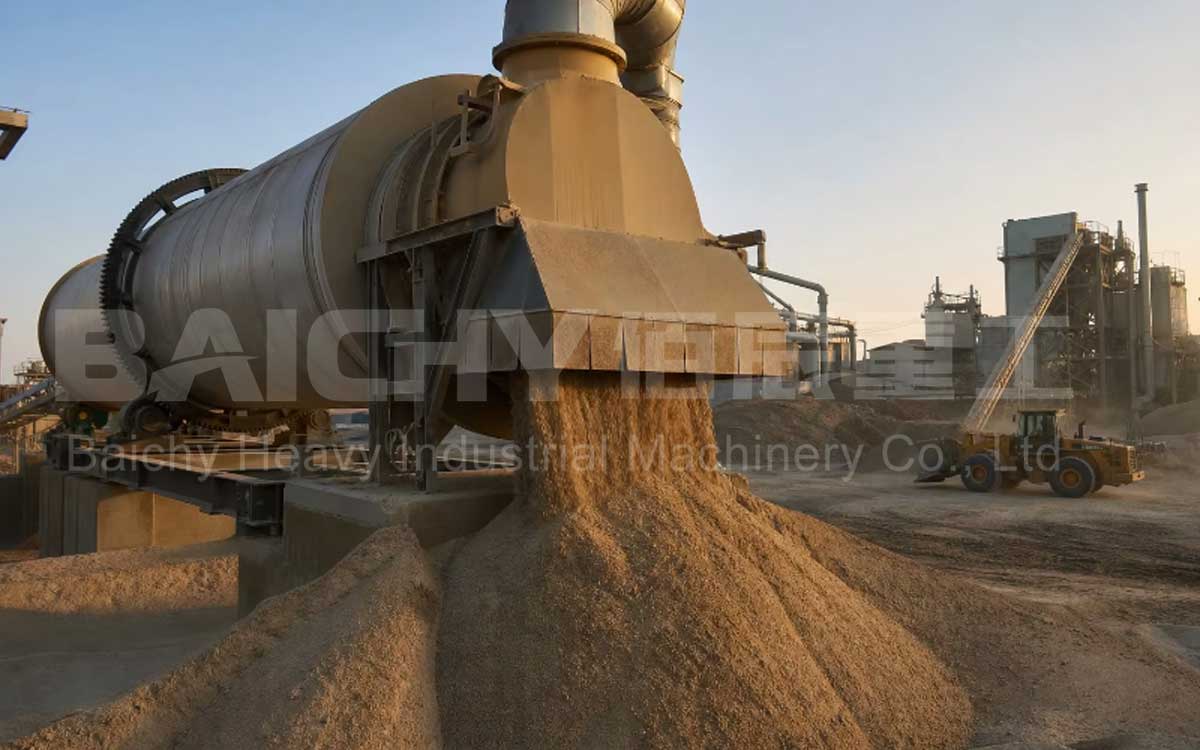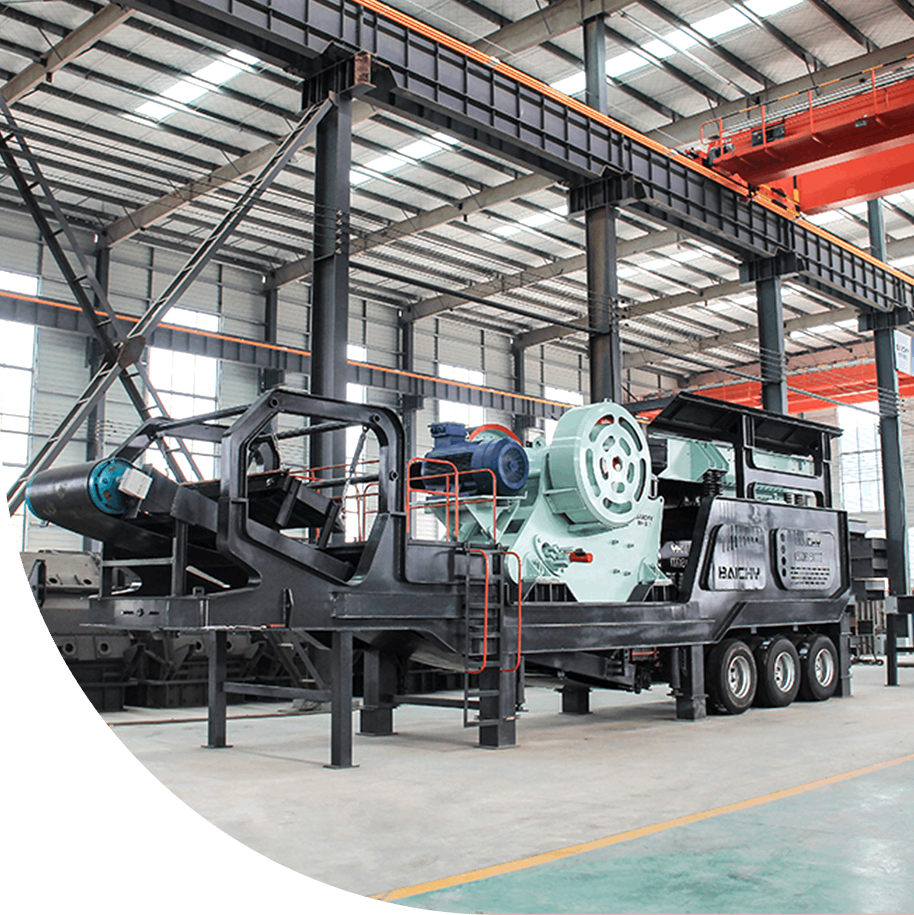


rotary dryer manufacturer
The cheapest quote for a rotary dryer is almost never the cheapest dryer. Buyers who choose a rotary dryer manufacturer purely on price routinely lose 30–50% more over five years through inflated capacity claims, higher fuel bills, unplanned downtime, and after-sales gaps. This guide gives you an 8-point checklist — tested against hundreds of drying projects for sand, slag, slime, clay, iron ore, sawdust, coal, and fertilizer — to separate engineering-driven manufacturers from resellers and traders before you sign an order.
Rotary drum dryers are long-life assets: a well-built machine runs 15–20 years. The manufacturer you pick today determines your fuel cost per ton for the next two decades. Read every point before comparing quotations — and take the scorecard at the end to every supplier meeting.
Why the Manufacturer Matters More Than the Machine
A rotary dryer is deceptively simple: a rotating cylinder, lifting flights, a heat source, and an induced-draft fan. Yet the performance gap between the best and worst machines processing identical material can exceed 40% in thermal efficiency and a factor of three in downtime. Most of that gap is decided before fabrication — in process engineering, heat-system integration, and quality control that you cannot see from a catalog photo.
Two questions expose most weak suppliers immediately:
"What is your guaranteed evaporation rate for my specific feed moisture — and what penalty applies if you miss it?"
"Can I audit your fabrication workshop and your previous installations of the same material?"
Strong manufacturers answer both in writing. Resellers deflect, blur the numbers, or push you to a "standard model."
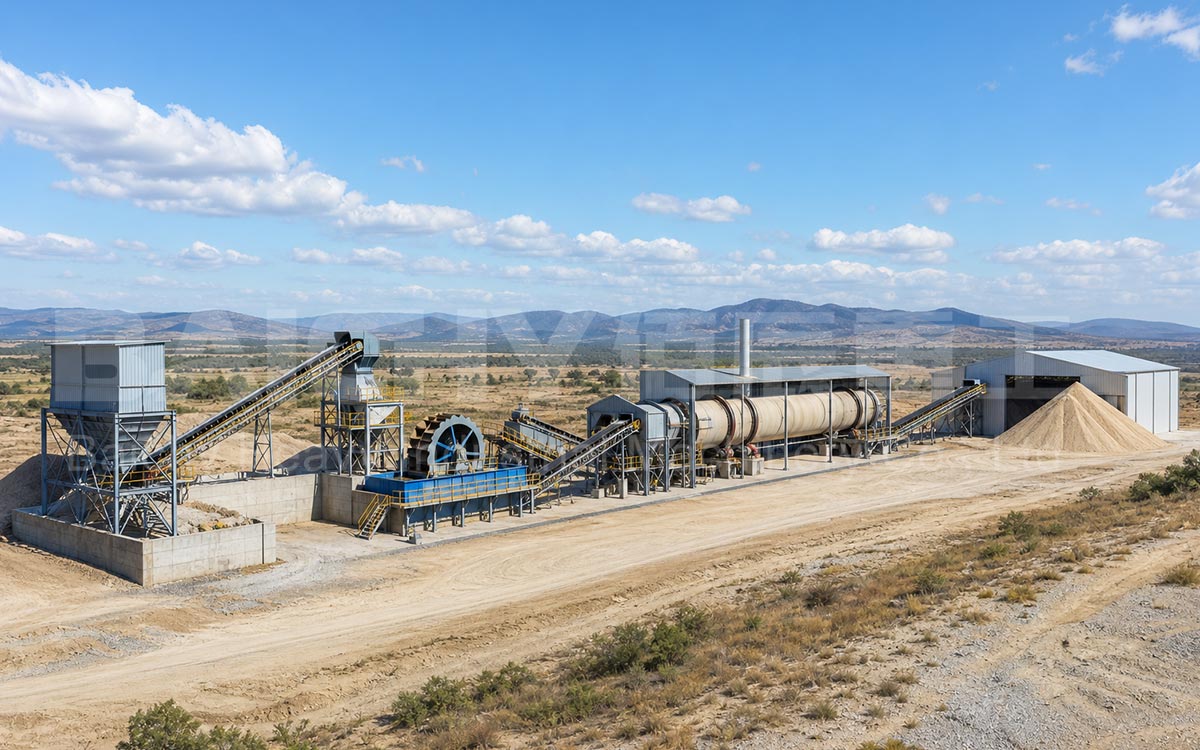
Quartz Sand Washing and Drying Production Line
The 8-Point Evaluation Checklist
1. Verify Evaporation Capacity — Not Drum Size or Total Weight
The only honest capacity metric for a rotary dryer is water evaporation capacity (kg H₂O/h), not "output tonnage" or "5 t/h dryer" labels. A 5 t/h claim means nothing until you define the feed moisture, target moisture, and inlet temperature.
What to verify:
• Ask for the guaranteed evaporation rate at your moisture range: e.g., sand from 8% to 0.5%, slime from 25% to 12%, sawdust from 45% to 10%.
• Demand the thermal calculation basis: inlet temperature, exhaust temperature, and assumed ambient conditions.
• Compare energy consumption claims in kcal per kg of water evaporated — 850–1,000 kcal/kg is efficient; anything above 1,200 kcal/kg means your fuel budget is leaking.
• Insist on a performance guarantee clause in the contract, with a penalty or acceptance test tied to measured evaporation.
• Real-world example: two "identical" 20 t/h sand dryers can differ by 15–25% in actual fuel consumption when one manufacturer sized the drum by volume instead of by evaporation duty. Over 6,000 operating hours a year, that difference is tens of thousands of dollars in diesel or coal.
2. Audit Shell and Component Quality
The drum shell, riding rings (tyres), trunnion rollers, and girth gear carry the whole load for 20 years. This is where cheap manufacturing hides.
Inspection checklist:
| Component | What a quality manufacturer provides | Red flag |
|---|---|---|
| Drum shell | Q235B/Q345R steel plate, thickness verified against diameter (e.g., ≥16 mm for Ø2.2 m class), rolled and welded to standard | Thin shell, unspecified steel grade, painted-over weld seams |
| Lifting flights | Material matched to abrasiveness (hardox/16Mn for sand and iron ore), correct profile angle for your material | Generic "standard" flights with no material-specific design |
| Tyres & rollers | Forged or thick-walled machined rings, proper interference fit, replaceable wear sleeves | Cast rings with visible porosity, no machining tolerance data |
| Gear drive | Hardened girth gear, proper pinion alignment, oil-bath or grease lubrication design | Open soft gears, no lubrication specification |
| Welding | Full-penetration welds, documented welding procedure, X-ray/UT inspection on load-bearing seams | No weld inspection records, no quality certificate |
Source: 8-Point Evaluation Checklist — How to Choose a Rotary Dryer Manufacturer. Use this table when auditing candidate suppliers; request inspection certificates and welding reports of the last machine shipped.
Ask for the inspection certificates and welding reports of the last machine they shipped. A manufacturer who cannot produce them is not doing the work themselves.
3. Match the Heat System to Your Real Fuel and Power
Fuel is 60–80% of a rotary dryer's lifetime operating cost. Your manufacturer must engineer the heat system around your available fuel, not their default configuration.
Heat-source options a competent rotary dryer manufacturer should offer:
• Hot-blast furnace (coal/coal gangue): lowest fuel cost, common in South Asia, Russia, and Latin America — ask about ash carryover control.
• Gas/diesel burner: cleanest option for food-grade or heat-sensitive materials like kaolin and phosphate; ask about flame safety interlocks.
• Biomass/sawdust burner: popular for wood drying and low-carbon programs.
• Waste-heat recovery: if you have kiln or power-plant exhaust, ask whether the dryer can be integrated — this can cut fuel cost to near zero.
• Electric or indirect (steam) drying: for heat-sensitive, dusty, or combustible materials (coal slime, dried sludge) where direct flame contact is a safety risk.
Also confirm the package includes the combustion chamber, induced-draft fan, cyclones, and ducting — many cheap quotes omit auxiliaries and you pay double later.
4. Demand Material-Specific Drying Experience
Sticky clay, abrasive sand, corrosive phosphate, explosive coal dust, heat-sensitive kaolin — each material demands different flight geometry, drum speed, and temperature control. A manufacturer that treats every dryer as the same "standard drum" will deliver poor output and chronic issues.
Ask for at least two reference installations of your exact material, then ask:
• What was the feed moisture and final moisture achieved?
• How often is the machine stopped for cleaning (sticking issues)?
• What is the actual fuel consumption per ton?
•What is the typical wear-part life (flights, shell lining)?
For sticky materials like coal slime or clay, ask specifically how they handle the first few meters of the drum where wet material tends to ball up — quality designs use back-mix or chain/flight arrangements in the drying zone. For combustible dust (coal, sawdust), ask about explosion protection design — hot spots, spark detection, and inerting are engineering questions, not accessories.
5. Check Emission Compliance Engineering Before You Buy
Air permits are becoming the deciding constraint in more and more markets. Your dryer must meet local emission limits (EPA standards in the US, EU BREF, GB standards in China, and national limits elsewhere) for dust and — for coal-fired systems — NOₓ and SO₂.
What to verify:
• Is a cyclone + baghouse filter included in the price, sized for your actual exhaust volume?
• For wet/sticky exhaust (sludge, kaolin), is there condensation and corrosion protection in the baghouse and ducting?
• Can the manufacturer provide a calculated emissions sheet for your fuel and capacity?
• For coal-fired dryers, is ash handling designed in, not bolted on?
A quote that "does not include dust collection because you can add it later" is a quote that has already failed this checklist.
6. Evaluate Automation and Process Control Depth
Modern rotary dryers should run with minimal operator attention. Evaluate the control package as part of the machine, not an extra.
Control features that pay for themselves:
• Outlet moisture or temperature feedback control — automatic fuel modulation instead of manual valve-twiddling.
• Variable-frequency drives on the drum and fans for partial-load efficiency.
• Bearing temperature and vibration monitoring on trunnion rollers — the 1 early warning of alignment problems.
• PLC + remote monitoring options so your team can supervise the dryer from a control room.
Each of these translates to money: automatic control typically saves 5–10% fuel versus manual operation, and bearing monitoring prevents one unplanned shutdown that could cost a full day of production.
7. Compare Service, Spare Parts, and Lead-Time Realities
A rotary dryer has a short list of wear items — flights, seals, trunnion roller bearings, refractory (if hot-blast furnace) — but a long list of ways to stop production. Evaluate the manufacturer's after-sales capability as hard as their factory:
• Installation and commissioning: is it included? Do they send an engineer to your site, or just a manual?
• Operator training: is it structured, with documentation in your language?
• Spare parts availability: guaranteed stock and dispatch time for flights, bearings, seals, and refractory parts.
• Response time: what is the contractual response for technical support?
Warranty terms: what is covered, for how long, and what is excluded — read the exclusions.
For international buyers, also verify realistic shipping and lead time (typically 30–60 days for a standard dryer after deposit) and how the machine is packed for ocean freight — inadequately braced drums arrive with oval shells and misaligned tyres.
8. Model Total Cost of Ownership — Never Compare Price Alone
Price is a small fraction of lifetime cost. Build a five-year TCO model before comparing quotations:
| Cost component | Typical share of 5-year TCO | What to compare |
|---|---|---|
| Purchase price | 15–25% | Quotation, freight, installation |
| Fuel | 45–60% | kcal/kg H2O evaporated × your fuel price |
| Electricity | 5–10% | Fan and drive power consumption |
| Maintenance & wear parts | 8–15% | Flights, bearings, refractory life |
| Downtime risk | 5–10% | Warranty, service response, parts lead time |
Source: 8-Point Evaluation Checklist — How to Choose a Rotary Dryer Manufacturer. Fuel represents 45–60% of five-year cost; compare written kcal/kg H2O energy figures, never purchase price alone.
A dryer that costs $20,000 more but burns 15% less fuel recovers the difference in roughly 12–18 months at typical operating hours — and keeps paying you back for the next decade.
Send This Data Sheet With Every RFQ
The quality of the quotation you receive depends almost entirely on the quality of the data you send. A competent rotary dryer manufacturer will not guess; they will ask for the parameters below. Suppliers who quote a "standard model" without requesting them are not doing engineering work — they are doing price work.
| Parameter | Why it matters | Example value |
|---|---|---|
| 1. Material name & source | Determines flight design, temperature limits, abrasiveness | River sand / coal slime / sawdust |
| 2. Feed moisture (%) | The single biggest driver of drum size and fuel cost | 8% → 15% → 45% |
| 3. Target moisture (%) | Sets the drying duty and residence time | 0.5% – 1% – 10% |
| 4. Required output (t/h) | Must be stated as product output at target moisture | 10 t/h sand at 0.5% |
| 5. Feed particle size (mm) | Affects flight profile and air velocity design | ≤ 5 mm – ≤ 50 mm |
| 6. Fuel type & local price | Dictates heat-system selection and operating cost | Coal $120/t, NG $8/MMBtu |
| 7. Power supply (V/Hz) | Motor, burner, and control re-engineering | 380 V/50 Hz; 440 V/60 Hz |
| 8. Local emission limits | Determines dust-collection and abatement scope | 50 mg/Nm³ dust |
| 9. Site altitude & climate | Affects fan sizing and heat balance at altitude | 1,200 m above sea level |
| 10. Intended operating hours | Basis for the TCO and payback model | 6,000 h/year |
Source: 8-Point Evaluation Checklist — How to Choose a Rotary Dryer Manufacturer. Send this sheet with every RFQ; compare the engineering responses, not the price lines.
Send this sheet to every candidate manufacturer and compare the engineering responses — the supplier who comes back with clarifying questions and a thermal calculation is the one doing real process work.
Red Flags: Walk Away From These
• No performance guarantee in the contract, or "capacity depends on conditions" language.
• Refusal to share reference sites of your material, or references that cannot be contacted.
• Quote excludes the heat source, fans, cyclones, or baghouse — then the "low price" evaporates.
• No engineering documentation: thermal calculation, GA drawing, or P&ID available only "after order."
• Trading company posing as manufacturer — verify factory ownership, workshop photos/video calls, and export licenses before deposit.
FAQ
1. How do I verify a rotary dryer manufacturer's claimed capacity?
Ask for the guaranteed water evaporation rate (kg H₂O/h) calculated for your feed moisture, target moisture, and fuel — not a "tons per hour of product" figure. Request the thermal calculation basis (inlet/exhaust temperatures, kcal per kg of water evaporated) and, for serious projects, insist on a performance acceptance test during commissioning, with a penalty clause if the machine misses the guaranteed evaporation. If the supplier cannot or will not put the number in the contract, treat the claim as unverified.
2. Should I buy from a local dealer or directly from the manufacturer?
Buy directly from the manufacturer when you need: a guaranteed evaporation rate backed by engineering, material-specific flight and heat-system design, custom voltage/frequency (e.g., 380 V/50 Hz, 440 V/60 Hz) configuration, and full commissioning support. A local dealer can be useful for routine spare parts and minor service — but if the dealer cannot produce engineering documentation, thermal calculations, and a written performance guarantee from the factory, you are paying a markup for a machine nobody can properly engineer. The common winning structure: buy from the manufacturer, and stock critical wear parts locally or with the dealer.
3. How much does a rotary dryer cost, and what really drives the price?
There is no honest one-line price: a sand drying line differs completely from a coal-slime or kaolin system. Real price drivers are drum size and steel weight, the heat-source package (hot-blast furnace vs. gas burner), dust collection scope, automation level, and export logistics. More importantly, look past the purchase price: fuel represents 45–60% of five-year cost. A more efficient machine that costs 10–20% more upfront usually wins the TCO comparison within two years. Ask each supplier for a written kcal/kg energy figure and build the five-year model in Point 8 before negotiating.
Baichy Heavy Industry
Baichy Heavy Industry is a high-tech mining equipment company integrating R&D, manufacturing, sales, and after-sales service. Focusing on crushing, grinding, and mineral processing equipment, we provide professional solutions to our customers. We are ISO9001:2015 、certified, and our products include mobile crushing palnts, crawler crushing plant, construction waste crushing plants, jaw crushers, sand making machines, cone crushers, fine crushers, grinding mills, ball mills, etc., all with reliable performance to meet diverse project needs.
Baichy Heavy Industry – Your Trusted Partner
To ensure optimal performance of your equipment, Baichy Heavy Industry offers:
- Professional on-site installation guidance
- Comprehensive operator training
- 24/7 technical support & maintenance services
Our complete after-sales service system guarantees long-term, stable operation of your machinery with minimal downtime.
Protect Your Rights – Only Use Official Channels
To avoid scams and ensure authentic support, contact us exclusively through:
• Official Website: www.baichychina.com
• WhatsApp: +8615093222637
• Email: [email protected]
Your satisfaction is our priority – expect prompt, professional service every time.
(Note: Beware of unauthorized third parties claiming to represent Baichy. Always verify through official contacts.)