
Dry Silica Sand Grinding System
A scope-first approach
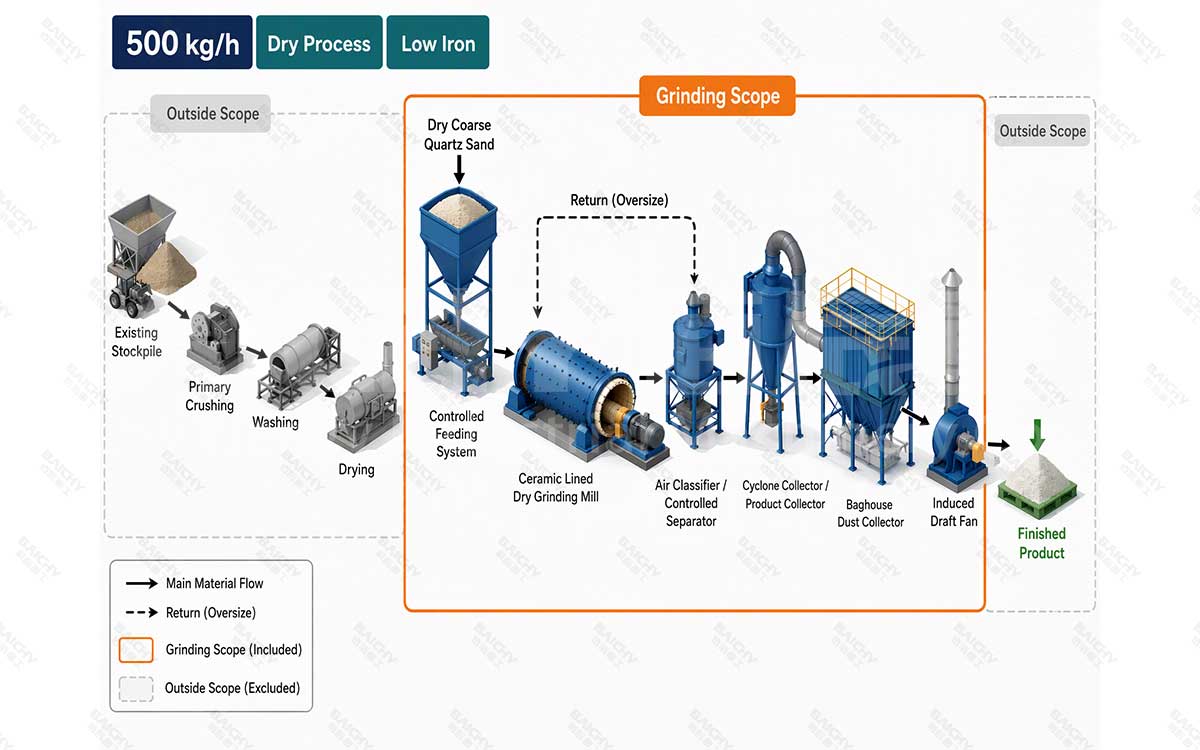
For a sodium silicate producer, a grinding project should not become a complete sand-processing line. If the feed is already pretreated and dry, washing, drying, primary crushing, and other upstream equipment can remain outside the scope.
The target is approximately 500 kg/h of dry coarse quartz sand, producing controlled 50–100 μm grades or one stable 70 μm product, with low iron contamination and only necessary auxiliaries.
Define the product with D-values
“50–100 μm” and “70 μm” are incomplete until the customer confirms whether they refer to D50, D90, D97, sieve passing rate, or another index. The specification should state D10, D50, D90, D97, permitted tolerance, coarse-fraction limit, fine-powder limit, test method, and whether 500 kg/h applies to every grade.
Option 1: flexible multi-specification grinding
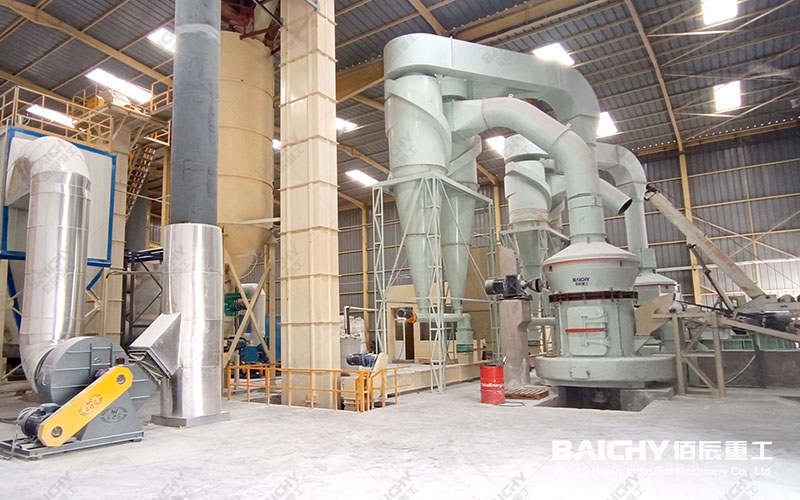
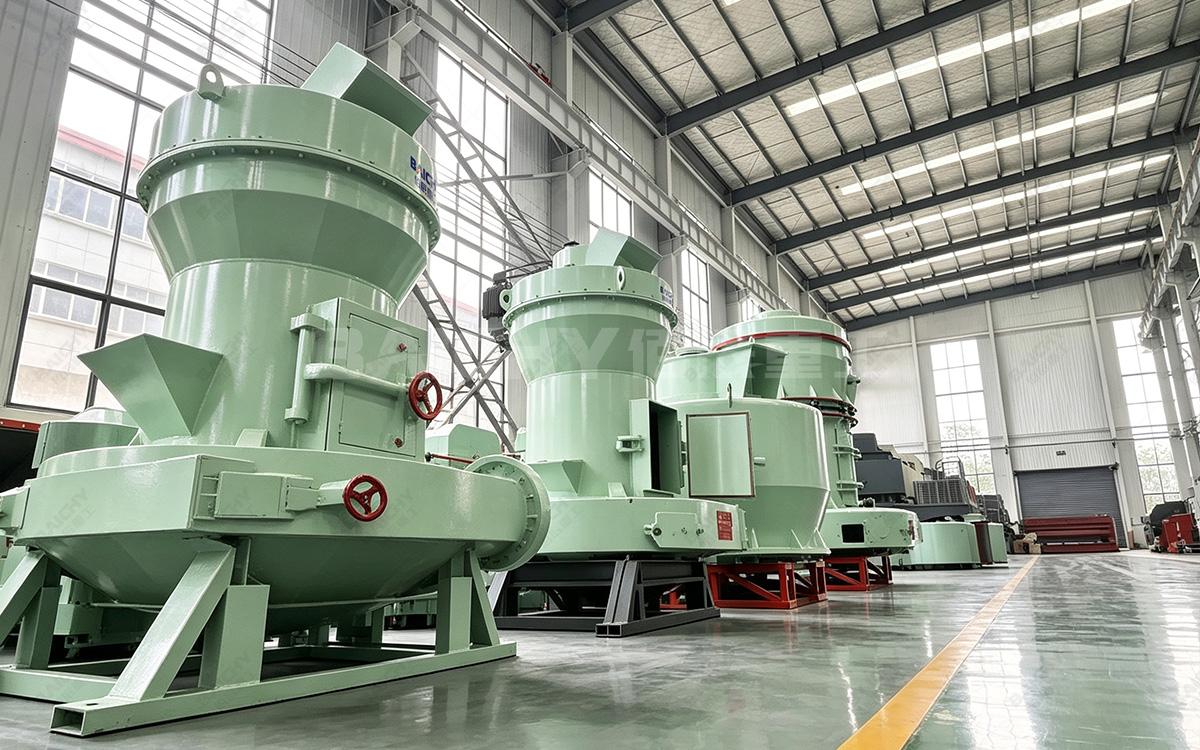
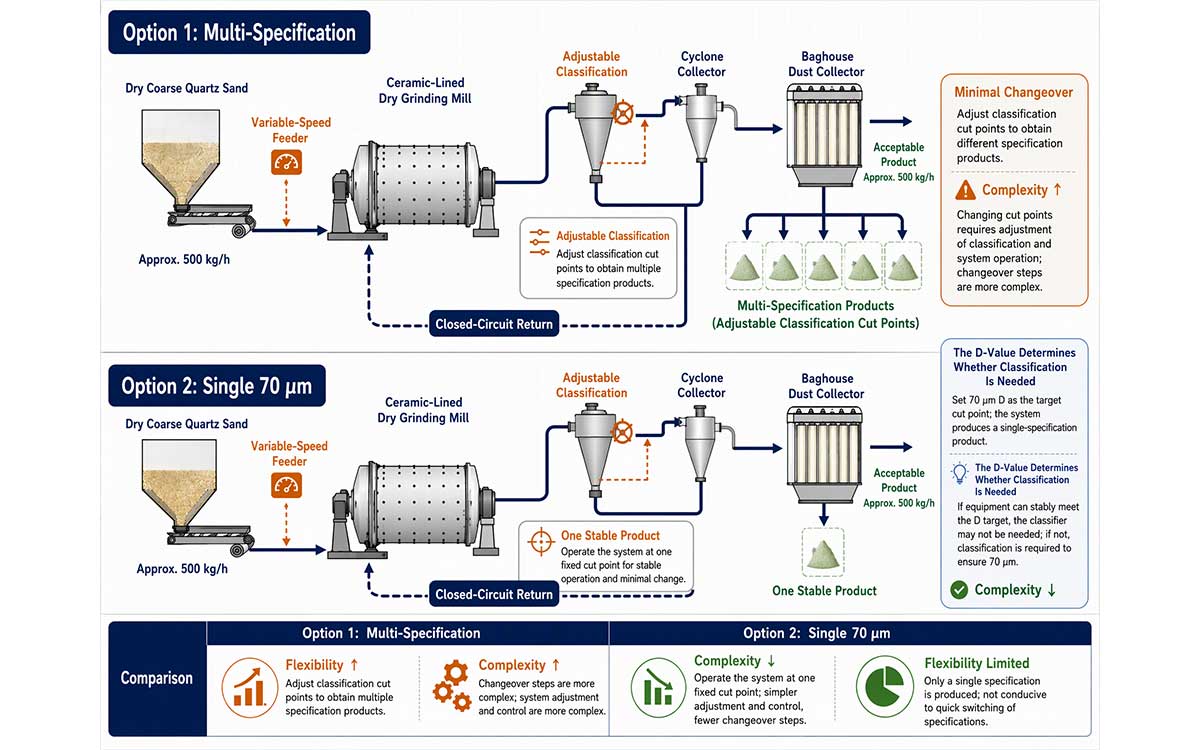
A ceramic-lined dry mill performs size reduction, while an adjustable air classifier controls the cut size and limits oversize material. Coarse particles can return to the mill in a closed circuit, while acceptable product is collected through the recovery and dust-control system.
This configuration can serve several products through changes to classifier speed, airflow, feed rate, and control settings. It suits plants where multiple grades have real sales value or future specifications are uncertain. The trade-off is operating complexity: setting changes, cleaning, stabilization, particle-size checks, transition material, and cross-contamination must be managed and priced.
Option 2: 70 μm single-specification grinding
This system is tuned around one continuous 70 μm product. Feed rate, mill loading, airflow, classification, and product collection can be optimized around one operating point. This creates a simpler routine, fewer changeovers, easier training, and more consistent monitoring.
Classification should not be removed automatically. If 70 μm means a controlled D90 or D97, or if the coarse fraction is strictly limited, an air classifier may still be essential. If it means a broad D50 target, a simpler arrangement may be possible after testing. This option is attractive when demand is stable and lower complexity, easier maintenance, and predictable operating cost are more important than future flexibility.
dry silica sand grinding system
Low-iron design must cover the whole material path
High-purity alumina ceramic media and lining—preferably 99% alumina or higher—can reduce iron introduced by the grinding zone. However, alumina media cannot guarantee zero iron. Contamination may also enter through the feed, feeder, screws, valves, transfer points, ducts, fasteners, and other contact parts.
The project should define the permitted total iron or Fe₂O₃ level, test method, and acceptance point. Wear varies with feed hardness, quartz content, loading, operating hours, and final fineness, so estimates and guarantees must be separated.
Necessary equipment—and what may be omitted
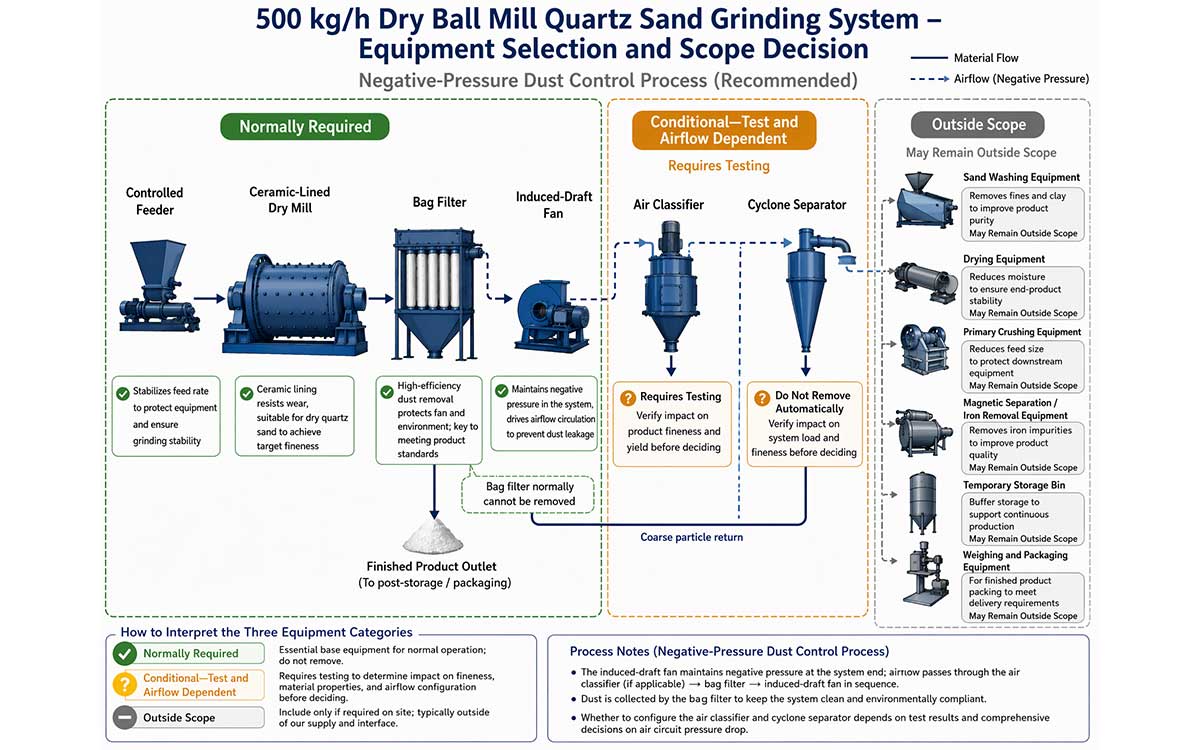
| Equipment | Function | Decision guide |
|---|---|---|
| Controlled feeder | Stable mill feed | Normally required for 500 kg/h |
| Ceramic-lined dry mill | Size reduction | Main unit; final type needs testing |
| Air classifier | Cut-size and coarse-fraction control | Valuable for multiple grades; check 70 μm target |
| Cyclone separator | Pre-separation and recovery | Evaluate from airflow and layout |
| Bag filter | Fine-particle capture and dust control | Normally required in negative pressure |
| Induced-draft fan | Airflow and pressure balance | Required for air classification or pneumatic transport |
A cyclone may be omitted if the recovery and filter design can handle the load. A classifier may be omitted only after PSD testing. A bag filter should not be removed when the process creates airborne fines or requires negative pressure.
Recommended process boundary
Dry prepared sand → feed hopper → controlled feeder → ceramic-lined dry mill → air classifier or controlled separation → cyclone/product collector → bag filter → finished-product outlet
Oversize material, when applicable, returns to the mill. Filter fines are recovered or handled according to the agreed product specification. Washing, drying, primary crushing, beneficiation, existing storage, and existing packing can remain outside the grinding scope when the customer already has these facilities.
low-iron quartz sand grinding
Technical and economic comparison
| Evaluation point | Multi-specification system | 70 μm single-specification system |
|---|---|---|
| Product range | Several alternating grades | One principal grade |
| Classification | Adjustable and more important | Based on the exact 70 μm D-value |
| Changeover | Settings, cleaning, transition checks | Minimal routine changeover |
| Control complexity | Higher | Lower |
| Initial investment | Usually higher | Potentially lower |
| Energy and wear | Report by product grade | Easier to optimize at fixed duty |
| Future flexibility | Stronger | Limited unless upgrade interfaces are reserved |
| Best fit | Variable orders and multiple grades | Stable 70 μm demand |
Exact mill model, kWh/t, motor power, wear rate, FOB/CIF price, delivery time, and warranty should be issued after confirming feed PSD, moisture, abrasiveness, product D-values, site power, and logistics. Separate budget estimates, test results, and contractual guarantees.
How should the customer choose?
Choose the flexible system when multiple grades are commercially important or future requirements are uncertain. Compare its added investment with the sales value created by those grades, including changeover costs.
Choose the 70 μm system when the specification is stable and simple operation is more valuable than flexibility. A practical compromise is to reserve space and connection points for a future classifier upgrade.
Before final quotation, request the D-value definition, feed sample or analysis, permitted iron/Fe₂O₃, capacity by grade, operating hours, and site information for electricity, dust regulations, space, compressed air, and Latakia Port delivery.
FAQ
1. Can pretreated dry silica sand enter the grinding system directly?
Yes, provided the feed meets the agreed moisture, particle-size, density, and cleanliness conditions. The estimated 500 μm maximum feed size must be verified because larger particles or agglomerates may require protection or pre-sizing.
2. Is an air classifier always required for 50–100 μm sand?
No. The decision depends on D-values, allowable coarse fraction, distribution width, and tested mill performance. It is generally more valuable for multiple grades or a strict upper-size limit.
3. Can the 70 μm system operate without a cyclone and bag filter?
Possibly without a cyclone, depending on airflow and product recovery. Dust collection and pressure control still need to be addressed. Removing a bag filter can reduce recovery and increase workplace dust and compliance risk.
4. Will 99% alumina media eliminate iron contamination?
No. It reduces contamination risk from the grinding zone, but raw material and every material-contact component must also be controlled. The contract should define an analytical iron limit and test method.
5. Which option is more economical?
A dedicated 70 μm system is usually the stronger candidate when one grade is sold continuously. The flexible system may create better value when several grades generate meaningful orders. Compare CAPEX, energy, wear, changeover loss, maintenance, and future expansion—not equipment price alone.
Baichy Heavy Industry
Baichy Heavy Industry is a high-tech mining equipment company integrating R&D, manufacturing, sales, and after-sales service. Focusing on crushing, grinding, and mineral processing equipment, we provide professional solutions to our customers. We are ISO9001:2015 Certified, and our products include mobile crushing palnts, crawler crushing plant, construction waste crushing plants, jaw crushers, sand making machines, cone crushers, fine crushers, grinding mills, ball mills, etc., all with reliable performance to meet diverse project needs.
Baichy Heavy Industry – Your Trusted Partner
To ensure optimal performance of your equipment, Baichy Heavy Industry offers:
- Professional on-site installation guidance
- Comprehensive operator training
- 24/7 technical support & maintenance services
Our complete after-sales service system guarantees long-term, stable operation of your machinery with minimal downtime.
Protect Your Rights – Only Use Official Channels
To avoid scams and ensure authentic support, contact us exclusively through:
• Official Website: www.baichychina.com
• WhatsApp: +8615093222637
• Email: [email protected]
Your satisfaction is our priority – expect prompt, professional service every time.
(Note: Beware of unauthorized third parties claiming to represent Baichy. Always verify through official contacts.)