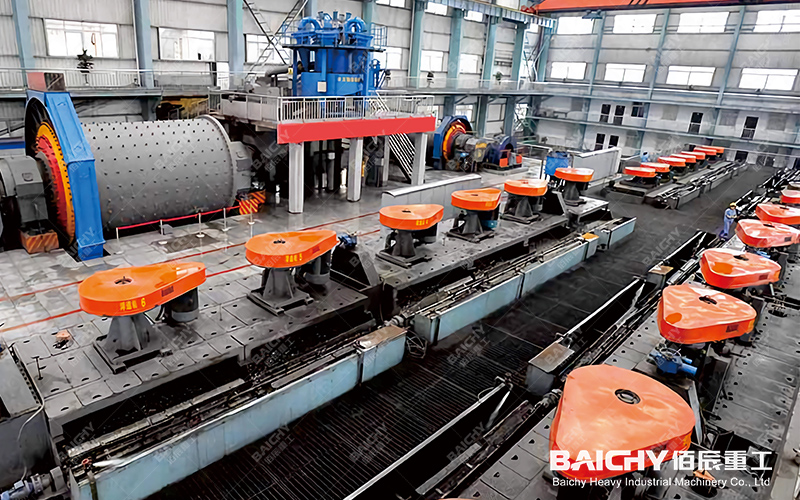
SF Flotation Machine
The flotation machine is the single most critical piece of equipment in a mineral processing plant for determining "metal yield." Given the same run-of-mine grade, selecting the right flotation machine and optimizing the process flow can boost recovery rates by 5–10 percentage points above the industry average—a difference that translates not merely into figures on a spreadsheet, but into hundreds of thousands of dollars in actual annual revenue.
Take a 500 TPD copper plant (with a feed grade of 0.8% Cu and an annual output of approximately 1,080 tonnes of copper metal) as an example: a mere 1-percentage-point increase in recovery yields an additional 10.8 tonnes of copper annually. At an LME price of $9,000 per tonne, this results in an annual revenue increase of approximately $97,000. Conversely, improper equipment selection, weak agitation, or poor froth control can lead to annual metal losses far exceeding the initial cost difference of the equipment itself.
The SF series self-aerating, mechanically agitated flotation machine offers an excellent cost-performance ratio for small- to medium-sized gold, copper, and lead-zinc processing plants. Its self-aerating design eliminates the need for a blower system, while its powerful agitation prevents sedimentation. Capable of handling a wide range of particle sizes (0.074–0.5 mm), it serves as a superior alternative to forced-air flotation machines of the same specification, offering both lower initial investment and reduced power consumption.
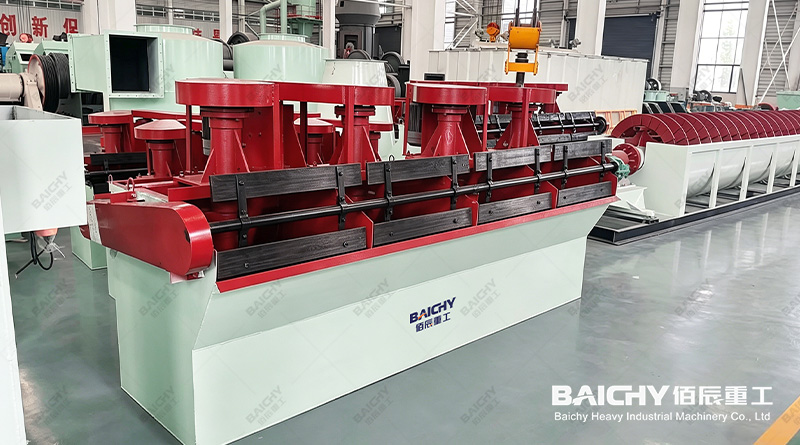
gold flotation machine
I. Pain Point Analysis: Why Your Processing Plant Is "Visibly" Losing Ore
Five common reasons why flotation recovery rates fail to improve—most of which are directly related to equipment:
1. Weak impeller agitation causing coarse particle sedimentation—insufficient pulp circulation allows coarse particles (>0.2 mm) to settle at the bottom of the cell, dragging down recovery rates by 3–8 percentage points due to these losses.
2. Unstable froth layer with alternating "froth overflow" and "empty bubbles"—significant liquid level fluctuations lead to either gangue overflow (reducing concentrate grade) or froth collapse (causing metal loss into the tailings).
3. Uncontrolled aeration leading to reagent waste—unstable airflow causes collector and frother consumption to spike by 15–30%, resulting in out-of-control reagent costs.
4. Rapid impeller/stator wear causing frequent downtime—standard cast-iron impellers fail within 3–6 months in abrasive pulp, incurring costs associated with replacement and production downtime.
5. Purchasing equipment without securing "recovery performance"—equipment arrives without expert setup of reagent regimes; flotation time, pulp density, and pH are managed based on guesswork, preventing recovery rates from reaching design targets even months after commissioning.
At its core, flotation is a "metal recovery business," not merely an "equipment transaction." When selecting a flotation machine, the key criterion is its ability to capture every liberated valuable mineral particle from the pulp and skim it off in the froth.
II. Core Specifications (SF Series; typical values; actual configuration prevails)
The SF series consists of self-aerating, mechanically agitated flotation machines. Cell configurations can be flexibly combined according to the process flow (roughing, cleaning, and scavenging). Effective cell volumes range from 0.37 to 16 m³, suitable for processing plants with capacities of 50–2,000 TPD.
| Model | Effective Volume (m³) | Impeller Diameter (mm) | Processing Capacity (m³/min) | Motor Power (kW) | Application Scenario |
| SF-0.37 | 0.37 | 386 | 0.2–0.4 | 1.5 | Laboratory/small pilot lines; cleaning operations |
| SF-0.7 | 0.7 | 450 | 0.3–0.9 | 3 | Cleaning for small-scale plants (50–100 TPD) |
| SF-1.2 | 1.2 | 550 | 0.6–1.6 | 5.5 | Roughing/cleaning/scavenging for plants (100–300 TPD) |
| SF-2.8 | 2.8 | 650 | 1.5-3.5 | 11 | Main cell type for plants (300–800 TPD) |
| SF-4 | 4.0 | 760 | 2.0–4.0 | 15 | Roughing/scavenging for plants (500–1200 TPD) |
| SF-8 | 8.0 | 900 | 4.0-8.0 | 30 | Roughing for large-scale plants (>1000 TPD) |
| SF-16 | 16.0 | 1050 | 8.0–16.0 | 55 | Roughing/scavenging for large-scale plants (2000 TPD class) |
Reference Process Configuration (based on a standard flow of 1 roughing, 2 cleaning, and 2 scavenging stages):
| Plant Scale | Roughing | Cleaning I | Cleaning II | Scavenging I | Scavenging II |
| 100 TPD Gold Mine | SF-1.2 × 4 cells | SF-0.7 × 3 cells | - | SF-1.2 × 3 cells | - |
| 300 TPD Copper Mine | SF-2.8 × 6 cells | SF-1.2 × 4 cells | SF-1.2 × 3 cells | SF-2.8 × 4 cells | SF-2.8 × 3 cells |
| 500 TPD Lead-Zinc Ore | SF-4 × 6 cells | SF-2.8 × 4 cells | SF-2.8 × 3 cells | SF-4 × 4 cells | SF-4 × 3 cells |
| 1000 TPD Copper Ore | SF-8 × 10 cells | SF-4 × 6 cells | SF-4 × 4 cells | SF-8 × 6 cells | SF-8 × 4 cells |
Cell configurations vary based on ore characteristics (dissemination size, oxidation rate) and target grades; the figures above represent typical values. Baichy can provide a precise cell configuration plan based on your ore test report.
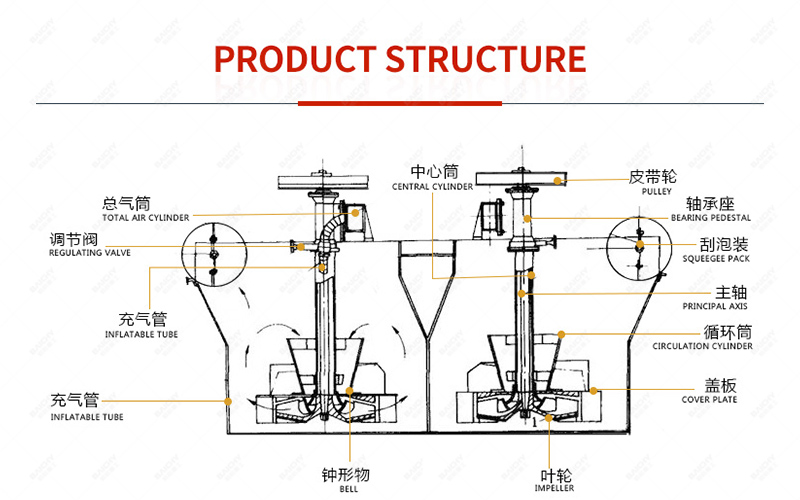
Flotation machine structural diagram
III. Selection Recommendations and Pitfall Avoidance Checklist
3.1 Selection based on ore type
• Gold Ore (Sulfide ore/auriferous pyrite; Sudan, South Africa, Zimbabwe, Mongolia) → SF Series + Stage Grinding-Flotation Process. The key to gold flotation is "float coarse, then grind fine": use large cells (SF-2.8/SF-4) for roughing to quickly recover liberated gold, followed by regrinding the rough concentrate and then cleaning to upgrade the product; when combined with the CIL (Carbon-in-Leach) process, recovery rates in the flotation stage can reach 90–96%.
• Copper Ore (Copper sulfide; Chile, Zambia, DRC, Indonesia) → SF Series + One-Roughing, Two-Cleaning, Two-Scavenging Process. SF-8 large cells for roughing + middlings regrinding and re-separation; concentrate grades of 20–28% Cu and recovery rates of 90–94% are achievable; oxidized copper ores require sodium sulfide pretreatment before flotation.
• Lead-Zinc Ore (Peru, Bolivia, Mexico) → SF Series + Preferential Flotation Process. Lead-zinc separation relies on lime to depress sphalerite and copper sulfate for activation; the SF series offers stable liquid levels and adjustable froth layer thickness, facilitating precise control during the cleaning stage; lead concentrate grades of 50–60% Pb and zinc concentrate grades of 45–55% Zn are achievable.
3.2 Six Common Pitfalls to Avoid
1. Cell volume ≠ processing capacity—Select the cell type based on pulp flow rate (m³/min) and determine the number of cells based on flotation time (8–15 minutes for roughing). Relying solely on "daily tonnage" to select cells inevitably leads to insufficient flotation time and reduced recovery rates;
2. Do not overlook grinding fineness—Flotation machines are designed for particle sizes of 0.074–0.5 mm; if the feed is too coarse (excessive +100 mesh fraction), particles will settle in the cell, whereas if it is too fine, the froth becomes sticky. Recommended feed fineness is 65–75% passing -200 mesh for gold ore and 55–80% for copper ore;
3. Reagent regimes are as critical as the equipment itself—For the same flotation machine, recovery rates can vary by 5–8 percentage points depending on the reagent regime (collector dosage, pH, frother). Require suppliers to provide reference reagent regimes for the specific ore type, rather than just delivering the equipment;
4. Beware of "empty bubbles" and "cell overflow"—Liquid level and aeration rate must be adjusted in coordination with the froth layer thickness (50–150 mm); verify froth skimming uniformity during the trial run, as fluctuations in concentrate grade will directly impact the selling price;
5. Compare Total Cost of Ownership (TCO), not just purchase price—Sum up the purchase cost, the cost of wear parts (impeller/stator) for three years, electricity consumption, reagent consumption, and losses due to downtime. Wear-resistant impellers may cost 30% more but last twice as long, resulting in greater savings over the full lifecycle;
6. Confirm power standards for African or Latin American mining sites—SF series motors can be customized for 380V/50Hz, 400V/50Hz, or 440V/60Hz; clarify local voltage and frequency before placing an order to avoid motor incompatibility upon delivery.
V. FAQ
Q1: What is the difference between the SF series flotation machine and the forced-air (XCF/KYF) flotation machine? How should I choose?
A: The SF series relies on impeller rotation for self-aspirating air, requiring no blower; it offers low investment, energy savings, and simple installation, making it suitable for small-to-medium-sized processing plants. XCF/KYF forced-air machines require a blower for air supply and feature independently adjustable aeration rates; they are suitable for large-scale plants (cell volume ≥8 m³) and processes requiring precise aeration control. Choose SF for capacities under 500 TPD; for large production lines, a combination of SF for roughing and XCF/KYF for cleaning is recommended.
Q2: How is the flotation machine's processing capacity calculated? How much ore can an SF-4 handle?
A: First, calculate the pulp flow rate: Daily processing capacity &pide; 24 hours &pide; pulp concentration (approx. 30–33% for roughing) &pide; pulp density (approx. 1.25–1.3 t/m³). Taking a 500 TPD copper mine as an example: 500 &pide; 24 &pide; 0.32 &pide; 1.28 ≈ 0.85 m³/min. Configuring a roughing circuit with six SF-4 cells (capacity 2–4 m³/min each) provides a total effective volume of 24 m³; with a required flotation time of 10 minutes, the process utilizes only about 8.5 m³, leaving ample margin. Number of cells = Pulp flow rate × Flotation time &pide; Cell volume (plus a 15–20% allowance for the froth layer); be sure to verify calculations using this formula before purchasing.
Q3: What are the most common reasons for failing to achieve high flotation recovery rates?
A: Ranked by frequency:
① Grinding fineness does not meet standards (under-grinding results in incomplete liberation of composite particles);
② Improper reagent regime (insufficient collector or uncontrolled pH);
③ Insufficient flotation time (too few cells configured);
④ Abnormal equipment agitation/aeration (impeller wear, unstable pulp level). The first three factors account for over 80% of the outcome—which is why Baichy insists on an integrated delivery model comprising "equipment + reagent regime + process commissioning."
Q4: Can the same set of flotation machines be used for both gold and copper ore flotation?
A: Yes. The SF series accommodates the fineness requirements for both gold ore (-200 mesh, 65–75%) and copper ore (-200 mesh, 55–80%). Switching between ore types requires only adjustments to the grinding fineness and reagent regime, without the need to replace equipment. However, the process configurations differ: gold ore processing often employs staged grinding and flotation, whereas copper ore processing typically uses a "one-rougher, two-cleaner, two-scavenger" circuit.
Q5: What support services are included with Baichy’s flotation machines?
A: Free ore analysis and beneficiation testing (determining grinding fineness, reagent regime, and the number of cells) → Equipment manufacturing (ISO 9001 certified; 45–90 day delivery) → On-site installation, commissioning, and a 72-hour trial run with actual ore → Training for operators and lab technicians (including hands-on reagent preparation) → 12-month full-machine warranty plus lifetime technical support, 48-hour remote response, and readily available stocks of wear parts such as impellers, stators, and liners.