
Raymond mill
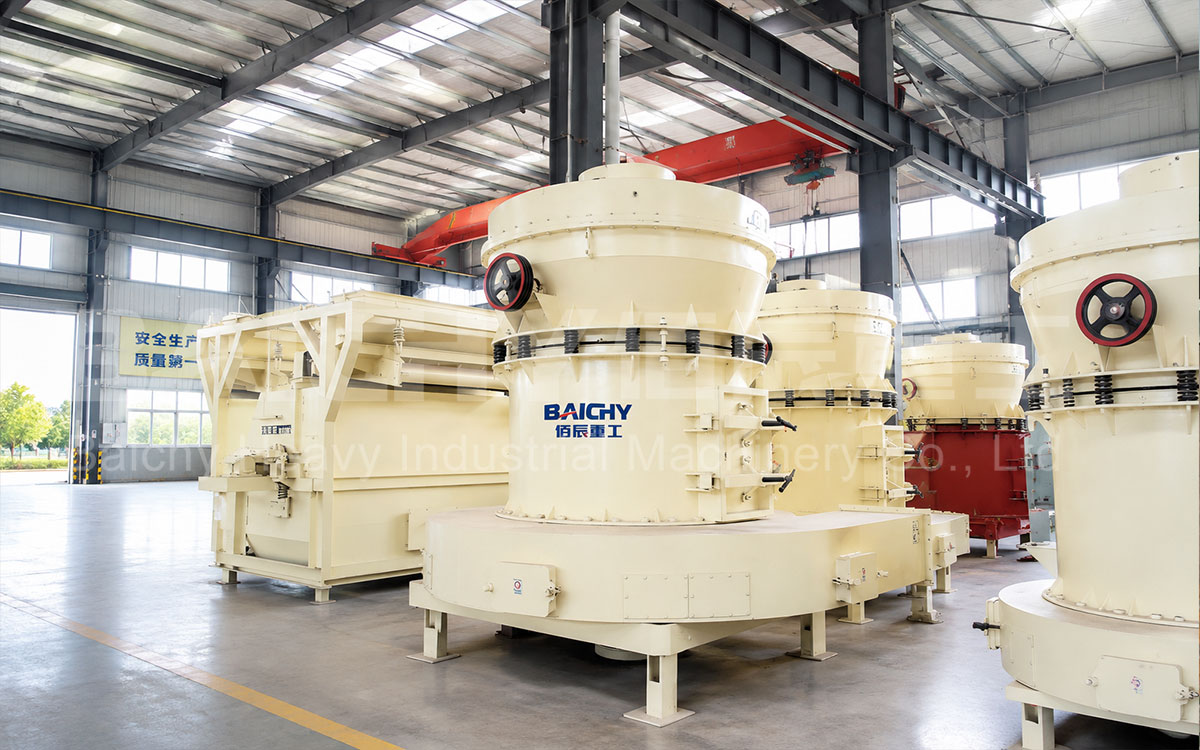
The Raymond mill (also known as a pendulum roller mill) is currently the leading, most cost-effective model for the non-metallic mineral powder market (targeting the 80–600 mesh range). It replaces traditional screening and grinding methods with a "roller-ring compression plus airflow classification" process. Key advantages include adjustable fineness without stopping the machine, a closed-loop dust circulation system that prevents leakage, and significantly lower electricity consumption per ton compared to ball mills of similar capacity. A single unit can handle the processing needs for over 500 types of materials, including limestone, gypsum, barite, and bentonite. For small-to-medium-sized powder processing plants with an hourly output of 0.5–36 tons, a 5R or YGM high-pressure Raymond mill is typically the equipment choice offering the fastest return on investment.
I. What is a Raymond mill? Overview
The Raymond mill is a pendulum-type dry grinding machine. Its core structure comprises the main unit (grinding rollers, grinding rings, and shovels), a classifier, a blower, a cyclone collector, and a pulse bag dust collector; upstream equipment typically includes a jaw crusher, bucket elevator, storage hopper, and electromagnetic vibrating feeder. With a century-long industrial history, it features a simple structure, low failure rate, and ease of maintenance, making it a model widely recognized in the powder industry for its ruggedness and durability.
In terms of product generations, Raymond mills fall into three tiers, each with different cost profiles and fineness limits:
• R Series (Classic Pendulum Mill): Models 3R, 4R, and 5R; output ranges from 80 to 325 mesh; offers the best cost-performance ratio; suitable for building-material grade powders.
• YGM Series (High-Pressure Pendulum Mill): Features 1,000–1,500 kg high-pressure springs installed on the roller assembly; grinding pressure is approximately 1.2 times that of standard Raymond mills with the same power rating; the fineness limit is raised to 425 mesh, enabling the processing of harder materials.
• YGMX Enhanced Series: Equipped with a cage-type classifier and VFD (Variable Frequency Drive) speed control; offers stepless fineness adjustment between 80 and 600 mesh; designed for high-value-added chemical powders. Quick Summary: For dry powder processing of non-metallic minerals—targeting a fineness of 80–600 mesh and an hourly output of 0.5–36 tons—the Raymond mill offers the best balance between initial investment and operating costs; the HGM ultrafine mill and ball mill should only be considered if the goal is ultrafine powder (above 600 mesh) or massive production capacity.
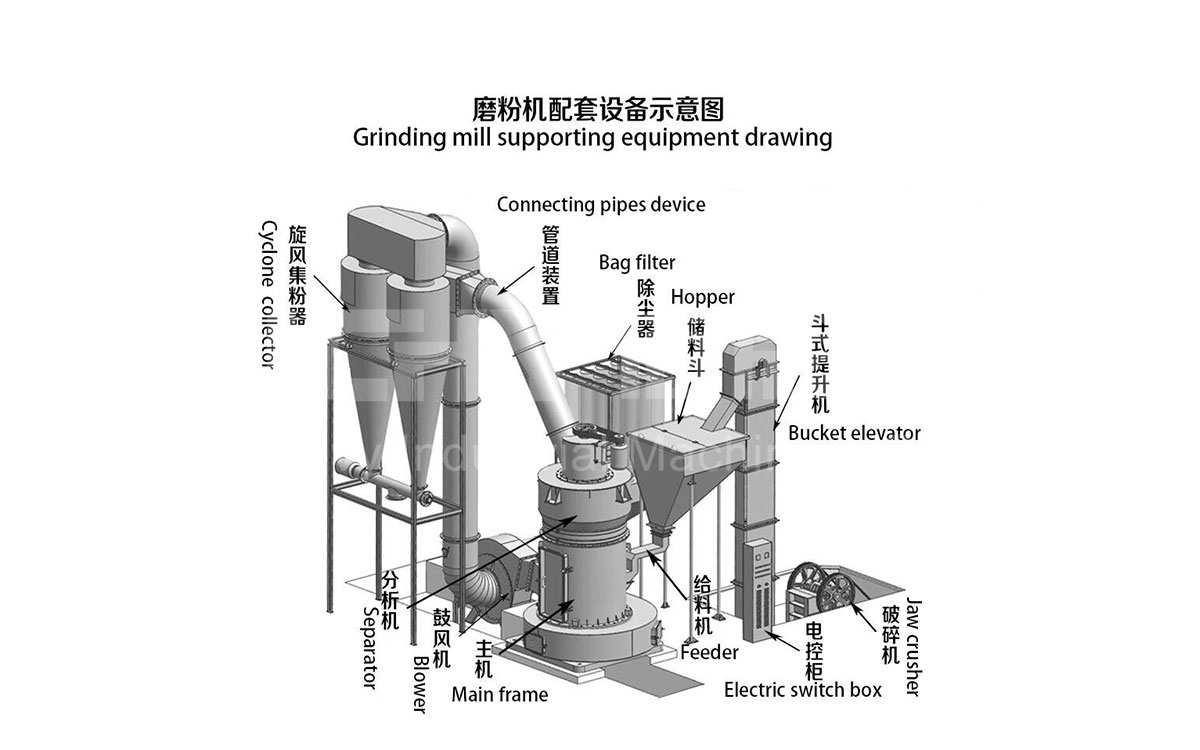
Grinding-mill-supporting-equipment-drawing
II. Typical Application Scenarios for Raymond Mills
Raymond mills are suitable for processing almost all non-flammable, non-explosive minerals with a Mohs hardness of ≤7 and a moisture content of ≤6%. The following four scenarios account for approximately 80% of global installations:
2.1 Calcium Carbonate (Ground Calcium Carbonate / GCC)
Calcite and limestone are dry-ground by Raymond mills into 200–425 mesh GCC, serving as mainstream raw materials for papermaking fillers, plastic masterbatches, coatings, and rubber reinforcement. Major agricultural nations like Brazil, Egypt, and Vietnam also process large quantities of 80–200 mesh agricultural lime for direct soil pH adjustment—this represents the primary demand for Raymond mills in the Latin American market.
2.2 Gypsum Powder (Natural Gypsum and Desulfurization Gypsum)
Natural gypsum and power plant desulfurization gypsum (FGD) are ground for use in the construction materials supply chain; 325-mesh construction gypsum powder is used for plasterboard, putty, and plastering mortar. The Raymond mill’s closed-circuit air classification system is highly adaptable to relatively soft, sticky materials like gypsum; a short "crushing-grinding" process can be achieved simply by pairing the mill with an upstream hammer crusher or jaw crusher.
2.3 Chemical Fillers and Adsorbent Materials (Barite, Bentonite, Talc)
Barite is ground to 325–425 mesh for use as a weighting agent in oil drilling; bentonite is ground to 200–325 mesh for use as a foundry sand binder and drilling mud; and talc powder is processed for the cosmetics and pharmaceutical markets. These materials command high unit prices and profit margins but require strict consistency in fineness, making the YGM high-pressure series the mainstream choice.
2.4 Raw Materials for Building Materials and Refractories
For the pulverization of medium-hard minerals—such as dolomite (metallurgical flux), potassium feldspar (ceramic glaze), and wollastonite (plastic filler)—the Raymond mill serves as the primary equipment; when paired with a classifier, it can consistently produce materials across various levels of fineness.
| Application Scenario | Typical Materials | Common Fineness | Recommended Model | Downstream Uses |
| Agricultural/Industrial Calcium Carbonate | Calcite, Limestone | 80–425 mesh | 5R4119 / YGM130 | Soil pH adjustment, papermaking, plastic masterbatch |
| Gypsum Building Materials | Natural gypsum, desulfurization gypsum | 325 mesh | YGM95 / YGM130 | Gypsum board, putty, plastering mortar |
| Chemical Fillers | Barite, bentonite, talc | 200–425 mesh | YGM130 / YGM160 | Drilling weighting agents, foundry binders |
| Metallurgical/Ceramic Raw Materials | Dolomite, potassium feldspar | 100–325 mesh | 4R3016 / 5R4119 | Metallurgical flux, ceramic glazes |
III. Core Parameter Table
| Model | Number of Rollers | Roller Dimensions (mm) | Feed Particle Size (mm) | Output Fineness (mm) | Capacity (t/h) | Main Motor (kW) |
| 3R2115 | 3 | 210×150 | ≤15 | 0.125–0.044 | 0.4–1 | 15 |
| 4R3016 | 4 | 300×160 | ≤25 | 0.125–0.044 | 1–4 | 30 |
| 5R4119 | 5 | 410×190 | ≤30 | 0.613–0.044 | 2.5–9.5 | 75 |
| YGM95 | 4 | 310×190 | ≤25 | 0.613–0.033 | 2.1–5.6 | 45 |
| YGM130 | 5 | 410×230 | ≤30 | 0.613–0.033 | 2.5–9.5 | 90 |
| YGM160 | 6 | 450×300 | ≤35 | 0.613–0.033 | 8–16 | 132 |
| YGM190 | 6 | 500×330 | ≤40 | 0.613–0.033 | 18–36 | 250 |
IV. Five Major Advantages of the Raymond Mill
4.1 Screenless Air Classification: Change specifications without stopping the machine; capture multiple market segments with one unit
Air classification replaces mechanical screening, with fineness determined by the classifier's rotational speed—adjusting the speed allows you to switch target markets. Transitioning from 80-mesh construction material powder to 325-mesh chemical powder takes only minutes; there is no need to purchase separate machines for different fineness levels, and screen clogging is eliminated.
4.2 Closed-Loop Operation with Low Power Consumption: 20–30% lower energy consumption per ton compared to ball mills
Air circulates within a positive/negative pressure loop, exhaust gas is purified by a pulse-jet bag filter, and the entire unit operates in a sealed state. For the same fineness range, the Raymond mill consumes significantly less electricity per ton than a ball mill. Furthermore, dust does not escape, eliminating the need for costly dust-control retrofitting and ensuring one-time approval during environmental inspections.
4.3 Compact Vertical Structure: Small footprint, reduced facility investment
The independent grinding system features high integration, with a single unit occupying approximately 150 m². This saves substantially on factory space and foundation construction costs compared to a ball mill line of equal capacity—representing tangible CAPEX savings for industrial parks with high land costs and for overseas projects.
4.4 High-pressure springs allow for compensation: No need to scrap worn roller rings; lower wear costs
The high-pressure springs in the YGM series maintain clamping pressure even as the roller rings wear down, eliminating the need to replace the entire set of wear parts immediately. The replacement cycle for high-manganese steel or wear-resistant alloy grinding rollers and rings ranges from 10 to 22 months (depending on material abrasiveness), keeping the wear cost per ton under control.
4.5 Simple structure and easy maintenance: Low failure rate; maintainable by local technicians
The Raymond mill lacks complex hydraulic or precision gear systems; routine maintenance involves only replacing grinding rollers and rings and inspecting air ducts and filter bags. At overseas sites, a local technician can perform independent maintenance after just one week of training, reducing reliance on the manufacturer's after-sales team.
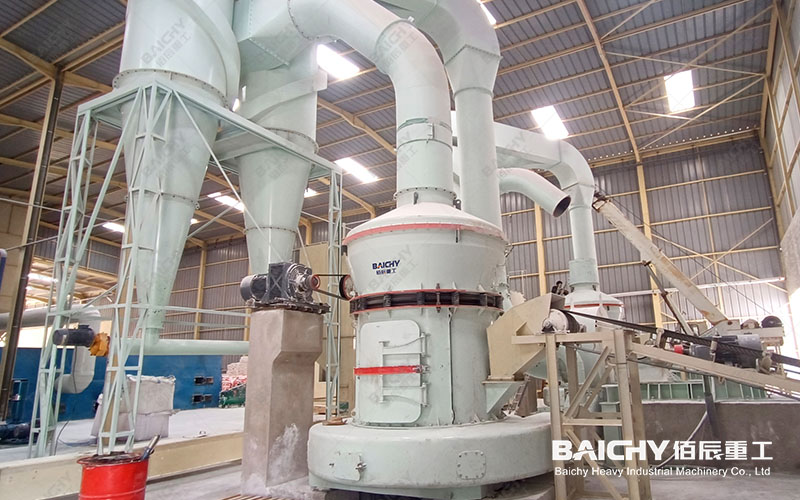
YGM high-pressure mill
V. Application Cases: Real-world performance in three typical operating scenarios
Case 1: Agricultural-grade calcium carbonate in Brazil (Hourly output: 4–5 tons; Fineness: 200 mesh)
Local soil tends to be acidic, resulting in consistently high demand for agricultural lime. The client selected the YGM130 to process calcite (Mohs hardness: 3) into 200-mesh agricultural lime, utilizing a system equipped with a PE jaw crusher, bucket elevator, and pulse dust collector. The motor was customized for a 60Hz/380V power grid. Daily output is 32–40 tons (based on a single 8-hour shift), with an electricity consumption of approximately 12 kWh per ton; the equipment investment was recouped within 10 months of commissioning.
Case 2: Construction-grade gypsum powder in the Middle East (Hourly output: 5–6 tons; Fineness: 325 mesh)
A gypsum board plant using natural gypsum as raw material selected the 5R4119 model configured in a closed-circuit system to supply 325-mesh construction gypsum powder directly to the production line. Once the classifier speed is set, fineness fluctuations remain within ±3%. Operating on a single-shift basis year-round, the replacement cycle for the grinding rollers and rings (high-manganese steel) is approximately 14 months, and annual maintenance costs account for only about 6% of the equipment purchase price. Case Study 3: Southeast Asia Barite Filler (3–4 t/h output, 425 mesh)
A client in the petroleum support sector processes barite for use as a drilling weighting agent. They selected the YGM160 high-pressure series mill to process material with a Mohs hardness of 3.5–4, achieving a stable 99% pass rate for the 425-mesh product. Compared to their previous ball mill setup, power consumption dropped by approximately 25% and the equipment footprint was reduced by nearly half; the project secured long-term downstream orders thanks to the consistent product fineness.
VI. Auxiliary Equipment and Upgrade Recommendations
A fully operational Raymond mill production line involves far more than just the main unit—if any item is missing from the quotation, issues will arise the moment production begins:
| Auxiliary Equipment | Function | Risk of Omission |
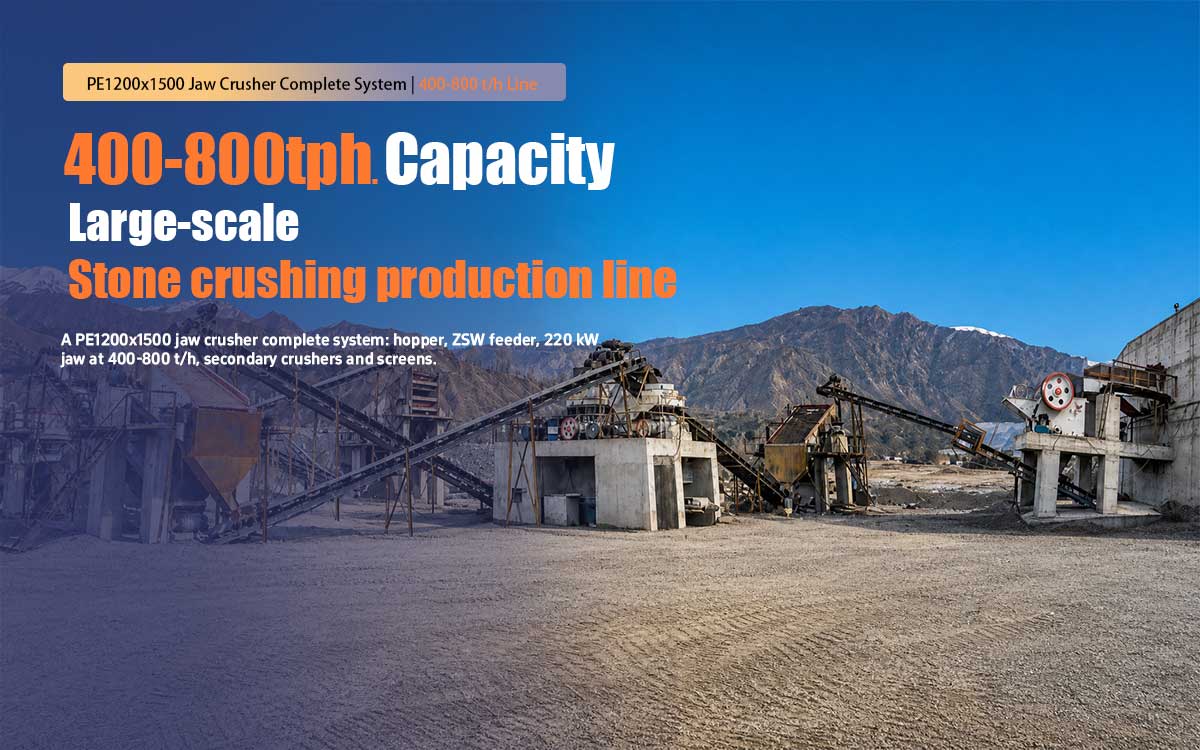
| Jaw Crusher (PE Series) | Pre-crushes raw ore to ≤30mm | Mill cannot accept raw feed directly |
| Bucket Elevator | Vertically conveys material to the storage hopper | Manual feeding; unstable production capacity |
| Electromagnetic Vibrating Feeder | Provides quantitative, uniform feeding | Overloading; uneven grinding; accelerated wear |
| Pulse Bag Dust Collector | Purifies exhaust gas to meet emission standards | Environmental violations; dust hazards in the work area |
| Electrical Control Cabinet | System interlocking and overload protection | Manual start/stop; lack of protection |
Capacity Upgrade Paths:
• Need for high-precision powder >600 mesh → YGMX Enhanced Series (cage classifier + VFD) or HGM Ultrafine Mill (600–2500 mesh);
• Need for ultra-high capacity >36 t/h → Vertical Mill (can save 25–35% power compared to ball mills for cement raw meal grinding) or large-scale ball mill;
• Raw material moisture content >6% → Install a rotary dryer or three-cylinder dryer upstream to prevent "clogging" (material sticking to the mill) and airflow blockages.
VII. FAQ
Q1: What materials can the Raymond mill process?
Suitable for non-flammable, non-explosive minerals with a Mohs hardness of ≤7 and a moisture content of ≤6%. This covers over 500 varieties, including limestone, calcite, gypsum, barite, talc, dolomite, kaolin, bentonite, potash feldspar, and marble. Materials with high silica content (e.g., quartz, corundum) accelerate roller-ring wear; for these, ball mills or HGM systems are recommended.
Q2: How do I choose between a Raymond mill, a ball mill, and an HGM ultrafine mill?
Selection based on fineness and capacity: For 80–600 mesh, hourly output of 0.5–36 tons, and priorities regarding footprint and power consumption → Raymond mill (including YGM high-pressure series); for 600–2500 mesh high-value-added ultrafine powder → HGM ultrafine mill; for ultra-high capacity or wet grinding applications → ball mill. Manufacturers can calculate the cost-per-ton based on your specific material before a final decision is made.
Q3: How can I get accurate capacity figures and a price quote?
Simply provide four pieces of information: material name and Mohs hardness, target fineness (mesh size), required hourly output, and local grid voltage/frequency (e.g., 380V/50Hz or 440V/60Hz). Baichen engineers will calculate figures based on both "nominal capacity" and "actual operational capacity." You will receive a response within 30 minutes detailing the suitable model, actual capacity, equipment list, and price range; on-site case studies involving the same material and operating conditions can also be provided upon request.