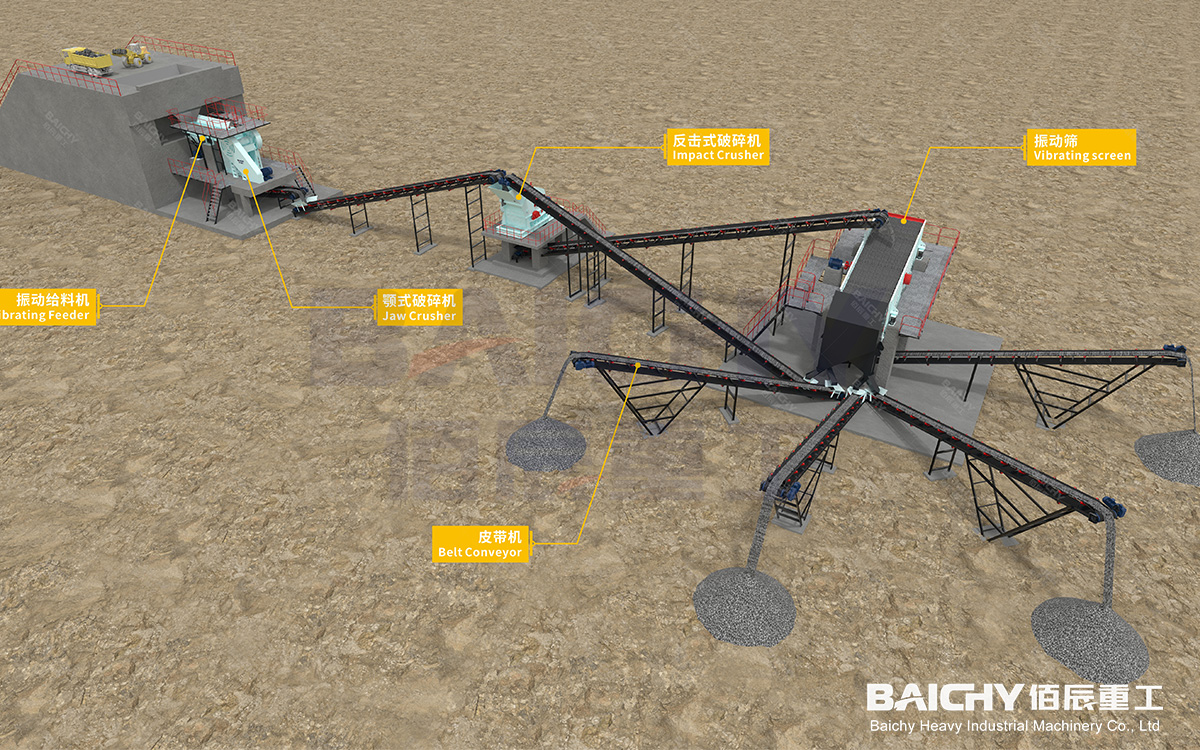
primary-and-secondary-crushers-plant
A combined primary and secondary crushers production line, consisting of a feeder, jaw crusher, impact crusher, and vibrating screen, is the most economical solution for processing medium-hardness materials such as limestone and gypsum. Its core advantage lies in utilizing the high crushing ratio of the jaw crusher to handle large feed pieces, and then using the impact crusher's crushing principle to achieve a cubic particle shape in the finished product. For investors seeking high-standard aggregates (such as for highways and high-rise buildings), this is the optimal solution for balancing operating costs and finished product quality.
I. Core Process Flow: The Synergistic Evolution of Primary and Secondary Crushers
In modern aggregate production, the configuration of primary and secondary crushers is not simply a matter of equipment stacking, but rather a precise calculation of energy utilization:
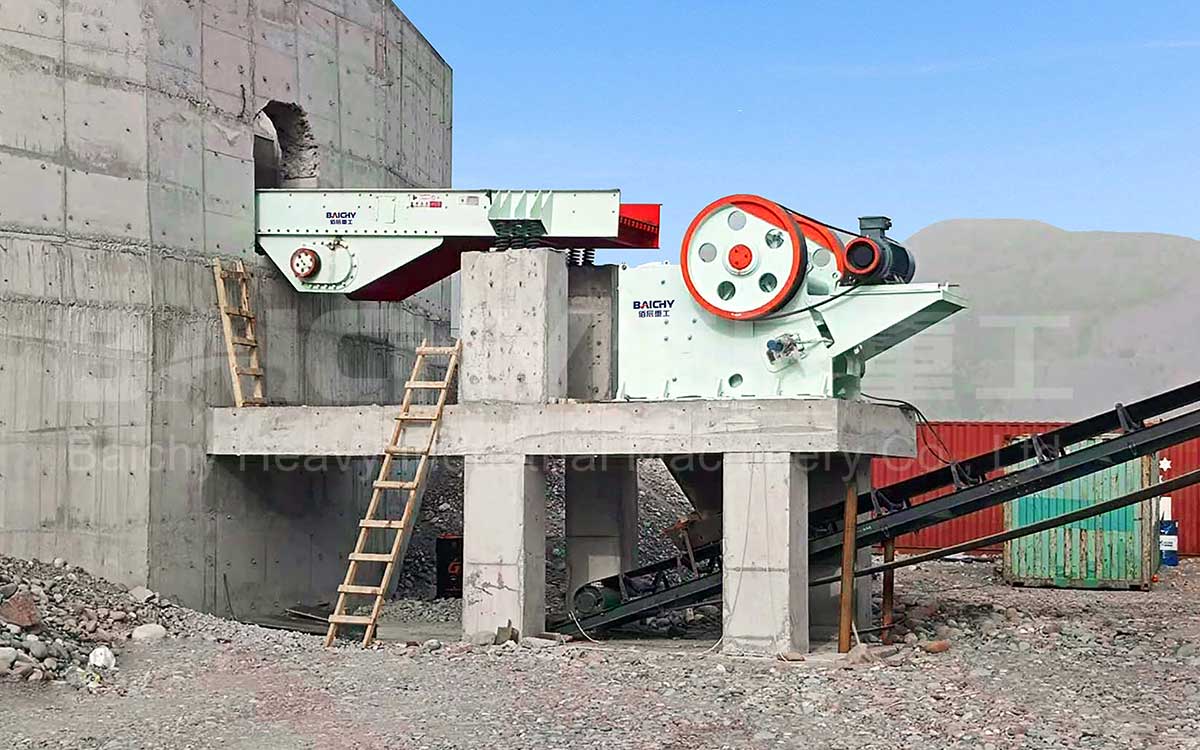
1. Primary Crushing Stage: The vibrating feeder delivers the raw material into the PE series jaw crusher. The jaw crusher, as the "hardest part" of the entire production line, is responsible for coarsely crushing large stones (500mm-1000mm) to approximately 100mm, reducing pressure in later stages.
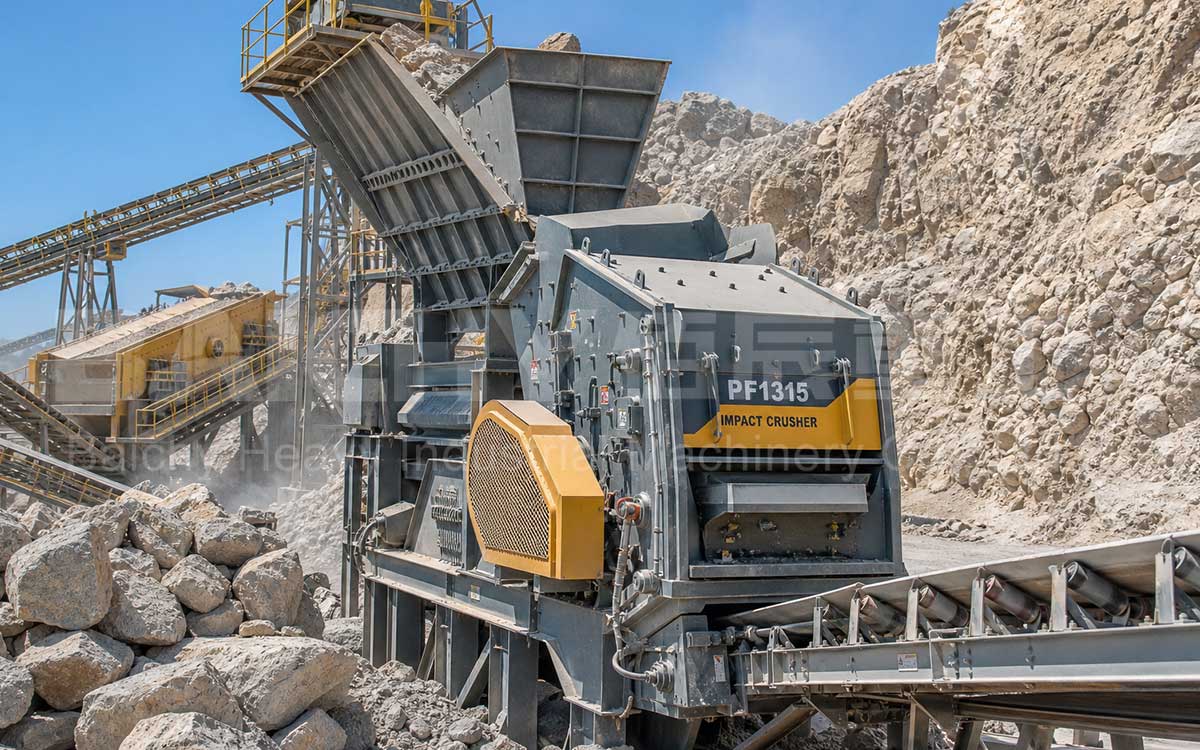
2. Secondary Crushing Stage: The finished product enters the impact crusher via a belt conveyor. Unlike the compression crushing of a cone crusher, the impact crusher uses a high-energy impact principle.
3. Grading Stage: A vibrating screen separates the crushed material into different sizes (e.g., 0-5mm, 5-10mm, 10-20mm). Unqualified large pieces of material are returned to the secondary crusher for further processing, forming a closed-loop cycle.
II. Key Application Scenarios of this Production Line
Based on the output characteristics of the primary and secondary crushers combination, it has irreplaceable advantages in the following areas:
① High-Grade Highway and Infrastructure Aggregate Production
Highway asphalt pavement has extremely strict requirements for aggregate particle shape (the content of needle-like and flaky particles must be strictly controlled). As a secondary crusher, the impact crusher effectively repairs the flaky material produced by the jaw crusher, generating cubic aggregates with full shape and rough surface, greatly enhancing the bonding strength of concrete.
② Limestone and Cement Raw Material Processing
In cement plants, limestone is a primary raw material. This primary and secondary crusher system can convert large ore pieces into finished products smaller than 30mm with extremely high throughput, and the wear of vulnerable parts is controlled, making it the preferred configuration for the front end of cement production.
③ Construction Waste Recycling
When processing construction concrete waste containing reinforced concrete, the jaw crusher, as a primary crusher, can initially crush large pieces of concrete, while the impact crusher has good vibration resistance and material shaping capabilities in secondary processing, making it suitable for producing recycled aggregates.
④ Gypsum, Calcium Powder, and Non-metallic Mineral Industry
For non-metallic minerals with low hardness but high added value, the two-stage configuration of primary and secondary crushers provides an extremely high crushing ratio, directly eliminating the need for tertiary crushing, shortening the process, and reducing energy consumption.
3. Technical Parameters and Typical Configuration Recommendations
| Equipment Role | Typical Model Example | Feed Size (max) | Power | Core Advantages |
| Primary Crusher | PE600×900 | 500 mm | 55-75 kW | High crushing ratio, simple maintenance |
| Secondary Crusher | PF1214 | 350 mm | 132 kW | Cubic particle shape, high yield |
4. Why Choose This Solution?
• Particle Shape Advantage: Compared to the combination of jaw crusher and cone crusher, this solution produces a product with a lower content of needle-like and flaky particles.
• Low Initial Investment: When processing medium to low hardness stone, the price of an impact crusher is significantly lower than that of a cone crusher with the same capacity.
• Easy Maintenance: The entire line has a simple structure; both primary and secondary crushers are classic mechanical structures, requiring less technical expertise from operators.
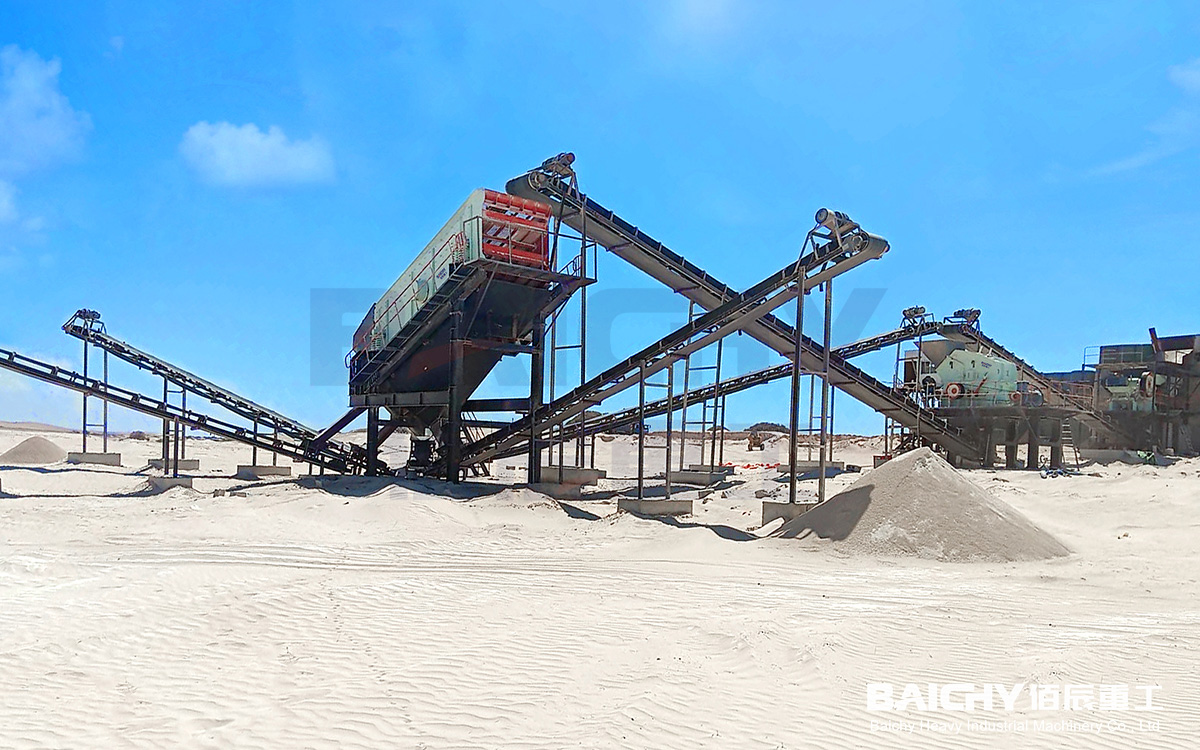
Somali-limestone-coarse-crushing-+-medium-and-fine-crushing-production-line
Frequently Asked Questions (FAQ)
Q1: Can this primary and secondary crusher line process granite?
A: While possible, granite's high hardness and abrasiveness will cause very rapid wear on the impact crusher's hammers, leading to a surge in operating costs. For granite or basalt, we recommend replacing the secondary crusher with a cone crusher.
Q2: Why is a vibrating screen necessary between the primary and secondary crushers?
A: Pre-screening removes small, qualified pieces of material from the jaw crusher, preventing them from entering the secondary crusher and causing over-crushing and unnecessary energy consumption.
Q3: Approximately how much floor space does this production line require?
A: A standard 100-150 tph production line requires approximately 1500-2500 square meters, depending on the length of the conveyor belts and the site layout.
Baichy Heavy Industry specializes in providing customized primary and secondary crusher solutions. Whether you are processing river pebbles or limestone, our engineers will match you with the most scientifically sound equipment solution through precise material hardness analysis.
Contact us for technical solutions: 0086 15093222637