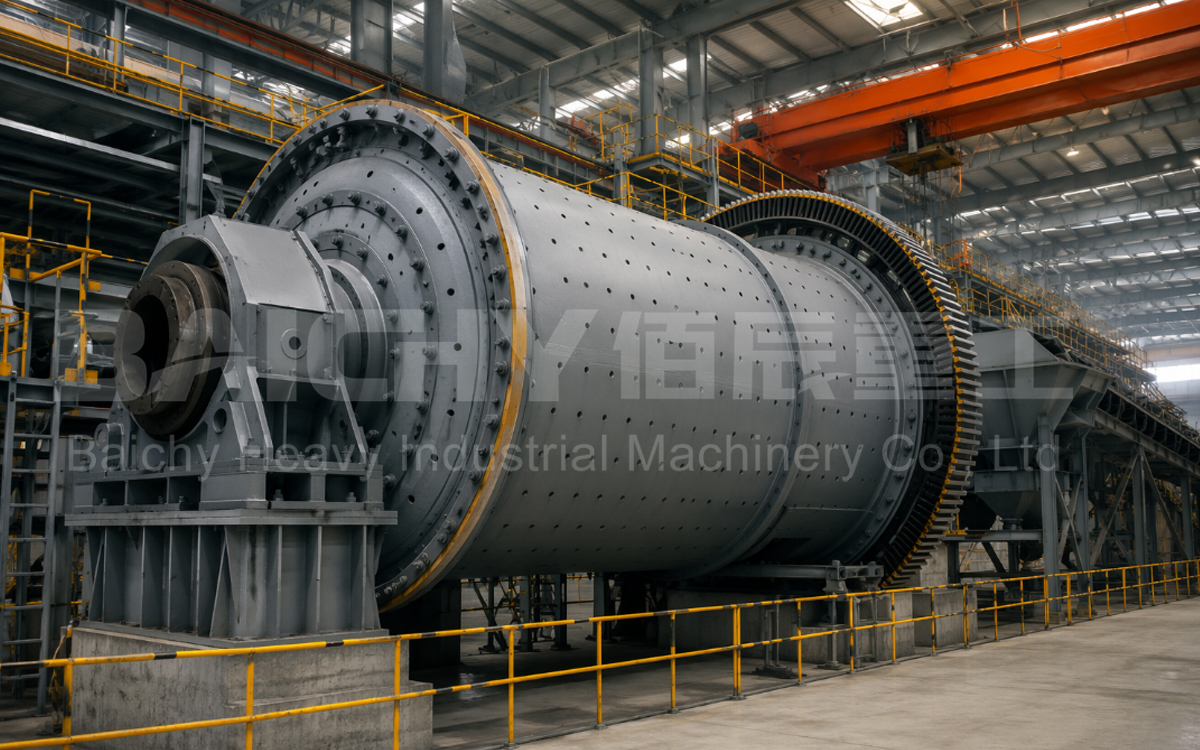
Bishoftu International Airport is a monumental infrastructure project currently underway in Ethiopia, featuring four parallel runways, 270 aircraft stands, and a total site area of 3,500 hectares; the design is led by Zaha Hadid Architects. For the first phase alone, the demand for sand and gravel aggregates is conservatively estimated at 1.5 to 2 million tons. This figure is not a mere guess but a calculation derived from runway thickness, apron surface area, and the volume of structural layers in the terminal buildings.
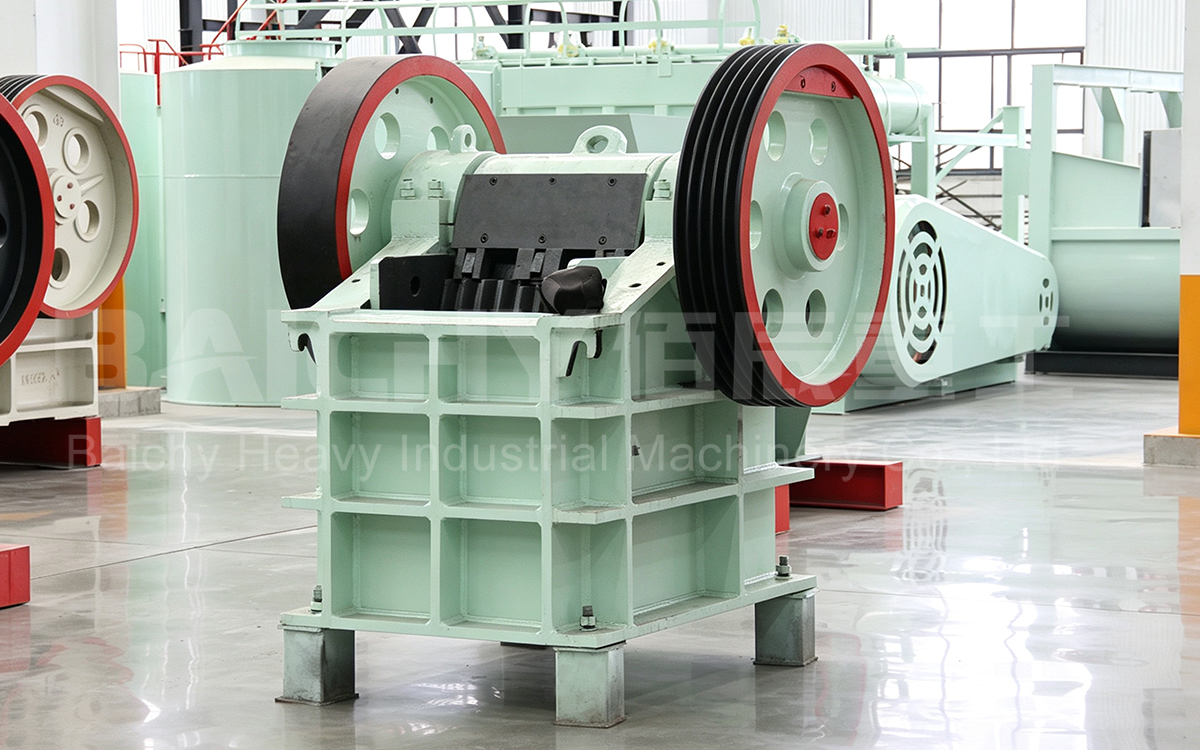
For suppliers of crushing and screening equipment, the question is not whether an opportunity exists, but rather who can provide a solution capable of handling basalt—a notoriously tough rock—thereby securing a place in the project. Baichy Heavy Industry’s PE jaw crushers, CS cone crushers, VSI sand-making machines, and mobile crushing stations are specifically designed for such large-scale operations involving high-hardness aggregates.
I. Reverse-calculating Project Volume: Sources of Aggregate Demand
Note on Data Basis: The following estimates are based on publicly available planning parameters for Bishoftu Airport (4 runways, 270 aircraft stands, 3,500-hectare site) and reference standards for runway thickness from Changi and Dubai airports. Actual requirements are subject to the project's final design specifications.、
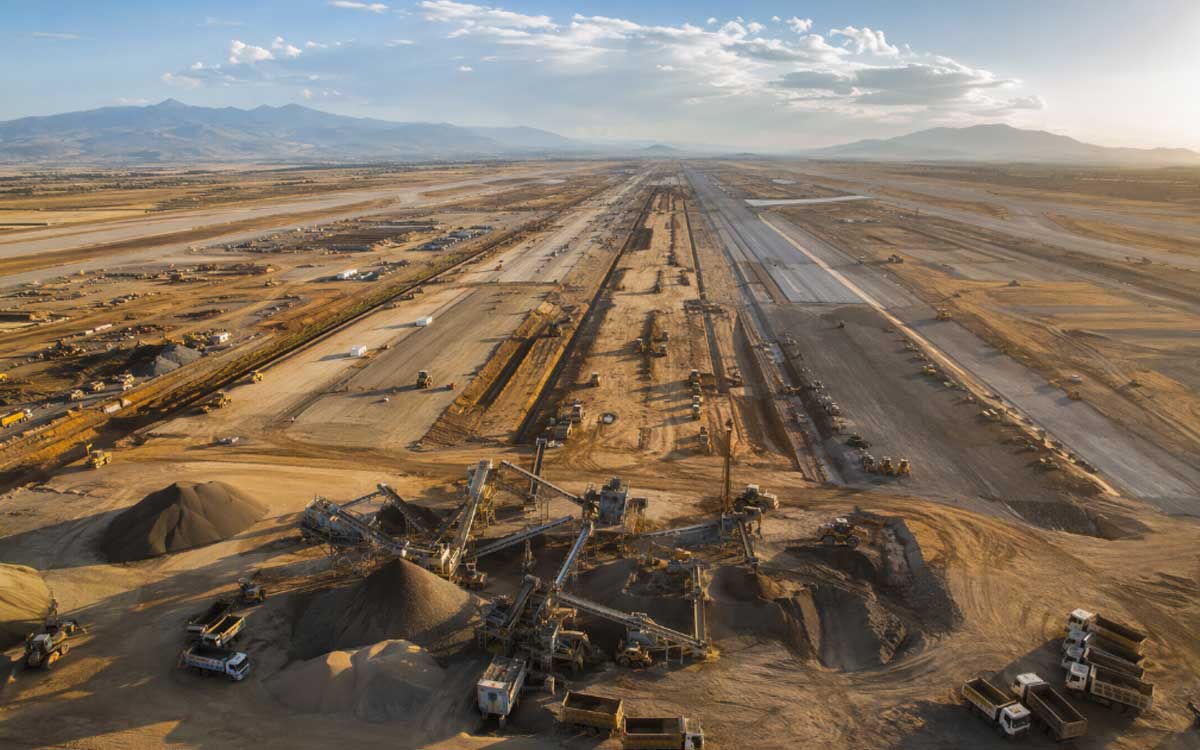
Airport runway construction site
1.1 Runway System — 4 Parallel Runways
| Parameter | Value |
| Dimensions per runway | 3,800m × 60m × 0.4m (surface + base layers) |
| Total concrete volume for 4 runways | ~365,000 m³ |
| Aggregate content in concrete | ~70% |
| Aggregate demand for runway system | ~250,000 tonnes |
1.2 Aprons + Taxiways — 270 Aircraft Stands
| Parameter | Value |
| Area per stand | 80m × 80m |
| Total paved area | ~1.73 million m² |
| Structural layer thickness | 50 cm |
| Total concrete volume | ~860,000 m³ |
| Aggregate demand for aprons & taxiways | ~600,000 tonnes |
1.3 Terminal + Cargo Station + Ancillary Facilities
| Parameter | Value |
| Total site area | 3,500 hectares |
| Phase I terminals | 2 |
| Annual cargo handling capacity | 1.5 million tonnes |
| Aggregate demand for infrastructure (conservative) | 500,000–800,000 tonnes |
Demand Summary
| Project Module | Aggregate Demand (Conservative Estimate) |
| Runway System | ~250,000 tonnes |
| Aprons + Taxiways | ~600,000 tonnes |
| Terminals + Ancillary Facilities | 500,000–800,000 tonnes |
| Phase Total | 1.5–2.0 million tonnes |
This excludes the backfill and roadbed materials required for site leveling. When combined with the 102,000 km of roads and 1.5 million housing units Ethiopia is developing concurrently, the total demand for sand and gravel reaches the scale of hundreds of millions of tonnes—with the airport serving as the most dazzling "jewel" in this vast landscape of demand.
<<What is the Total Investment Cost for a 200TPH Stone Crusher Plant in Ethiopia?>>
II. Equipment Integration: Baichy Product Lines × Six Major Application Scenarios
The Ethiopian Highlands are characterized primarily by basalt—a rock type featuring high hardness (Mohs scale 6–7), strong abrasiveness, and high density. These lithological characteristics directly dictate the core requirements for equipment selection: wear-resistant parts must be of a high grade, the crushing ratio must be sufficient, and the overall machine structure must be robust enough to withstand continuous, high-intensity operation.
| Application Scenario | Core Requirements | Core Requirements Baichy Product | Selection Notes |
| Quarry Primary Crushing | Processing large basalt blocks (≤750mm) | PE/PEX Series Jaw Crusher | PE750×1060 or PE600×900; standard Mn18Cr2 high-manganese steel jaw plates offer high abrasion resistance against basalt. |
| Secondary Crushing | Crushing 150–300mm feed to 20–40mm | CS Cone Crusher | CS220 utilizes inter-particle (lamination) crushing; high-chromium cast iron concave liners extend service life by 30% compared to standard Mn13 steel when processing basalt. |
| Tertiary Crushing/Shaping | Producing 5–20mm aggregate + manufactured sand | PF Impact Crusher or CS Cone Crusher | Choose Impact Crusher for superior particle shape; choose Cone Crusher for higher output. |
| Sand Making | Strict gradation requirements for airport concrete sand | VSI Sand Making Machine | VSI-9526 with "rock-on-rock" crushing chamber; produces rounded sand particles meeting C30–C50 concrete standards. |
| Grading & Screening | Simultaneous production of 4 product specifications | YK Series Circular Vibrating Screen | 4YK2160 four-deck screen; simultaneously produces 0–5, 5–10, 10–20, and 20–40mm fractions. |
| Sand Washing | High clay content in basalt weathering layers in parts of Ethiopia | Wheel/Spiral Sand Washer | XSD Wheel Sand Washer; 150–300 tph capacity; controls clay content to below 3%. |
| Multi-point Mobile Operations | Segmented runway construction requiring frequent equipment relocation | Crawler/Tire-mounted Mobile Stations | Combination of crawler-mounted jaw crusher, cone crusher, and screening station. |
III. Recommended Solutions: Two Configuration Options
Option A: Stationary Production Line — Centralized Supply from Large Quarries
Applicable Scenario: Project utilizes one or more fixed quarries; material is centrally crushed and then transported to various construction sites by a fleet of trucks.
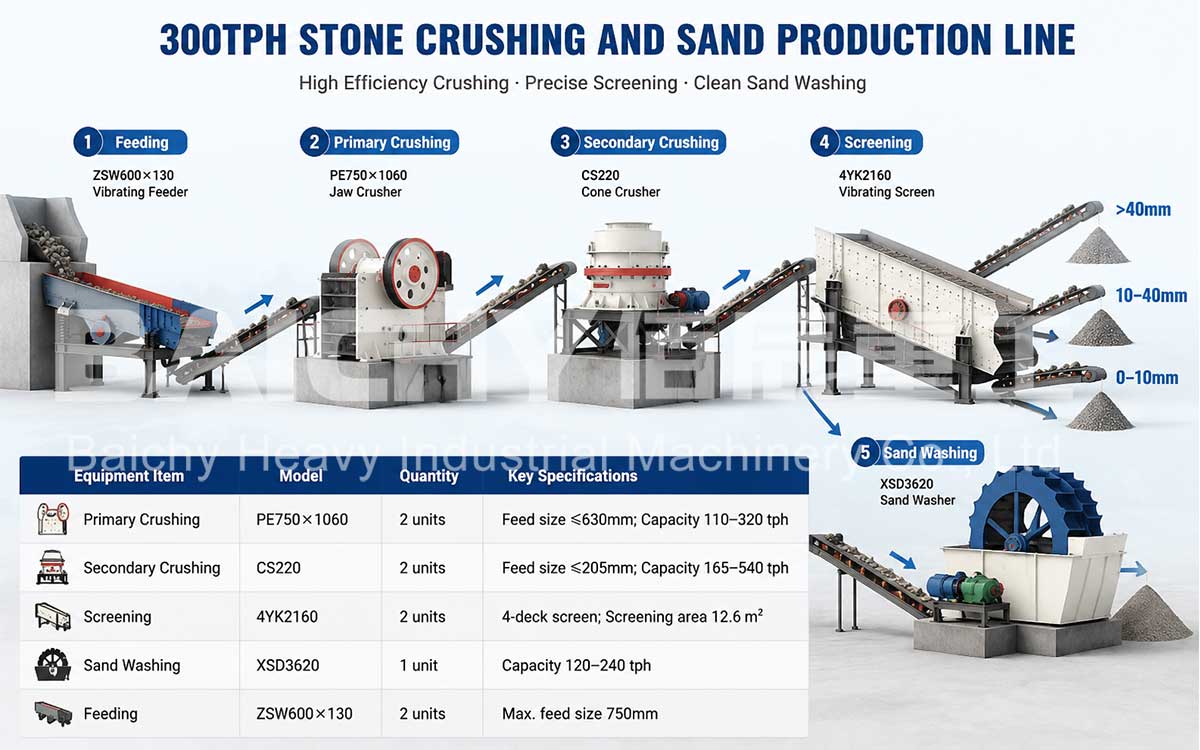
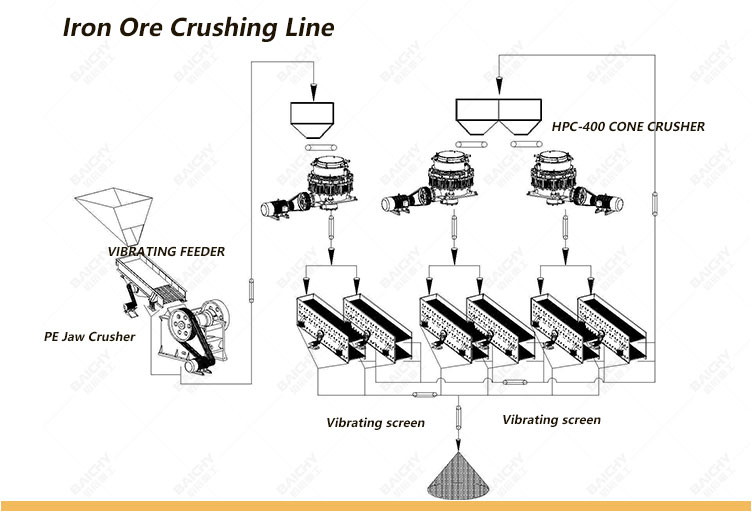
300TPH STONE CRUSHINGANDSAND PRODUCTION LINE
| Equipment Item | Model | Quantity | Key Specifications |
| Primary Crushing | PE750×1060 | 2 units | Feed size ≤630mm; Capacity 110–320 tph |
| Secondary Crushing | CS220 | 2 units | Feed size ≤205mm; Capacity 165–540 tph |
| Screening | 4YK2160 | 2 units | 4-deck screen; Screening area 12.6m² |
| Sand Washing | XSD3620 | 1 unit | Capacity 120–240 tph |
| Feeding | ZSW600×130 | 2 units | Max. feed size 750mm |
Design Capacity: 200–300 tph (actual measured capacity for basalt, not nominal limestone rating). Finished Product Specs: 0–5mm (manufactured sand), 5–10mm, 10–20mm, 20–40mm. Economic Analysis: 300 operating days/year × 20 hours/day × 250 tph = 1.5 million tons/year; a single line meets the total aggregate demand for Phase I; average cost controlled at $1.8–2.2 per ton.
<<FIXED STONE CRUSHING PLANT CONFIGURATIONS>>
Option B: Mobile Crushing Station Combination — Flexible relocation to follow construction zones
Suitable Scenario: Airport construction sites are dispersed; runways, aprons, terminals, and cargo stations are built in phases, requiring equipment to relocate frequently.
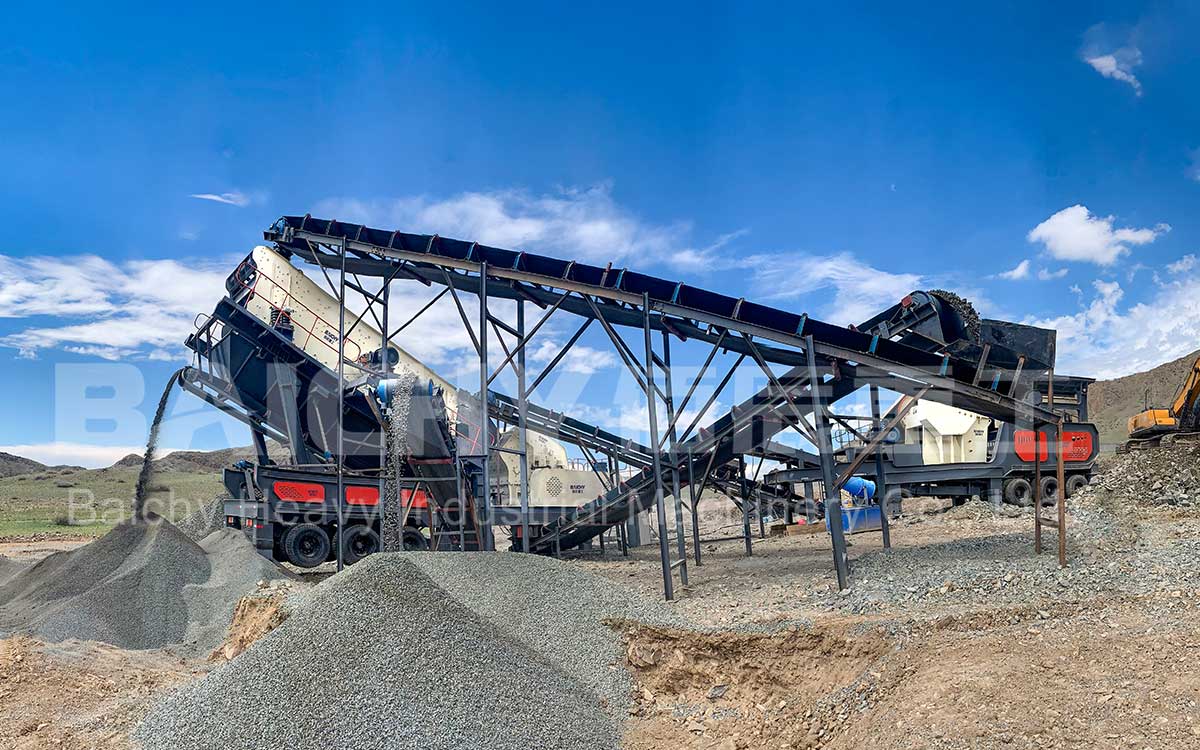
Mobile Crushing Station Combination
| Equipment | Model | Key Advantages |
| Mobile Jaw Crusher | YDPZ75-1242 | Crushing chamber identical to the PE750×1060; crawler-mounted self-propulsion |
| Mobile Cone Crusher | YDPZ300-2160 | Main unit identical to the HP300; hydraulic discharge opening adjustment |
| Mobile Screening Station | YDPZ-2160 | 4-deck screen; foldable discharge conveyor; relocation and setup completed in 15 minutes |
Why mobile stations are suitable for airport projects:
• Runway construction is a linear project; with a fixed production line, the transport distance increases as construction progresses, causing the cost per ton to rise from 0.3 to over 0.8.
• Mobile stations, however, move forward as each section is completed, keeping the transport distance consistently within 2 km.
• Relocation time: Crawler self-propulsion + hydraulic folding discharge conveyor → 15–20 minutes to switch work locations.
IV. FAQ
Q1: How long do the jaw plates last when Baichy jaw crushers process Ethiopian basalt?
A: Using a PE750×1060 crusher equipped with Mn18Cr2 jaw plates and a feed size of ≤630mm, each set of plates can process approximately 80,000–120,000 tons of basalt (approx. 400–500 hours). We recommend keeping 3–4 spare sets on hand to ensure the project does not halt while waiting for replacement parts.
Q2: How long does it take to go from order placement to commissioning for a 200 tph production line?
A: Baichy's standard lead times: Jaw crusher 25 days, cone crusher 30 days, vibrating screen 20 days, sand washer 15 days. Inland transport from the Port of Djibouti to Ethiopia takes approximately 7–10 days. Including foundation construction and installation/commissioning, the total time from order to official operation is approximately 60–75 days.
Q3: Are mobile stations suitable for airport construction? How does the cost compare to a fixed production line?
A: While the initial purchase cost of a mobile plant is about 20–30% higher, it eliminates the infrastructure expenses associated with fixed production lines (such as concrete foundations and steel-structure factory buildings) as well as long-distance transportation costs. For linear construction projects—such as runways—with durations exceeding six months, the mobile plant offers a more favorable total lifecycle cost.
Q4: Can Ethiopia's power supply handle this production line?
A: A 200 tph plant has a total installed power capacity of approximately 650–750 kW; Ethiopia possesses an abundant hydroelectric power supply supported by the Grand Ethiopian Renaissance Dam. Baichy’s standard motors are 380V/50Hz, matching Ethiopia's grid standards. If diesel generators are used during the initial construction phase, 400V/50Hz motors can be supplied upon request.
Q5: Does Baichy have an after-sales team in Ethiopia?
A: Baichy operates a regional service center in East Africa that covers Ethiopia, Kenya, and Tanzania. We provide installation guidance, operational training, and 24-hour technical support. Wear parts can be quickly replenished via the Djibouti–Addis Ababa logistics corridor.