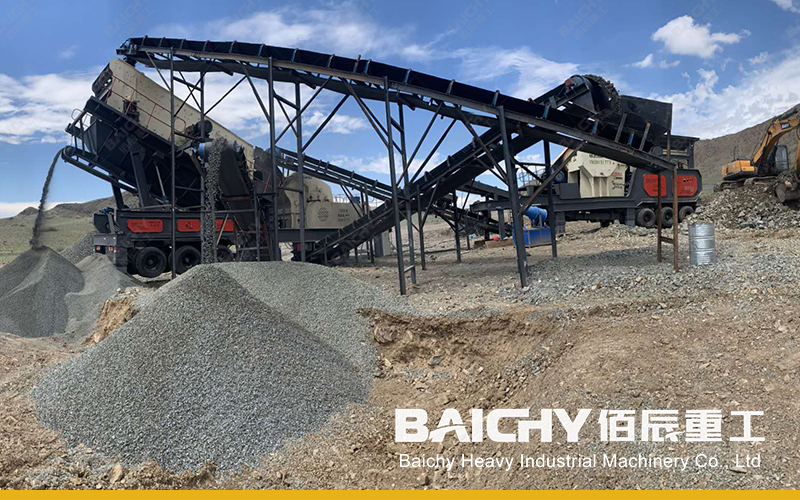
150-200tph mobile crushing plant
The 150–200 TPH mobile combined crushing station offers the shortest payback period for limestone crushing projects. It integrates the entire process—feeding, primary crushing, secondary crushing, and screening—onto a single mobile chassis. This eliminates the need for concrete foundations or steel structure installation, allowing for integrated commissioning and production within 24 hours of arrival. The comprehensive cost per ton is approximately ¥2.9, with a production capacity deviation of less than 5% compared to fixed lines of the same specifications. If your project duration is under three years, involves multiple work sites, or faces limitations regarding on-site power and foundation infrastructure, this solution vastly outperforms fixed production lines in terms of investment recovery speed.
I. Overview: Why Limestone Requires a "Combined" Mobile Station
Limestone is a medium-soft rock with a bulk density of approximately 1.6 t/m³, a Mohs hardness of 3–4, and low abrasiveness. These characteristics dictate that the optimal crushing pathway is "jaw crushing (primary) + impact crushing (secondary)." Impact crushers offer a high reduction ratio and excellent particle shape for medium-soft materials; their blow bars boast a service life exceeding 180 hours, and the wear cost per ton is only one-third that of processing granite.
The mobile combined crushing station transforms this process into a standardized product. A ZSW vibrating feeder, PE-series jaw crusher, PF impact crusher, and circular vibrating screen are integrated onto an independent wheeled chassis in the correct process sequence, with final assembly and commissioning completed by the manufacturer. The purchaser receives not a collection of inpidual machines requiring on-site assembly, but a complete production line ready for immediate operation. While the chassis is mobile, the core crushing units are not; they utilize the same models found in fixed lines, ensuring no compromise in production capacity.
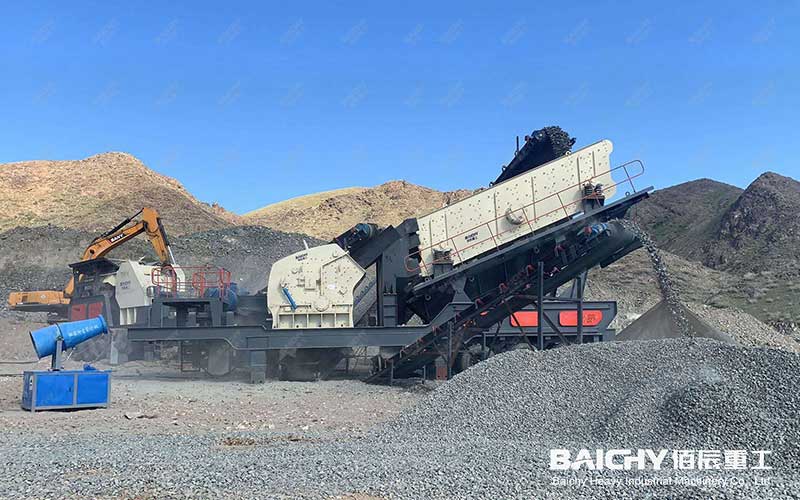
limestone crushing plant
II. Application Scenarios
| Scenario | Typical Requirements | Value of the Combined Station |
| Aggregate line for cement plants/ready-mix concrete stations | 0–31.5mm continuously graded aggregate | Impact crushing for shaping; flake/elongated particle content <10%; ready for direct storage |
| Metallurgical flux limestone (for steel mills/power plant desulfurization) | 40–80mm lump flux | Four-deck screen produces four product sizes in one pass; controllable particle size |
| Highway/railway linear projects | Local material sourcing along the route; relocation with project progress | Production line moves alongside project advancement |
| Short-term leased quarries/river dredging sites | Short extraction windows; rapid site clearance | Foundation-free; leaves no trace upon removal; mobilize only after approval |
| Construction site self-production/self-use | On-site crushing for backfill/sub-base materials | Eliminates transport costs and price markups associated with purchasing external aggregates |
III. Standard Configuration and Core Parameters
The following details the standard configuration for a 150–200 TPH mobile combined crushing station (capacity rated based on medium-hardness limestone):
| Equipment Unit | Main Unit Model | Quantity | Power (kW) | Feed Size (mm) | Output Size (mm) | Single-Unit Capacity (t/h) |
| Mobile Feeding Unit | ZSW490×110 | 1 | 15 | ≤500 | - | 120–280 |
| Mobile Jaw Crushing Unit (Primary) | PE750×1060 | 1 | 110 | ≤630 | 80-140 | 110-180 |
| Mobile Impact Crushing Unit (Secondary) | PF1315 | 1 | 220 | ≤350 | 5–40 (adjustable) | 130–250 |
| Mobile Screening Unit | 4YK2160 (4-deck screen) | 1 | 37 | ≤200 | 0–5/5–20/20–40/40–80 | 80–320 |
| Total Line | - | 4 | ~382 | ≤630 | Four product sizes | 150-200 |
Production capacity conversion basis (using limestone = 1.0 as the benchmark): Dolomite × 0.95, Blue Limestone × 0.90; if processing granite, multiply capacity by 0.75–0.85 and replace the impact crusher with a cone crusher. All quotes are calculated using this standard to avoid discrepancies between "nominal 200 tph" and "actual 150 tph" performance.
Quick calculation of operating costs (Unit: RMB/ton; electricity cost: ¥0.8/kWh): Electricity consumption ~2.2 kWh/t (¥1.76) + Jaw plate wear (¥0.36) + Blow bar wear (¥0.39) + Screen mesh (¥0.15) + Labor (¥0.24) ≈ Total cost of ¥2.90/ton. Based on an annual output of 200,000 tons, annual operating costs are approximately ¥580,000; compared to a stationary line, the ¥250,000–¥400,000 saved on foundation and installation costs translates directly into first-year profit.
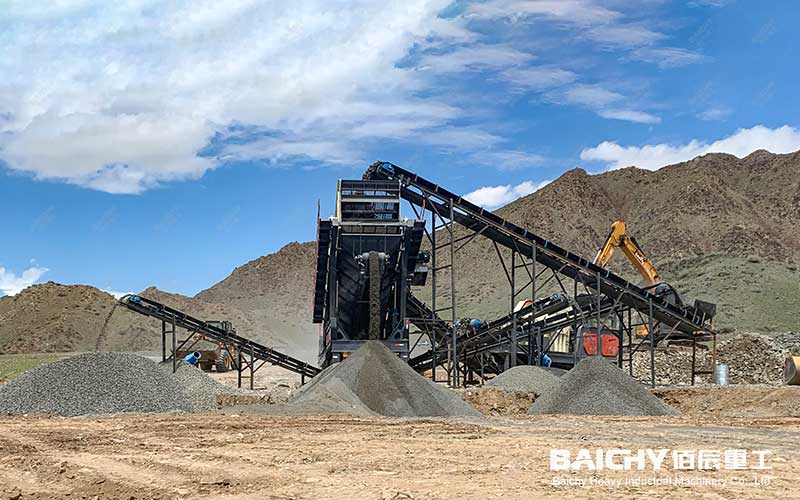
mobile combined crushing station
IV. Equipment Advantages: Turning Specifications into Profit
1. Foundation-free, immediate production — Upon arrival, the sequence of "connect power → test run → feed material" allows for output within 4–6 hours; compared to the 15–30 day installation cycle of stationary lines, production starts 2–4 weeks earlier. For cement plant projects racing against deadlines, these 2–4 weeks represent 2–4 weeks of cash flow.
2. Impact Crusher + Limestone = Optimal Match — High reduction ratio (achieving finished particle size in a single pass), long blow bar lifespan, and rounded particle shape; the finished product can be used directly as concrete aggregate without secondary shaping.
3. Relocation costs near zero — The four units feature wheeled chassis; the entire line can be relocated using a single 50-ton class tractor unit and a crew of 2–3 people, resuming production in 1–2 days. In contrast, a single relocation of a stationary line causes 10–20 days of downtime; based on a daily output of 1,200 tons and a gross profit of ¥15/ton, the loss from downtime during one relocation ranges from ¥180,000 to ¥360,000.
4. Global Power Compatibility — The entire line requires approximately 382 kW and supports 380V/50Hz, 400V/50Hz, and 440V/60Hz configurations, eliminating the need for local electrical modifications for export projects; it also operates at full load when powered by diesel generator sets.
V. Customer Case Study: Limestone Aggregate Project in Mexico
A Mexican cement group needed to construct a 150–200 tph limestone production line at a quarry to supply regional ready-mix concrete plants. However, the site was far from urban areas, foundation construction conditions were poor, and the group planned to relocate to a new quarry site in two years. By adopting the Baichy four-unit mobile modular crushing station (ZSW490×110 + PE750×1060 + PF1315 + 4YK2160), the following results were achieved:
Commissioning Timeline: Material output began on the second day after equipment arrival, saving approximately 25 days compared to a stationary plant solution;
Actual Capacity: Stable at 175–190 tph under limestone operating conditions, with a product compliance rate exceeding 95%;
Product Gradation: Four fractions (0–5, 5–20, 20–40, and 40–80 mm); the flake-and-elongation content of the 5–20 mm aggregate was <10%, meeting C30–C50 concrete grading standards;
Economic Analysis: Comprehensive cost per ton was approximately ¥2.9; relocating the entire plant to the new site after two years took only 2 days, whereas a stationary plant solution would have required over 20 days of downtime for this process.
Case Insight: When choosing a mobile crushing line for a limestone project, the key factor isn't just "output," but rather the number of relocations and the speed of commissioning over the project's lifecycle—these two variables ultimately determine the Total Cost of Ownership (TCO).
VI. Recommended Related Equipment
1. Crawler-type mobile crushing station — Self-propelled (no towing vehicle required) and capable of entering mining areas independently; ideal for sites without established roads and for mine reclamation projects.
2. Wheeled standalone units (Jaw Crusher / Impact Crusher / Screening Station) — Customers with existing fixed equipment can add specific units as needed, gradually upgrading to a combined processing line.
3. Fixed limestone crushing line — For projects with secure mining rights and a lifespan exceeding 5 years, a fixed line can further reduce the cost per ton by 10–15%.
4. Limestone grinding equipment (Raymond Mill / Vertical Mill) — If the product needs to extend beyond aggregates to 325-mesh powder (for desulfurization, chemical use, or calcium feed additives), the output from the crushing station can be fed directly into the mill.
VII. FAQ
Q1: Why is an impact crusher recommended over a cone crusher for limestone?
Limestone has a much lower abrasiveness index (Ai) than granite; impact crusher blow bars can last over 180 hours, with wear costs per ton being only one-third of those in hard-rock applications. Additionally, impact crushers offer high reduction ratios and produce rounded particle shapes, yielding aggregate-grade products in a single pass and eliminating the need for a closed-loop circuit. While cone crushers excel in wear resistance due to inter-particle (lamination) crushing, their advantages in purchase cost and power consumption are not realized with limestone—their true value lies in processing granite or basalt.
Q2: Can mobile combined crushing stations handle limestone with high moisture or clay content?
Yes, but configuration adjustments are required: for moisture content <5%, production can proceed directly; for 5–8%, it is recommended to install sprayers on the screening unit and provide an outlet for clay discharge; for high clay content, a grizzly screen and a clay discharge conveyor can be installed at the feeding section to separate soil before primary crushing, thereby protecting the impact crusher's blow bars and ensuring the final product meets clay content standards. Customization is available based on the raw ore's moisture and clay content provided at the time of ordering.
Q3: How long does it take from order placement to commissioning? How are exports handled?
The delivery lead time for a standard four-unit combination is 30–40 days (covering main unit assembly, chassis welding, and integrated system commissioning), with material output achievable within 24 hours of arrival on-site. For export, the transport dimensions of each unit are kept within 13.5m × 3.0m × 4.2m, making them compatible with 40HQ flat-rack containers or Ro-Ro (Roll-on/Roll-off) vessels. The equipment supports electrical standards such as 380V/50Hz, 400V/50Hz, and 440V/60Hz, includes multilingual operation manuals, and comes with remote commissioning guidance at the destination port. These units have already been exported to over 15 countries, including Mexico, the Philippines, Kenya, and Chile.
Baichy Heavy Industry
Baichy Heavy Industry is a high-tech mining equipment company integrating R&D, manufacturing, sales, and after-sales service. Focusing on crushing, grinding, and mineral processing equipment, we provide professional solutions to our customers. We are ISO9001:2015 、certified, and our products include mobile crushing palnts, crawler crushing plant, construction waste crushing plants, jaw crushers, sand making machines, cone crushers, fine crushers, grinding mills, ball mills, etc., all with reliable performance to meet diverse project needs.
Baichy Heavy Industry – Your Trusted Partner
To ensure optimal performance of your equipment, Baichy Heavy Industry offers:
- Professional on-site installation guidance
- Comprehensive operator training
- 24/7 technical support & maintenance services
Our complete after-sales service system guarantees long-term, stable operation of your machinery with minimal downtime.
Protect Your Rights – Only Use Official Channels
To avoid scams and ensure authentic support, contact us exclusively through:
• Official Website: www.baichychina.com
• WhatsApp: +8615093222637
• Email: [email protected]
Your satisfaction is our priority – expect prompt, professional service every time.
(Note: Beware of unauthorized third parties claiming to represent Baichy. Always verify through official contacts.)