

Mining Crusher
Mining crushers are critical pieces of equipment that determine the cost and production capacity of entire mineral processing and aggregate production lines; selecting the wrong model leads to long-term expenses associated with high power consumption, excessive wear, and frequent blockages. The decision-making process follows a single primary logic: first, determine the ore hardness and feed particle size; next, identify the crushing stage (primary, secondary, or tertiary/fine); and finally, select the specific model and capacity. The general rule is: use jaw crushers for primary crushing of hard rock; cone crushers for secondary and tertiary crushing of hard rock; impact or hammer crushers for medium-to-soft ores; and Vertical Shaft Impact (VSI) crushers for sand making and shaping. Clarifying this logic before discussing brands and prices ensures you remain in a strong position during procurement negotiations.
I. Overview of Mining Crushers: Their Role in the Production Line
1.1 Definition and Function
Mining crushers are machines used in metal, non-metal, and construction material mining operations to reduce large, run-of-mine ore chunks to particle sizes suitable for downstream processing. Positioned at the very beginning of the mineral processing flow, they directly determine the quality of the feed for subsequent grinding and separation stages. Even a slight reduction in crushed particle size significantly impacts the capacity and power consumption of downstream grinding mills. This drives the industry philosophy of "crush more, grind less" (or "substitution of grinding with crushing"): optimizing the crushing stage is more cost-effective than simply scaling up grinding mills.
1.2 Classification of Crushing Stages
Based on discharge particle size, mining crushing operations are typically categorized into three stages: primary crushing (discharge size: 100–350 mm; typical equipment: jaw crusher); secondary crushing (discharge size: 30–100 mm; typical equipment: cone crusher, impact crusher, hammer crusher); and tertiary/fine crushing (discharge size: 5–30 mm; typical equipment: fine-crushing jaw crusher, short-head cone crusher, double-roll crusher, and VSI). Most metal ore processing plants employ a standard three-stage process: jaw crushing (primary) + cone crushing (secondary/tertiary) + grinding. In contrast, smaller-scale aggregate lines or cement quarries often utilize a simpler two-stage closed-loop process: jaw crushing + impact crushing.
II. Main Types of Mining Crushers and Applicable Materials
2.1 Jaw Crusher: The Primary Choice for Primary Crushing of Hard Rock and Metal Ores
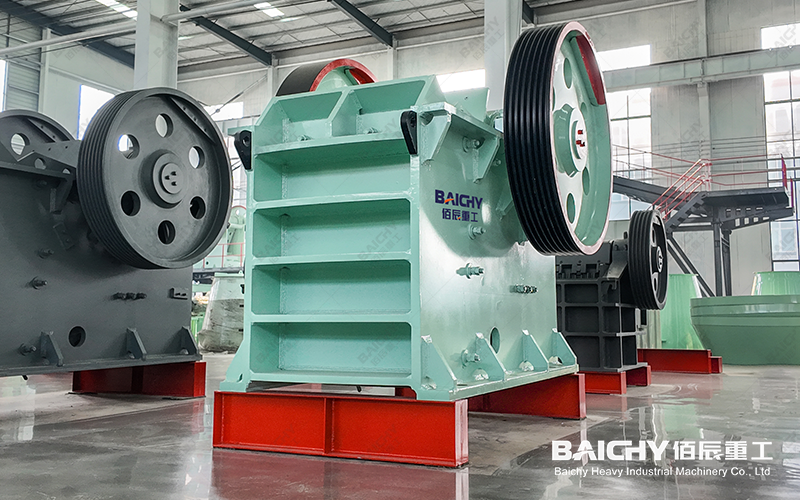
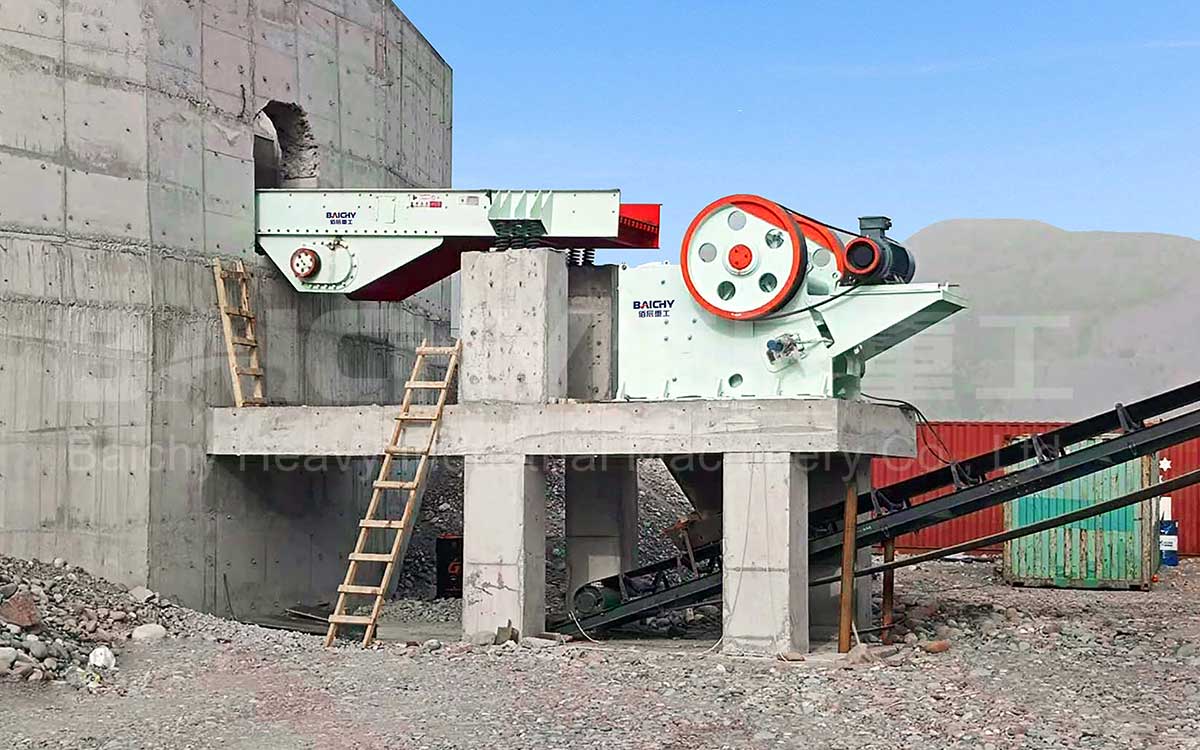
PE series Jaw Crusher
Operating on the principle of compression crushing, jaw crushers feature large feed openings and high tolerance for material hardness. They are the standard equipment for the initial crushing stage in hard-rock mines—such as those for gold, iron, and copper—and serve as the starting point for complete crushing production lines. Baichy’s PE, PEX, and C90 series cover a full range of specifications from 150×250 to 1500×1800, with single-unit capacities ranging from a few tons to hundreds of tons per hour, making them the most widely used models in the mining crusher family.
2.2 Cone Crusher: The Efficiency Leader for Secondary and Tertiary Crushing of Hard Rock
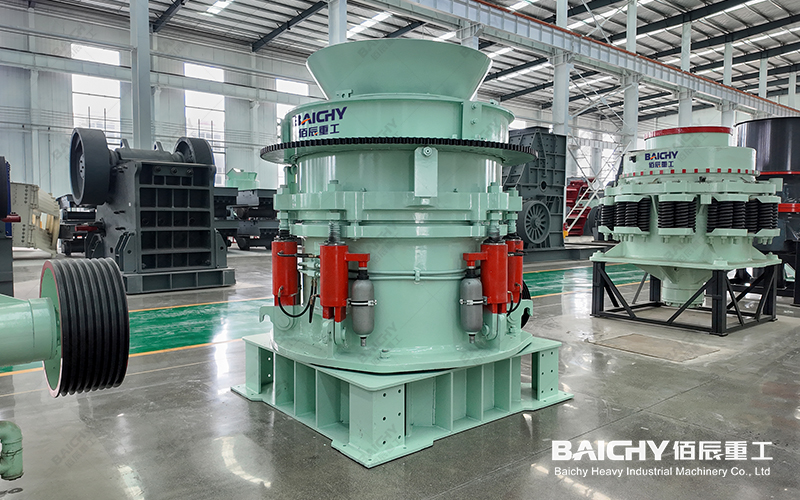
Cone Crusher
Utilizing the principle of inter-particle (lamination) crushing, cone crushers are specialized for the secondary and tertiary crushing of medium-to-high hardness ores. They produce high-quality particle shapes with a high proportion of fine fractions, making them the mainstream choice for secondary crushing in gold processing plants and aggregate production lines for basalt and granite. Two types are available—CS spring-style and HP multi-cylinder hydraulic-style—catering to standard operating conditions and high-output hard-rock applications, respectively.
2.3 Impact Crusher and Hammer Crusher: Cost-Effective Solutions for Medium-Soft Ores
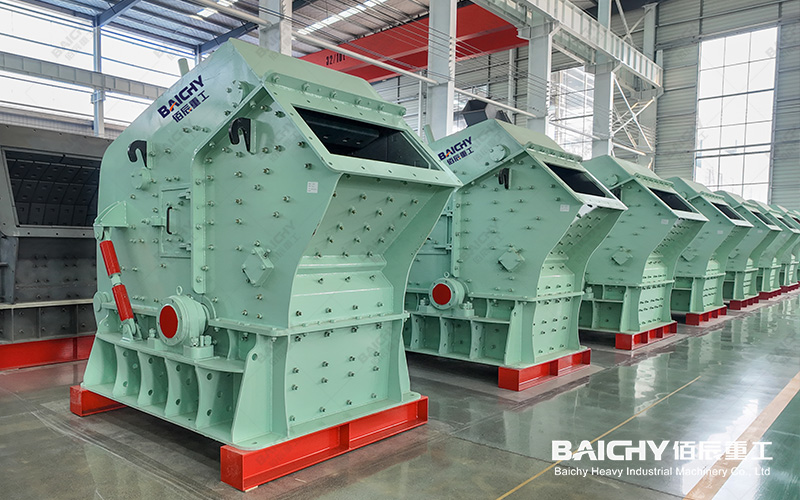
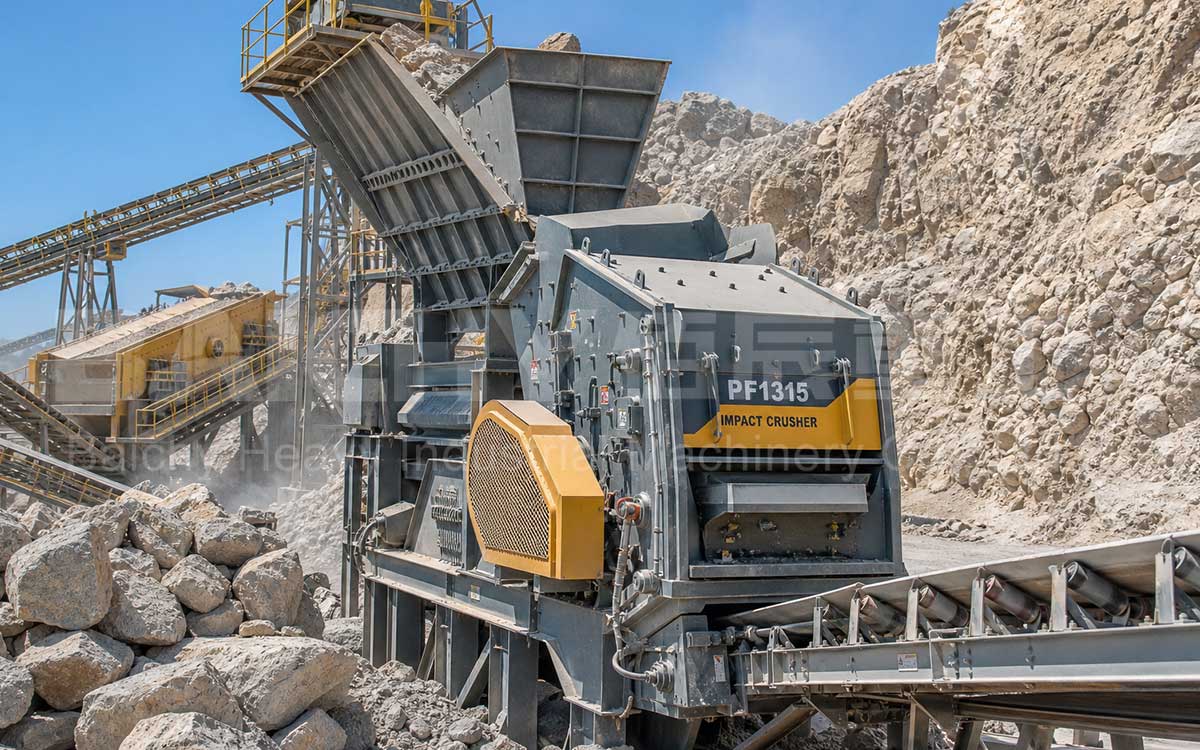
PF series Impact Crusher
For medium-soft materials such as limestone, gypsum, shale, and weathered rock, impact crushers or hammer crushers can complete secondary and fine crushing in a single stage; both equipment investment costs and electricity consumption per ton are lower than those of cone crusher-based systems. Hammer crushers offer the advantage of "single-stage shaping," simplifying the process flow; however, they experience rapid hammer wear when processing highly abrasive hard rock. Therefore, equipment selection must be based on material analysis data rather than relying solely on past experience.
2.4 VSI Sand-Making Machine and Roller Crusher: Fine Crushing, Shaping, and Specialized Applications
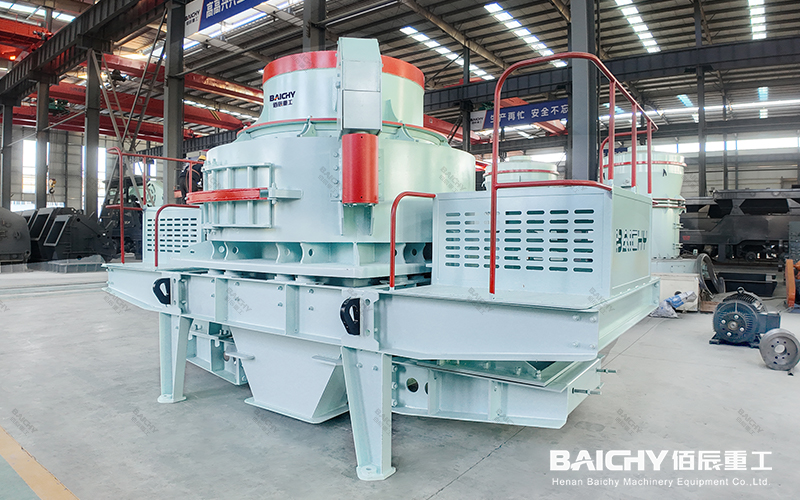
Sand Making Machine
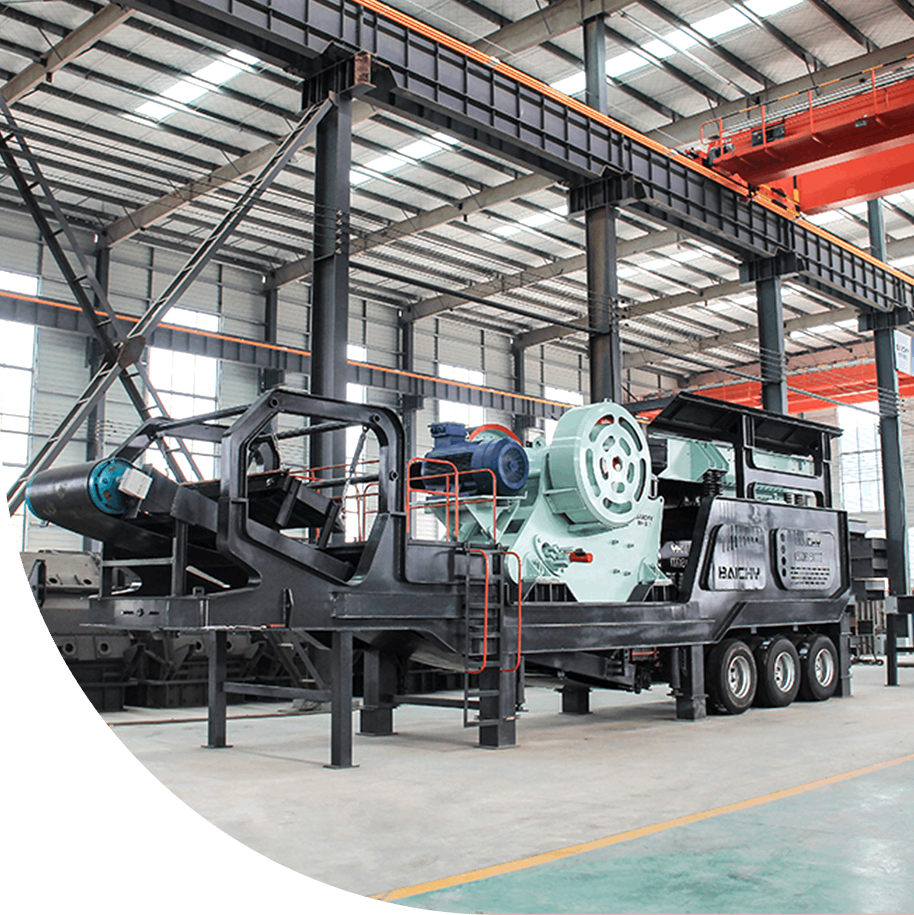
VSI (Vertical Shaft Impact) crushers are employed when there is a need for manufactured sand and particle shaping. Meanwhile, toothed-roll or double-roll crushers are commonly used for medium-soft, brittle materials like coal and coke, utilizing a shearing and splitting action to minimize the production of excessive fines. Mobile crushing stations mount the aforementioned primary crushing units onto wheeled or tracked chassis, enabling mining crushers to relocate and immediately commence production.
| Model Series | Crushing Principle | Suitable Materials (Mohs Hardness) | Feed Size (mm) | Discharge Size (mm) | Capacity (t/h) | Typical Application Stage |
|---|---|---|---|---|---|---|
| Jaw (PE/PEX/C90) | Compression | Hard to extremely hard rock (≤ Grade 7) | ≤1500 | 40–350 | 10–800 | Primary Crushing |
| Cone (CS/HP) | Inter-particle Crushing (Lamination) | Medium-hard to extremely hard rock (Grades 5–8) | ≤350 | 5–65 | 30–600 | Secondary/Tertiary Crushing |
| Impact (PF/PFW) | Impact | Medium-soft (≤ Grade 4) | ≤800 | 10–80 | 30–500 | Secondary Crushing/Shaping |
| Hammer (PC/PCH/PCK) | Impact-Shear | Medium-soft, brittle (≤ Grade 4) | ≤600 | 10–60 | 10–300 | Single-stage/Secondary & Tertiary Crushing |
| Roller (2PG/Toothed) | Compression/Shear | Medium-soft/brittle, wet/sticky | ≤800 | 25–200 | 10–300 | Primary/Secondary Crushing |
| VSI (Vertical Shaft Impact) | Rock-on-Rock/Rock-on-Metal | Medium-hard to hard rock shaping | ≤60 | 0–25 | 30–600 | Sand Making/Shaping |
III. Typical Application Scenarios for Mining Crushers
3.1 Metal Mines: Crushing hard rock such as gold, iron, and copper
Metal ore processing plants require the crushing stage to provide a stable feed to the grinding mills. Taking gold mines as an example, a common configuration involves Jaw Crushing (primary) + Cone Crushing (secondary/tertiary) + Ball Milling, reducing run-of-mine ore from hundreds of millimeters down to the required mill feed size. For high-capacity iron and copper mines, the number of crushing stages must be calculated based on dual metrics—crushing ratio and capacity—to prevent overloading inpidual units. Baichy provides comprehensive equipment lists covering the entire process flow—from crushing to flotation or magnetic separation—for operations such as CIL/CIP gold mines and magnetite processing.
3.2 Non-metallic minerals and sand/aggregate: Basalt, granite, and river pebbles
Production lines for basalt and granite aggregates demand high standards for particle shape and gradation; the mainstream solution is a closed-loop circuit comprising "jaw crusher + cone crusher (or impact crusher) + screening." Due to the high abrasiveness of river pebbles, a configuration of primary jaw crushing followed by cone crushing is generally recommended to minimize wear on impact crusher blow bars. In these scenarios, single-unit capacity is typically rated based on a limestone bulk density of 1.6 t/m³; adjustments based on density are required when processing denser ores to avoid a significant discrepancy between "nominal capacity" and "actual capacity."
3.3 Remote mining areas and mobile operations: Unstable power, frequent site relocation, and extreme cold
Mobile mining crushers offer a practical solution for scenarios lacking fixed infrastructure, such as advancing open-pit mines, material extraction along road construction routes, and small-to-medium-sized mining sites. Wheeled units facilitate road transport, while tracked units adapt to off-road conditions; pairing them with diesel generator sets eliminates reliance on the power grid. Specific operational conditions—such as power rationing by Eskom in South Africa, extreme cold (-30°C) in Russia, or 60Hz grids in Latin America—require careful selection of motor voltage/frequency (380V/400V/440V/660V; 50/60Hz) and hydraulic system low-temperature adaptability; Baichy offers customization for each of these parameters.
IV. Core advantages of Baichy mining crushers: Why choose Baichy?
1. Comprehensive process integration: A single package covers the entire "crushing–grinding–beneficiation" workflow. Baichy Heavy Industry manufactures jaw crushers, cone crushers, impact crushers, hammer crushers, VSI crushers, ball mills, Raymond mills, magnetic separators, flotation machines, and screening/washing equipment. Buyers avoid the hassle of coordinating with multiple vendors; a single supplier handles the selection, delivery, and commissioning of the entire line—from raw ore to concentrate—ensuring superior equipment compatibility and clearly defined after-sales responsibilities.
2. Design optimized for hard rock; predictable service life for wear parts. High-manganese steel jaw plates, a lamination crushing chamber, and a reinforced frame are designed for continuous mining operations; the jaw plates are reversible, keeping the per-ton cost of wear parts controllable. For mining sites where downtime translates directly into financial loss, this reliability is far more valuable than the lure of a low initial price.
3. Transparent capacity ratings, with nominal and actual figures listed separately. Ambiguous specifications are a major concern when purchasing mining crushers; here, throughput figures are based on a standard reference (limestone bulk density of 1.6 t/m³) and adjusted for other materials based on density. Configuration sheets including capacity calculations are provided during the selection phase to prevent the disappointment of discovering—after purchase—that the actual capacity is unclear or misunderstood.
4. Significant potential for optimizing electricity consumption per ton. By optimizing the crushing ratio distribution—following the "crush more, grind less" principle—the mill receives finer feed material. This typically results in lower overall power consumption compared to production lines that rely on inadequate crushing and force the mill to do the heavy lifting. For markets sensitive to electricity prices, this distinction is a critical factor in long-term operating costs.
5. Customization for specific operating conditions and comprehensive trial testing. Customizations are available for high-altitude derating, extreme cold (hydraulic systems), 60Hz electrical standards, and explosion-proof requirements. For new materials, the process supports material analysis followed by trial testing before the final order is signed, replacing verbal promises with hard data.
V. Technical Parameters for PE Series Mining Crushers (Jaw Crushers)
The table below lists typical specifications for Baichy's PE series. Processing capacity is rated based on a limestone bulk density of 1.6 t/m³; actual capacity varies depending on material hardness, moisture content, and discharge opening width.
| Model Series | Crushing Principle | Suitable Materials (Mohs Hardness) | Feed Size (mm) | Discharge Size (mm) | Single-Unit Capacity (t/h) | Typical Application Stage |
|---|---|---|---|---|---|---|
| Jaw (PE/PEX/C90) | Compression | Hard to extremely hard rock (≤ Grade 7) | ≤1500 | 40–350 | 10–800 | Primary Crushing |
| Cone (CS/HP) | Inter-particle Crushing (Lamination) | Medium-hard to extremely hard rock (Grades 5–8) | ≤350 | 5–65 | 30–600 | Secondary/Tertiary Crushing |
| Impact (PF/PFW) | Impact | Medium-soft (≤ Grade 4) | ≤800 | 10–80 | 30–500 | Secondary Crushing/Shaping |
| Hammer (PC/PCH/PCK) | Impact-Shear | Medium-soft, brittle (≤ Grade 4) | ≤600 | 10–60 | 10–300 | Single-stage/Secondary & Tertiary Crushing |
| Roller (2PG/Toothed) | Compression/Shear | Medium-soft/brittle, wet/sticky | ≤800 | 25–200 | 10–300 | Primary/Secondary Crushing |
| VSI (Vertical Shaft Impact) | Rock-on-Rock/Rock-on-Metal | Medium-hard to hard rock shaping | ≤60 | 0–25 | 30–600 | Sand Making/Shaping |
Selection Note: When crushing higher-density materials (such as iron ore), adjust the capacity using a density coefficient and verify the motor power margin. Motor voltage (380V/400V/440V/660V) and frequency (50/60Hz) can be customized according to project requirements. Please refer to the respective product pages for detailed specifications on cone crushers and impact crushers.
VI. Reference Cases for Mining Crusher Applications
Case 1: Basalt Airport Aggregate Project in Ethiopia. The client required basalt processing for airport concrete aggregate. The selected configuration—PE400×600 jaw crusher (primary crushing) + impact crusher (secondary shaping) + vibrating screen (closed-loop circuit)—achieved a throughput of approximately 40–60 t/h with a 380V/50Hz power setup. The final product met local concrete aggregate grading requirements, serving as a typical example of a small-to-medium capacity hard rock processing line.
Case 2: Mobile River Pebble Crushing Line in Venezuela. River pebbles are highly abrasive and the deposit sites are scattered. A tire-mounted mobile station (featuring a jaw crusher) was used for flexible site transitions, eliminating the need for fixed infrastructure; diesel generator sets were employed to handle power supply constraints. This "mobile primary crushing + on-site screening" approach kept processing costs within an acceptable range and aligned with local riverbed aggregate management strategies.
Case 3: Crushing Section Retrofit for a South African Gold Processing Plant. The plant supplied feed to the grinding section using a "jaw crusher (primary) + cone crusher (secondary/fine)" setup. To address frequent start-stop cycles caused by ESKOM power rationing, variable-frequency feeders and buffer bins were installed to minimize no-load impact on the main equipment. A ball mill was integrated with the CIL (Carbon-in-Leach) process section, creating a seamless end-to-end flow from crushing and grinding to leaching.
(The above represents typical configuration references based on similar projects; specific solutions require on-site material analysis and production line layout design.)
VII. Selecting Mining Crushers: Five Key Questions
Clearly answering the following five questions establishes a solid foundation for selecting the right mining crusher:
How hard and abrasive is the material? This determines the equipment family: for Mohs hardness above 5, a jaw crusher + cone crusher combination is preferred; for hardness below 5, impact crushers or hammer crushers may be considered.
What is the maximum feed particle size? This determines the feed opening dimensions—the opening must be larger than the maximum particle size to prevent chamber blockage.
What are the target output particle size and production capacity? These determine the number of processing stages and inpidual machine specifications; remember to adjust capacity calculations based on material density.
Are the moisture and clay content high? For wet, sticky materials, it is recommended to pair the jaw crusher with a vibrating feeder for pre-screening; for the fine crushing stage, avoid equipment models prone to clogging or material buildup.
Stationary or mobile? What are the power supply and climatic conditions? These factors determine the base design and any customizations needed for electrical systems, low-temperature operation, or high-altitude environments.
Submit these details to the manufacturer and request a written equipment selection proposal that includes production capacity calculations; this is far more reliable than any verbal recommendation.
VIII. Recommended Equipment Related to Mining Crushers
Configure equipment based on its position in the production line to create a complete "feeding—crushing—screening—grinding/beneficiation" chain:
Primary (Coarse) Crushing: PE/C90 Jaw Crusher (preferred for hard rock; models range from PE400×600 to PE1200×1500)
Secondary (Medium/Fine) Crushing: CS Cone Crusher / HP Multi-cylinder Hydraulic Cone Crusher (hard rock); PF Impact Crusher (medium-soft ore)
Sand Making & Shaping: VSI Vertical Shaft Impact Crusher (aggregate shape and manufactured sand)
Special Materials: Toothed Double-Roll Crusher (coal/coke/wet sticky materials); Double-Roll Crusher (fine, hard materials)
Mobile Applications: YDPZ Series Tire-mounted/Crawler-mounted Mobile Crushing Stations (for frequent site relocation or operations without permanent infrastructure)
Upstream Auxiliaries: ZSW Vibrating Feeder (uniform feeding and pre-screening); YK Circular Vibrating Screen (grading); Spiral Sand Washer and Dewatering Screen (wet processing stage)
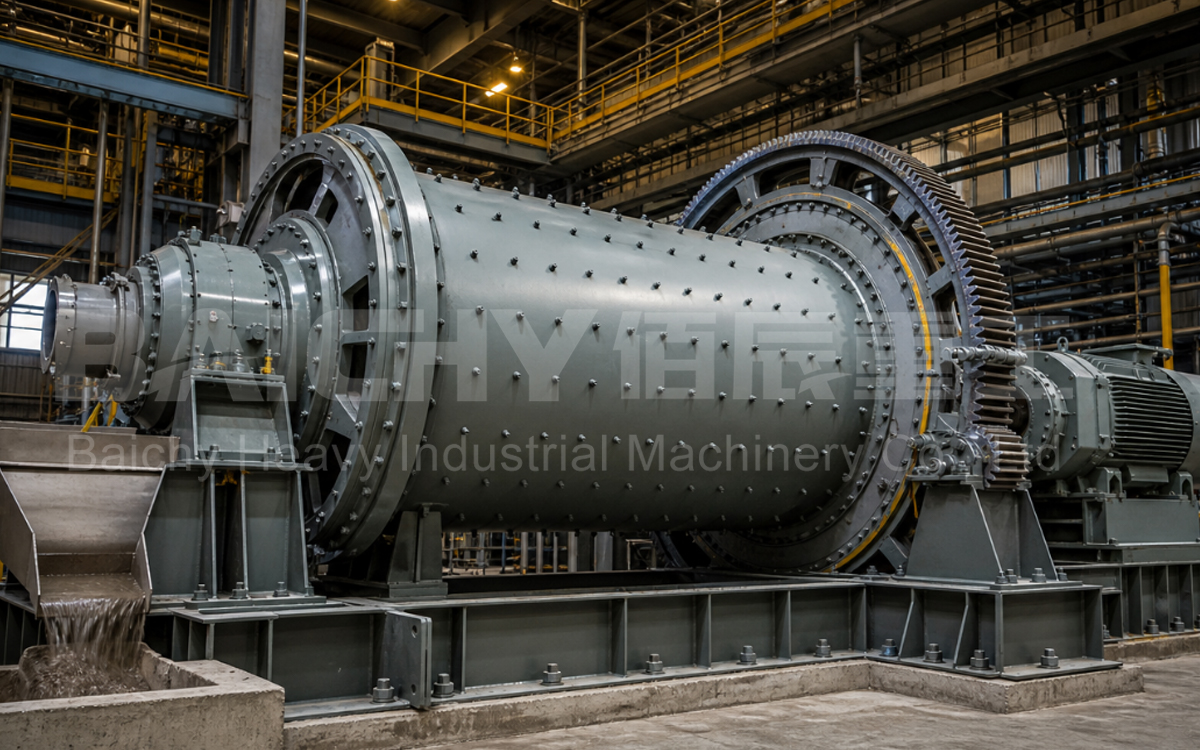
Downstream Grinding & Beneficiation: Ball Mill (overflow type/ceramic lining); Raymond Mill; Magnetic Separator and Flotation Machine (metal ore beneficiation)
IX. Mining Crusher FAQs
Q1: Is there a difference between mining crushers and standard aggregate crushers?
There is no fundamental difference in the core machinery types (jaw crushers, cone crushers, impact crushers, etc.); the distinction lies in the supporting system logic. Mining applications prioritize seamless particle size transitions and continuous feeding for downstream grinding and beneficiation processes. They also frequently face harsh operating conditions—such as high altitudes, extreme cold, and unstable power supplies. Consequently, equipment selection focuses on crushing ratio distribution, customized electrical systems, and spare parts availability, rather than merely comparing the price of inpidual units.
Q2: For hard rock, should I choose "jaw crusher + cone crusher" or "impact crusher + hammer crusher"?
It depends on hardness and abrasiveness. For hard rocks with a Mohs hardness above 5—such as granite, basalt, and iron ore—a "jaw crusher + cone crusher" configuration is mandatory, as impact plates and hammer heads cannot withstand highly abrasive materials. Conversely, for medium-soft materials like limestone and gypsum, impact or hammer crushers are suitable and offer lower investment costs and reduced electricity consumption per ton. Sending a material analysis report (covering compressive strength, abrasion index, and moisture content) to the manufacturer allows them to provide a preliminary recommendation within an hour.
Q3: Why does the nominal capacity of mining crushers differ from the actual output?
Most manufacturers rate capacity based on a limestone bulk density of 1.6 t/m³ and a specific discharge opening width. Actual capacity drops when crushing dense materials like iron ore or when the discharge opening is narrowed; conversely, loose materials may result in higher-than-rated output. To keep the discrepancy within expected limits, ask the manufacturer to provide a capacity calculation table adjusted for your specific material and include a trial run clause in the agreement.