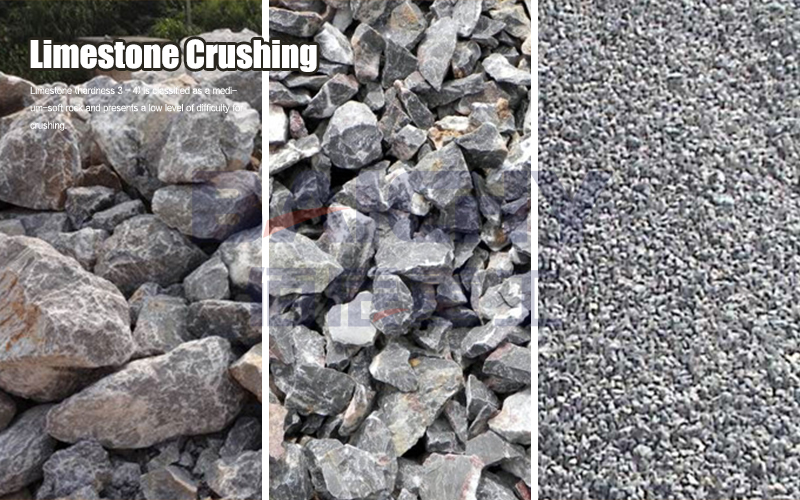
Limestone (hardness 3–4) is classified as a medium-soft rock
Limestone (hardness 3–4) is classified as a medium-soft rock, making it relatively easy to crush. Based on your specific requirements, equipment selection primarily depends on the feed size, target output, and the intended use of the finished product (whether for aggregate production or manufactured sand).
I. Quick Reference Guide for Mainstream Equipment Selection
| Equipment Type | Crushing Stage | Key Features | Applicable Scenarios |
| Jaw Crusher | Primary Crushing | Simple structure, large feed opening (≤1200mm), wear-resistant | The "first gateway" of a production line; processes large blocks of raw ore |
| Impact Crusher | Secondary/Tertiary Crushing | Excellent particle shape (predominantly cubical), low energy consumption; sensitive to wet or sticky materials | Production of construction aggregates; secondary crushing where specific finished particle shapes are required |
| Hammer Crusher | Single-Stage Crushing | Produces finished product in a single pass; streamlined process, low investment cost | Small-to-medium-sized cement or lime plants; suitable for dry materials where low initial investment is a priority |
| Cone Crusher | Secondary/Tertiary Crushing | Highly wear-resistant, high production capacity; however, particle shape is generally poorer (more flaky/elongated particles) | Large-scale continuous production; scenarios involving hard rocks where extreme wear resistance is required |
| Vertical Shaft Impact Crusher (VSI) | Tertiary Crushing/Sand Making | Specialized shaping capabilities; produces manufactured sand with excellent gradation | Production of high-quality manufactured sand or final shaping/finishing of aggregates |
II. Classic Production Line Configuration Schemes
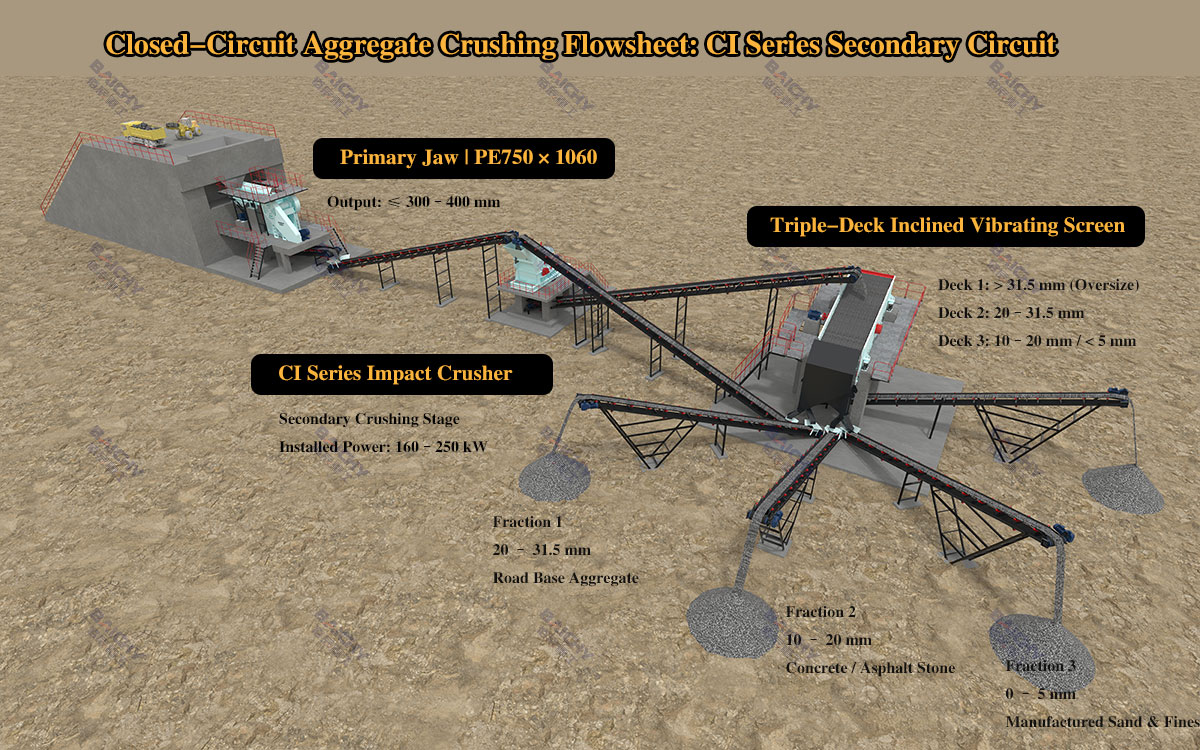
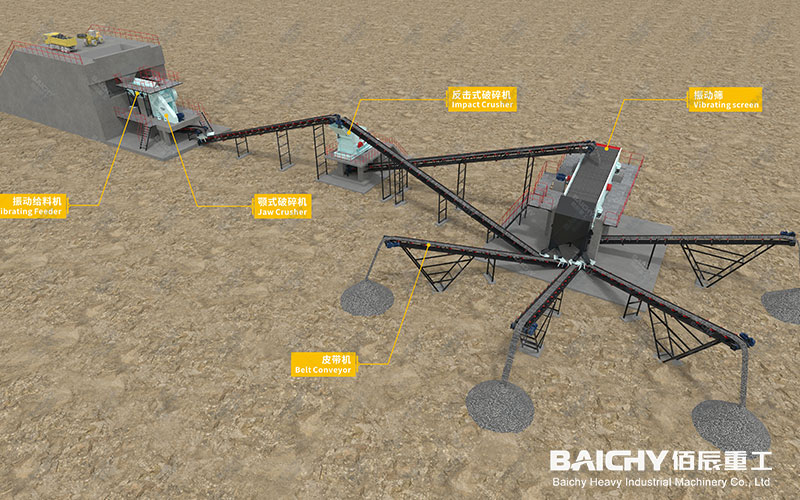
1. Standard Aggregate Line (Recommended): "Jaw Crusher + Impact Crusher"
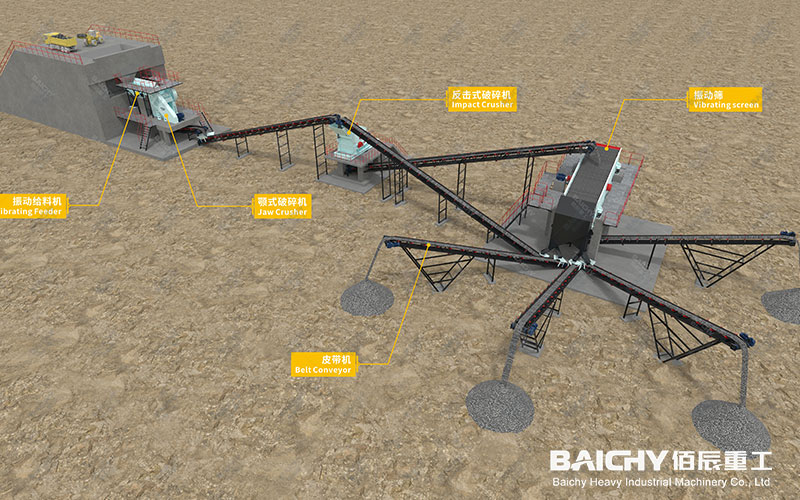
Jaw Crusher + Impact Crusher
This is the most mature and proven configuration. The jaw crusher handles primary crushing, while the impact crusher performs secondary/tertiary crushing and refines the particle shape. It is ideal for producing high-quality aggregates for construction—such as standard-grade crushed stone—and offers excellent overall cost-effectiveness.
2. Simple & Economical Line: "Single-Stage Hammer Crusher"
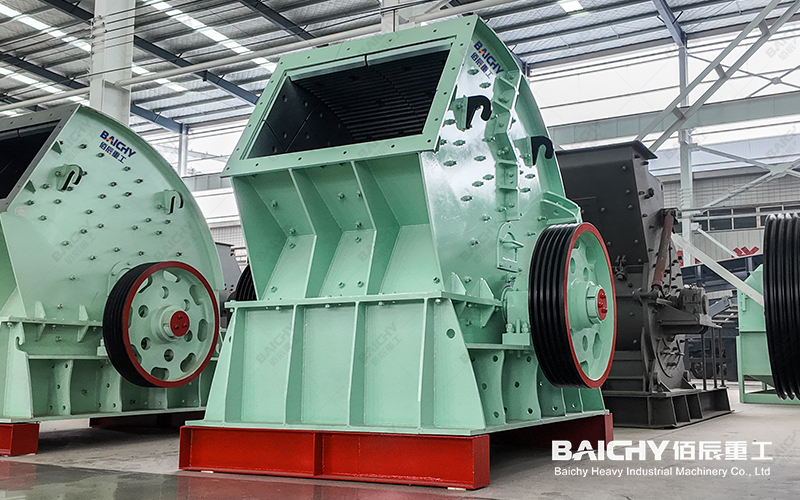
Heavy Hammer Crusher
If the raw material size is relatively small (≤600mm) and the moisture content is low, a single heavy-duty hammer crusher can directly produce the finished product. The advantages include fewer machines, a smaller footprint, and lower investment costs; however, the disadvantages include rapid wear of the hammer heads and a susceptibility to clogging when processing wet materials.
3. Full-Specification Sand Production Line: "Jaw Crusher + Impact Crusher + Vertical Shaft Impact (VSI) Crusher"
If you require both crushed stone and manufactured sand, a VSI sand-making machine must be added to the downstream end of the aggregate line to produce manufactured sand with excellent gradation.
III. Key Selection Guide: Avoiding Common Pitfalls
• Moisture is a "Killer": If the limestone feedstock has a high moisture content (or contains a significant amount of clay/mud), the use of impact crushers or hammer crushers is strictly prohibited, as they are highly prone to clogging. For wet material scenarios, priority should be given to jaw crushers or cone crushers.
• Particle Shape Determines Value: If the final product is intended for high-grade concrete or asphalt paving, particle shape is critical; therefore, an impact crusher or a VSI shaper must be included in the configuration. If the material is intended merely for roadbed sub-base layers—where particle shape requirements are less stringent—a more wear-resistant cone crusher may be selected instead.
• Wear Part Costs: The blow bars/hammers in hammer crushers and impact crushers experience relatively rapid wear (typically requiring replacement every few months); thus, for long-term operations, the cost of spare parts must be factored into the overall calculation. In contrast, the jaw plates in jaw crushers offer a relatively longer service life.
If you can provide specific details regarding your feed size, target output capacity (t/h), and desired finished product specifications, I can recommend a more precise and tailored configuration solution for you.
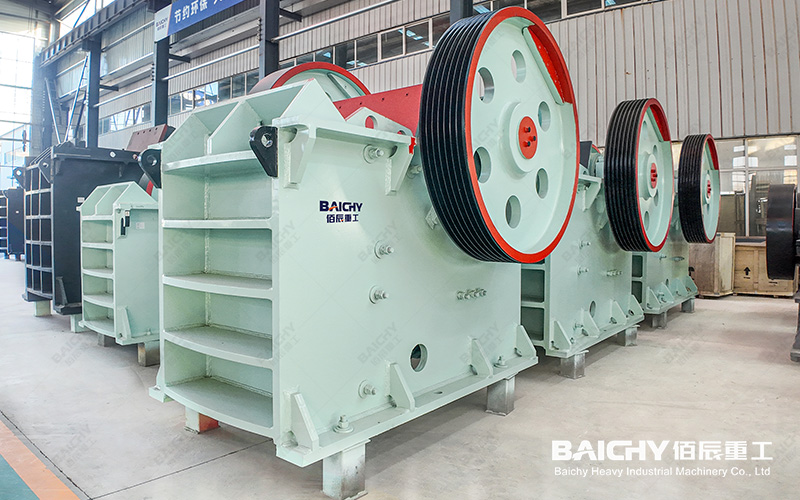
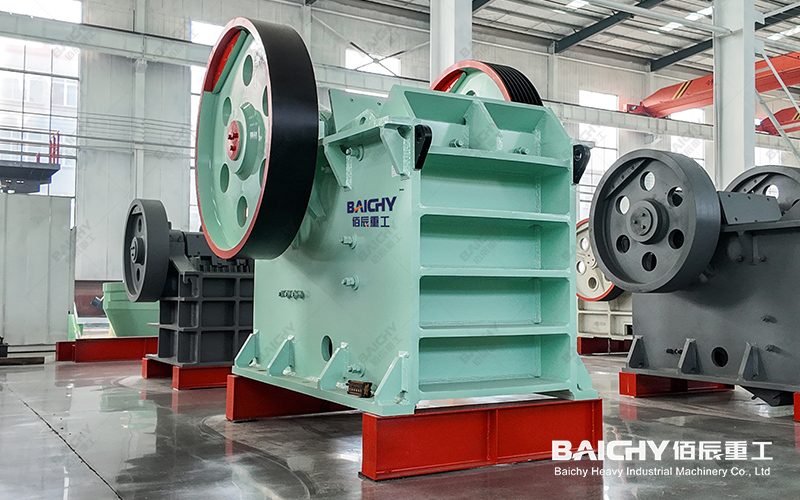
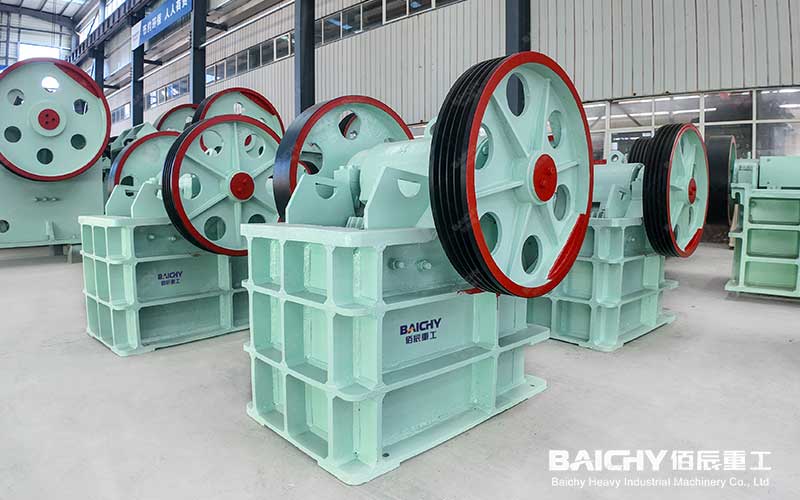
Jaw Crusher For Crushing Limeatone
Frequently Asked Questions (FAQ)
1: When crushing limestone, should I choose a jaw crusher, an impact crusher, or a hammer crusher? Which configuration offers the best cost-performance ratio?
Answer: Limestone (with a Mohs hardness of 3–4) is classified as a medium-soft rock. The core factors to consider when selecting the appropriate equipment are the raw material's particle size, moisture content, and the intended application of the finished product.
Preferred for Coarse Crushing (Large Lumps): Jaw Crusher. Featuring a large feed opening (up to 1200 mm) and a robust structure, the jaw crusher serves as the "first line of defense" in the production line, making it ideal for processing large blocks of limestone fresh from the quarry.
Preferred for Fine Crushing/Aggregates (Superior Particle Shape): Impact Crusher. If the finished product is intended for commercial concrete or high-standard construction aggregates, the impact crusher produces the best particle shape (cubic/cuboidal) and offers relatively lower energy consumption.
Note: If the limestone feedstock has a moisture content exceeding 10% or contains a significant amount of clay/mud, exercise caution when using an impact crusher (as it is prone to clogging). Economical Solution (Single-Stage Crushing): Hammer Crusher. If the raw material size is relatively small (≤600mm) and dry, a single-stage hammer crusher can directly produce finished products, offering the lowest equipment investment and a simple process flow.
Classic Configuration: For standard aggregate plants with an hourly output exceeding 200 tons, the combination of a "Jaw Crusher + Impact Crusher" represents the "golden combination" with the highest overall cost-effectiveness.
2: How should limestone crushing equipment be configured for hourly outputs of 100 tons, 200 tons, and 500 tons? What are the approximate costs?
Answer: Capacity configuration must be determined in conjunction with the number of crushing stages required. The following are common reference schemes (prices represent approximate equipment ranges only and do not include civil works or installation costs):
| Target Output | Recommended Configuration Scheme | Core Equipment List (Example) | Estimated Equipment Investment (USD 10,000s) |
| 100 t/h | Simple & Economical | Heavy-Duty Hammer Crusher (Single-Stage) | 5 - 10 |
| 200 t/h | Standard Aggregate Plant | Jaw Crusher (PE600×900) + Impact Crusher (PF1214) | 15 - 25 |
| 500 t/h | Large-Scale Production Line | Jaw Crusher + Multiple Impact Crushers (or) Large Cone Crusher | 40 - 70 |
• Note: Actual prices are significantly influenced by factors such as brand (domestic vs. imported), motor configuration, and the level of automation. The price of mobile crushing stations is typically 30% to 50% higher than that of stationary crushing plants.
3: How often do the wear parts (blow bars/hammer heads) of a limestone crusher need to be replaced? Are the maintenance costs high?
Answer: Although limestone is not considered an extremely hard material, it still causes wear and tear on consumable parts.
• Replacement Cycle: Taking the blow bars of a commonly used impact crusher as an example: under normal operating conditions for crushing limestone, the service life is typically between 300 and 600 hours. If the raw material contains siliceous (SiO2) impurities, the rate of wear will accelerate. The service life of hammer heads in a hammer crusher is generally shorter.
• Maintenance Costs: The primary maintenance cost for both impact crushers and hammer crushers stems from the replacement of blow bars and hammer heads. Based on an annual limestone processing volume of 100,000 tons, the cost of wear parts accounts for approximately 15% to 20% of the total production cost. It is recommended to keep a spare set of wear parts on-site and to select high-chromium alloy materials to extend their service life.
• Routine Maintenance: Focus on monitoring bearing temperatures (<70°C) and the lubrication system; check the tightness of all bolts during every shift.
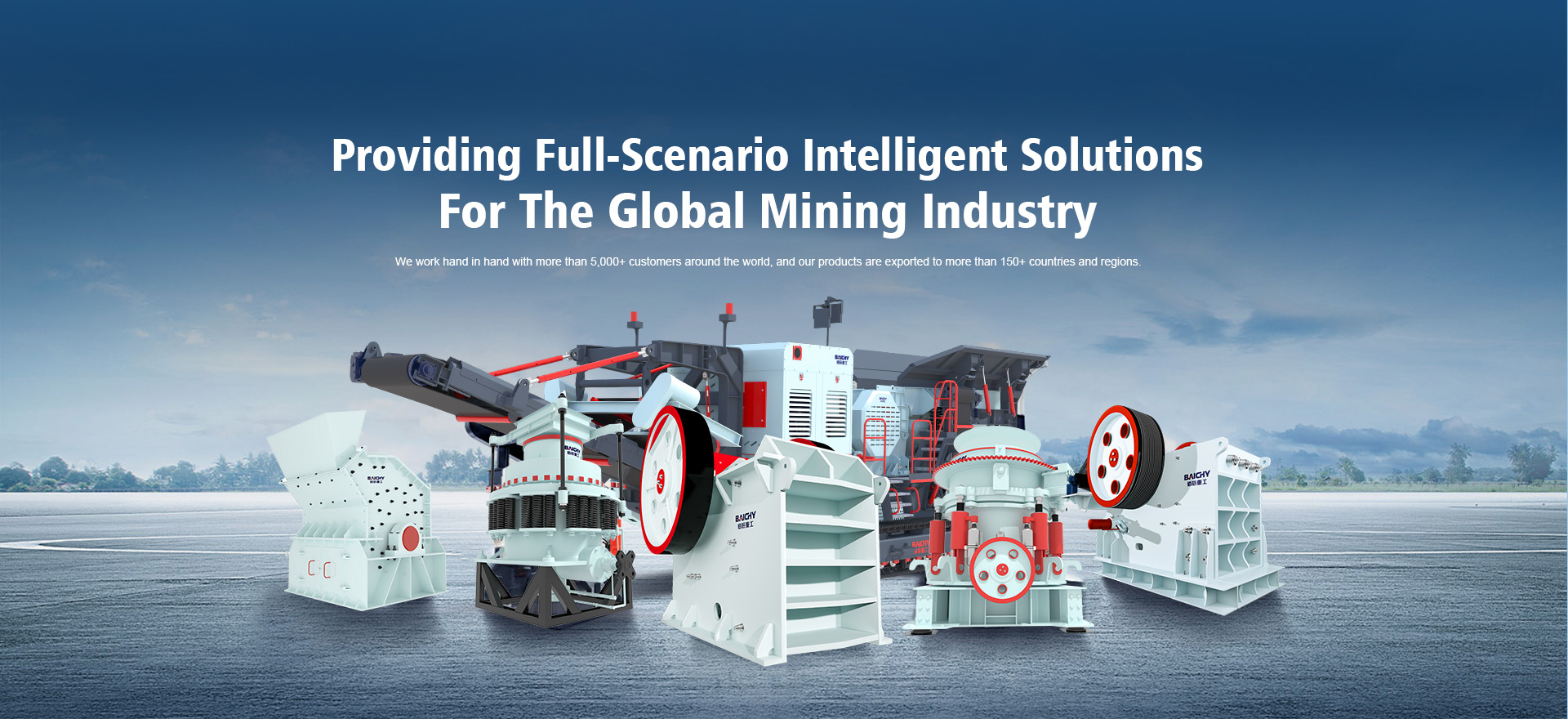
About of Baichy Heavy Industry
Baichy Heavy Industry is a high-tech mining equipment company integrating R&D, manufacturing, sales, and after-sales service. Focusing on crushing, grinding, and mineral processing equipment, we provide professional solutions to our customers. We are ISO9001:2015 、certified, and our products include mobile crushing palnts, crawler crushing plant, construction waste crushing plants, jaw crushers, sand making machines, cone crushers, fine crushers, grinding mills, ball mills, etc., all with reliable performance to meet diverse project needs.
Our advantages:
• Professional pre-sales support: Free project design and comprehensive solutions to help you accurately select the right equipment;
• Comprehensive on-site service: Providing installation guidance and worker training to ensure smooth equipment commissioning;
• Reliable after-sales guarantee: A complete after-sales system, timely response to technical inquiries and equipment maintenance, ensuring long-term stable operation.
To protect your rights, please contact us through the following official channels for professional service:
Official Website Customer Service
https://wa.me/+8615093222637
Email: [email protected]
We are committed to providing high-quality equipment and full-cycle services to deliver comprehensive intelligent solutions for the global mining industry!