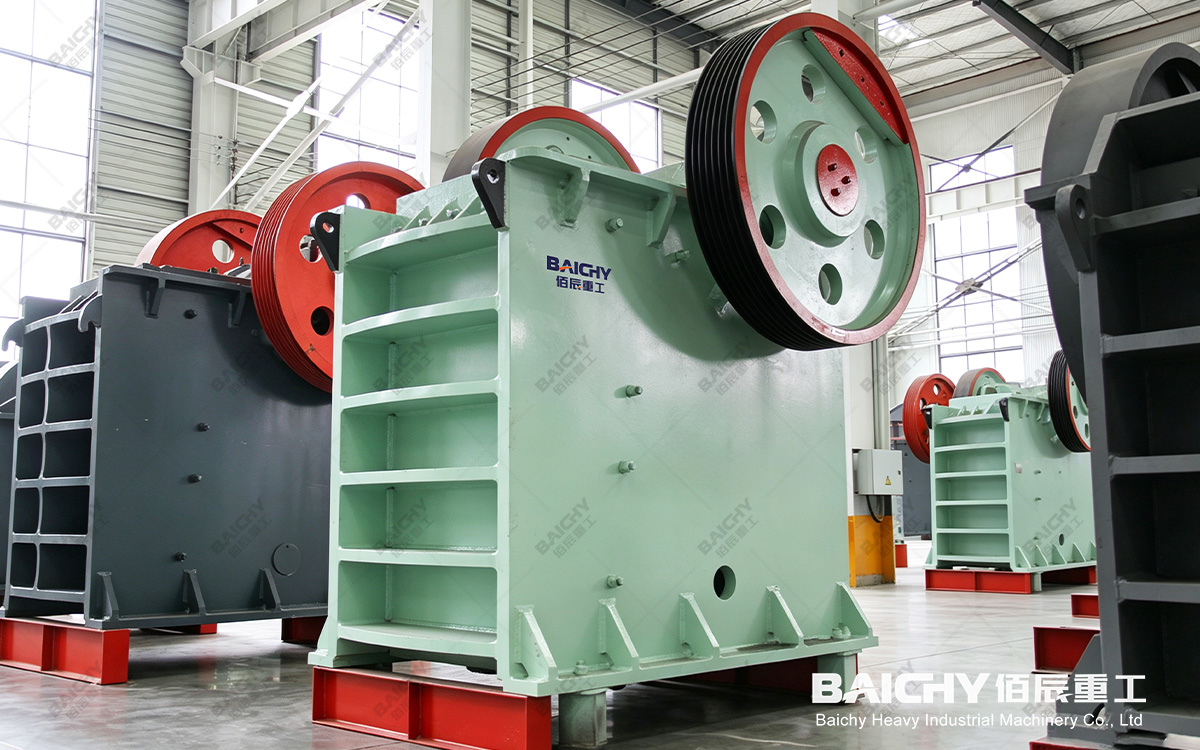
Jaw Crushers for Concrete
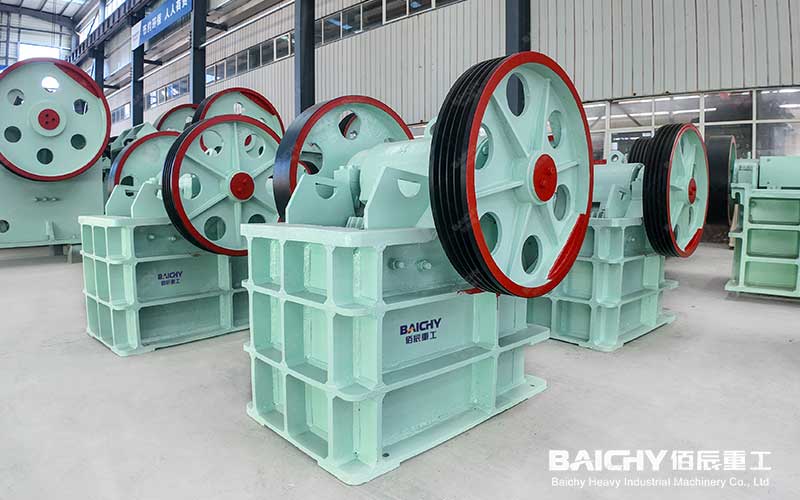
A jaw crusher designed for concrete is specialized equipment—featuring a jaw crusher as the primary unit—geared toward the coarse crushing of concrete and brick-concrete waste; it serves as the standard initial stage in global production lines for recycled construction aggregate. While the compressive strength of demolished concrete typically ranges from 20 to 60 MPa (C20–C60), its tensile strength is merely one-tenth of that value. The jaw crusher’s mechanism of compression and splitting specifically exploits this mechanical weakness; consequently, a jaw crusher processing concrete can achieve an actual throughput 1.2 to 1.5 times higher than its rated capacity for hard rock, while experiencing less wear on the jaw plates. For projects with an annual processing capacity of 100,000 tons, the combined revenue streams (savings on disposal fees plus aggregate sales) typically result in a static payback period of 1 to 1.5 years.
I. Overview: Why the Jaw Crusher is Essential for Concrete Crushing
Jaw crushers designed for concrete operate on the same principle as general-purpose mining jaw crushers: a movable jaw plate periodically compresses a stationary jaw plate, exerting pressure to split the material. However, concrete processing involves three often-underestimated characteristics that make the jaw crusher indispensable:
1. Mechanical Compatibility: Concrete’s tensile strength is only one-tenth of its compressive strength, making it easier for tensile stress cracks—generated by compression—to propagate. Additionally, its bulk density (2.2–2.4 t/m³) is lower than that of hard rock; for the same power input, throughput is higher, resulting in increased rather than decreased capacity.
2. Rebar Tolerance: Jaw crushers handle rebar by bending and squeezing it out rather than cutting it, ensuring no damage to the jaw plates under normal operating conditions. This capability—which impact crushers and cone crushers lack—makes the jaw crusher the only safe choice for the primary crushing of reinforced concrete.
3. Industry Validation: The EU’s construction waste recycling rate approaches 90% (Eurostat), and the US EPA estimates that concrete accounts for nearly two-thirds of total construction and demolition waste. In contrast, my country generates over 2 billion tons of construction waste annually, yet the resource utilization rate remains below 5% (according to Ministry of Housing and Urban-Rural Development figures). "Primary jaw crushing + iron removal + secondary crushing/shaping + screening" is a standard process chain that has been widely adopted globally for over two decades.
In short: for any project involving concrete processing, the first piece of equipment is almost invariably a jaw crusher designed for concrete—tasked with "swallowing and crushing" demolition waste to transform it into semi-finished material ready for further processing.
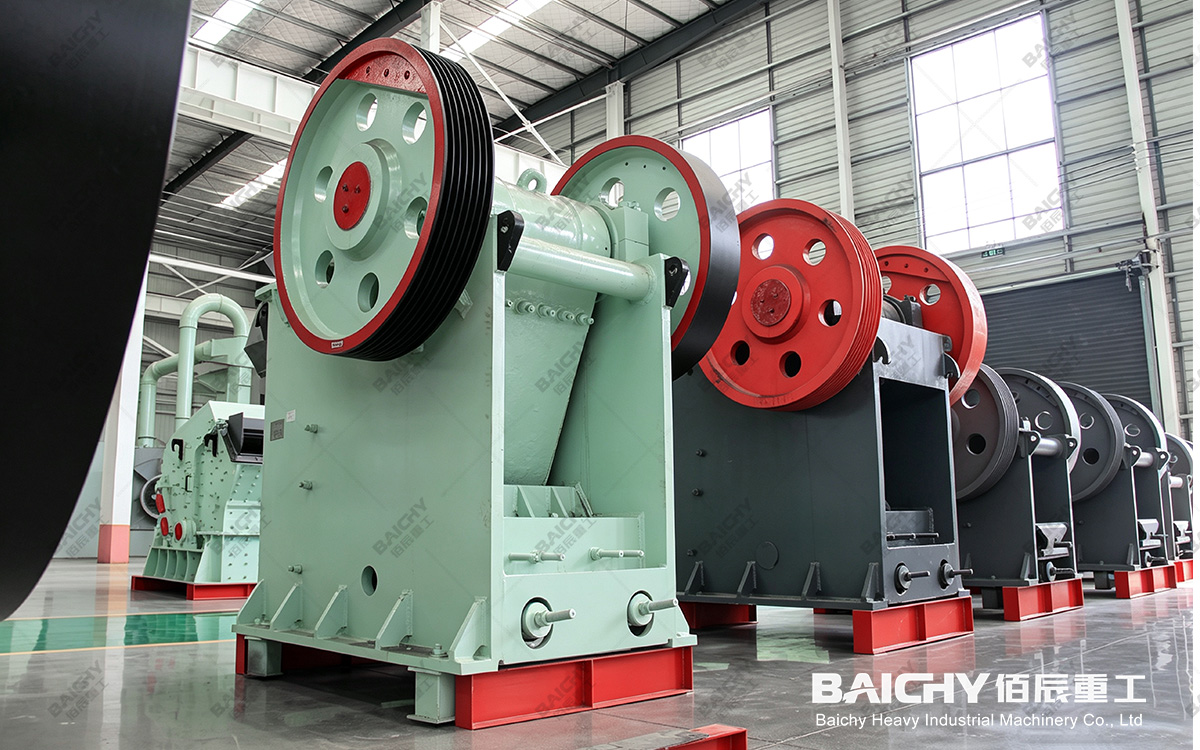
concrete crushing equipment
II. Typical Application Scenarios for Concrete Jaw Crushers
2.1 Urban Construction Waste Recycling Centers
These centers centrally receive demolition waste from across the city. The jaw crusher serves as the core unit for primary crushing, working alongside magnetic iron removal, impact crushing (for shaping), and multi-stage screening to create a production line that supplies recycled aggregates consistently. This scenario features the clearest subsidy policies and the most mature business models, making it the primary market for stationary jaw crushers.
2.2 Waste Reuse at Ready-Mixed Concrete Plants and Precast Component Factories
Leftover concrete, test cubes, and waste components are crushed on-site, with the resulting recycled aggregates reused in low-grade concrete, bedding layers, or masonry blocks. Transforming waste—which would otherwise incur transport costs—into valuable production raw materials represents an application with minimal investment and rapid returns.
2.3 Road and Bridge Renovation
Demolished materials from old concrete road surfaces and bridge decks are centrally crushed into graded aggregates (0–50 mm) for reuse in roadbed base layers. This process has been proven over two decades in Europe and the US; for projects with tight schedules or dispersed material sources, mobile jaw crushing stations allow for on-site primary crushing, eliminating the need to transport all debris off-site.
2.4 On-Site Crushing at Demolition Sites
For short-term projects such as urban village redevelopment or factory demolition, mobile jaw crushing stations eliminate the need for concrete foundations and allow for immediate production upon arrival. Crushing proceeds alongside demolition, with aggregates used on-site for backfilling or bedding layers, or sold externally—effectively turning a "disposal cost" into a "revenue stream." III. Six Key Advantages of Jaw Crushers for Concrete
• High tolerance for rebar and low failure rate: The compression-based crushing action naturally handles foreign objects like rebar and bolts; the failure rate is far lower than that of impact or cone crushers, making it the only safe choice for the primary crushing of reinforced concrete.
• Increased throughput: Due to concrete's lower density and abrasiveness, throughput for a given model is 1.2–1.5 times the rated capacity for hard rock; jaw plate lifespan extends by 20%–40%, simultaneously reducing spare part costs.
• Flexible, adjustable output: The discharge opening is easily adjustable, allowing output sizes of 40–200 mm to be set as needed for direct feeding into secondary crushers or for immediate sale.
• Lower cost per ton: Electricity consumption and wear-part costs per ton are lower than those of mobile stations or impact crushers; in long-term stationary operations, the comprehensive cost per ton is 20%–30% lower.
• Rugged durability and high resale value: The PE series is the world's most widely used primary crusher model, featuring readily available parts, low maintenance requirements, and high residual value.
• Excellent scalability: Seamlessly integrates with iron removers, impact crushers, vibrating screens, and mobile stations, allowing for expansion into a complete recycling production line as needed.
IV. Core Specifications: Baichy Jaw Crusher Selection Chart for Concrete Applications
| Baichy Model | Feed Opening (mm) | Max. Feed Size (mm) | Discharge Opening Adjustment Range (mm) | Concrete Processing Capacity (t/h)* | Main Motor (kW) | Typical Applications |
|---|---|---|---|---|---|---|
| PE400×600 | 400×600 | 340 | 40–100 | 25–60 | 30 | Small-scale disposal stations; auxiliary equipment for commercial concrete plants |
| PE500×750 | 500×750 | 425 | 50–130 | 45–100 | 55 | Medium-scale resource recovery lines; road recycling stations |
| PE600×900 | 600×900 | 500 | 65–160 | 70–180 | 75 | 100 t/h class processing centers |
| PE750×1060 | 750×1060 | 630 | 80–200 | 120–280 | 110 | Large-scale disposal sites; 200 t/h class production lines |
*Note: Based on demolished concrete with a compressive strength of 30–45 MPa and minor rebar content; capacity is 1.2–1.5 times the rated capacity for hard rock, varying with discharge opening settings and debris/soil content; final specifications are subject to the Baichy factory configuration sheet.
V. Relevant Case Study and Cost-Benefit Analysis
Case Study: Municipal Road Renovation Project in a South China City (Mobile On-site Crushing + Recycling/Reuse)
Application Conditions: Approx. 100,000 tons of material from demolished old concrete pavement; compressive strength C30–C50; contains minor amounts of dowel bar rebar and soil debris.
Configuration: YDPZ mobile jaw crushing station for on-site primary crushing + self-discharging magnetic separator + mobile screening station; crushed material used directly for the project's roadbed base layer (no off-site transport).
Calculation basis (typical values for a Tier-2 city): Production capacity of 80 t/h; single 10-hour shift per day; project duration of approximately 130 working days (road renovation is a short-term project); aggregate yield of approximately 80%:
| Metric | Value |
|---|---|
| Annual concrete processing volume | Approx. 100,000 tons |
| Annual recycled aggregate (graded material) output | Approx. 80,000 tons |
| Savings on spoil removal/disposal costs (at 25 RMB/t) | Approx. 2.5 million RMB/year |
| Value of reused recycled aggregate (at 30 RMB/t) | Approx. 2.4 million RMB/year |
| Equipment & ancillary investment (mobile station + iron removal + screening) | Approx. 4–6 million RMB |
| Static payback period | Approx. 1–1.5 years |
Conclusion: Using a mobile jaw crusher for concrete transforms project disposal costs into aggregate value, with a payback period of approximately 1–1.5 years. Upon project completion, the equipment can be relocated to the next site—an asset mobility advantage that fixed production lines lack.
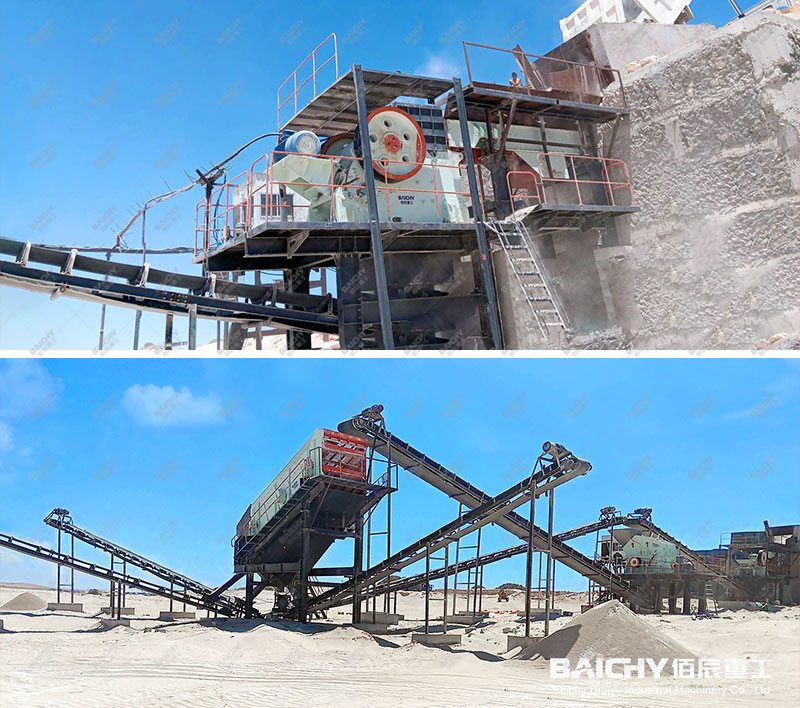
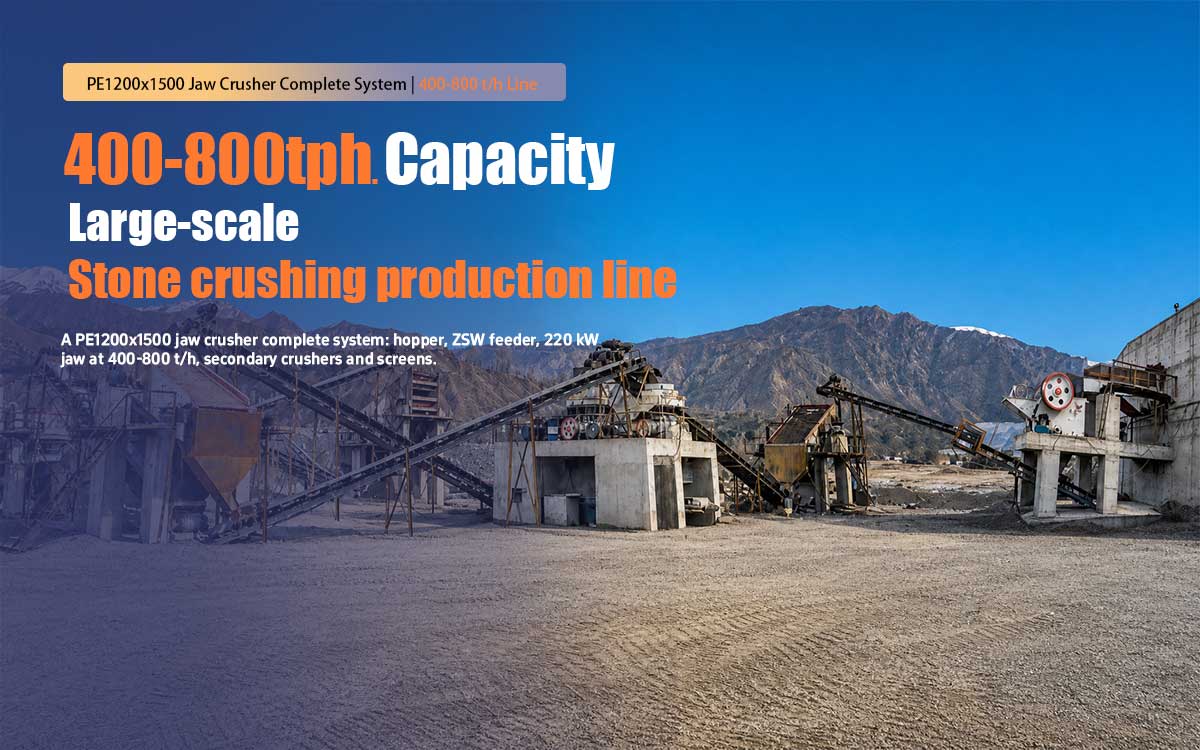
Concrete Crushing Production Line
VI. Recommended Equipment (Complete Recycling Line Setup)
Primary crushing is merely the first step; Baichy offers complete construction waste recycling line solutions:
• PF Series Impact Crusher: Handles secondary crushing and shaping of jaw crusher output, producing high-quality cubic aggregates (0–40 mm);
• Self-discharging/Permanent Magnet Iron Remover: Separates rebar and wire, protecting secondary crushing and screening equipment—essential for concrete processing applications;
• 2YK/3YK Vibrating Screen: Performs multi-stage screening (0–5, 5–10, 10–31.5 mm) for direct truck loading and sales;
• ZSW Vibrating Feeder (with grizzly bars): Pre-screens fine spoil materials to prevent clogging the jaw crusher chamber;
• YDPZ Mobile Jaw Crushing Station: An alternative to fixed plants for short-term projects and multi-site rotation scenarios; requires no foundation and allows for immediate production upon arrival.
VII. FAQ
Q1: How does a jaw crusher designed for concrete differ from a standard mining jaw crusher?
While the core machine structure is the same, the configuration differs to suit specific needs. The concrete-specific setup focuses on three enhancements: thicker wear-resistant liners in the crushing chamber to withstand abrasion from rubble and rebar; a larger feed opening to accommodate reinforced concrete beams and columns; and integration into a "crushing–iron removal–screening" system featuring a magnetic separator and vibrating screen. If you already own a mining-grade jaw crusher, you can usually adapt it for concrete processing simply by installing an iron separator and adjusting the discharge opening.
Q2: How is the jaw crusher's output converted into marketable recycled aggregate?
The jaw crusher's output (40–200 mm) is merely a semi-finished product; downstream processes—specifically "iron removal → impact crushing for shaping → multi-stage screening"—are required. Magnetic separation removes rebar; an impact crusher reshapes flaky material into cubical particles; and a vibrating screen classifies the product into sizes such as 0–5 mm, 5–10 mm, and 10–31.5 mm. The output from a complete line is comparable to natural aggregate; however, if the product is intended solely for roadbed base material, a combination of jaw crushing and screening suffices.
Q3: What is the investment cost for a concrete jaw crushing line, and what is the payback period?
A small stationary line (PE400×600 crusher + iron separator + screen) costs approximately 0.8–1.5 million RMB; a complete 100 t/h capacity recycling line costs about 6–9 million RMB; and a mobile single-unit station costs around 4–6 million RMB. The payback period depends on processing volume and dual revenue streams (savings on waste disposal fees + aggregate sales revenue). For a project with an annual capacity of 100,000 tons, the payback period is typically 1–1.5 years, a timeframe that can be further shortened if resource recovery subsidies are included.
Baichy Heavy Industry
Baichy Heavy Industry is a high-tech mining equipment company integrating R&D, manufacturing, sales, and after-sales service. Focusing on crushing, grinding, and mineral processing equipment, we provide professional solutions to our customers. We are ISO9001:2015 、certified, and our products include mobile crushing palnts, crawler crushing plant, construction waste crushing plants, jaw crushers, sand making machines, cone crushers, fine crushers, grinding mills, ball mills, etc., all with reliable performance to meet diverse project needs.
Baichy Heavy Industry – Your Trusted Partner
To ensure optimal performance of your equipment, Baichy Heavy Industry offers:
- Professional on-site installation guidance
- Comprehensive operator training
- 24/7 technical support & maintenance services
Our complete after-sales service system guarantees long-term, stable operation of your machinery with minimal downtime.
Protect Your Rights – Only Use Official Channels
To avoid scams and ensure authentic support, contact us exclusively through:
• Official Website: www.baichychina.com
• WhatsApp: +8615093222637
• Email: [email protected]
Your satisfaction is our priority – expect prompt, professional service every time.
(Note: Beware of unauthorized third parties claiming to represent Baichy. Always verify through official contacts.)