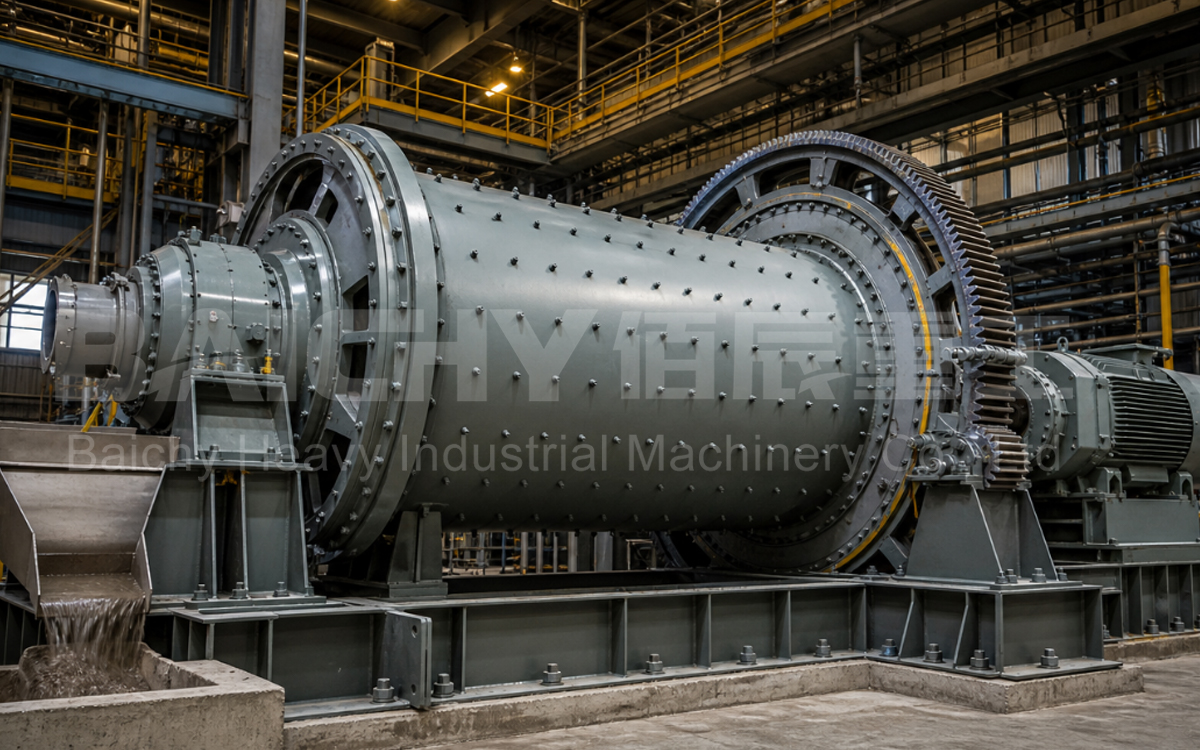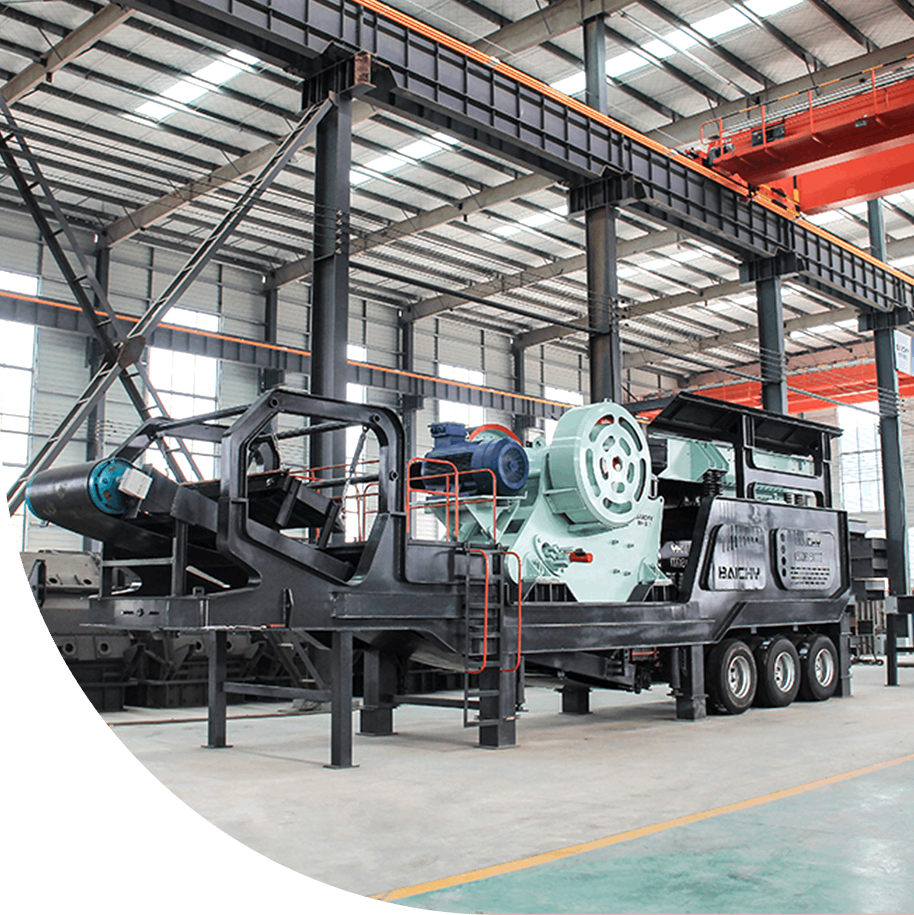

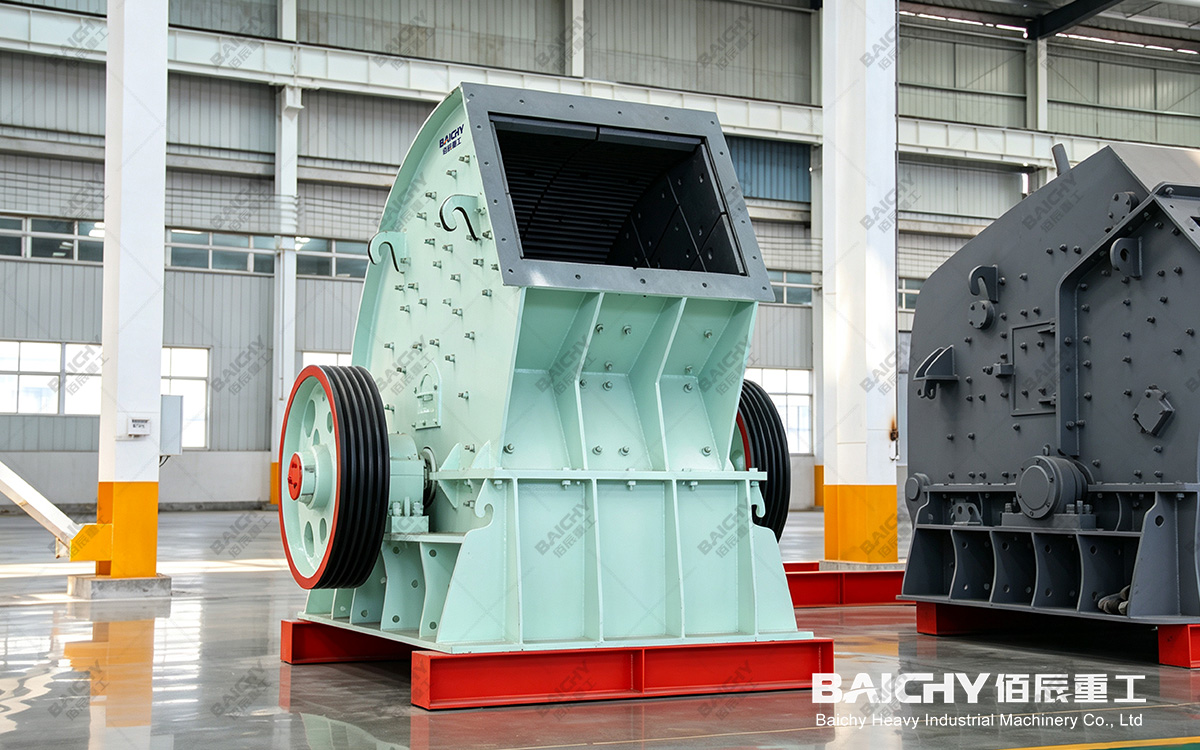
Heavy-duty hammer crusher
Why the Heavy-Duty Hammer Crusher Offers the Best TCO for Primary Crushing
If your raw materials—such as limestone, dolomite, gypsum, coal gangue, or construction waste—have a compressive strength of no more than 200 MPa, the heavy-duty hammer crusher represents the most cost-effective "single-stage" solution available today. It accepts feed sizes up to 1000 mm and allows the output to go directly to screening, effectively condensing the traditional two-stage "jaw crusher + impact crusher" process into a single-machine operation. This reduces total investment by approximately 40% and cuts electricity consumption per ton by over 40%. The bottom line: for materials of low to medium hardness (up to 200 MPa compressive strength), the cost per ton using a heavy-duty hammer crusher is lower than that of any two-stage crushing configuration.
I. What is a Heavy-Duty Hammer Crusher?
The heavy-duty hammer crusher (PCZ series) consists of a heavy-duty rotor, high-chromium hammer heads, impact liners, and a grate screen. Upon entering the crushing chamber, large stones are shattered by the impact of high-speed rotating hammers; the material then strikes the impact liners for secondary breakage before the final output size is regulated by the grate screen. Compared to standard hammer crushers, heavy-duty models feature larger rotor diameters and heavier hammer heads, allowing for larger feed sizes (up to 1000 mm) and higher reduction ratios (exceeding 20:1)—achieving the desired product size in a single pass.
Comparison with the Two-Stage Jaw Crusher + Impact Crusher Process
| Comparison Item | Heavy-Duty Hammer Crusher | Two-Stage (Jaw + Impact) |
|---|---|---|
| Number of Machines | 1 | 2 |
| Crushing Stages | Single-stage | Two-stage |
| Feed Size | ≤1000 mm | ≤1200 mm (Jaw Crusher) |
| Civil Works & Conveying Investment | Low | High (requires extra feeding/conveying/buffer bin) |
| Electricity Consumption per Ton | >40% Lower | Baseline |
| System Failure Points | Few | Many |
| Material Hardness Suitability | ≤200 MPa | ≤200 MPa (Impact Crusher stage) |
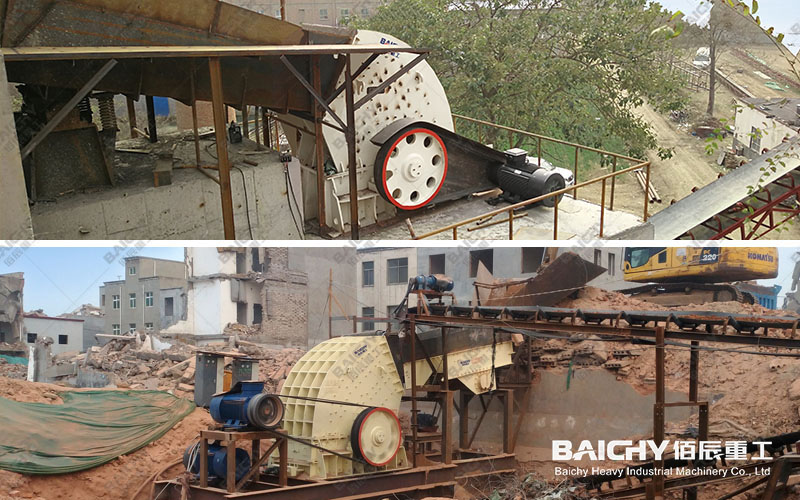
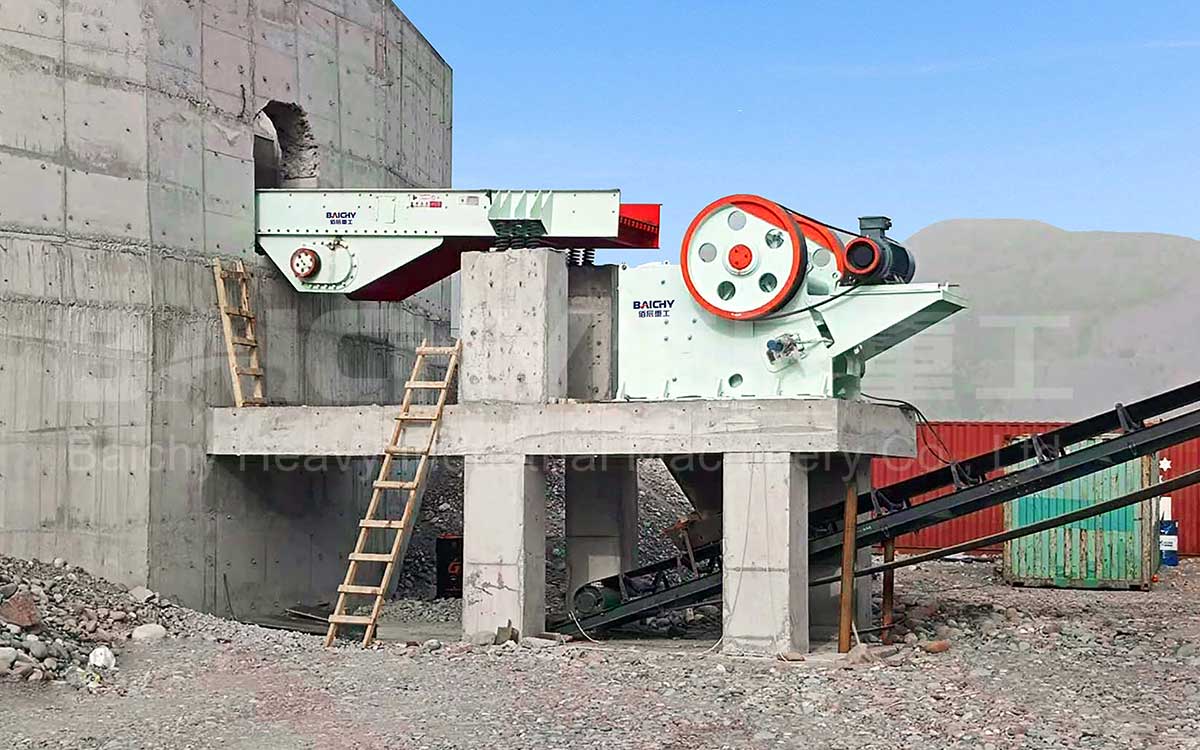
Customer site featuring a heavy-duty hammer crusher
II. Application Scenarios for Heavy-Duty Hammer Crushers
1. Sand and Aggregate Production Lines
Manufactured sand and aggregate production represents the largest market for heavy-duty hammer crushers. Limestone and dolomite mines typically employ a "single-stage crushing" approach using heavy-duty hammer crushers. The output (adjustable to 0–40mm) is fed directly into circular vibrating screens for classification. This simple yet high-capacity configuration is ideal for large-scale aggregate production lines (100–3000 t/h) and is the preferred primary crusher for new projects at major sand and gravel plants.
2. Limestone Crushing for Cement Plants
Cement raw meal mills are sensitive to feed particle size. A single heavy-duty hammer crusher can reduce raw ore (≤1000mm) to the required output size (≤75mm) in one step, replacing the traditional combination of jaw and impact crushers. Widely used in energy-saving retrofitting projects for cement plants both domestically and internationally, these crushers consistently boost the hourly output of raw meal mills following installation.
3. Construction Waste Recycling
Mobile heavy-duty hammer crusher units can crush demolition concrete and brick-concrete waste into recycled aggregates in a single pass. Their high reduction ratio and ability to produce well-shaped particles perfectly meet the requirements for recycled aggregates, making them a mainstream primary crushing solution for urban solid waste disposal and circular economy projects.
4. Auxiliary Crushing for Mines, Power Plants, and Desulfurization
Applications involving coal gangue, gypsum, and limestone preparation for power plant desulfurization also benefit from the heavy-duty hammer crusher's low power consumption and single-stage processing capabilities. They can be directly linked to grinding mills to create an integrated crushing-and-grinding workflow.
III. Core Advantages of Heavy-Duty Hammer Crushers
1. Single-Stage Processing Eliminates Secondary Crushing
A single unit handles both primary and secondary crushing, eliminating the need for an additional impact crusher, an intermediate conveyor belt, and a buffer hopper. This reduces both system investment costs and the required footprint, resulting in a more compact production line layout.
2. Over 40% Electricity Savings
The combination of a high-inertia rotor and an efficient crushing chamber design results in significantly lower electricity consumption per ton compared to two-stage crushing systems. For a 200 t/h limestone production line, annual electricity cost savings can reach hundreds of thousands of yuan, demonstrating clear advantages for long-term operation.
3. Large feed size and high reduction ratio
Accommodates a maximum feed size of 1000mm with a reduction ratio exceeding 20:1; allows for relaxed blasting granularity requirements and the potential elimination of grizzly screens, thereby reducing primary blasting costs.
4. Excellent product shape
Produces angular, cubical particles with minimal flaky material, meeting the strict aggregate shape requirements for projects such as highways and bridges; suitable for direct use in commercial concrete plants.
5. Compact structure and low civil engineering costs
Features a modular design with a compact footprint and minimal foundation requirements; ideal for expansion or renovation projects with space constraints, helping to shorten construction timelines.
6. Easy maintenance and long-lasting wear parts
Equipped with high-chrome alloy hammers and replaceable liners, along with an external oil pump lubrication system (featuring automatic shutdown protection for high oil temperatures); ensures quick hammer replacement, high spare part interchangeability, and reliable supply.
IV. Technical Parameters of PCZ Series Heavy-Duty Hammer Crusher
| Model | Rotor Diameter × Length (mm) | Feed Opening (mm) | Feed Particle Size (mm) | Capacity (t/h) | Motor Power (kW) |
|---|---|---|---|---|---|
| PCZ1308 | Φ1330×790 | 870×780 | ≤380 | 60–160 | 132 |
| PCZ1410 | Φ1400×1000 | 1060×740 | ≤450 | 80–210 | 2×90 |
| PCZ1610 | Φ1600×1000 | 1090×930 | ≤480 | 100–230 | 2×132 |
| PCZ1612 | Φ1600×1200 | 1340×1140 | ≤500 | 120–350 | 2×160 |
| PCZ1615 | Φ1600×1500 | 1570×1140 | ≤550 | 200–550 | 2×200 |
| PCZ1716 | Φ1700×1600 | 1420×1200 | ≤600 | 400–850 | 2×250 |
| PCZ1720 | Φ1700×2000 | 2030×1200 | ≤650 | 500–1000 | 2×400 |
| PCZ1920 | Φ1900×2000 | 1980×1210 | ≤750 | 800–1500 | 2×500 |
| PCZ2225 | Φ2200×2500 | 2530×1610 | ≤1000 | 1500–3000 | 1250 |
Capacity values refer to limestone conditions (density ≈ 1.6 t/m³). For harder or wetter materials (moisture ≤ 15%), actual capacity may be reduced. Customized configurations are available upon request.
Note: Production capacity is rated based on limestone (bulk density: 1.6 t/m³); capacity is adjusted downward if material hardness is higher or moisture content is greater (recommended ≤15%). Specific configurations can be customized; the actual process design prevails.
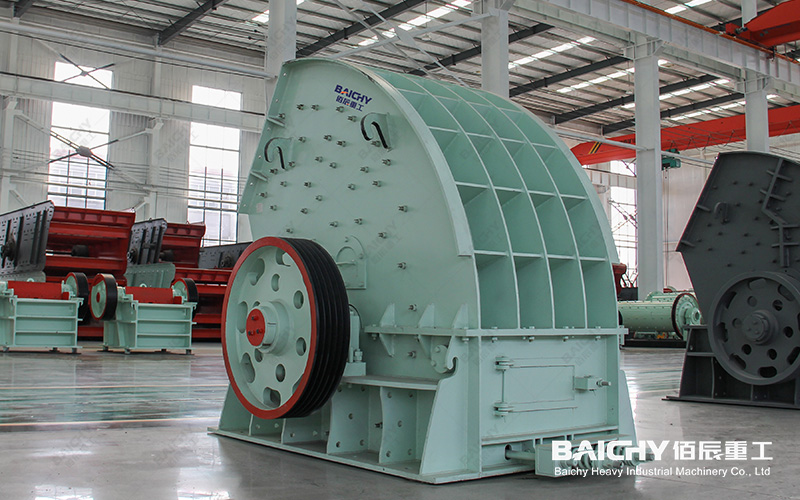
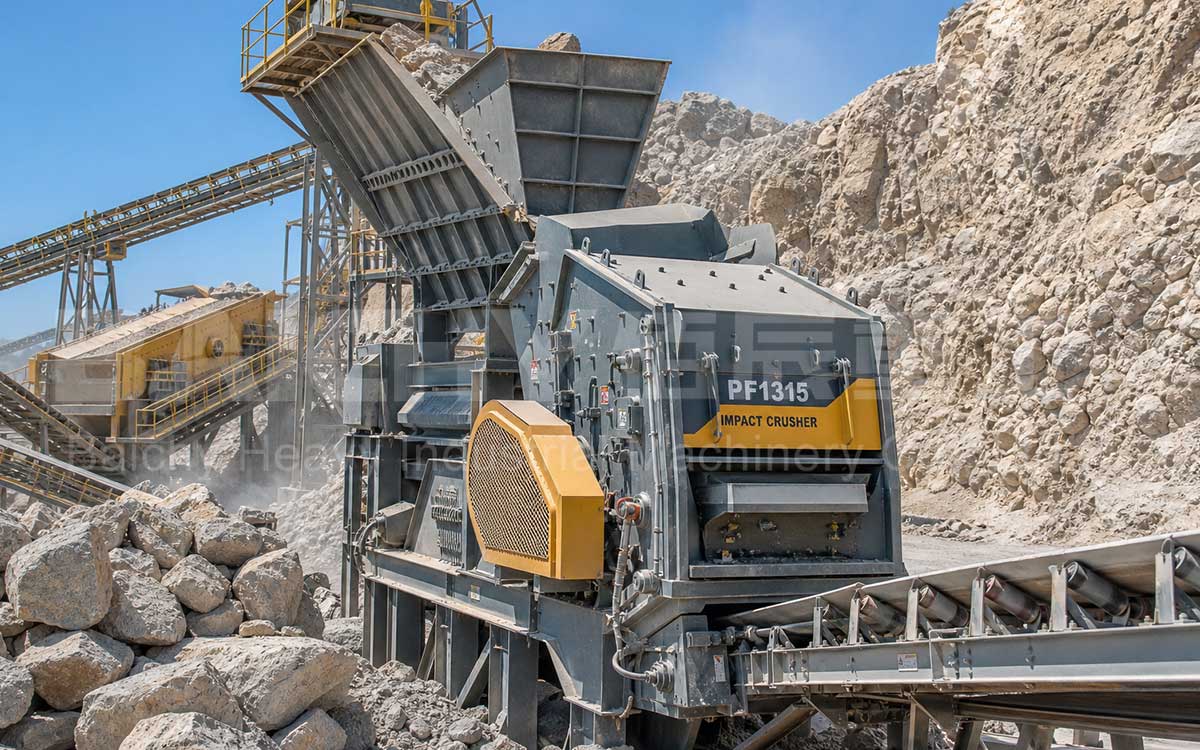
PCZ heavy-duty hammer crusher
V. Application Case Studies
Case 1: 1,000 t/h limestone aggregate line; single-stage reduction using a heavy-duty hammer crusher
Configuration: ZSW600×130 vibrating feeder + PCZ1920 heavy-duty hammer crusher + YK3070 circular vibrating screen. Run-of-mine ore (≤750 mm) is fed directly into the hammer crusher; output (≤75 mm) is sent for screening; final products are three aggregate sizes: 0–5 mm, 5–15 mm, and 15–31.5 mm. Compared to a jaw crusher + impact crusher setup of the same capacity, total investment is reduced by approximately 40%, and electricity consumption per ton drops by about 35%.
Case 2: 200 t/h mobile construction waste processing unit
Configuration: Wheeled mobile station equipped with a PCZ1615 heavy-duty hammer crusher + iron remover + double-deck vibrating screen. Demolition concrete blocks (containing rebar) undergo iron removal and are crushed in a single stage into recycled aggregate for on-site backfilling or brick making, eliminating off-site disposal costs; the project payback period is generally under two years.
Case 3: Limestone crushing system upgrade for a cement plant
The original two-stage crushing system had reached its capacity limit. After upgrading to a PCZ1720 heavy-duty hammer crusher, the single-unit capacity reached 500–1,000 t/h with a stable output size of ≤65 mm. The feed particle size for the raw meal mill became uniform, and hourly production increased by approximately 8%–10%.
VI. Recommended Related Equipment
Heavy-duty hammer crushers are typically integrated into complete production lines with the following equipment; Baichen Heavy Industry offers comprehensive solutions and process designs:
ZSW Series Vibrating Feeder: Ensures uniform feeding and buffers material impact to protect the crusher chamber;
YK/GTS Series Circular Vibrating Screen: Performs graded screening to precisely control the particle size of the finished product;
Impact Crusher: Used for downstream shaping (e.g., for high-grade concrete projects); see the impact crusher product page for details;
Jaw Crusher: An alternative for the primary crushing of high-hardness materials; see the jaw crusher product page for details;
VSI Sand-Making Machine: Used for sand making and shaping to improve the quality of fine aggregates;
Pulse Bag Dust Collector: Ensures compliance with environmental emission standards;
Raymond Mill/Ball Mill: Suitable for limestone powder production (e.g., for power plant desulfurization or calcium carbonate powder); can be directly linked with the heavy-duty hammer crusher.
VII. Selection Recommendations
Check Hardness and Moisture Content: The operational limits for heavy-duty hammer crushers are a compressive strength of ≤200 MPa and a moisture content of ≤15%; if these limits are exceeded, a jaw crusher plus cone crusher configuration is recommended;
Select Based on Peak Capacity: Allow a 10%–15% margin when selecting capacity to prevent clogging and downtime during peak operation;
Consider Output Particle Size Requirements: If there is a high demand for fine material, choose a model with smaller grate bar spacing or add downstream shaping equipment;
Calculate Total Cost of Ownership (TCO): Hammer heads and liners are the primary wear parts; choosing high-chrome alloy materials and ensuring local spare parts availability results in lower long-term operating costs.
VIII. Frequently Asked Questions (FAQ)
Q1: Can heavy-duty hammer crushers crush granite or basalt?
They are not suitable for direct use with high-hardness materials. Heavy-duty hammer crushers are designed for materials with low-to-medium hardness (compressive strength ≤200 MPa), such as limestone, dolomite, gypsum, coal gangue, and construction waste. For materials with hardness exceeding 200 MPa—such as granite or basalt—a jaw crusher plus cone crusher configuration is recommended; otherwise, hammer heads will wear out too quickly, leading to uncontrolled costs.
Q2: What is the service life of the hammers in a heavy-duty hammer crusher?
It depends on the material's abrasiveness and moisture content, as well as the hammer material. When crushing limestone, high-chromium alloy hammers typically last 3–6 months (corresponding to an output of approximately 100,000–200,000 tons); however, the service life is significantly shorter when crushing construction waste or materials with high silica content. The hammers are reversible to maximize utilization, and Baichen provides genuine spare parts to ensure a reliable supply.
Q3: How does a heavy-duty hammer crusher differ from standard hammer crushers and impact crushers?
Standard hammer crushers accept smaller feed sizes (generally ≤300mm) and are limited to medium-to-fine crushing. Impact crushers accept feed sizes up to 500mm and produce good particle shapes but have a limited reduction ratio. Heavy-duty hammer crushers fall between the two: they accept feed sizes up to 1000mm and achieve product specifications in a single pass. Acting as a "large-scale primary crusher" that replaces a two-stage crushing setup, they offer the lowest overall operating costs.
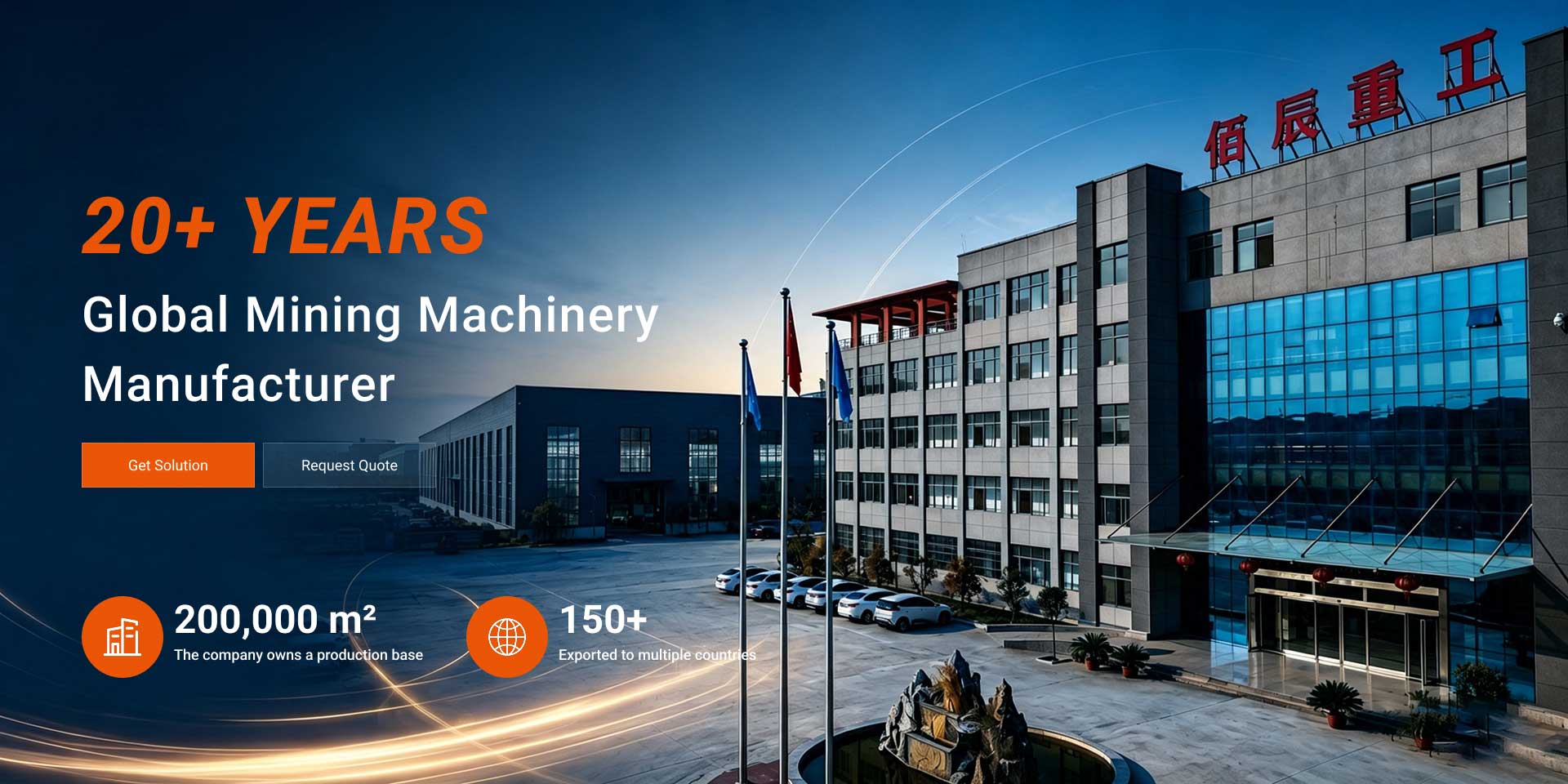
Baichy Heavy Industry
Baichy Heavy Industry is a high-tech mining equipment company integrating R&D, manufacturing, sales, and after-sales service. Focusing on crushing, grinding, and mineral processing equipment, we provide professional solutions to our customers. We are ISO9001:2015 、certified, and our products include mobile crushing palnts, crawler crushing plant, construction waste crushing plants, jaw crushers, sand making machines, cone crushers, fine crushers, grinding mills, ball mills, etc., all with reliable performance to meet diverse project needs.
Baichy Heavy Industry – Your Trusted Partner
To ensure optimal performance of your equipment, Baichy Heavy Industry offers:
- Professional on-site installation guidance
- Comprehensive operator training
- 24/7 technical support & maintenance services
Our complete after-sales service system guarantees long-term, stable operation of your machinery with minimal downtime.
Protect Your Rights – Only Use Official Channels
To avoid scams and ensure authentic support, contact us exclusively through:
• Official Website: www.baichychina.com
• WhatsApp: +8615093222637
• Email: [email protected]
Your satisfaction is our priority – expect prompt, professional service every time.
(Note: Beware of unauthorized third parties claiming to represent Baichy. Always verify through official contacts.)