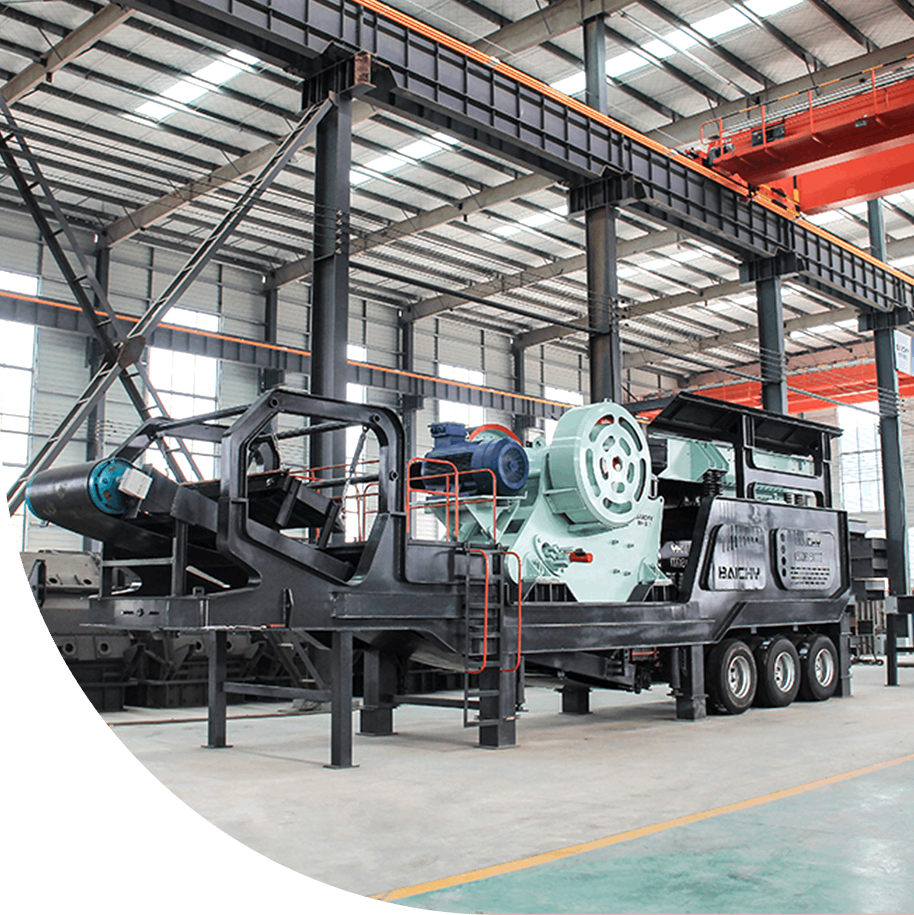

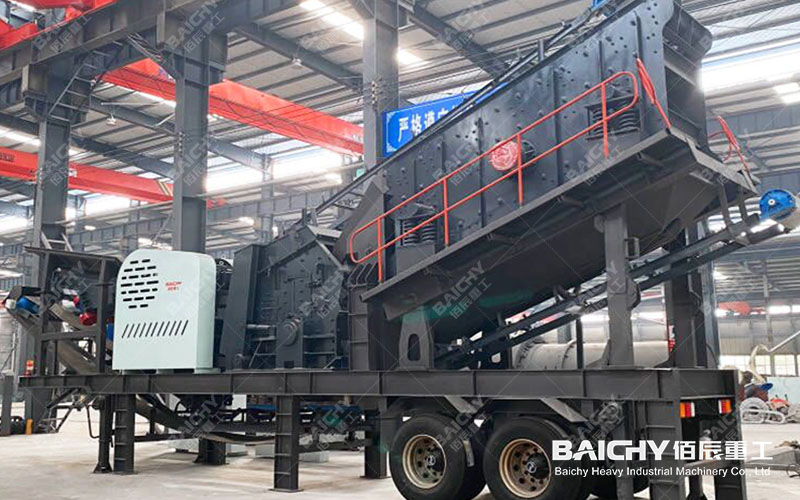
4-in-1 mobile crushing station
The "four-in-one" mobile crushing station integrates four process stages—feeding, primary crushing, secondary crushing, and screening—onto a single mobile chassis. It eliminates the need for concrete foundations, steel structure installation, and lengthy commissioning; the system can be fully integrated and operational within 24 hours of arrival, resume production within one day of relocation, and achieve an all-in cost of approximately ¥3.1 per ton. If your project lasts less than three years, involves multiple work sites, or lacks stable power and infrastructure, this equipment offers a higher return on investment (ROI) than a stationary production line.
I. Pain Point Analysis: Why Complete Production Lines Often Fail
The three major pitfalls of stationary production lines:
1. Infrastructure costs drain cash flow — A stationary crushing line with a 150 tph (tons per hour) capacity requires a total investment of ¥250,000–¥400,000 for concrete foundations, steel platforms, and anchor bolt embedding, with a construction period of 15–30 days. These investments yield zero residual value when the project ends.
2. Relocation halts operations — Moving a stationary line requires dismantling, foundation preparation, re-installation, and commissioning, resulting in 10–20 days of downtime per move. Based on a daily output of 1,200 tons and a gross profit of ¥15 per ton, the loss from a single relocation shutdown amounts to approximately ¥180,000–¥360,000.
3. Mismatch between approval timelines and production windows — The approval process for mining licenses and environmental impact assessments often outpaces production line construction, or the line is completed just as the mine nears closure. Completed lines sit idle, while the cost of tied-up capital accumulates at an annualized rate of 6–8%.
Hidden costs of standalone mobile stations:
Assembling a line on-site using two or three independent mobile stations (e.g., jaw crusher, impact crusher, and screening station) may appear flexible but actually incurs three hidden losses:
① Inter-unit transfer requires connecting conveyors and intermediate stockpiles, leading to double handling of materials;
② Poor feeding continuity causes main units to frequently idle, resulting in an actual capacity 15–20% lower than the rated capacity;
③ Independent electrical controls for each unit necessitate on-site electricians for system integration, extending the commissioning period to 3–7 days. The four-unit mobile crushing station solves this problem at the source: the four units undergo complete assembly and commissioning at the factory, so on-site operations require only "connecting power, test-running, and feeding material."
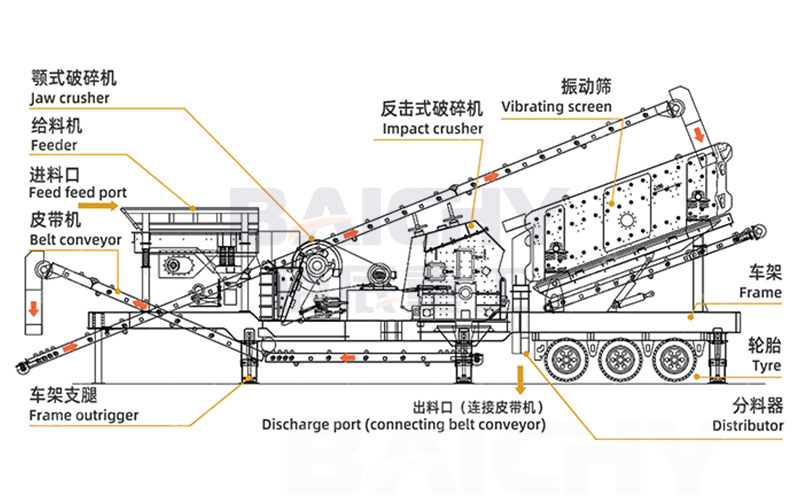
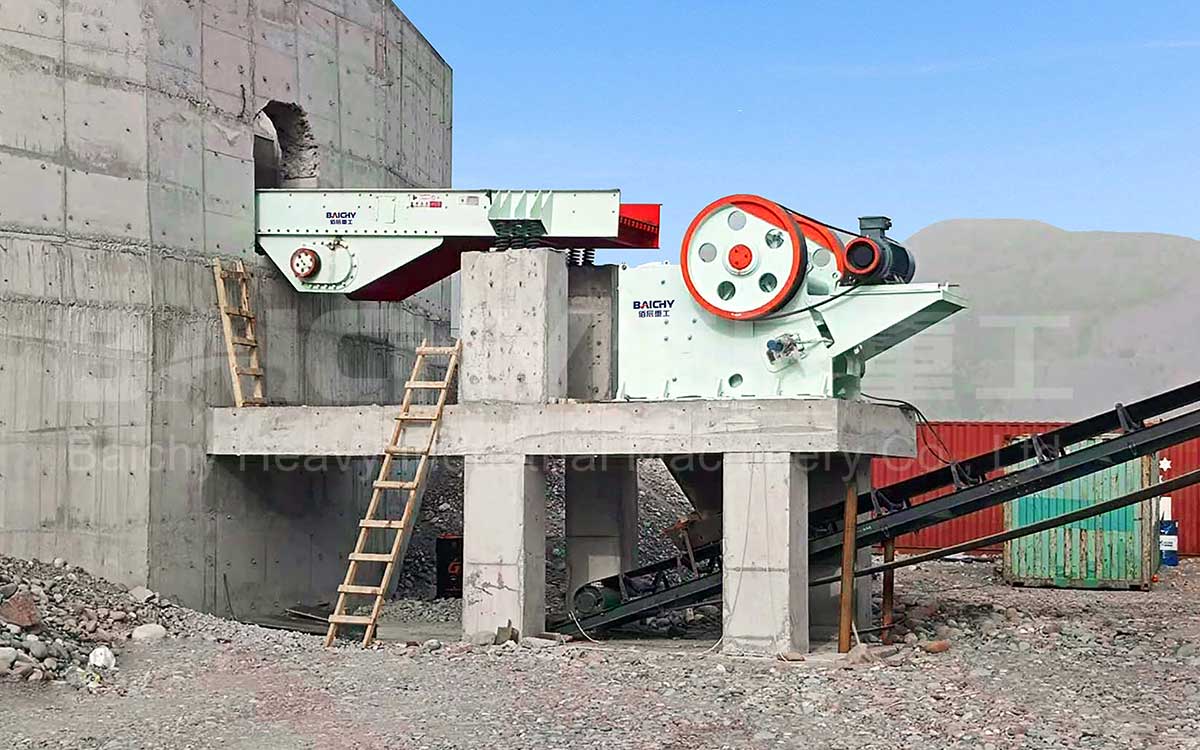
4-in-1 mobile crushing station Structural diagram
II. Advantages of the Four-Unit Configuration
It integrates the entire process line into a single station, eliminating not just inpidual pieces of equipment but the entire intermediate logistics chain. The feeder, jaw crusher, secondary crusher, and four-deck screen are mounted on a unified chassis assembly; material flows in a closed loop within the station, eliminating the need for ground stockpiling, re-handling, or intermediate material piles.
| User Concerns | Conventional Perceptions | Actual Performance of the 4-Unit Combination |
| "Mobile station capacity is surely lower than fixed lines" | Mobile = Downgraded specs | Same crusher models as fixed lines (PE750×1060, PF1315); identical crushing chambers; capacity variance <5% |
| "Is a 4-unit combination hard to operate?" | More complex = harder to use | Centralized control via a single electrical cabinet; one operator per machine; 10 minutes from startup to discharge |
| "Mobile station output particle size is unstable" | Mobile = Simple = Poor precision | 4-deck screen produces 4 product grades simultaneously (0-5/5-20/20-40/40-80mm); particle shape identical to fixed lines |
| "Is overall relocation slow?" | Larger size = harder to move | Each unit has a wheeled chassis and tow-pin connection; full line disassembly + relocation completed in 1 day |
Two configuration paths (hard rock/soft rock); one production line covers mainstream operating conditions:
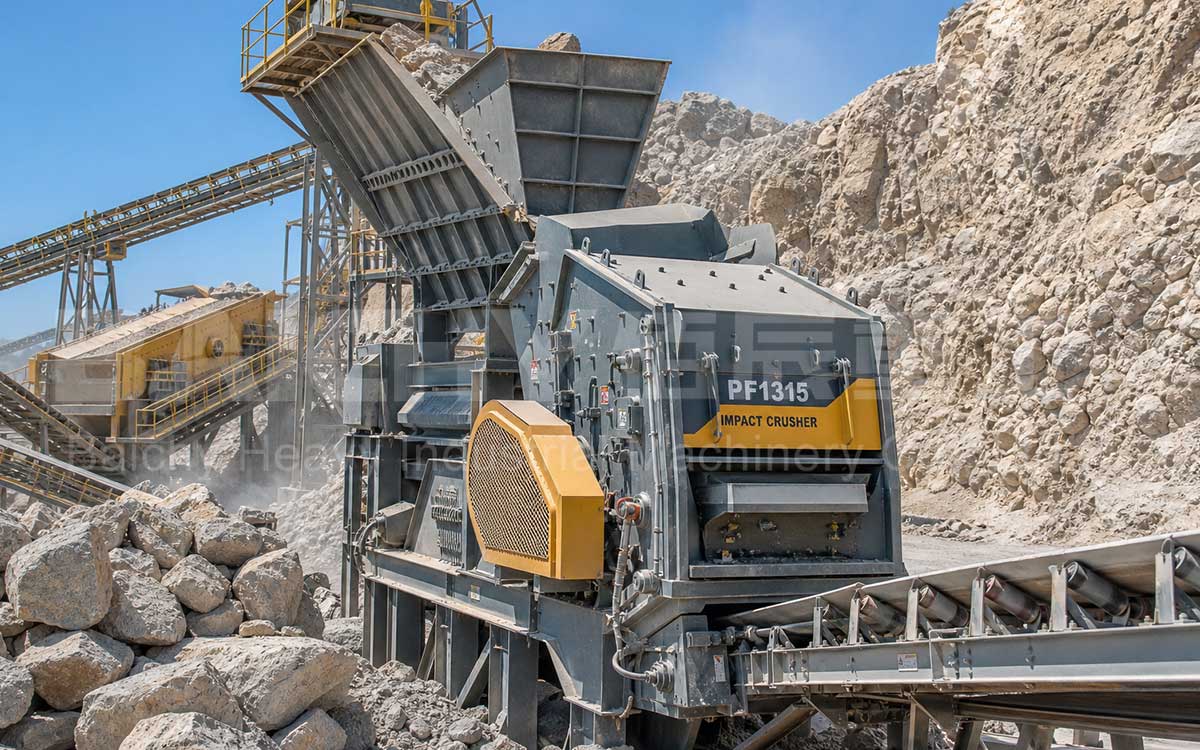
• Soft/Medium-Hard Rock (Limestone/Bluestone/Dolomite/Construction Waste) → ZSW490×110 Feeder + PE750×1060 Jaw Crusher + PF1315 Impact Crusher + 4YK2160 4-Deck Screen; impact crusher provides secondary shaping for excellent particle shape; limestone hourly output: 200–250 tons
• Hard Rock (Granite/Basalt/River Pebbles) → ZSW490×110 Feeder + PE750×1060 Jaw Crusher + PYB1200 Cone Crusher + 4YK2160 4-Deck Screen; cone crusher handles highly abrasive materials; granite hourly output: 150–200 tons
Capacity conversion basis (Limestone = 1.0): Granite ×0.75–0.85, Basalt ×0.70–0.80, River Pebbles ...×0.80–0.90. All quotations and proposals are calculated based on this standard to avoid discrepancies between nominal ratings (e.g., "nominal 250 tph" vs. "actual 180 tph").
III. Core Parameter Table
The following outlines two standard configurations for the four-unit mobile crushing station (capacities are rated based on medium-hardness limestone):
| Equipment Unit | Host Model | Qty | Power (kW) | Feed Size (mm) | Output Size (mm) | Single-Unit Capacity (t/h) |
| Mobile Feeding Unit | ZSW490×110 | 1 | 15 | ≤500 | - | 120–280 |
| Mobile Jaw Crushing Unit (Primary) | PE750×106 | 1 | 110 | ≤630 | 80–140 | 110–180 |
| Mobile Secondary Crushing Unit | PF1315 Impact Crusher | 1 | 220 | ≤350 | 5–40 (adjustable) | 130–250 |
| Mobile Screening Unit | 4YK2160 | 1 | 37 | ≤200 | 0–5/5–20/20–40/40–80 | 80–320 |
| Total Line (Soft Rock Config.) | - | 4 | ~400 | ≤630 | 4 product grades | 200–250 |
Note: The total weight of the soft rock configuration line is approximately 105–110 t; transport dimensions for inpidual units are kept within 13.5 m × 3.0 m × 4.2 m, suitable for 40HQ flat-rack container transport or Ro-Ro (Roll-on/Roll-off) shipping. The standard configuration (PE600×900 Jaw Crusher + PF1214 Impact Crusher + 4YK1860 Screen) offers a limestone processing capacity of 120–180 tph, suitable for small-scale aggregate yards requiring 60–100 tph.
IV. Selection Recommendations and Pitfall Avoidance
When should you choose the "4-in-1" mobile station, and when should you avoid it?
| Operating Conditions | Recommended Solution | Reasoning |
| Project duration <3 years; ≥2 sites | ✅ 4-in-1 Mobile Station | Foundation costs cannot be amortized; site transfer costs determine economic viability. |
| Riverbed extraction / temporary land lease / pending permits | ✅ 4-in-1 Mobile Station | No foundation required; leaves no trace upon removal; can enter the site after permits are approved. |
| Single quarry site; duration >5 years | Fixed Plant | Long-term operation of a fixed line offers 10–15% lower cost per ton. |
| Feed size >650mm | Assessment Required | Exceeds the permissible feed size for the PE750×1060 crusher; requires a grizzly screen upstream or an upgrade to the primary crusher. |
| Need for 0–5mm high-quality sand | Add Sand Washing Unit | A wheel-type sand washer (XSD series) can be attached to the discharge end of the screening unit. |
3 Common Pitfalls:
• Oversized feed material — The PE750×1060 crusher has an inlet of 750×1060mm, but the maximum permissible feed edge length is only 630mm. Blasting fragmentation must be controlled or a grizzly screen installed on-site; otherwise, material jams will cause the primary crusher to stop, with each jam taking 30–60 minutes to clear.
• Power supply requirements — A full line configured for soft rock requires approximately 400kW of power, necessitating a 500kVA transformer or a diesel generator set of 450kW+. Temporary sites often face forced speed reductions due to insufficient generator power, effectively cutting actual production capacity by 30%.
• Mismatch between screen mesh size and product specifications — The mesh combination for the 4YK2160 four-deck screen (e.g., 5/20/40/80mm) must be aligned with product sales requirements before ordering. Once the mesh configuration is set, changing screens on-site takes 2–3 days and alters the output product mix.
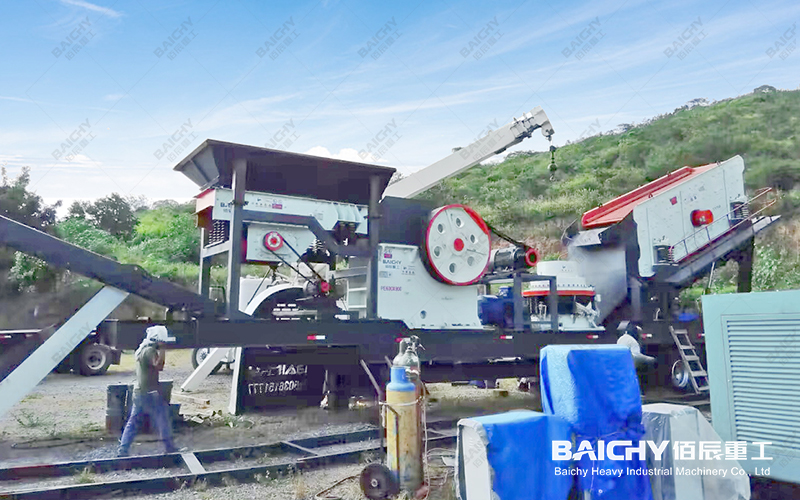
4-in-1 mobile crushing station Customer Site
V. FAQ
Q1: Can the output of the 4-in-1 mobile crushing station really match that of a fixed production line?
Yes, it can. The main crushing units in the four-unit mobile combination are identical in model to those used in stationary lines—specifically the PE750×1060 jaw crusher, PF1315 impact crusher, and PYB1200 cone crusher. Since the crushing chamber structures are the same, any difference in production capacity stems solely from the continuity of the material feed. When equipped with the standard ZSW490×110 vibrating feeder and hopper, the feeding rate matches that of a stationary line, keeping the variance in total line capacity within 5%. This challenges the misconception that "mobile stations mean downgraded specs": it is the chassis that is mobile, not the main crushing unit itself.
Q2: How long does it take to relocate the plant? What equipment is required?
Relocating the entire line involves three steps: ① Retracting the support legs and dismantling the inter-unit conveyor belts (approx. 4 hours); ② Towing the four units away one by one using a tractor truck (speed limit of 40 km/h for road transport); ③ Positioning at the new site, stabilizing the support legs, connecting power, and performing integrated system testing (approx. 6–8 hours). Production resumes within a total of 1–2 days, compared to the 10–20 days of downtime required for a single relocation of a stationary line. The move requires only one 50-ton class tractor truck and 2–3 operators.
Q3: Why is a cone crusher recommended over an impact crusher for hard rock applications?
The abrasiveness index (Ai) of granite and basalt is 3–5 times that of limestone; in hard rock applications, the service life of impact crusher blow bars is reduced by approximately 60% (dropping from about 180 hours to 70 hours), and spare part costs eat into profits. Cone crushers utilize the principle of inter-particle (lamination) crushing, and their liner service life is 3–4 times that of impact crusher blow bars. Although the initial unit price is 150,000–200,000 RMB higher, the 5-year Total Cost of Ownership (TCO) is actually lower. Cone crusher solutions are also recommended for river pebble (high-silica content) applications.
Q4: How long does it take from placing the order to commencing production?
The delivery cycle for the standard four-unit combination is 30–40 days (including main unit assembly, chassis welding, and integrated testing of the four-unit system). Upon arrival, the process follows the sequence of "connecting power → no-load testing → feeding material," with output achieved within 24 hours. Compared to the 15–30 days required for "foundation curing plus installation and commissioning" for fixed production lines, this enables production to start 2–4 weeks earlier—a crucial advantage for projects racing against deadlines, as those 2–4 weeks translate directly into 2–4 weeks of cash flow.