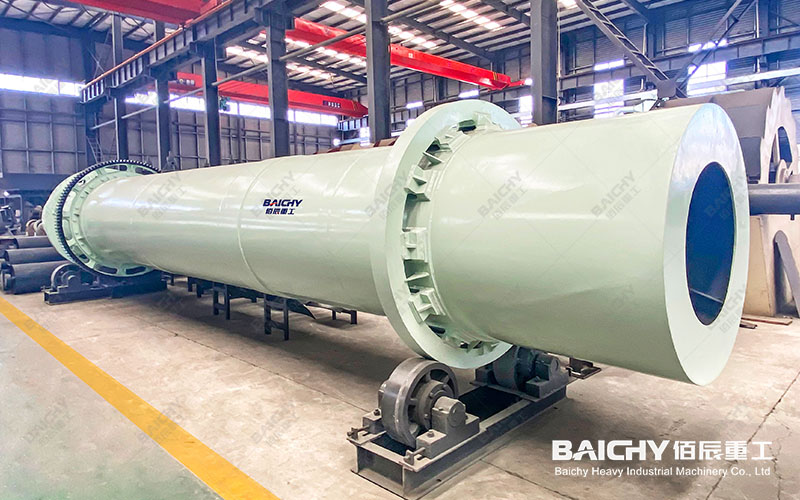
Rotary dryer manufacturers
When purchasing a rotary dryer, you are not merely buying a steel cylinder attached to a motor; you are acquiring the full engineering capabilities of the manufacturer. Factors such as the quality of the steel and welds, the layout of the internal lifting flights, thermal calculations, dust collection systems, material testing, and after-sales support will all directly impact your fuel costs and equipment downtime over the next decade.
For a dryer of the same specifications (e.g., φ2.4 × 18 m), a reliable manufacturer will provide a measured capacity curve based on your specific material, clearly listing throughput rates for scenarios such as "drying from 10% to 0.5% moisture" versus "drying from 20% to 0.5%." In contrast, an unreliable manufacturer might quote an impressive "nominal capacity" that turns out to be only 70% of the actual output upon delivery.
I. Why the True Value of a Rotary Dryer Lies in Manufacturing
The rotary dryer (also known as a rotary drum dryer) is often the most underestimated component in production lines handling high-moisture materials like sand, mineral powder, coal, and sludge. While it does not directly produce the final product, its performance dictates downstream quality control, transportation costs, and storage requirements. For instance, with wet sand at 15% moisture, approximately 14 tons of every 100 tons transported is water; similarly, if iron ore concentrate exceeds moisture limits, it will be rejected by pelletizing and sintering units. If the drying process is flawed, profits will be lost during the loading stage, regardless of how well the preceding crushing, grinding, and washing processes were executed.
At first glance, the equipment appears uniform—featuring an inclined rotating drum, internal lifting flights, inlet/outlet seals, a hot-blast stove, and a dust collection system—but the real differences lie in the details: Is the drum made of Q235 steel or boiler-grade Q245R/Q345R steel? Is the wall thickness 8 mm or 25 mm? Are the lifting flights simple straight plates, or are they segmented and designed specifically for the material? Are the riding rings and support rollers made of hardened forged steel? Does the dust collection system utilize a two-stage setup (cyclone plus bag filter) or just a single stage? These differences do not appear on the initial quotation but become glaringly obvious in maintenance records and fuel costs three to five years down the line. A rotary dryer manufacturer’s technical expertise and factory-floor quality control standards directly determine your annual maintenance frequency and fuel cost per ton of material processed.
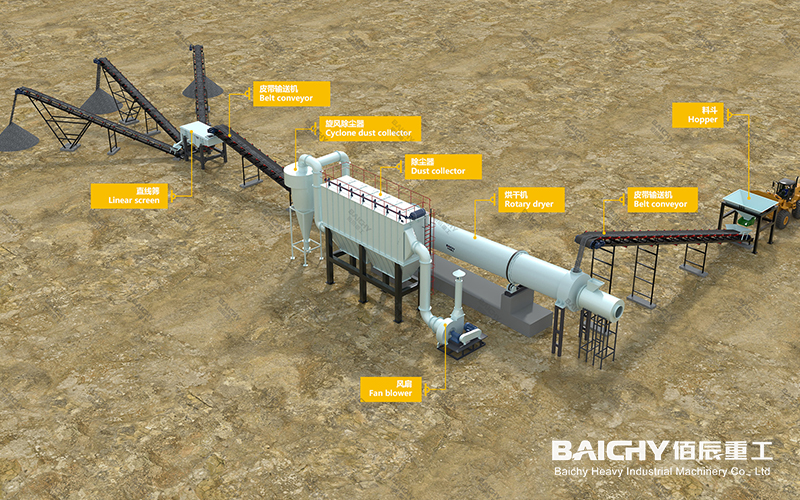
Process flow diagram of the single-drum dryer
1. Three Typical Profiles of Manufacturers
Integrated Production Line Manufacturers: Manufacturers like Baichy—who produce crushing, grinding, mineral processing, and drying equipment—offer integrated designs covering crushing, grinding, drying, and dust removal. Their equipment features matched interfaces and capacities, and a single call resolves issues for the entire line. Specialized Dryer Manufacturers: These possess deep expertise in drying technology but often require third-party coordination to integrate with other production line components. Traders: These lack manufacturing facilities, testing capabilities, and spare parts systems; while their prices are 15%–30% lower, they carry the highest risk. International buyers should be particularly wary of "private-label" quotes; requesting factory videos, weld flaw detection reports, and recent export bills of lading allows for quick screening.
II. Key Application Scenarios for Rotary Dryers
1. Sand, Gravel, and Manufactured Sand Production Lines
Sand discharged from sand-washing machines typically has a moisture content of 8%–20%; wet sand freezes in winter, causes bridging in storage silos, and leads to inaccurate mortar mix ratios. Rotary dryers reduce moisture to below 1%, cutting transport weight by approximately 7%–14%. Buyers of dry-mixed mortar and foundry sand are willing to pay a premium for guaranteed low moisture content. This scenario offers the fastest return on investment: a φ1.5×12 m model can handle small-to-medium production lines with capacities of 8–15 t/h.
2. Mineral Concentrate and Powder Drying
Mineral concentrates (such as iron ore, copper ore, and fluorite) often retain 12%–15% moisture after filtration, directly affecting pelletizing processes and downstream settlement. Because mineral powders are highly abrasive, the equipment requires wear-resistant liners and a counter-current, high-temperature process (inlet temperatures of 600–700°C). Single-unit capacities can exceed 200 t/h, making them standard equipment for large-scale mineral processing plants.
3. Environmental Protection and Chemical Industries
Municipal and industrial sludge, as well as desulfurization gypsum, are high-viscosity materials prone to agglomeration; they require L-shaped anti-sticking lifters and sealing systems, with wet scrubbing towers added for sludge applications to control odors. Conversely, heat-sensitive materials such as fertilizers (NPK, ammonium sulfate) are processed using a low-temperature co-current flow method to prevent the decomposition of active ingredients.
4. Biomass and Agricultural Processing
Materials such as sawdust, straw, and distillers' grains have low flash points; inlet air temperatures must be kept below 300°C. Indirectly heated rotary dryers or biomass-fired hot air furnaces are suitable choices, balancing safety with carbon neutrality compliance.
Regardless of the material category, selecting the right rotary dryer manufacturer is crucial to ensuring the drying system aligns precisely with upstream crushing and washing capacities; if the drying stage becomes a bottleneck, the entire production line will be forced to halt and wait for it.
III. Eight Key Criteria for Identifying Reliable Rotary Dryer Manufacturers
| Check Item | Practices of Reliable Manufacturers | Benefits |
|---|---|---|
| Drum Material & Wall Thickness | Q245R/Q345R boiler steel; wall thickness calculated based on drum diameter and operating conditions | 20–25 year design life; prevents premature fatigue cracking |
| Tyres, Trunnion Rollers & Drive | Forged steel tyres, hardened trunnion rollers, variable frequency drive (VFD) | Low wear on rotating parts; only 3–5 days of scheduled annual downtime |
| Segmented Lifter Design | Three-section combination: L-shaped (feed end) + curved (middle) + straight (discharge end) | Prevents wall sticking with high-moisture materials; uniform material curtain; minimal dust generation |
| Co-current / Counter-current Capability | Flow direction recommended based on material heat sensitivity; no "one-size-fits-all" approach | Counter-current operation boosts thermal efficiency by 15–25%, reducing fuel costs |
| Heat Source Compatibility | Multi-fuel quotes: coal, gas, biomass, and waste heat | Not tied to a single energy market; switchable based on local energy prices |
| Dust Collection System | Standard two-stage system: cyclone + bag filter; scrubber tower upgrade available | Ensures emissions compliance; avoids environmental fines and production shutdowns |
| Material Testing Capability | Free 5–10 kg sample testing; moisture reduction curve provided | Capacity calibrated by actual testing; avoids "nominal capacity" pitfalls |
| Electrical & After-sales | Electrical systems customized for 380V/50Hz or 460V/60Hz; installation guidance for export projects | Ready for immediate installation upon arrival; commissioning and production start within 30–60 days |
Compare candidates against all eight points: only manufacturers that can provide an actual tested moisture reduction curve and are willing to put capacity commitments in writing should move to the quotation stage.
Evaluate suppliers against these eight criteria to filter out most vendors claiming to be rotary dryer manufacturers. Only those capable of providing measured capacity curves and willing to guarantee capacity in the contract should proceed to the price comparison stage.
IV. HG Series Rotary Dryer Technical Parameters (Sand/Gravel Materials, Counter-current, Wet-basis Capacity)
The table below lists parameters for Baichy's flagship rotary dryers. For any given model, lifter designs and wear-resistant liners can be customized based on material moisture content and abrasiveness.
| Model Specifications | Capacity (Inlet 10% → Outlet 0.5%) | Capacity (Inlet 20% → Outlet 0.5%) | Main Motor Power | System Footprint (incl. hot air furnace & dust collector) |
|---|---|---|---|---|
| φ1.5×12 m | 8–15 t/h | 5–8 t/h | 15 kW | Approx. 120 m² |
| φ2.0×16 m | 20–35 t/h | 12–20 t/h | 22 kW | Approx. 180 m² |
| φ2.4×18 m | 35–55 t/h | 22–35 t/h | 37 kW | Approx. 240 m² |
| φ2.8×20 m | 55–85 t/h | 35–55 t/h | 55 kW | Approx. 300 m² |
| φ3.0×22 m | 70–110 t/h | 45–70 t/h | 75 kW | Approx. 360 m² |
| φ3.6×25 m | 120–200 t/h | 80–130 t/h | 132 kW | Approx. 460 m² |
Rated for quartz sand (loose bulk density approx. 1.6 t/m³), counter-current operation, inlet air temperature 600–700°C. Convert capacity by material density for iron ore concentrate and other minerals; the higher the inlet moisture, the lower the actual throughput. Confirm final model against the moisture reduction curve from free sample testing.
Note: The table above is calibrated based on quartz sand (loose bulk density approx. 1.6 t/m³), counter-current operation, and an inlet air temperature of 600–700°C. Capacities for materials like iron ore concentrate are adjusted based on density; higher initial moisture content results in lower actual throughput. For specific materials and target moisture levels, please refer to the capacity curves generated from free sample testing—ensure accuracy rather than estimation. Baichy also offers triple-pass (three-cylinder) dryers and indirect-heating rotary dryers; choose triple-pass models for space-constrained sites and indirect-heating models for high-purity materials. Our product range covers capacities from 3 to 200 t/h.
V. Application Case Studies from Rotary Dryer Manufacturers
The following examples represent typical deliveries (anonymized) made by Baichy Rotary Dryer Manufacturer over the past three years across Southeast Asia, South America, and the domestic market, covering three major material categories: sand and gravel, mineral powder, and coal.
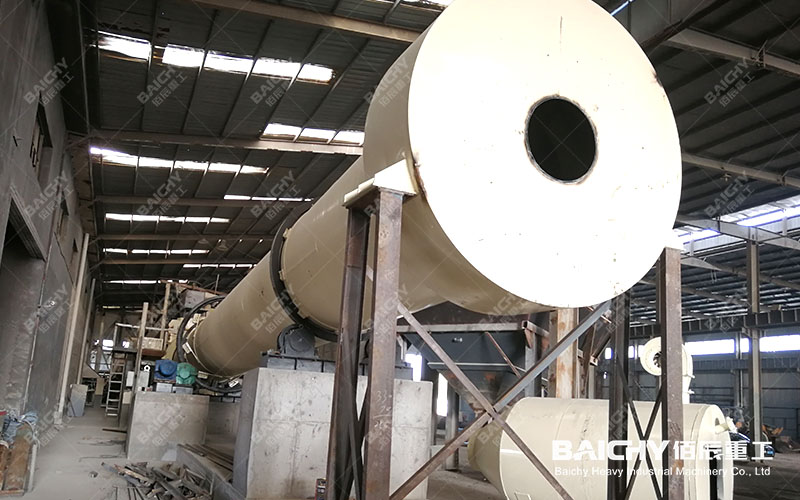
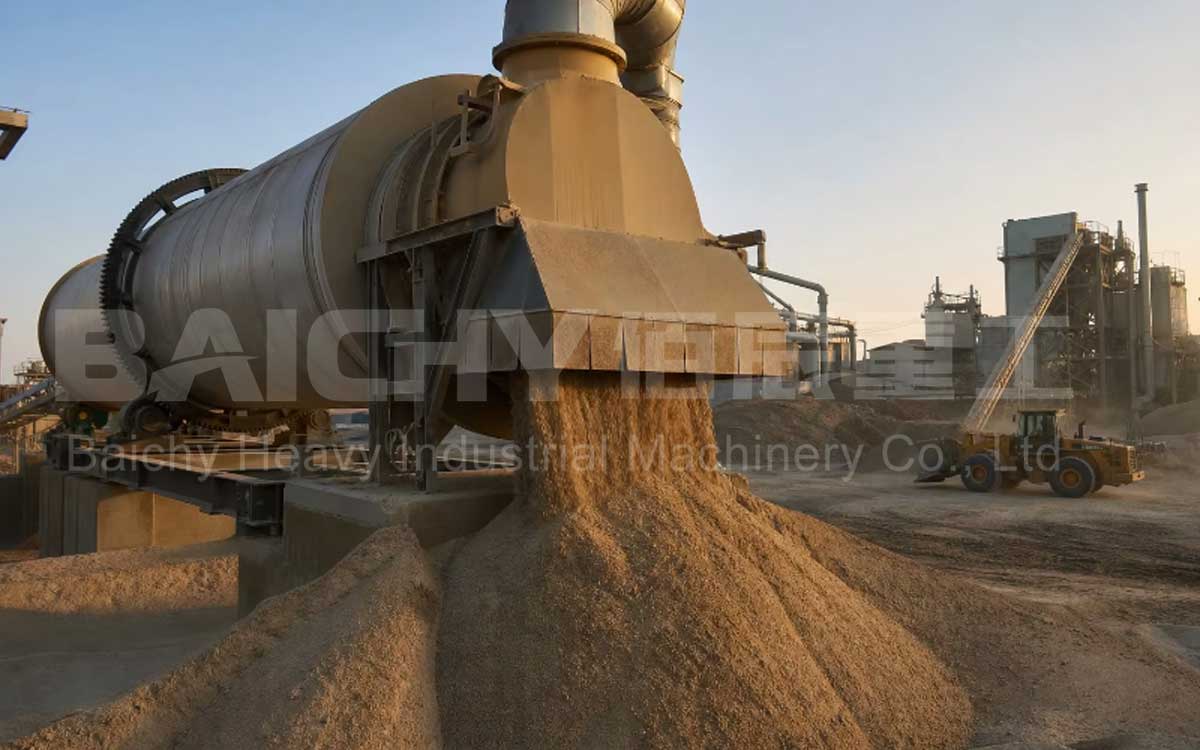
single-drum dryers
Case Study 1: Manufactured sand drying at a plant in Southeast Asia (approx. 30 t/h).
The output from the client's sand-washing line had a moisture content of 15%–18%, leading to moisture-based price deductions during transport and poor sales during the rainy season. A Φ2.8×6 m triple-pass dryer was selected to reduce moisture to below 0.8%. The dried sand was supplied for dry-mixed mortar production, adding approximately $2–3 in value per ton and allowing the investment in the drying system to be recouped within 13 months.
Case Study 2: Iron ore concentrate drying at a beneficiation plant in South America (approx. 50 t/h).
Hematite concentrate had a moisture content of 12%, causing the pelletizing workshop to reject batches exceeding moisture limits. A Φ2.4×18 m single-drum counter-flow unit consistently reduced moisture to below 1%; savings on freight costs and the elimination of moisture-based price deductions alone enabled the equipment cost to be recovered within 18 months.
Case Study 3: Coal slime resource utilization in China (approx. 10 t/h).
Filter-pressed coal slime had a moisture content of 22%–25%. An HG1816 rotary dryer equipped with a material-breaking device was used to reduce output moisture to below 8%, allowing the product to be blended with clean coal for sale. This added 30–50 RMB in value per ton, with the investment recovered in approximately 8 months. (These cases summarize typical operating conditions; specific data may vary depending on the material and site conditions.)
VI. Recommended Auxiliary Equipment for Rotary Dryers
A complete drying system comprises the main dryer unit, a hot-blast stove, dust removal equipment, and conveying systems. A responsible rotary dryer manufacturer will match auxiliary equipment to the specific operating conditions of the production line to ensure balanced capacity across all stages of the process.
HG Series Single-Drum Rotary Dryer: 8–200 t/h capacity; handles sand, gravel, mineral powder, and filter cakes; the workhorse of the production line.
Three-Drum (Triple-Pass) Dryer: 3–80 t/h capacity; ideal for space-constrained sites; length is approximately 60% shorter than single-drum models (see Three-Drum Dryer product page).
Indirect-Heating Rotary Dryer: For silica sand purification and heat-sensitive materials; hot air does not come into direct contact with the material.
Coal/Gas Hot Air Furnaces & Cyclone/Baghouse Dust Collectors: Comprehensive solutions for heat generation and environmental compliance.
Spiral Sand Washer & Fine Sand Recovery Machine: Upstream sand washing equipment (see Spiral Sand Washer solution).
Raymond Mill & Ball Mill: Integrated with the drying line for fine powder grinding; dried material feeds directly into the mill.
VII. Rotary Dryer Manufacturer FAQ
Q1: How can I distinguish between a rotary dryer manufacturer and a trading company?
Check for four indicators:
① Real factory photos and recent export bills of lading;
② Material specifications for the drum steel and weld flaw detection reports;
③ Presence of a test workshop—ask for a free test using a 5–10 kg sample (trading companies lack the equipment to do this);
④ Availability of spare parts inventory and after-sales engineers.
Manufacturers who can provide material moisture content curves and are willing to guarantee production capacity in the contract are almost certainly not trading companies.
Q2: Is the capacity listed on the rotary dryer specification sheet merely "nominal"? How is actual operational capacity guaranteed?
Some manufacturers in the market list capacities based only on ideal conditions, meaning output drops significantly when input moisture increases. Baichy’s standard requires specifications to list two tiers: throughput for 10% input moisture and 20% input moisture, along with details on material density, flow direction, and inlet air temperature. Please send representative samples before signing a contract; the manufacturer should provide a measured moisture curve within 5 working days, and acceptance testing should be based on the trial data.
Q3: What materials can Baichy dryers process? What parameters are needed for equipment selection?
Suitable materials include sand, mineral powder, iron ore concentrate, coal slime, sludge, desulfurization gypsum, sawdust, distillers' grains, and chemical fertilizers; the appropriate machine type—single-drum, triple-drum, or indirect heating—is selected based on material characteristics. Selection requires only five parameters: material type and initial moisture content, particle size and viscosity, target production capacity (based on dry material), target final moisture content, and on-site voltage and available heat sources. We will provide a matching model recommendation, a production line layout, and an FOB/CIF quotation within 48 hours of receiving the information.
Baichy Heavy Industry
Baichy Heavy Industry is a high-tech mining equipment company integrating R&D, manufacturing, sales, and after-sales service. Focusing on crushing, grinding, and mineral processing equipment, we provide professional solutions to our customers. We are ISO9001:2015 、certified, and our products include mobile crushing palnts, crawler crushing plant, construction waste crushing plants, jaw crushers, sand making machines, cone crushers, fine crushers, grinding mills, ball mills, etc., all with reliable performance to meet diverse project needs.
Baichy Heavy Industry – Your Trusted Partner
To ensure optimal performance of your equipment, Baichy Heavy Industry offers:
- Professional on-site installation guidance
- Comprehensive operator training
- 24/7 technical support & maintenance services
Our complete after-sales service system guarantees long-term, stable operation of your machinery with minimal downtime.
Protect Your Rights – Only Use Official Channels
To avoid scams and ensure authentic support, contact us exclusively through:
• Official Website: www.baichychina.com
• WhatsApp: +8615093222637
• Email: [email protected]
Your satisfaction is our priority – expect prompt, professional service every time.
(Note: Beware of unauthorized third parties claiming to represent Baichy. Always verify through official contacts.)