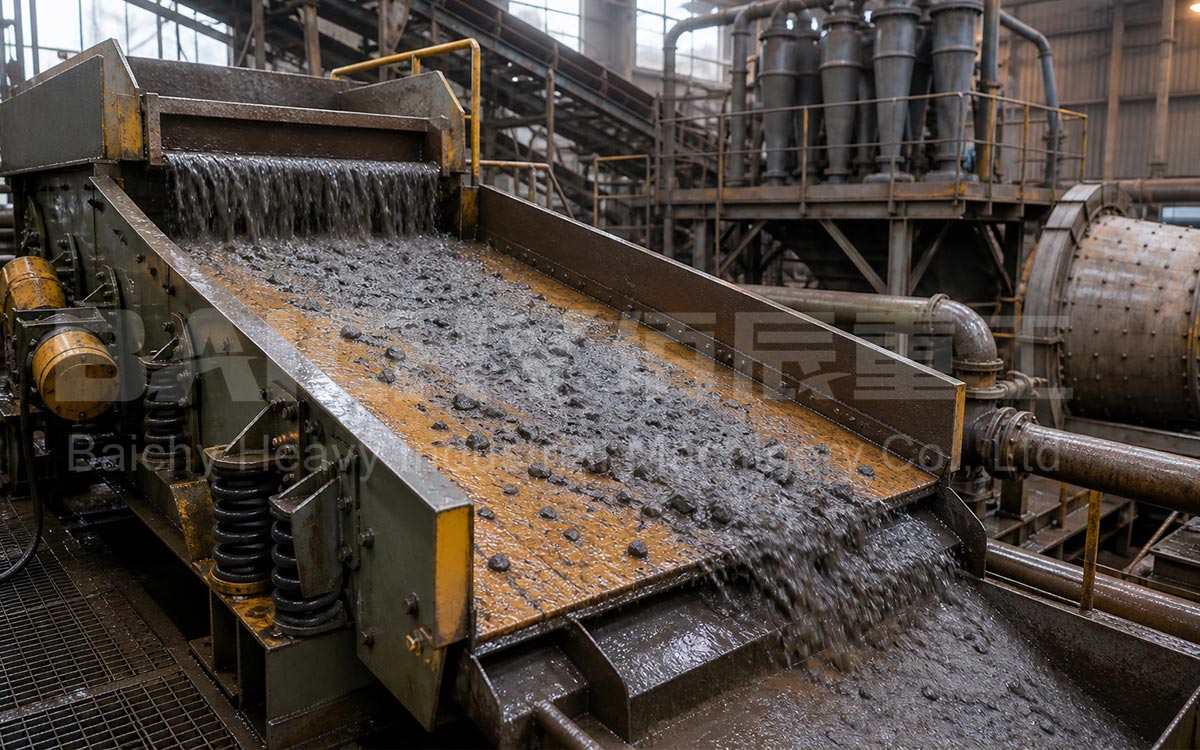
High-frequency vibrating screens
The high-frequency vibrating screen is a powerful tool for enhancing fine-particle classification efficiency in mineral processing plants, coal preparation plants, and the sand and aggregate industry. Baichy Heavy Industry’s high-frequency vibrating screens utilize a core combination of "high-frequency, low-amplitude vibration" and "fine polyurethane screening media." This setup boosts the classification efficiency for fine materials (0.075–6 mm) to over 80%—significantly outperforming hydrocyclones, which typically achieve 40%–60%. This process markedly reduces over-grinding and can increase mill hourly throughput by 15%–30%. These screens are applied across seven key areas: classification in grinding circuits, iron concentrate re-classification, coal desliming, quartz sand classification, manufactured sand fines recovery, tailings dry stacking, and chemical powder classification, making them one of the highest ROI investments for fine-particle screening operations.
I. What is a High-Frequency Vibrating Screen? Understanding Application Scope through Working Principles
The high-frequency vibrating screen is a fine-particle classification device characterized by high vibration frequency and low amplitude. Driven by dual vibration motors to generate linear motion, the screen operates at frequencies typically ranging from 25 to 50 Hz (1,500–3,000 cycles per minute) with an amplitude of only 1–3 mm. Material on the screen surface undergoes high-frequency tossing and rapid stratification; fine particles quickly pass through the mesh, while coarse particles are discharged along the screen surface. The screening surface utilizes polyurethane mesh (with aperture sizes of 0.075–3 mm), which is wear-resistant, self-cleaning, and resistant to blinding (clogging). The boundary for applying high-frequency screens versus conventional vibrating screens is determined by two variables: particle size and classification efficiency.
• For processing fine-grained materials (0.075–6 mm) where high classification efficiency is required → Choose high-frequency screens.
• For processing coarse-grained materials (>6 mm) where desliming and impurity removal are the primary objectives → YK circular vibrating screens or linear vibrating screens are more economical choices.
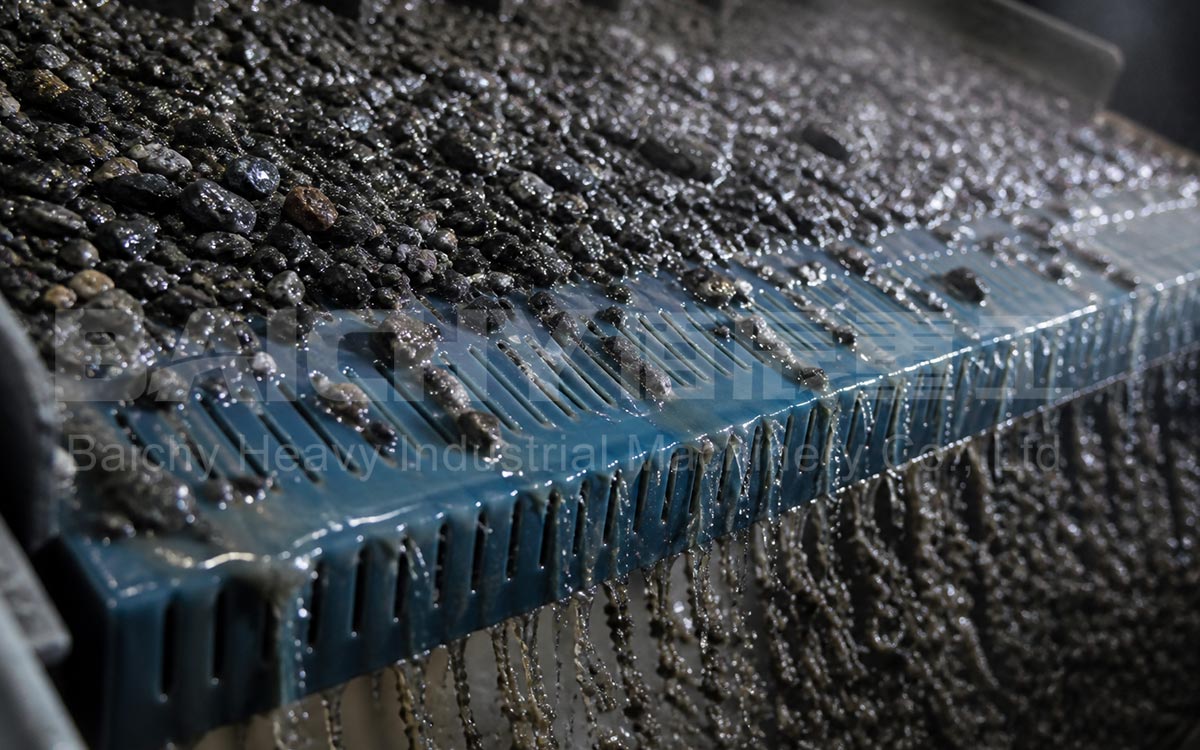
high-frequency screening machines
II. Seven Key Application Scenarios: Where to Install High-Frequency Vibrating Screens
Scenario 1: Classification in Mineral Processing Grinding Circuits (Core Application)
The grinding circuit is the most typical application scenario for high-frequency screens. Discharge from the ball mill enters the high-frequency screen for classification; undersize material (meeting size specifications) proceeds to the next stage, while oversize material is returned to the ball mill for regrinding. Compared to using hydrocyclones alone, this equipment offers higher classification efficiency and more stable underflow concentration, significantly reducing over-grinding—a crucial factor for improving concentrate grade and lowering grinding energy consumption. A common configuration is a two-stage closed-circuit system featuring "hydrocyclone pre-classification + high-frequency screen final classification."
Scenario 2: Fine-Particle Re-classification of Iron and Non-ferrous Metal Concentrates
Iron ore processing plants frequently use high-frequency screens to re-classify magnetic separation concentrates or rough concentrates. Oversize particles are returned for regrinding, while undersize particles proceed to subsequent operations, helping to stabilize concentrate grade and increase metal recovery rates. This application is equally suitable for processing plants handling non-ferrous metals such as gold, copper, and molybdenum.
Scenario 3: Desliming and Classification of Fine Coal in Coal Preparation Plants
High-frequency vibrating screens are used in coal preparation plants for the desliming, medium removal, and classification of fine coal. Coal slime smaller than 0.5 mm is removed via screening and sent to the coal slime water system, while fine clean coal (0.5–3 mm) is classified and recovered; when combined with thickeners and dewatering screens, this enables a closed-loop circulation of wash water.
Scenario 4: Precision classification of non-metallic minerals (e.g., quartz sand, feldspar)
Silica sand processing demands strict particle size ranges (such as 0.1–0.5mm and 0.5–1mm classification). High-frequency screens, utilizing polyurethane screens with narrow slots to achieve precise multi-stage classification, serve as standard equipment for glass sand and foundry sand production lines.
Scenario 5: Fine sand recovery and gradation adjustment for manufactured sand
In wet sand-making lines, high-frequency vibrating screens recover fine sand (0.075–1.2mm) from sand-washing overflow and adjust the fineness modulus of the finished product. When paired with high-frequency dewatering screens, they create a "recovery + dewatering" combination that minimizes fine sand loss.
Scenario 6: Tailings dry stacking and process water recycling
High-frequency screens perform fine-particle screening and preliminary dewatering on thickened tailings slurry. This reduces storage pressure on tailings ponds and allows filtrate to be recycled into the process system, alleviating water supply constraints in water-scarce mining areas.
Scenario 7: Precision classification of chemical and building material powders
High-frequency vibrating screens are also suitable for the precision classification of powders such as chemical raw materials, refractory materials, and abrasives. They achieve efficient screening of 0.1–1mm powder materials, expanding the application scope of traditional mining screening equipment.
III. Equipment Advantages: Why high-frequency vibrating screens are the preferred choice for fine-particle classification
• High classification efficiency: High-frequency vibration causes rapid material stratification; classification efficiency for particles larger than 0.075mm reaches 80%–90%, significantly outperforming hydrocyclones (40%–60%).
• Reduced over-grinding and increased mill capacity: Particles of the desired size pass through the screen promptly and avoid repeated grinding. This increases mill throughput by 15%–30% while simultaneously reducing electricity consumption per ton of ore.
• Wear-resistant, non-clogging screens: Polyurethane screens feature self-cleaning capabilities and precise slot dimensions, offering a service life measured in years. Maintenance costs are far lower than those associated with frequently replaced hydrocyclone apex nozzles.
• Continuous operation and low energy consumption: High-frequency, low-amplitude vibration minimizes mechanical stress on the equipment, with energy consumption approximately 60%–70% that of comparable equipment, supporting 24-hour continuous production.
Based on a processing plant handling 3,000 tons of iron ore per day, increasing the classification efficiency of the grinding circuit from 50% to 80% boosts the mill's hourly throughput by approximately 20%. With an annual operating time of 8,000 hours and an electricity rate of 0.6 RMB/kWh, annual electricity cost savings can reach hundreds of thousands of RMB; the value gained from improved metal recovery—resulting from reduced over-grinding—is even more substantial. IV. Key Specifications Table
The table below lists common specifications for the Baichy GK series high-frequency vibrating screen. Screen aperture, amplitude, and vibration frequency can be customized based on material properties and site conditions:
| 型号 Model |
筛面尺寸 (mm) Screen Surface Size |
筛孔 (mm) Aperture |
处理量 (t/h) Processing Capacity |
振幅 (mm) Amplitude |
振动频率 (Hz) Vibration Frequency |
电机功率 (kW) Motor Power |
|---|---|---|---|---|---|---|
| GK-1230 | 1200×3000 | 0.075–3 | 8–20 | 1–3 | 25–50 | 3×2 |
| GK-1530 | 1500×3000 | 0.075–3 | 15–35 | 1–3 | 25–50 | 4×2 |
| GK-1830 | 1800×3000 | 0.075–3 | 25–50 | 1–3 | 25–50 | 5.5×2 |
| GK-2445 | 2400×4500 | 0.075–3 | 40–80 | 1–3 | 25–50 | 7.5×2 |
| GK-3055 | 3000×5500 | 0.075–3 | 60–120 | 1–3 | 25–50 | 11×2 |
Note: Processing capacity is calculated based on a material bulk density of 1.6 t/m³; capacities for materials with higher specific gravity, such as iron ore or quartz sand, can be adjusted proportionally.
V. Typical Application Case Studies
Case Study 1: Grinding Circuit Retrofit at an Iron Ore Processing Plant
At a domestic iron ore processing plant, the original grinding circuit relied solely on hydrocyclones for classification. This resulted in an efficiency of approximately 50%, severe over-grinding, and significant fluctuations in concentrate grade. Following the retrofit, the process adopted a "hydrocyclone pre-classification + two GK-2445 high-frequency vibrating screens for final sizing" configuration. Classification efficiency rose to over 80%, hourly mill throughput increased by approximately 20%, the content of -0.075mm fines (over-grinding) dropped significantly, concentrate grade improved steadily by 0.5–1 percentage point, and the equipment investment was recouped in about 10 months.
Case Study 2: Precision Classification of Quartz Sand
A glass sand processing enterprise needed to separate quartz sand into two fractions: 0.1–0.5mm and 0.5–1mm. Three GK-1830 high-frequency screens were used in series for classification, with apertures set at 0.5mm and 0.1mm respectively. The product met the target particle size specifications with a pass rate exceeding 95%, the selling price of the finished sand increased by about 30%, and production capacity met the supply requirements for two float glass production lines.
VI. Recommended Auxiliary Equipment
High-frequency screens typically serve as the core unit in the screening stage; a complete line configuration following the "feeding—classification—dewatering—recovery" sequence is recommended:
• Feeding and Pre-classification: ZSW vibrating feeder ensures stable feeding; YK circular vibrating screen performs coarse particle pre-classification to reduce the load on the high-frequency screen.
• Classification and Regrinding: High-frequency vibrating screen (GK series) + hydrocyclone cluster for two-stage classification; coarse particles from the screen oversize are returned to the ball mill for regrinding, creating a closed-circuit grinding loop.
• Dewatering and Recovery: High-frequency dewatering screen (HDS series) handles fine particle dewatering; fine sand recovery unit captures ultrafine particles from the overflow; spiral classifier is suitable for coarse particle classification tasks.
• Auxiliary Systems: Slurry pumps, thickeners, and belt conveyors complete the closed-circuit process.
Baichy Heavy Industry offers comprehensive EPC services—ranging from process design and equipment selection to installation and commissioning—and customizes complete line solutions based on your material characteristics, processing capacity, and target particle size.
VII. FAQ
Q1: What is the difference between high-frequency vibrating screens and standard vibrating screens? How should I choose?
It depends on the particle size and classification requirements. For processing fine-grained materials (0.075–6 mm) where high classification efficiency is required (e.g., in grinding circuits or fine classification), choose a high-frequency vibrating screen. For coarser materials (above 6 mm)—where the primary goals are desliming, impurity removal, or standard classification—the YK circular vibrating screen or linear vibrating screen is a more economical choice. These two types of equipment can be used in combination: the circular vibrating screen performs coarse classification to reduce the load, while the high-frequency screen ensures precise final classification.
Q2: Can high-frequency vibrating screens replace hydrocyclones?
In grinding circuits, high-frequency vibrating screens and hydrocyclones are complementary rather than mutually exclusive alternatives. High-frequency vibrating screens offer higher classification efficiency (over 80%) compared to hydrocyclones (40%–60%); however, hydrocyclones have no moving parts, require less floor space, and involve lower investment costs. In actual production, the optimal configuration is a two-stage closed-circuit system featuring "hydrocyclone pre-classification + high-frequency screen precision control," balancing efficiency with investment costs.
Q3: Do the screens on high-frequency vibrating screens get clogged? What is their service life?
No, they do not clog. Baichy's high-frequency vibrating screens utilize polyurethane screen panels featuring apertures that widen from top to bottom, providing self-cleaning capabilities. Combined with high-frequency vibration and optional spray-cleaning systems, even ultra-fine particles (0.075 mm) pass through steadily without clogging the holes. Polyurethane screens offer superior wear resistance compared to metal screens, with a service life measured in years under normal operating conditions; routine maintenance requires only checking the exciter, springs, and screen tension.
Baichy Heavy Industry
Baichy Heavy Industry is a high-tech mining equipment company integrating R&D, manufacturing, sales, and after-sales service. Focusing on crushing, grinding, and mineral processing equipment, we provide professional solutions to our customers. We are ISO9001:2015 、certified, and our products include mobile crushing palnts, crawler crushing plant, construction waste crushing plants, jaw crushers, sand making machines, cone crushers, fine crushers, grinding mills, ball mills, etc., all with reliable performance to meet diverse project needs.
Baichy Heavy Industry – Your Trusted Partner
To ensure optimal performance of your equipment, Baichy Heavy Industry offers:
- Professional on-site installation guidance
- Comprehensive operator training
- 24/7 technical support & maintenance services
Our complete after-sales service system guarantees long-term, stable operation of your machinery with minimal downtime.
Protect Your Rights – Only Use Official Channels
To avoid scams and ensure authentic support, contact us exclusively through:
• Official Website: www.baichychina.com
• WhatsApp: +8615093222637
• Email: [email protected]
Your satisfaction is our priority – expect prompt, professional service every time.
(Note: Beware of unauthorized third parties claiming to represent Baichy. Always verify through official contacts.)