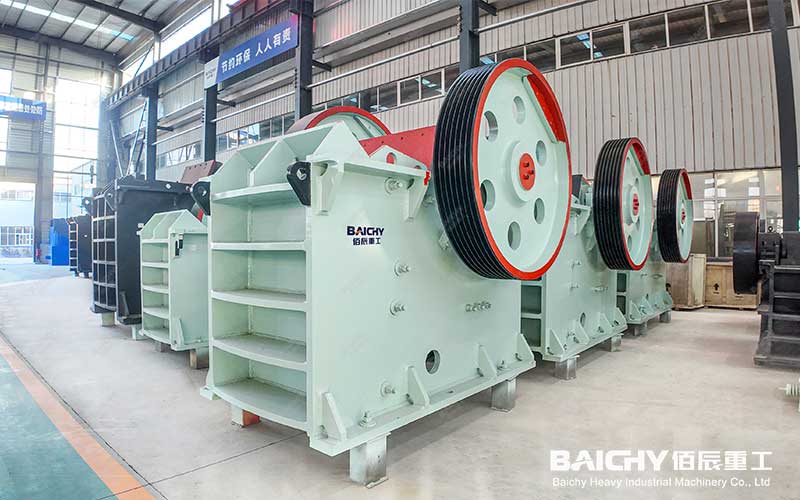
Jaw crusher, concrete crushing
The jaw crusher is the standard piece of equipment for the primary crushing stage in concrete recycling lines. Demolished concrete typically has a compressive strength of C20–C60 (20–60 MPa)—far lower than that of granite (150–250 MPa). The jaw crusher’s crushing action (compression) exploits a specific weakness: concrete's tensile strength is only one-tenth of its compressive strength. Consequently, crushing efficiency for concrete is actually higher than for hard rock; actual throughput can reach 1.2–1.5 times the rated capacity for hard rock, while jaw plate wear is reduced. Compared to mobile crushing stations, stationary jaw crushers offer lower per-ton costs and higher capacity utilization, making them the preferred choice for long-term, fixed-site operations such as waste disposal facilities and commercial concrete plants. This article provides a comprehensive overview—covering operating principles, application scenarios, advantages, technical specifications, and case studies—regarding the feasibility and equipment selection criteria for using jaw crushers to process concrete.
I. Overview: Why "Using Jaw Crushers for Concrete" Is a Valid Concept
Concrete is a composite material consisting of cement mortar, aggregates, and steel reinforcement. Its high iron content and irregular shapes often raise doubts among users accustomed to processing homogeneous ores or rocks. However, both mechanical principles and engineering practice confirm the viability of this approach:
Material Suitability: Concrete's tensile strength is only one-tenth of its compressive strength, meaning tensile stress cracks—generated during compression—propagate more easily. Its bulk density (2.2–2.4 t/m³) is lower than that of hard rock, allowing for higher throughput.
Handling Rebar: Jaw crushers bend and squeeze out rebar rather than cutting it, preventing damage to the jaw plates under normal operating conditions. Magnetic separators installed at the discharge point effectively remove iron, protecting downstream equipment.
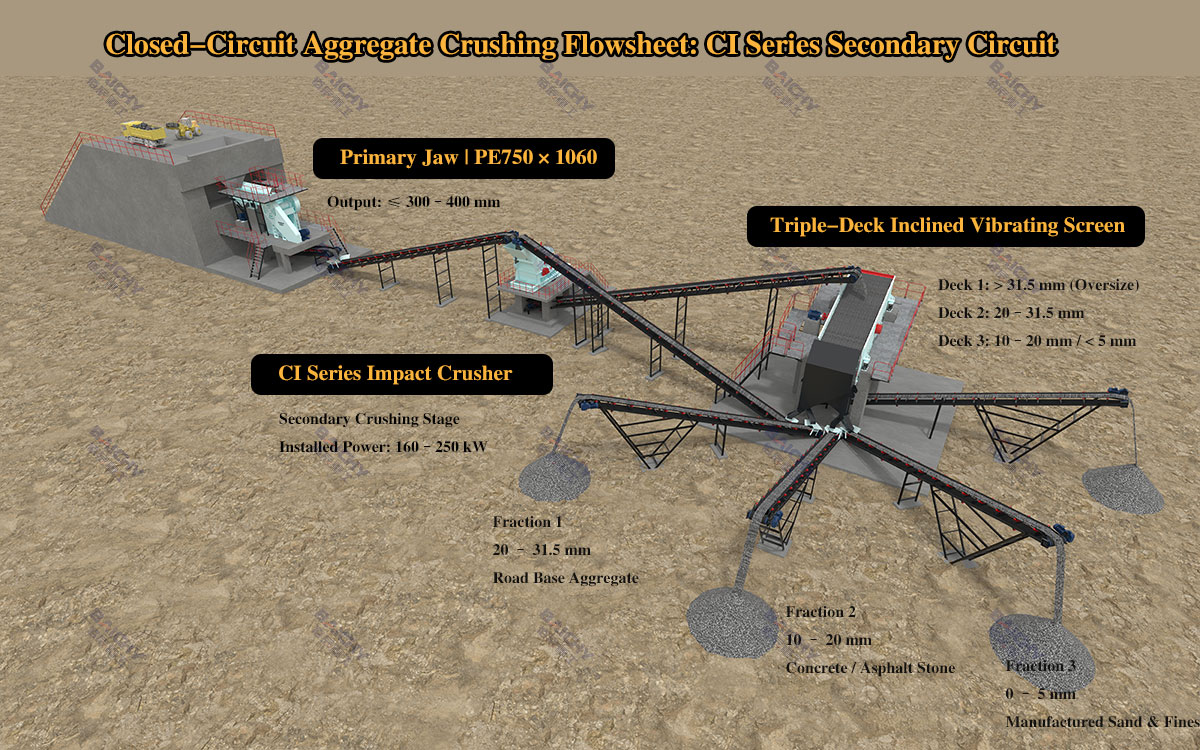
Industry Validation: The EU’s construction waste recycling rate approaches 89%. In my country, annual output exceeds 2 billion tons, yet the resource utilization rate remains below 5% (according to Ministry of Housing and Urban-Rural Development figures). The process chain of "primary jaw crushing + iron removal + impact crushing (for shaping) + screening" is the global industry standard.

construction waste crushing
II. Typical Application Scenarios for Jaw Crushing of Concrete
2.1 Construction Waste Recycling Centers (Stationary Production Lines)
These centers centrally receive demolition waste from across the city. The jaw crusher serves as the core primary crushing unit, working alongside impact crushers, screening equipment, and iron removers to form a stable production line for recycled aggregates. This scenario offers the clearest subsidy policies and the most mature operational model.
2.2 Waste Reuse at Ready-Mix Concrete Plants / Precast Component Factories
Residual concrete from mixing plants, test blocks, and waste components from precast factories are crushed on-site. The resulting recycled aggregates are reused in low-grade concrete, sub-base layers, or masonry blocks, effectively converting waste disposal costs into the value of usable aggregate.
2.3 Stationary Recycling Stations for Road and Bridge Renovation
Concrete removed from old road surfaces and bridge decks is transported to a central stationary station. It is crushed into 0–50 mm graded material for use in roadbed sub-bases—a process proven effective in Europe and the US for over two decades.
2.4 Support for Mining and Large-Scale Engineering Projects
Concrete components mixed with tunnel muck or mine waste rock, as well as demolition debris from temporary facility foundations, are processed on the same stationary line used for ore. This approach spreads depreciation costs and increases the overall utilization rate of the production line.
III. Six Core Advantages of Jaw Crushing for Concrete
Lower Cost Per Ton: Stationary jaw crushers have lower unit prices and lower electricity consumption per ton compared to mobile stations; long-term operations yield a 20%–30% reduction in comprehensive cost per ton.
Increased Capacity: Processing capacity for concrete is 1.2–1.5 times the rated capacity for hard rock, meaning the same crusher model handles a higher volume of material.
Reduced Wear and Longer Service Life: Concrete is less abrasive than hard rock; the replacement cycle for jaw plates is extended by 20%–40%, reducing spare parts costs.
Impact Resistance and Durability: Compression-based crushing handles foreign objects like rebar and bolts well, resulting in a failure rate far lower than that of impact or cone crushers.
Adjustable Output: The discharge opening is flexibly adjustable, allowing the output size to be set freely between 0 and 150 mm for direct sale as recycled aggregate.
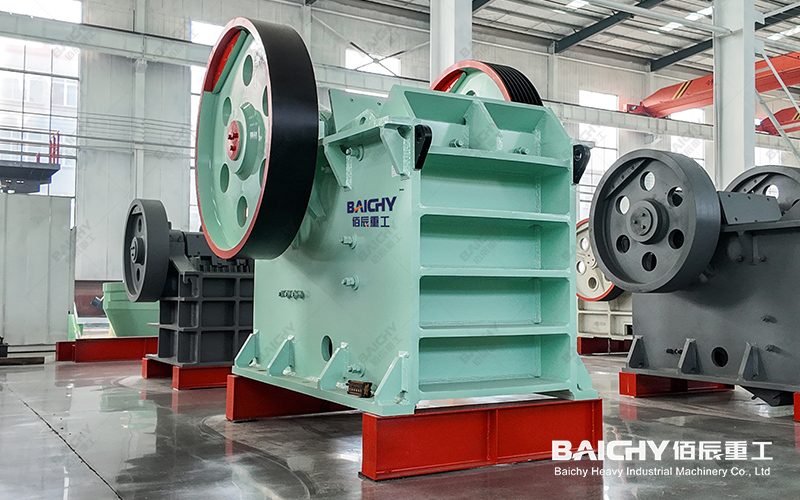
Mature and Reliable: The PE series is the most widely used primary (coarse) crusher model globally, featuring readily available spare parts, low maintenance requirements, and high residual value.
IV. Core Specifications: Typical Baichy Jaw Crusher Configuration for Concrete Processing
| Baichy Jaw Crusher Model | Feed Opening (mm) | Max. Feed Size (mm) | Concrete Processing Capacity (t/h)* | Main Motor (kW) | Typical Applications |
|---|---|---|---|---|---|
| PE400×600 | 400×600 | 340 | 25–60 | 30 | Small-scale disposal stations; auxiliary equipment for commercial concrete plants |
| PE500×750 | 500×750 | 425 | 45–100 | 55 | Medium-scale resource recovery lines; road material recycling sites |
| PE600×900 | 600×900 | 500 | 70–180 | 75 | 100 t/h class fixed processing centers |
| PE750×1060 | 750×1060 | 630 | 120–280 | 110 | Large-scale disposal sites; production lines exceeding 200 t/h capacity |
* Note: Based on demolished concrete with compressive strength of 30–45 MPa and a small amount of rebar. Actual capacity is 1.2–1.5 times the hard-rock rated value and varies with discharge setting and soil content; final specifications subject to Baichy factory configuration.
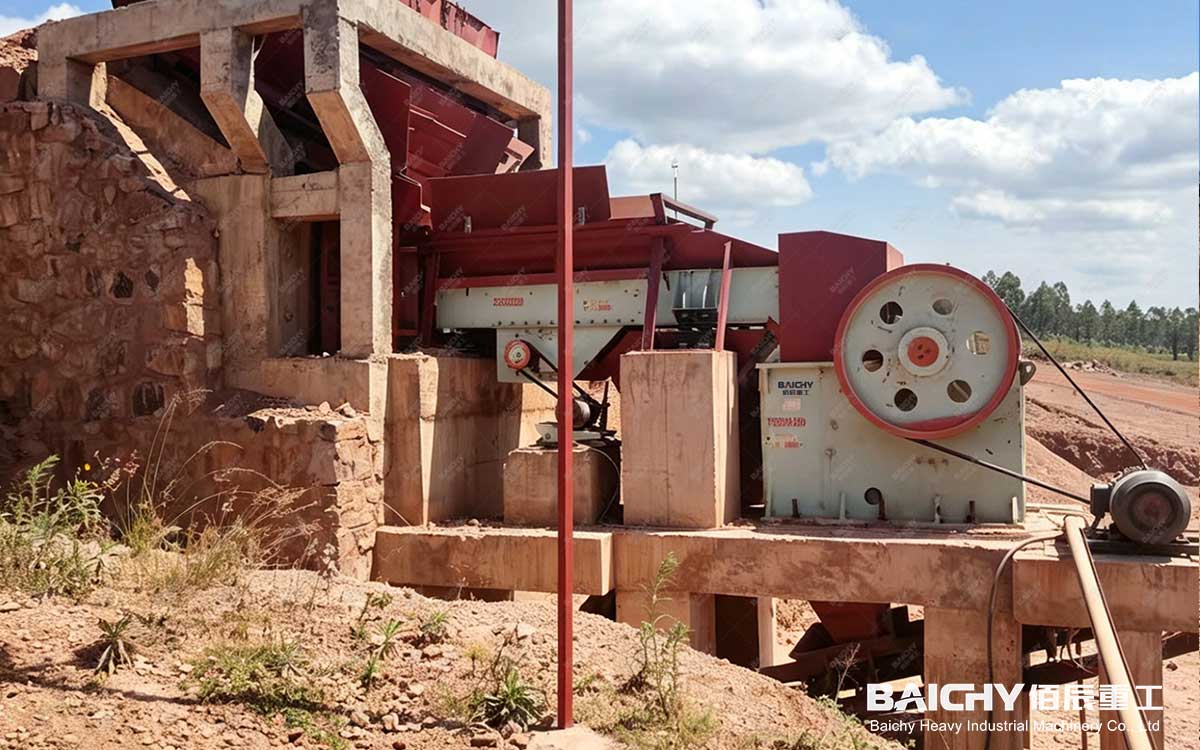
stationary crushing line
V. Relevant Case Study and ROI Analysis
Case Study: Construction Waste Resource Recovery and Processing Center in a City in East China (Fixed Line)
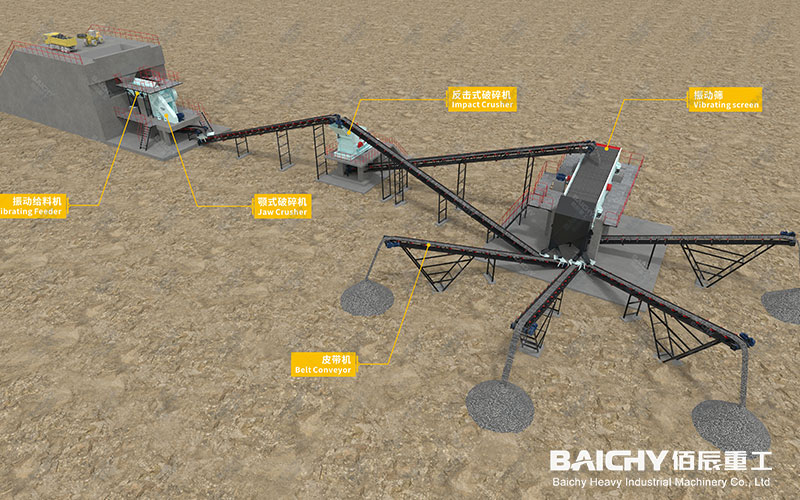
Configuration: ZSW Vibrating Feeder + PE600×900 Jaw Crusher + Self-discharging Magnetic Separator + PF1214 Impact Crusher + 2YK1860 Vibrating Screen.
Calculation basis (typical values for a Tier 2 city): Production capacity of 100 t/h; two shifts (16 hours/day); 300 operating days/year; 80% utilization rate; aggregate yield of approximately 85%:
| Metric | Value |
|---|---|
| Annual concrete processing volume | ~380,000 tons |
| Annual recycled aggregate production | ~320,000 tons |
| Savings on spoil transport/disposal fees (at 25 RMB/t) | ~9.5 million RMB/year |
| Recycled aggregate sales revenue (at 40 RMB/t) | ~12.8 million RMB/year |
| Equipment and auxiliary investment (estimated) | ~6–9 million RMB |
| Static payback period | ~1.5–2 years |
Conclusion: A stationary jaw crushing line generates revenue from both disposal fee savings and aggregate sales, typically resulting in a payback period of under two years; with the addition of resource recovery subsidies, this can be reduced to approximately one year.
VI. Recommended Equipment
Stationary jaw crushing is merely the first stage of the concrete processing line; a complete recycling line requires the following auxiliary equipment (all available as a complete package from Baichy):
PF Series Impact Crusher: Handles secondary crushing and shaping of jaw crusher output, producing high-quality cubic aggregates (0–40 mm);
Self-discharging/Permanent Magnetic Separator: Removes rebar and wire, protecting secondary crushing and screening equipment—essential for concrete processing applications;
Vibrating Screen (2YK/3YK Series): Performs multi-stage screening (0–5, 5–10, 10–31.5 mm) for direct loading and sale;
ZSW Vibrating Feeder (with grizzly bars): Pre-screens to remove fine spoil materials, preventing fines from clogging the jaw crusher chamber;
YDPZ Mobile Jaw Crushing Station: An alternative to stationary units for short-term projects or multi-site rotations; requires no concrete foundation and allows for immediate production upon arrival.
VII. FAQ (3 Questions)
Q1: Will crushing concrete containing rebar with a jaw crusher damage the equipment?
No, it will not. Jaw crushers utilize a compression crushing method; they bend and squeeze out reinforcing bars rather than shearing them, so under normal operating conditions, they do not damage the jaw plates or the drive system. The real risk lies in the secondary crushing stage—long rebar entering an impact crusher or screening equipment can cause severe damage. Therefore, installing a magnetic separator after the jaw crusher is recommended; this is a standard configuration that distinguishes concrete recycling lines from mining lines.
Q2: For crushing concrete, should I choose a stationary jaw crusher or a mobile jaw crushing station?
It depends on the project duration and site conditions: For disposal sites or commercial concrete plants with long-term operations (over 3 years) and low electricity costs, choose a stationary jaw crusher (unit costs are 20%–30% lower). For short-term demolition sites or operations requiring rotation across multiple work faces, choose a mobile jaw crushing station (no foundation required; production starts immediately upon arrival). Most resource recovery projects ultimately adopt a model where a stationary line serves as the primary system, supplemented by mobile stations.
Q3: What are the production capacity and output particle size when using a jaw crusher for concrete?
Taking the PE600×900 model as an example, the capacity for concrete applications is approximately 70–180 t/h (1.2–1.5 times the rated capacity for hard rock), with an adjustable output size of 0–150 mm. If graded aggregate (0–31.5 mm) is required, stable production can be achieved by adding an impact crusher and a screening station downstream of the jaw crusher. Actual capacity varies based on feed size, moisture content, and the amount of soil/debris present; it is recommended to provide material specifications so the manufacturer can propose the appropriate equipment selection.
Baichy Heavy Industry
Baichy Heavy Industry is a high-tech mining equipment company integrating R&D, manufacturing, sales, and after-sales service. Focusing on crushing, grinding, and mineral processing equipment, we provide professional solutions to our customers. We are ISO9001:2015 、certified, and our products include mobile crushing palnts, crawler crushing plant, construction waste crushing plants, jaw crushers, sand making machines, cone crushers, fine crushers, grinding mills, ball mills, etc., all with reliable performance to meet diverse project needs.
Baichy Heavy Industry – Your Trusted Partner
To ensure optimal performance of your equipment, Baichy Heavy Industry offers:
- Professional on-site installation guidance
- Comprehensive operator training
- 24/7 technical support & maintenance services
Our complete after-sales service system guarantees long-term, stable operation of your machinery with minimal downtime.
Protect Your Rights – Only Use Official Channels
To avoid scams and ensure authentic support, contact us exclusively through:
• Official Website: www.baichychina.com
• WhatsApp: +8615093222637
• Email: [email protected]
Your satisfaction is our priority – expect prompt, professional service every time.
(Note: Beware of unauthorized third parties claiming to represent Baichy. Always verify through official contacts.)