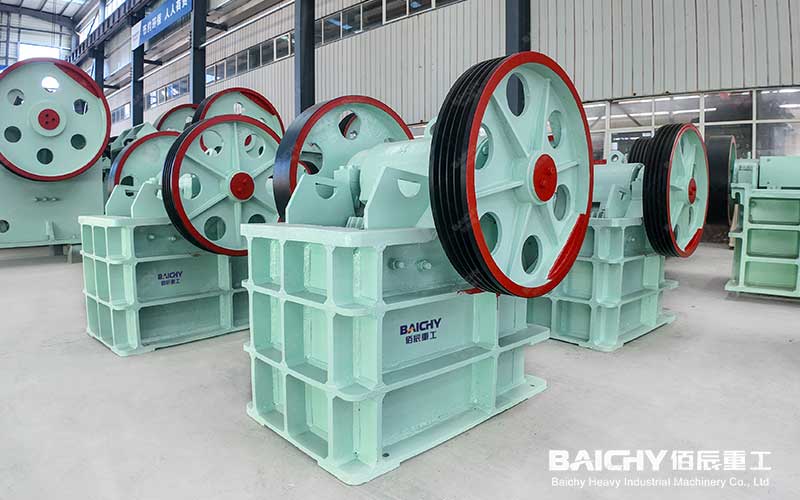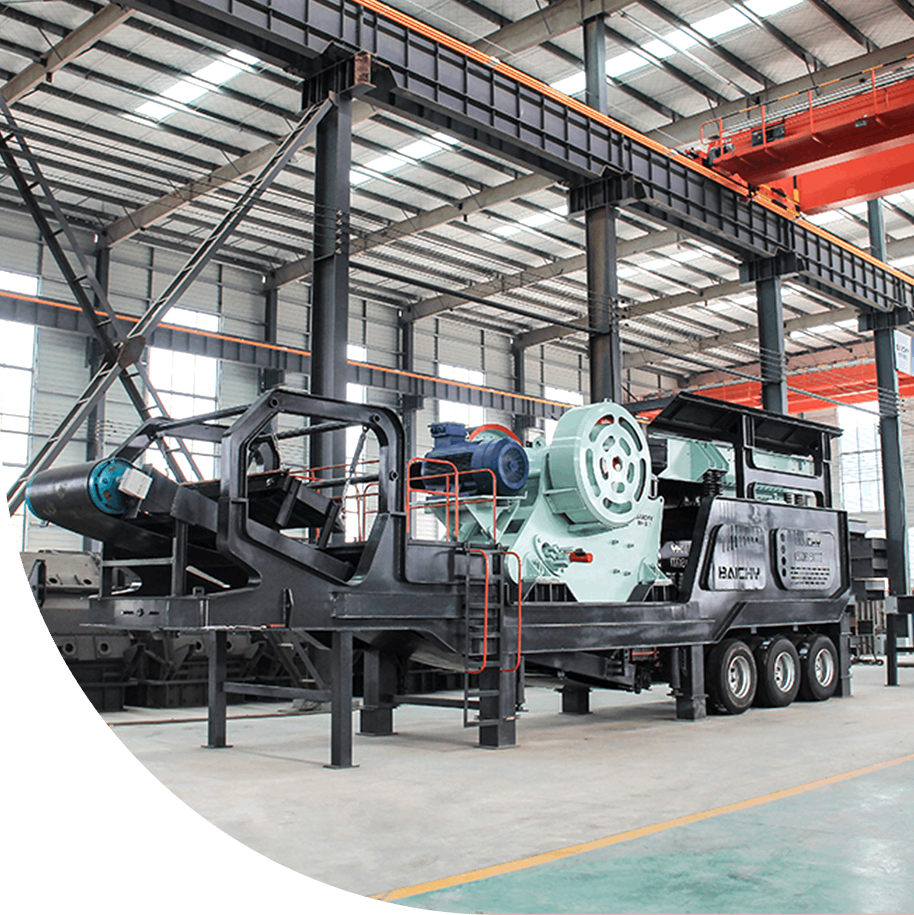


coarse crushing equipment for manufactured sand
The jaw crusher is the primary equipment of choice for crushing and sand-making operations involving siliceous, abrasive materials such as river pebbles and gravel. These stones typically feature an SiO₂ content exceeding 65% and a Mohs hardness of 6–7; under such conditions, impact-based crushers—such as hammer crushers and impact crushers—suffer from rapid blow bar wear, leading to uncontrollable per-ton costs. In contrast, jaw crushers rely on a compression-based crushing mechanism where wear is concentrated on replaceable jaw plates, resulting in an overall per-ton cost that is typically 30%–50% lower than that of hammer crushers. Consequently, whether in a stationary production line or a mobile crushing station, the jaw crusher should handle the initial stage of the process.
I. How the Jaw Crusher Solves the Challenge of Crushing Hard Stone: An Overview

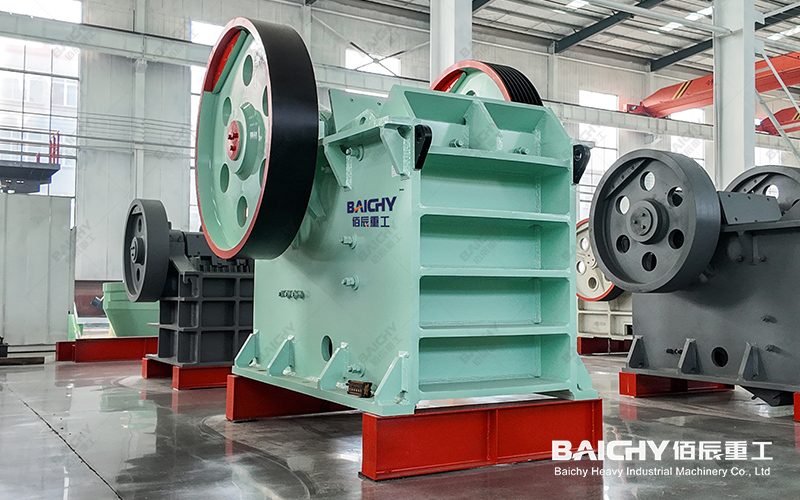
Structural-diagram-of-the-PE-series-jaw-crusher
River pebbles and gravel are notoriously difficult materials to crush in the aggregate industry; they possess smooth surfaces and dense internal structures, with some river pebbles exhibiting compressive strengths exceeding 250 MPa—rivaling that of granite. Hammer-type crushers—often associated with the notion that "soft materials are easy to crush"—fail rapidly in this application, representing a common pain point for stone crushing production lines.
The jaw crusher’s solution lies in a mechanism that uses controlled movement against a stationary surface: the swing jaw periodically approaches the fixed jaw, compressing the material within the crushing chamber in stages until it is reduced to a size smaller than the discharge opening. Because it does not rely on high-speed impact, the jaw crusher’s relative advantage becomes even more pronounced as the material becomes harder and more abrasive. A single PE-series unit can handle the primary crushing of large river pebbles (up to 500 mm) into semi-finished products smaller than 100 mm, providing a stable feed size for subsequent shaping by an impact crusher or sand-making by a VSI crusher.
II. Typical Application Scenarios for Jaw Crushers
| Application Scenario | Material Characteristics | Why Choose a Jaw Crusher |
|---|---|---|
| River pebble sand-making lines | High hardness, high abrasiveness, large rounded stones | Controlled wear during compression crushing; stable primary crushing capacity |
| Concrete batching plant aggregates | Sensitive to particle shape and clay content | Coarse crushing followed by shaping equipment allows for controlled gradation |
| Highway/railway roadbed crushed stone | Requires continuous supply and high output | Simple structure and low failure rate; suitable for continuous operation |
| Quarry natural gravel | High clay content, uneven lump sizes | Deep crushing chamber grips large stones effectively; reduces need for pre-screening |
| Mobile construction waste recycling | Space constraints; requires rapid site relocation | Can be mounted on mobile stations for on-site crushing, reducing material transport |
Take river sand and gravel projects as an example: the peak extraction season typically lasts only 4–6 months. Customers need equipment that is both cost-effective to operate and highly durable—the reliability of a jaw crusher capable of 8 hours of continuous operation is precisely the critical factor for such seasonal projects.
III. Core Parameters and Technical Specifications
The following table lists parameters for mainstream PE series models; capacity ratings are based on medium-hard material (bulk density approx. 1.6 t/m³):
| Model | Feed Opening (mm) | Max. Feed Size (mm) | Discharge Opening (mm) | Capacity (t/h) | Motor Power (kW) |
|---|---|---|---|---|---|
| PE-250×400 | 250×400 | 210 | 20–60 | 5–20 | 15 |
| PE-400×600 | 400×600 | 340 | 40–100 | 16–64 | 30 |
| PE-500×750 | 500×750 | 425 | 50–100 | 40–110 | 55 |
| PE-600×900 | 600×900 | 500 | 65–180 | 60–180 | 75 |
| PE-750×1060 | 750×1060 | 630 | 80–180 | 110–320 | 110 |
Parameter Interpretation (Value-Oriented): River pebbles are harder than the standard reference material; actual capacity should be estimated at 70%–85% of the tabulated values. For example, if the target output is 100 t/h, a calculation based on 80% efficiency shows that the PE-600×900 model is sufficient. There is no need to blindly select a larger model—while a larger unit requires 30%–40% higher initial investment, the trade-off regarding jaw plate lifespan and power consumption is often not cost-effective. Crushing line planning should be based on "Nominal Capacity × Conversion Factor" rather than simply copying nominal values.
IV. Equipment Advantages: Why Jaw Crushers Are the Preferred Choice for Crushing Lines
1. Deep-cavity compression crushing—handling hard materials with ease: Featuring an increased eccentric throw and a deep V-shaped crushing cavity, the crusher delivers a large swing stroke for the moving jaw. This enables the machine to effectively grip and fracture 250 MPa-grade river pebbles in a single pass, eliminating the need for pre-crushing.
2. Long jaw plate lifespan and low consumable costs per ton: High-manganese steel jaw plates typically last 3–6 months when processing river pebbles, with a single set capable of crushing 20,000–40,000 tons of material; this contrasts sharply with hammer crushers, which require blow bar replacement every 3–4 weeks, resulting in vastly different downtime costs.
3. Rapid discharge opening adjustment: Uses hydraulic wedges or shims for adjustment, allowing for a continuously variable output size of 20–180mm; a single unit accommodates various product specifications, offering flexibility in production switching.
4. Simple structure and low maintenance requirements: Maintenance focuses on just three key wear parts—jaw plates, toggle plates, and bearings. On-site workers can perform maintenance independently after brief training, eliminating the need for resident manufacturer technicians in remote mining areas.
5. Mobile compatibility: The unit can be mounted on a YDPZ wheeled mobile station for on-site crushing by the river, saving on transportation costs associated with hauling crushed stone.
V. Real-world Case Studies

Granite Crushing and Sand-Making Production Line
Case Study 1: River Pebble Sand-Making Line in the Philippines (Stationary)
The client purchased a PE-600×900 crusher for primary crushing, paired with an impact crusher for shaping and a wheel-bucket sand washer, with a designed capacity of 100–150 t/h. After primary crushing, the semi-finished river pebbles maintain a stable particle size of under 120mm, ensuring a uniform feed load for the impact crusher. The finished manufactured sand has a fineness modulus controlled between 2.6 and 3.0 and is supplied directly to local concrete mixing plants. The line has operated continuously for two extraction seasons with only one set of jaw plates replaced; electricity consumption per ton is approximately 20% lower than that of hammer crusher setups in the same region.
Case Study 2: Mobile River Stone Crushing in Venezuela
For a river gravel project in Venezuela, the client selected a mobile jaw crushing station for on-site processing, bypassing local restrictions on heavy vehicle transport. The mobile station became operational within 48 hours of arrival, screening material into 0–5mm and 5–20mm fractions for direct use in infrastructure backfilling and as concrete aggregate. Overall logistics costs dropped by approximately 40%, significantly shortening the investment payback period. Note: Specific production capacity and operating data vary depending on the material and site conditions; please contact us for detailed equipment selection and calculations tailored to your specific material and application.
VI. Recommended Auxiliary Equipment: A Complete Crushed Stone and Sand-Making Production Line
| Process Stage | Recommended Equipment | Function |
|---|---|---|
| Primary Crushing | PE Series Jaw Crusher | Reduces ~500mm river pebbles to under 100mm |
| Secondary Crushing | PF Impact Crusher / CS Cone Crusher | Particle shaping and control of final product shape |
| Sand Making & Shaping | VSI Sand-Making Machine | Produces 0–5mm manufactured sand |
| Screening | Circular Vibrating Screen / Linear Screen | Grading and closed-circuit material recirculation |
| Sand Washing | Wheel-type / Spiral Sand Washer | Removes mud/silt to meet cleanliness standards |
| Mobile Solution | YDPZ Wheeled Mobile Crushing Station | On-site crushing at riverbeds; rapid site relocation |
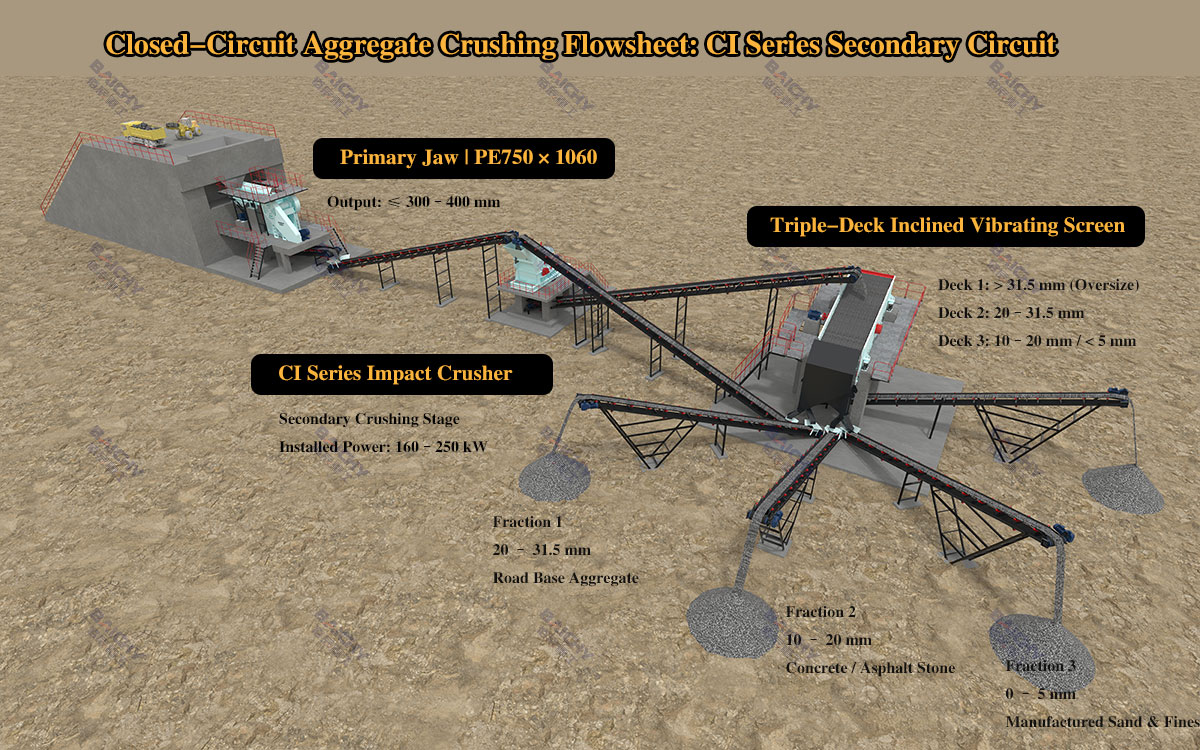
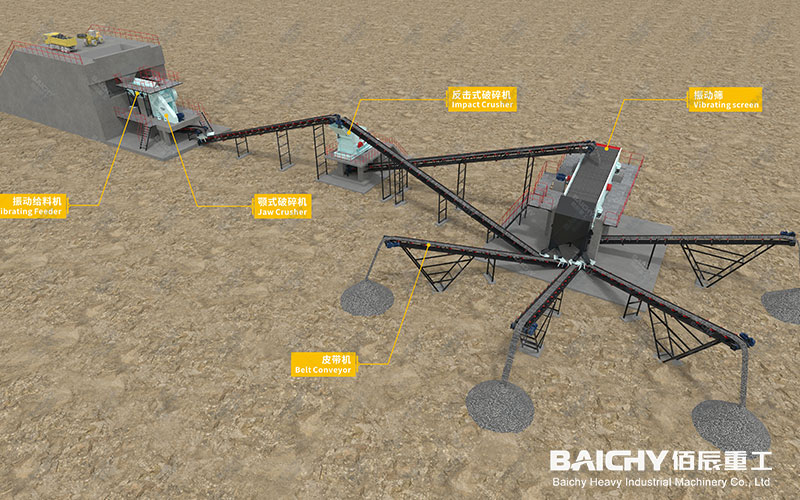
Selection Logic: Crushed stone lines follow a three-stage structure: "Jaw Crusher (Primary) → Impact/Cone Crusher (Secondary) → VSI Sand Maker." The reliability of the primary crushing stage determines the production line's maximum capacity, making the jaw crusher indispensable in this role.
VII. FAQ
Q1: Can a jaw crusher directly crush river pebbles?
Yes, that is its core application. River pebbles are hard with smooth surfaces; impact-based crushers (like hammer crushers) suffer from severe wear and struggle with long-term operation. Jaw crushers utilize a compression principle, concentrating wear on replaceable jaw plates, making them the most economical solution for primary crushing of river pebbles. It is recommended to base equipment selection on 70%–85% of the nominal capacity.
Q2: What size jaw crusher should be selected for a 100 t/h crushed stone line?
Applying an 80% conversion factor, the PE-600×900 (nominal capacity 60–180 t/h) is suitable, accommodating a maximum feed size of 500mm. If the raw material contains many large chunks, a vibrating feeder can be installed upstream to regulate the feed; if future capacity expansion is required, consider the PE-750×1060 instead.
Q3: What is the service life of the jaw plates when crushing stone, and is the replacement cost high?
When processing river pebbles, high-manganese steel jaw plates typically last 3–6 months, with a single set capable of crushing approximately 20,000 to 40,000 tonnes of material. The purchase cost of a set of PE-600×900 jaw plates accounts for about 5%–8% of the total machine price; furthermore, the plates are reversible (usable on both sides), resulting in a consumable cost per tonne of finished product that is significantly lower than that of the blow bar system used in impact crushers.
Baichy Heavy Industry
Baichy Heavy Industry is a high-tech mining equipment company integrating R&D, manufacturing, sales, and after-sales service. Focusing on crushing, grinding, and mineral processing equipment, we provide professional solutions to our customers. We are ISO9001:2015 、certified, and our products include mobile crushing palnts, crawler crushing plant, construction waste crushing plants, jaw crushers, sand making machines, cone crushers, fine crushers, grinding mills, ball mills, etc., all with reliable performance to meet diverse project needs.
Baichy Heavy Industry – Your Trusted Partner
To ensure optimal performance of your equipment, Baichy Heavy Industry offers:
- Professional on-site installation guidance
- Comprehensive operator training
- 24/7 technical support & maintenance services
Our complete after-sales service system guarantees long-term, stable operation of your machinery with minimal downtime.
Protect Your Rights – Only Use Official Channels
To avoid scams and ensure authentic support, contact us exclusively through:
• Official Website: www.baichychina.com
• WhatsApp: +8615093222637
• Email: [email protected]
Your satisfaction is our priority – expect prompt, professional service every time.
(Note: Beware of unauthorized third parties claiming to represent Baichy. Always verify through official contacts.)