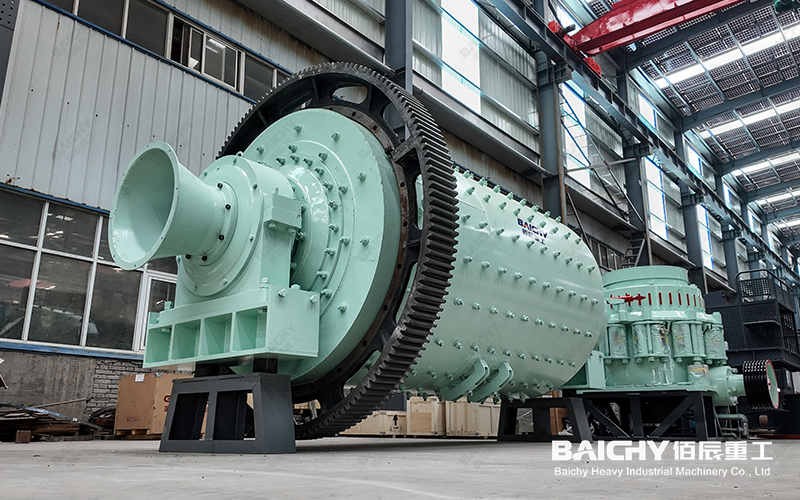
30 t/h Gold Ore Ball Mill
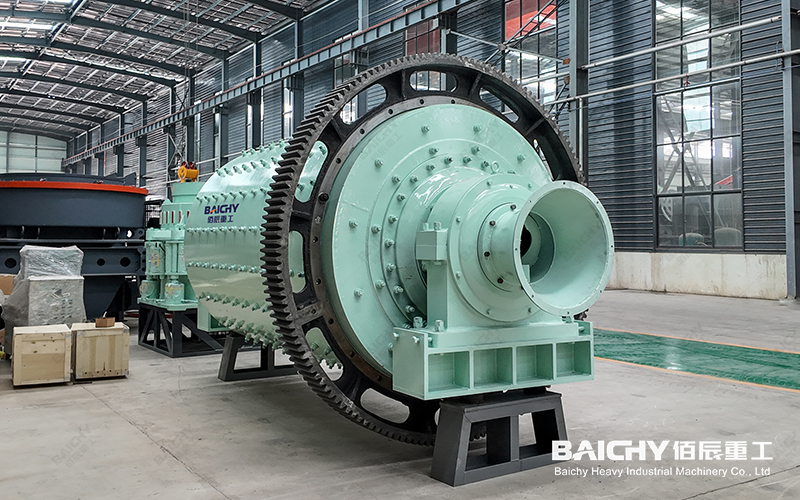
For medium-hardness gold ore with a processing capacity of 30 t/h (tons per hour), the Φ2.4×3.0m (MQG 2430) grate-type ball mill represents the preferred solution, offering the most balanced performance and robust operation. Compliant with the Chinese National Standard GB/T 25708-2010 ("Ball Mills and Rod Mills"), this model features a standard capacity range of 23–48 t/h; it can reliably meet the output requirements for a 30 t/h throughput while offering exceptional interchangeability of spare parts.
Option 1: MQG 2430 — Balanced Performance Model (Highly Recommended)
The MQG 2430 is a widely utilized "star model" in beneficiation plants with a 30 t/h scale, effectively balancing power consumption with maintenance costs.
• Key Conclusion: Under operating conditions involving a feed size of ≤25 mm and a product fineness where 60%–70% passes through a -200 mesh screen, this model can reliably handle a 30 t/h load.
- Technical Parameters (based on GB/T 25708-2010):
• Shell Dimensions: Φ2400 mm × 3000 mm
• Motor Power: 245 kW – 280 kW
• Ball Charge: Approx. 30 – 35 tons
- Production Capacity: 23 – 48 t/h (varies depending on required product fineness)
• Applicable Scenarios: Primary coarse grinding of medium-hardness gold ore (the MQG grate-type mill features rapid discharge, minimizing the risk of over-grinding).
Option 2: MQG/MQY 2436 — High Fineness & Hard Ore Capacity Model
If the ore possesses a relatively high Protodyakonov hardness (e.g., quartz vein ore) or if the required product fineness demands that over 85% pass through a -200 mesh screen, it is recommended to select a model with an extended shell length to ensure adequate grinding time.
• Key Conclusion: The Model 2436 offers a larger effective volume and installed power capacity, making it suitable for processing high-hardness ores or providing future headroom for production expansion up to 40–50 t/h.
- Technical Parameters (based on GB/T 25708-2010):
• Shell Dimensions: Φ2400 mm × 3600 mm
• Motor Power: 280 kW – 320 kW
• Ball Charge: Approx. 38 – 42 tons
- Production Capacity: 28 – 55 t/h
Option 3: MQG 2130 Economical Compact Model (For Restricted Scenarios)
This option should be considered only when the ore is extremely soft or when the feed material has already been pre-ground to a very fine consistency; it is not recommended as the primary selection for a 30 t/h throughput under standard ore hardness conditions.
• Key Conclusion: The nominal upper limit for this model is 36 t/h; when utilized for continuous production at a rate of 30 t/h in a standard gold mining operation, the operational margin is insufficient, which is likely to result in a throughput bottleneck.
• Key Data: Motor Power: 155–185 kW; Processing Capacity: 14–36 t/h.
Decision Basis for Selecting a 30 t/h Gold Ore Grinding System
Before finalizing the configuration for a 30 t/h production line, a structured comparison based on the following criteria is required to clarify specific equipment details:
| Decision Dimension | Comparison of Key Options | Conclusion |
| Mill Discharge Structure | Grate Type (MQG) vs. Overflow Type (MQY) for Primary Grinding | MQG 2430 Grate Type: Selected for primary grinding due to rapid discharge, which prevents over-grinding; MQY Overflow Type: Selected for secondary fine grinding. |
| Energy-Saving Configuration | Sliding Bearings vs. Rolling Bearings + Variable Frequency Drive (VFD) | Rolling Bearing Structure: (Saves 10%-20% on electricity); VFD Starter Cabinet: (Protects the power grid). |
| Circulation System | Open Circuit vs. Closed Circuit (with Hydrocyclones/Classifiers) | Closed Circuit: For a 30 t/h system, a set of hydrocyclones is mandatory to establish a closed circuit; this ensures that the "30 t/h" throughput figure refers to the actual output of qualified fines, rather than merely the gross material flow through the mill. |
Validation via Real-World Application Cases
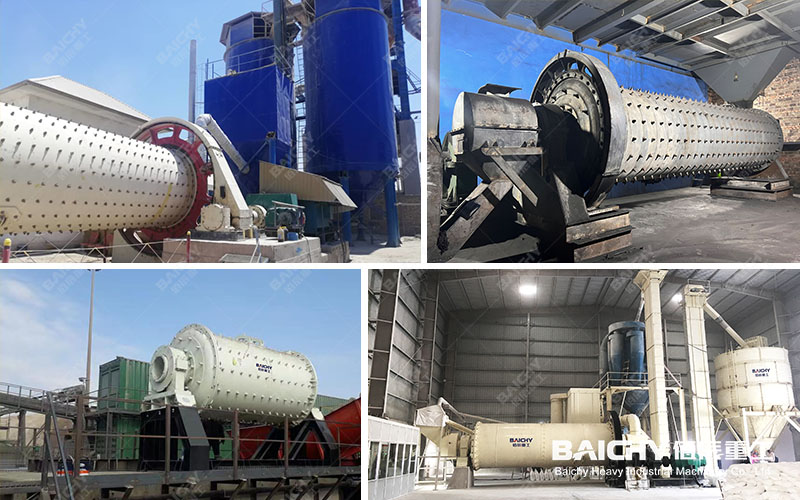
On-site view of the 30 t/h dry ball mill grinding operation
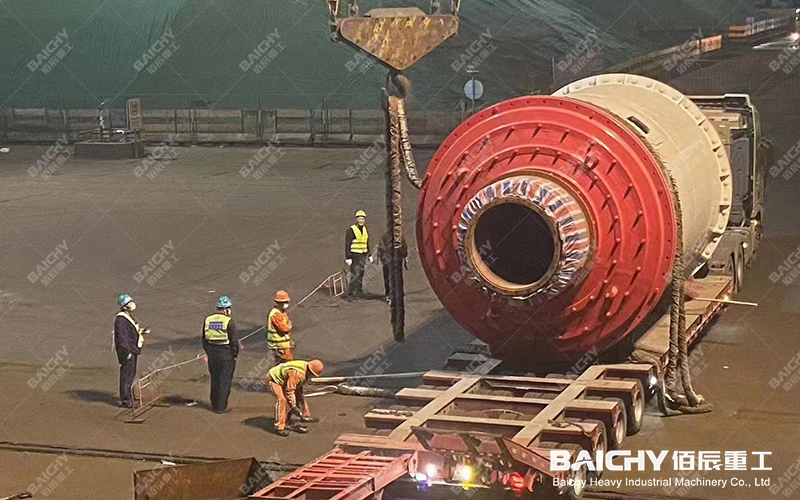
Shipment Site of Large-Scale Gold Mine Ball Mill
The MQG 2430 model has a proven track record with established operational data in actual 30 t/h scale gold mining projects, demonstrating its suitability for medium-scale operations:
• Case Project: 30 t/h Hard Rock Gold Gravity Separation Plant in the Congo (A BAICHY EPC Project, Implemented in 2025)
• Ore Conditions: Medium-hardness hard rock gold ore; Feed size <20 mm; Target liberation size: 0–1 mm (with >60% passing -200 mesh).
• Configuration Result: The MQG 2430 was selected as the primary grinding mill, integrated with a classification system, achieving a stable processing throughput of 30 t/h with a gold recovery rate of 80%–90%.
Frequently Asked Questions (FAQs) on Selecting a 30 t/h Gold Ore Ball Mill
Q1: What size ball mill is required to process 30 t/h of gold ore?
A: For medium-hardness ore and standard fineness requirements, the optimal choice is the Φ2.4 × 3.0 m (MQG 2430) Grate-Type Ball Mill. Its production capacity range of 23–48 t/h reliably covers a continuous operational load of 30 t/h.
Q2: Which national standards do the technical parameters of the MQG 2430 ball mill comply with?
A: The specifications regarding its shell dimensions, power rating, and ball charge capacity adhere to the type and basic parameter standards outlined in the Chinese National Standard GB/T 25708-2010, Ball Mills and Rod Mills.
Q3: For a 30 t/h gold ore grinding circuit—specifically for the primary and secondary grinding stages—should I choose the MQG or the MQY model?
A: For the primary, coarse grinding stage, we recommend the MQG (Grate-type) model due to its rapid discharge rate. If a subsequent secondary regrinding stage is required to achieve a higher degree of fineness, you may opt for the MQY (Overflow-type) 2430 or 2130 model.
Q4: Is it mandatory to equip a 30 t/h ball mill with a hydrocyclone?
A: Yes. Operating in an open circuit cannot guarantee the required product fineness; therefore, it is essential to configure a closed-circuit system (typically paired with an FX350 or a similar hydrocyclone cluster) to ensure that the stated 30 t/h throughput consists of qualified material passing the -200 mesh sieve.
Q5: If my gold ore is particularly hard, should I select the 2430 or the 2436 model for a 30 t/h throughput?
A: For hard ores (e.g., quartz veins with a grindability index f > 12) or applications requiring a product fineness of over 85% passing -200 mesh, we recommend upgrading to the Φ2.4 × 3.6m (2436) model. This extends the grinding duration, thereby preventing the 2430 model from becoming capacity-constrained.
Q6: What are the approximate motor power requirements and energy consumption levels for the MQG 2430?
A: The standard motor configuration ranges from 245 to 280 kW. If the optional rolling bearing structure and variable frequency drive (VFD) control system are selected, actual operational energy consumption can be reduced by 10% to 20% compared to traditional sliding bearing systems.