Heavy-duty roll crusher
Heavy-duty roll crushers (exemplified by the 2PGC series heavy-duty toothed roll crusher) utilize a combined crushing mechanism of compression and shearing via high-strength toothed rolls. A single unit can process raw coal, coke, slag, and medium-hard ores sized up to 800mm, reducing them to under 150mm in a single pass while keeping the over-pulverization rate below 10% and consuming over 30% less electricity per ton compared to hammer crushers. For demanding, continuous-operation environments—such as coal preparation plants, coking plants, and sintering plants—this equipment serves as a core crushing solution that balances production capacity, product size compliance, and operating costs.
I. What is a Heavy-Duty Roll Crusher: Working Principle and Positioning
The heavy-duty roll crusher is a large-scale, heavy-duty model within the roll crusher family. It differs from conventional double-roll crushers in three key ways: the toothed roll shells provide strong gripping force, enabling them to handle large lumps and withstand high impact; the frame and bearing housings are reinforced for 24-hour continuous operation; and the roll gap adjustment system employs a dual-safety mechanism combining springs and hydraulics, allowing the rolls to automatically retract upon encountering metal debris to protect the machine.
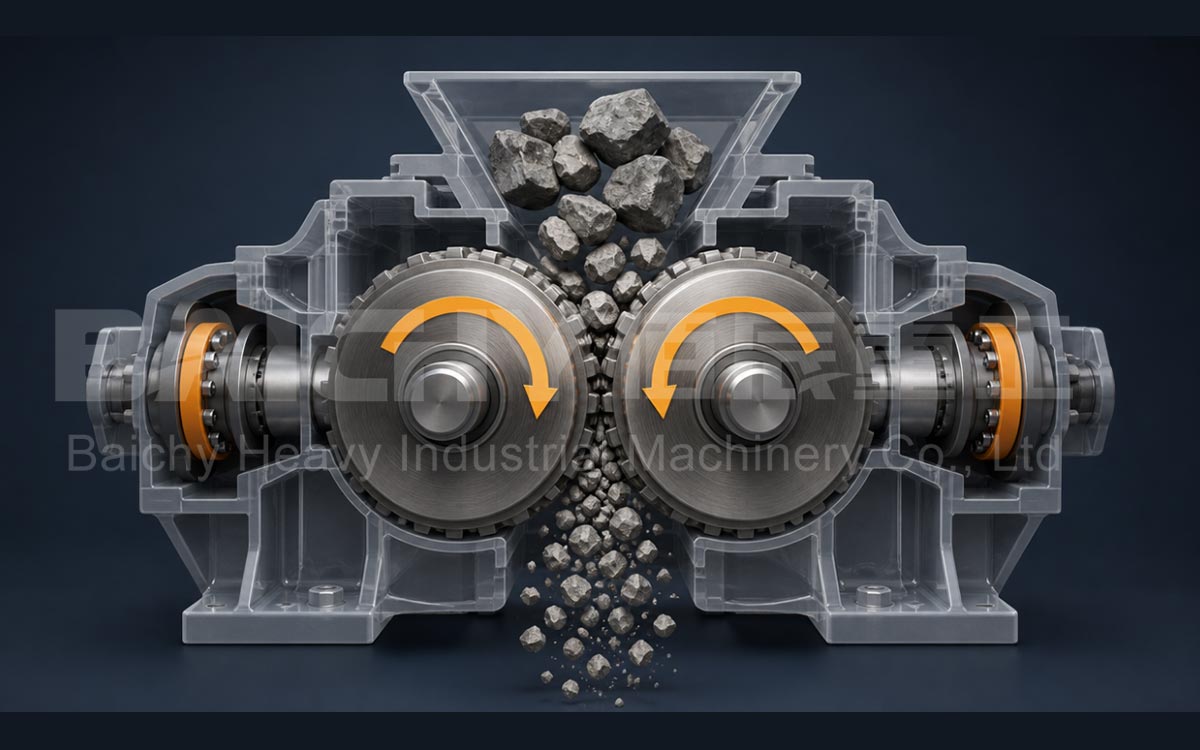
Working Principle of the Double-Roll Crusher
Working Principle: Material falls between the two rolls, and the counter-rotating toothed rolls draw it into the gap. Crushing occurs through the combined action of compressive force and the shearing force of the tooth surfaces. The final particle size is determined by both the roll spacing and the tooth profile—this fundamental difference from the high-speed impact principles used in hammer crushers and impact crushers is the primary reason for the low over-pulverization rate and minimal dust generation.
II. Typical Application Scenarios
• Coal Preparation Plants: Coarse crushing of run-of-mine coal, lump coal, and gangue to 50–150mm; replaces hammer crushers to increase lump coal yield and reduce fines loss.
• Coking Plants: Medium-to-fine crushing of coke and coke breeze; where pricing is based on particle size, excessive fines generation results in financial loss, making roller extrusion the most advantageous method.
• Metallurgy/Sintering: Pre-crushing of sinter, furnace slag, and steel slag to 10–50mm, providing a stable particle size range for subsequent grinding and magnetic separation processes.
• Mining Operations: Secondary crushing of medium-hard ores; reduces feed size for the grinding stage, thereby lowering energy consumption in ball mills.
• Chemical & Building Materials: Precision granulation of brittle materials such as calcium carbide, cement clinker, and clay.
III. Core Advantages
1. Handles Large Lumps, Simplifies Production Lines: Feed size capacity of 800–1000mm allows large lumps of raw coal to be fed directly into the machine, eliminating the primary coarse crushing stage and reducing investment in conveyors and storage bins.
2. Low Fines Generation, High Product Yield: Low-speed extrusion crushing results in a fines rate of <10%; compared to the 18%–25% fines ratio of high-speed impact crushers, this retains an additional 5–15% of usable product per ton for materials priced by particle size (such as coal and coke).
3. Self-Cleaning Toothed Rollers, No Clogging with Wet/Sticky Materials: Toothed roller surfaces combined with scraper mechanisms ensure continuous operation even with wet coal (10%–15% moisture) or clay-rich ores, allowing production to continue during the rainy season.
4. Dual Hydraulic and Spring Protection: Automatically retracts to discharge uncrushable objects (like iron chunks) and quickly resets, preventing machine jams and motor burnout.
5. Low Maintenance Costs: No hammerheads or high-speed rotors; roller shells can be repaired via hard-facing 2–3 times, with each repair costing only 20%–30% of a new replacement part.
IV. Technical Parameters (Typical Configuration for 2PGC Series)
| Model | Roll Diameter × Length (mm) | Feed Size (mm) | Discharge Size (mm) | Capacity (t/h) | Motor Power (kW) |
|---|---|---|---|---|---|
| 2PGC450×500 | 450×500 | ≤100 | ≤25 | 20–55 | 2×11 |
| 2PGC600×750 | 600×750 | ≤300 | ≤50 | 60–100 | 2×22 |
| 2PGC900×900 | 900×900 | ≤800 | ≤150 | 100–160 | 2×45 |
| 2PGC1200×1500 | 1200×1500 | ≤1000 | ≤150 | 150–350 | 2×75 |
V. Customer Case Studies
Case 1: Raw Coal Primary Crushing Retrofit at an Inner Mongolia Coal Preparation Plant.
Originally, a hammer crusher was used for lump coal; hammer heads required monthly replacement, and the lump coal yield was under 70%. After switching to the 2PGC900×900, raw coal (≤800mm) is fed directly into the machine with a discharge size of ≤150mm. Lump coal yield increased to over 85%, electricity consumption per ton dropped by approximately 32%, the roll tooth hard-facing repair cycle extended to 6 months, and annual maintenance costs decreased by nearly 40%.
Case 2: Sinter Crushing at a Southeast Asian Steel Plant.
A sintering plant belonging to a steel group required a discharge size of ≤50mm with a low fines generation rate. By adopting the 2PGC600×750 model in a closed-circuit configuration with screening, the product particle size remains stable and the fines content is significantly reduced. The unit has operated continuously for 8,000 hours without requiring a major overhaul, and the comprehensive cost per ton is 25% lower than the previous hammer crusher setup.
Note: The above summarizes typical operating conditions; specific parameters vary depending on the material and site conditions. Detailed technical proposals tailored to specific rock types are available upon request.
VI. Related Recommended Equipment
A complete production line typically requires the following equipment to work in tandem with the heavy-duty roll crusher, forming a "feeding–crushing–screening–conveying" closed-loop system:
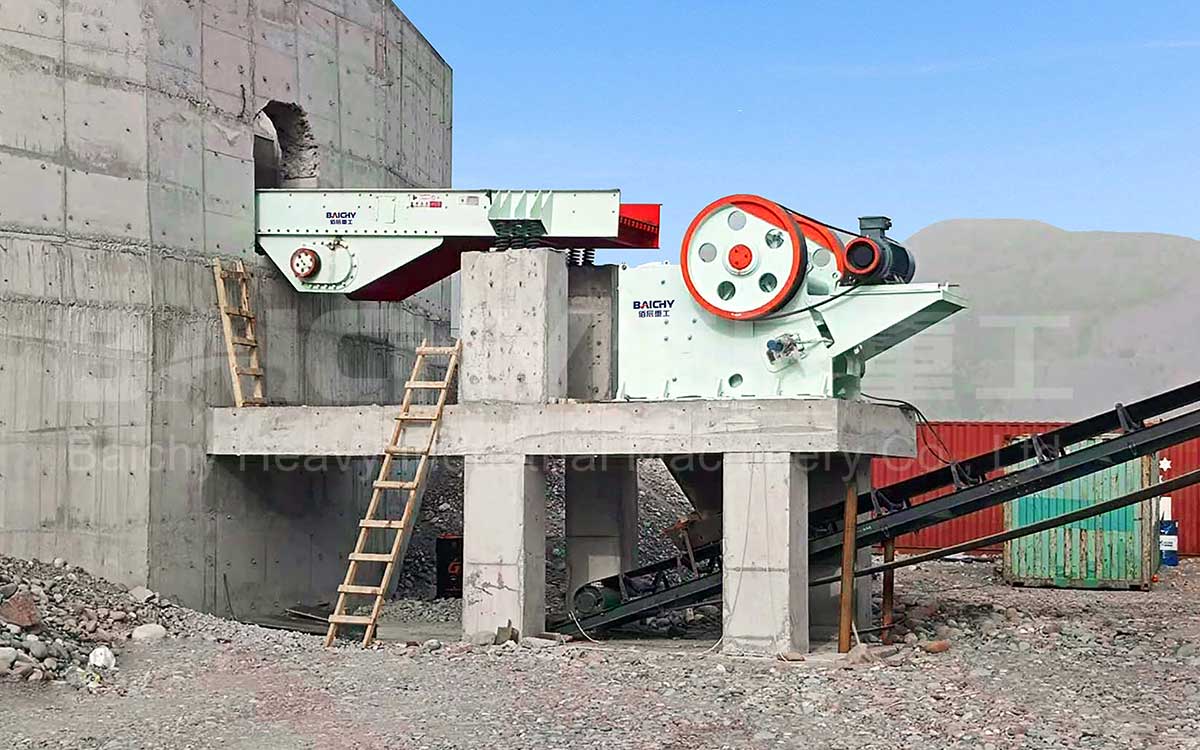
• Vibrating Feeder (ZSW Series): Ensures uniform, continuous feeding; prevents large lumps from damaging the hopper and guarantees full-load operation;
• Jaw Crusher (PE/PEX/C Series): Performs primary coarse crushing of oversized raw ore to provide suitable feed material;
• Circular Vibrating Screen (YK Series): Handles closed-circuit screening and product grading to control output particle size;
• Belt Conveyor: Connects process stages and incorporates a magnetic separator to prevent metal debris from damaging the roll teeth;
• Bag-type Dust Collector: Integrated with enclosed conveying systems to control dust, meeting "green mine" and environmental impact assessment requirements.
VII. FAQ
Q1: What materials can the heavy-duty roll crusher process?
It is primarily designed for brittle materials of low to medium hardness, such as raw coal, coke, coal gangue, sinter, furnace slag, steel slag, clay, calcium carbide, cement clinker, and medium-hard ores with a compressive strength below 150 MPa. It is not suitable for highly abrasive, hard rocks like granite or basalt—those are best handled by jaw crushers and cone crushers. Please provide the material's lithology before equipment selection.
Q2: How do I choose between a heavy-duty roll crusher and a hammer crusher?
Base your decision on two factors: First, consider the material's value. For coal and coke, pricing is based on particle size—meaning fines represent a financial loss—so a roll crusher is preferable (fines generation rate <10% vs. 18%–25% for hammer crushers). Second, consider material characteristics; roll crushers are ideal for wet, sticky, or iron-bearing materials as they resist clogging and feature hydraulic protection, whereas hammer crushers offer higher single-unit capacity for processing hard rock at high volumes. If you are unsure, provide the manufacturer with details on rock properties and capacity requirements to compare proposed solutions.
Q3: What should be done when the toothed roll wears out, and what is its service life?
The roll shells are made of high-manganese steel or alloy hard-facing materials; when processing coal or coke, the service life is typically 6–12 months, depending on the material's abrasiveness. Once worn, they can be repaired via on-site hard-facing 2–3 times—at a cost of only 20%–30% of a new roll. Baichy Heavy Industry provides genuine replacement shells and hard-facing technical support, preventing the need to scrap the entire roll.
Summary
Heavy-duty roll crushers redefine the secondary and tertiary crushing stages for materials of low-to-medium hardness by offering "large-lump intake, low fines output, and high reliability." Low fines generation translates directly into higher sales revenue; self-cleaning rolls and hydraulic protection ensure continuous operation; and repairable roll shells keep long-term maintenance costs low. Whether for a new production line or an upgrade, be sure to have the manufacturer calibrate capacity based on your specific material before selecting equipment—Baichy Heavy Industry offers tailored solutions and trial-run support.
Baichy Heavy Industry
Baichy Heavy Industry is a high-tech mining equipment company integrating R&D, manufacturing, sales, and after-sales service. Focusing on crushing, grinding, and mineral processing equipment, we provide professional solutions to our customers. We are ISO9001:2015 、certified, and our products include mobile crushing palnts, crawler crushing plant, construction waste crushing plants, jaw crushers, sand making machines, cone crushers, fine crushers, grinding mills, ball mills, etc., all with reliable performance to meet diverse project needs.
Baichy Heavy Industry – Your Trusted Partner
To ensure optimal performance of your equipment, Baichy Heavy Industry offers:
- Professional on-site installation guidance
- Comprehensive operator training
- 24/7 technical support & maintenance services
Our complete after-sales service system guarantees long-term, stable operation of your machinery with minimal downtime.
Protect Your Rights – Only Use Official Channels
To avoid scams and ensure authentic support, contact us exclusively through:
• Official Website: www.baichychina.com
• WhatsApp: +8615093222637
• Email: [email protected]
Your satisfaction is our priority – expect prompt, professional service every time.
(Note: Beware of unauthorized third parties claiming to represent Baichy. Always verify through official contacts.)