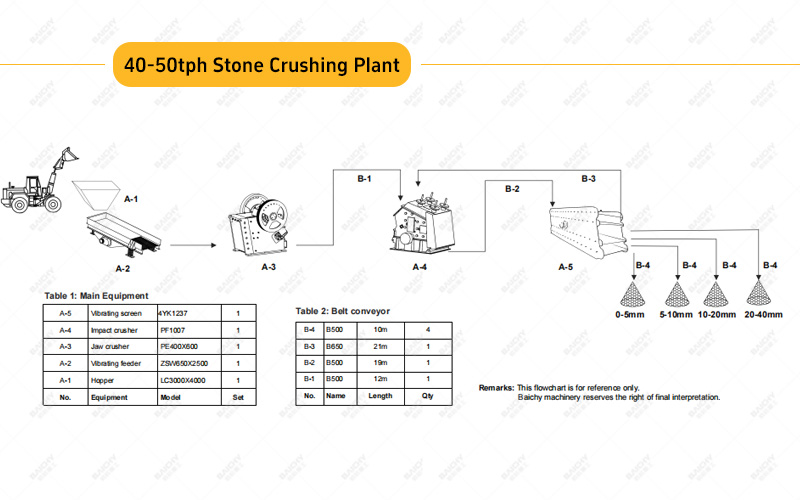
40-50tph gravel production line process layout diagram
I. 50 tons per hour: the optimal production capacity for small and medium-sized sand and gravel projects.
A crushing production line with an hourly capacity of 50 tons represents the "golden" capacity configuration for small-to-medium-sized quarries and manufactured sand projects. Taking medium-soft rock like limestone as an example, the standard setup comprises four stages of equipment: a vibrating feeder, a jaw crusher, an impact crusher, and a circular vibrating screen. The total investment ranges from $150,000 to $280,000; given reasonable aggregate pricing, most projects can recoup their investment within 6 to 12 months.
Why is 50 tons per hour considered the "golden capacity"? This capacity meets routine demands—such as rural infrastructure, road base construction, and small-scale concrete mixing plants—without requiring the massive land, power, and capital associated with production lines exceeding 100 tons per hour. For investors new to the aggregate industry, a 50 t/h line offers a manageable risk profile and the quickest path to getting started.
1.1 Fundamental differences from high-capacity lines
• Low investment threshold: The core of a 50 t/h line requires only 3–4 main machines, whereas a 200 t/h line typically requires over 8.
• Flexible footprint: The standard configuration occupies approximately 800–1,200 m², making it suitable for leased sites or temporary land use.
• Rapid commissioning: Modular equipment design allows for on-site installation in just 2–4 weeks, enabling a quick, efficient start-up.
• Lean staffing: Operations require only 2–3 personnel, keeping labor costs low.
II. Application Scenarios
2.1 Small-to-medium quarries and aggregate processing
Produces standard aggregate sizes (e.g., 0–5mm, 5–10mm, 10–20mm) suitable for direct supply to concrete mixing plants, precast component factories, and road construction projects.
2.2 River pebble and cobble sand making
Due to the high hardness and abrasiveness of river pebbles, a "jaw crusher + cone crusher" configuration for hard rock is recommended. Alternatively, a sand-making machine can be added at the final stage to further process 10–20mm aggregate into 0–5mm manufactured sand, helping to meet the demand for sand where natural sand is scarce.
2.3 Construction Waste Recycling
A mobile 50 t/h production line can be deployed directly to demolition sites to crush construction waste into recycled aggregate, thereby resolving stockpiling issues while generating additional revenue.
2.4 Pre-processing for Small-scale Mine Beneficiation
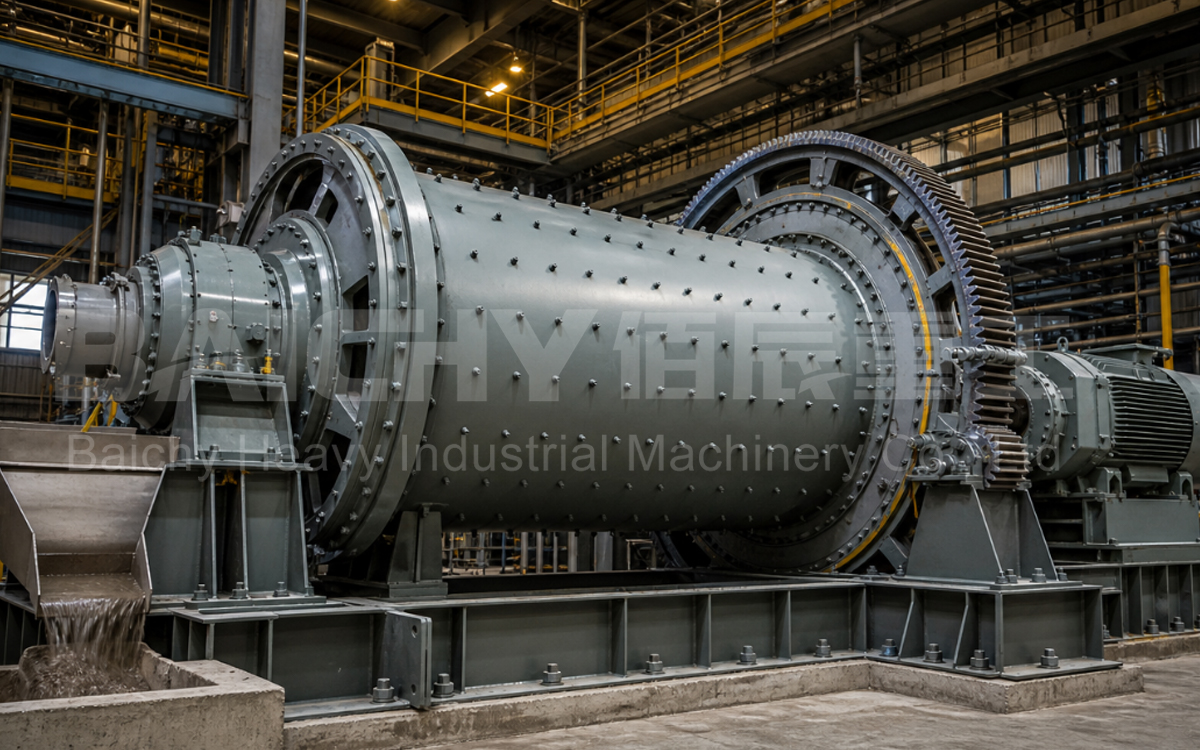
Serving as a pre-crushing stage prior to ball milling, this process reduces raw ore from 300–500 mm to a mill feed size of 30–50 mm, significantly enhancing grinding efficiency and lowering specific power consumption.
III. Standard Configuration List (Including Specifications)
The following table outlines the standard configuration for a 50 t/h crushing production line (suitable for soft to medium-hard rock). Capacity ratings are based on a limestone bulk density of 1.6 t/m³; when processing hard rock such as granite or basalt, it is recommended to adjust the expected capacity downward by 15–25%.
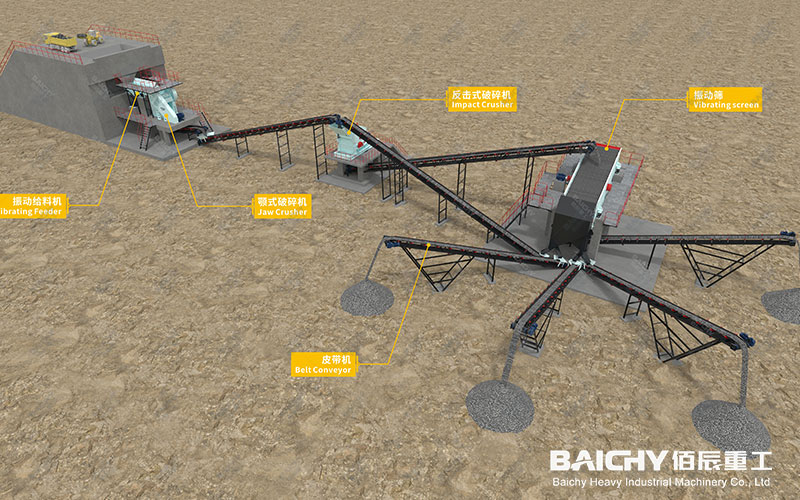
Soft Rock Crushing Production Line: Jaw Crusher + Impact Crusher
| Equipment Name | Model Example | Design Capacity | Motor Power | Functional Role |
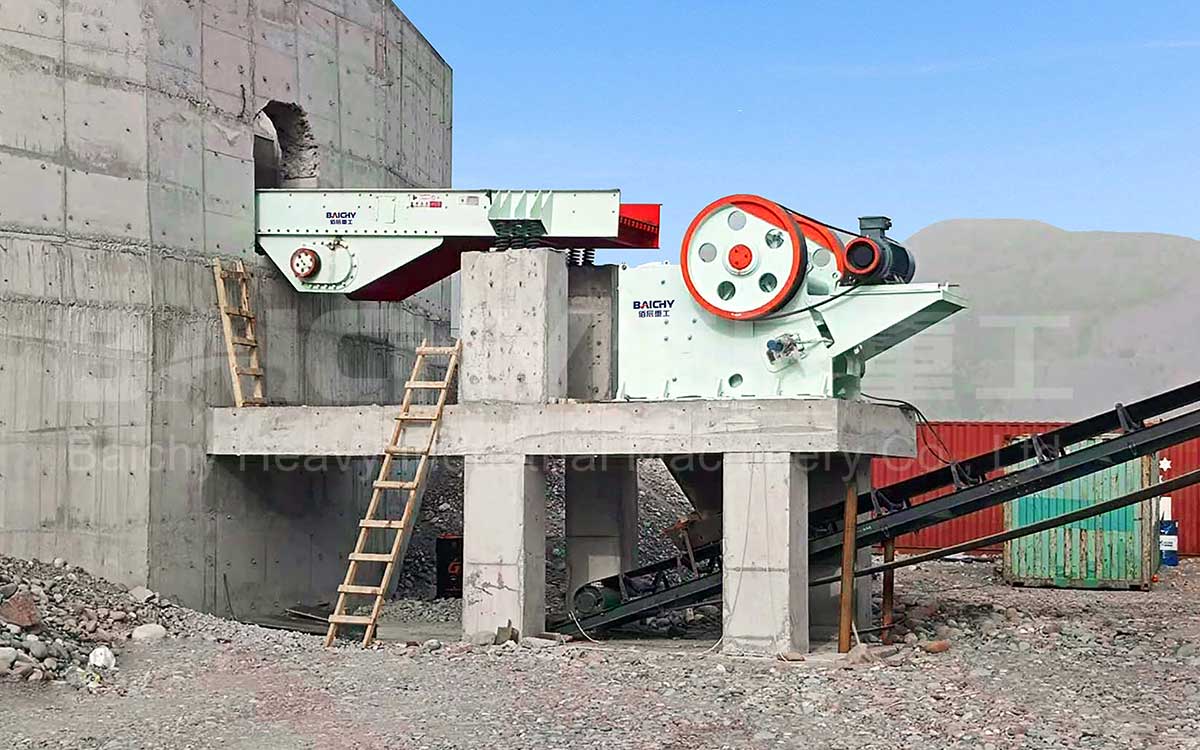
| Vibrating Feeder | ZSW380×96 | 50–100 t/h | 11 kW | Uniform feeding; pre-screening to remove soil |
| Jaw Crusher | PE400×600 | 30–60 t/h | 30 kW | Primary (coarse) crushing; output size 60–100 mm |
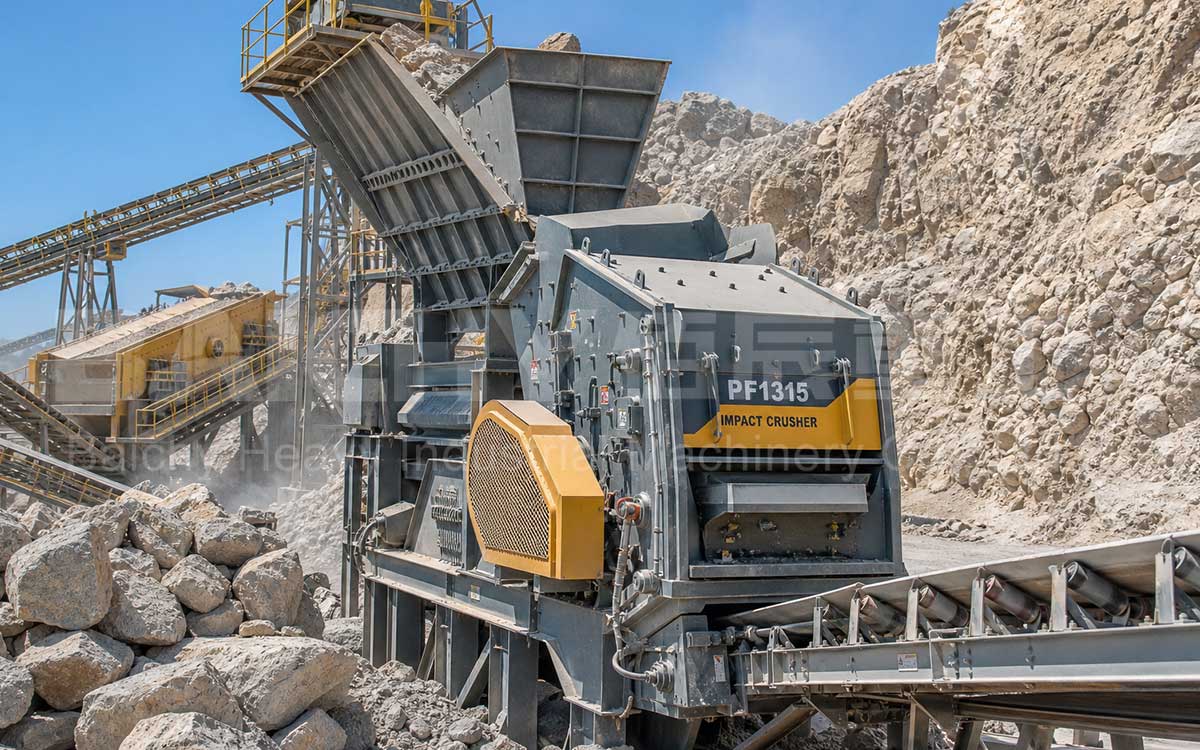
| Impact Crusher (Soft Rock) | PF1210 | 50–80 t/h | 90 kW | Secondary (medium) crushing; output size ≤40 mm |
| Cone Crusher (Hard Rock) | PYB900 | 45–60 t/h | 55 kW | Secondary crushing for hard rock; produces uniform particle shape |
| Circular Vibrating Screen | YK1545 | 50–120 t/h | 15 kW | Three-stage particle size classification |
| Belt Conveyor | B500×12m | - | 4×5.5 kW | Material transfer and linkage |
| Electrical Control System | PLC Control Cabinet | - | - | Centralized control, overload protection, fault alarms |
Key Selection Logic: For medium-soft rock (limestone, gypsum, dolomite), choose an impact crusher for high sand yield and good particle shape; for hard rock (granite, basalt, river pebbles), a cone crusher is mandatory to extend the service life of wear parts by 3–5 times.
IV. Cost Breakdown (2026 Reference Range)
| Cost Item | Reference Range (USD) | Notes |
| Main Equipment (Feeding + Crushing + Screening) | $90,000–$160,000 | Lower for soft rock (impact crusher) setups; higher for hard rock (cone crusher) setups |
| Belt Conveyors & Electrical Control System | $20,000–$40,000 | Adjusted based on site layout length |
| Steel Platforms & Civil Foundations | $20,000–$50,000 | Fixed plants require foundations; mobile stations do not |
| Installation, Commissioning & Sea Freight | $15,000–$30,000 | Depends on destination and installation conditions |
| Total Line Cost (Reference) | $150,000–$280,000 | Excludes sand-making expansion modules and spare parts inventory |
Profitability Analysis: Taking the $150,000 soft-rock setup as an example—based on a daily output of 400 tons, an average aggregate selling price of $18/ton, and a production cost of approximately $8/ton—the daily gross profit is about $4,000, with a payback period of 9–12 months. If the final product is sold as manufactured sand, the premium can increase by another 15–20%.
V. Equipment Advantages
• Low Investment, Fast Return: Streamlined equipment configuration with no redundancies; requires less capital and offers a short payback period.
• Modular, Rapid Installation: Independent modular units assembled on-site according to blueprints; production can begin within 2–4 weeks.
• Intelligent Control for Energy Efficiency: Features PLC centralized control and variable-frequency feeding; total line energy consumption is controlled at 1.2–1.8 kWh/ton, resulting in significant annual electricity savings.
• Wear-Resistant Design for Longevity: Jaw plates and blow bars utilize high-manganese steel or high-chromium materials, ensuring stable operation even in hard-rock applications.
• Global Power Standard Compatibility: Supports customization for 380V/50Hz, 400V/50Hz, 440V/60Hz, 480V/60Hz, etc., enabling "plug-and-play" operation for overseas projects.
• High Expandability: Interfaces for sand-making and sand-washing machines are pre-installed; the system can be upgraded to an integrated "crushing + sand-making + washing" production line without replacing the main unit.
VI. Relevant Case Studies
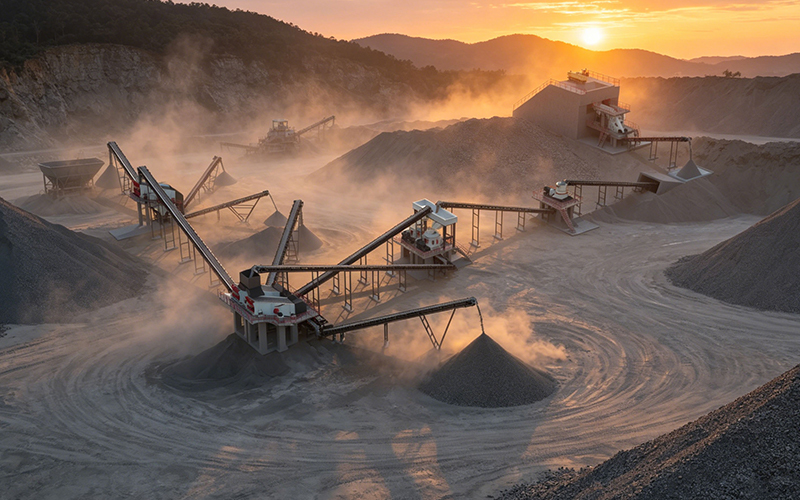
Hard Rock Crushing Plant
6.1 Fixed River Pebble Crushing Line in the Philippines (C90 Configuration)
Designed for the highly abrasive nature of river pebbles, this hard-rock configuration utilizes a C90 jaw crusher, a PYB900 cone crusher, and a vibrating screen. Actual on-site production capacity remains stable at 48–55 t/h. The finished product supplies local road base construction and concrete mixing plants, with equipment uptime maintained at over 95% since commissioning.
6.2 Small-to-Medium Granite Project in Southeast Asia
Utilizing a combination of ZSW380×96, PE400×600, and PF1210 units, the granite crushing capacity is approximately 42–50 t/h. The yield of 0–5mm manufactured sand reaches 28%; when paired with a fine sand recovery machine, the fines content in the final product is effectively controlled, directly meeting local standards for commercial concrete plants.
VII. Recommended Auxiliary Equipment
Based on the operating conditions of a 50 t/h crushing production line, the following auxiliary equipment is recommended (available for combined purchase):
• PE400×600 Jaw Crusher: Primary crusher for coarse crushing; easy maintenance and globally standardized spare parts.
• PE500×750 Jaw Crusher: Upgrade option for applications requiring larger feed sizes.
• PF1210 Impact Crusher: Secondary crushing for medium-soft rock; produces excellent particle shape and high sand yield.
• PYB900 Cone Crusher: Essential for hard rock applications; features inter-particle (lamination) crushing and long-lasting wear parts.
• YK1545 Circular Vibrating Screen: Three-stage screening with modular screens for quick replacement.
• VSI-7611 Sand-Making Machine: Expansion unit for the finishing stage; directly produces high-quality manufactured sand.
• YDPZ Series Mobile Crushing Station: An optimal solution for sites requiring frequent relocation or construction waste processing.
Need a complete proposal, detailed quotation, or production line layout drawing? Please provide details regarding the material lithology, feed particle size, and target product specifications; our engineers will prepare a tailored configuration plan within 24 hours.
FAQ (Frequently Asked Questions)
FAQ 1: What is the approximate investment cost for a crushing production line with an hourly output of 50 tons?
The estimated budget for the complete line is US$150,000–$280,000 (2026 price range). The variation depends primarily on material hardness: a configuration using an impact crusher for medium-soft rock costs approximately US$150,000–$200,000, while a configuration using a cone crusher for hard rock costs approximately US$220,000–$280,000 (excluding civil engineering and site preparation costs).
FAQ 2: What are the configuration differences between hard rock and soft rock?
The key difference lies in the secondary crushing equipment: soft rock (limestone, gypsum, dolomite) utilizes an impact crusher, offering lower investment costs and superior particle shape; hard rock (granite, basalt, river pebbles) requires a cone crusher, as using an impact crusher would result in excessive blow bar wear and downtime costs that far exceed the initial price difference. Primary jaw crushing, screening, and feeding equipment are generally the same for both types.
FAQ 3: How long does it take to recoup the investment for a 50 tph production line?
Based on a daily output of 400 tons, an average aggregate selling price of US$18/ton, and a production cost of US$8/ton, the daily gross profit is approximately US$4,000. The payback period for a soft rock configuration is 9–12 months; if sand-making and sand-washing equipment are added to produce and sell manufactured sand at a premium price, the payback period can be further shortened to 7–10 months.