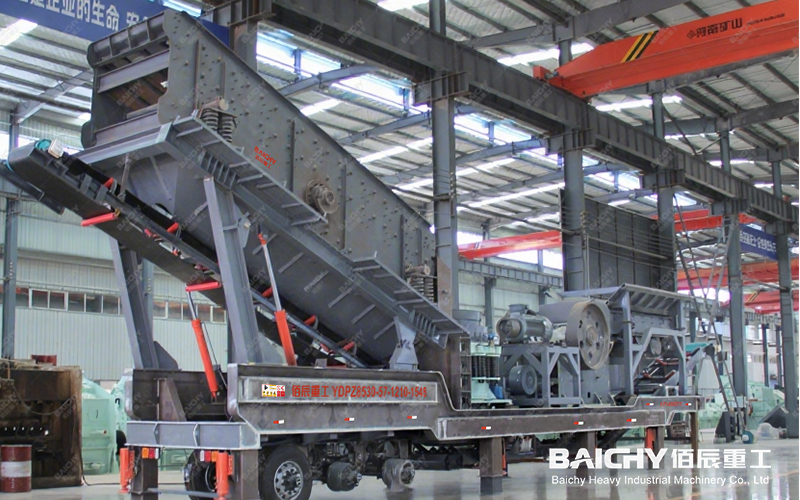
4-in-1 Mobile Crushing Station (50-150 TPH)
I. Core Equipment Configuration (Capacity: 50–150 t/h)
Baichy Heavy Industry’s Four-in-One Mobile Crushing Plant is a mobile gravel plant that integrates four major functions into a single unit: feeding, crushing, screening, and conveying.
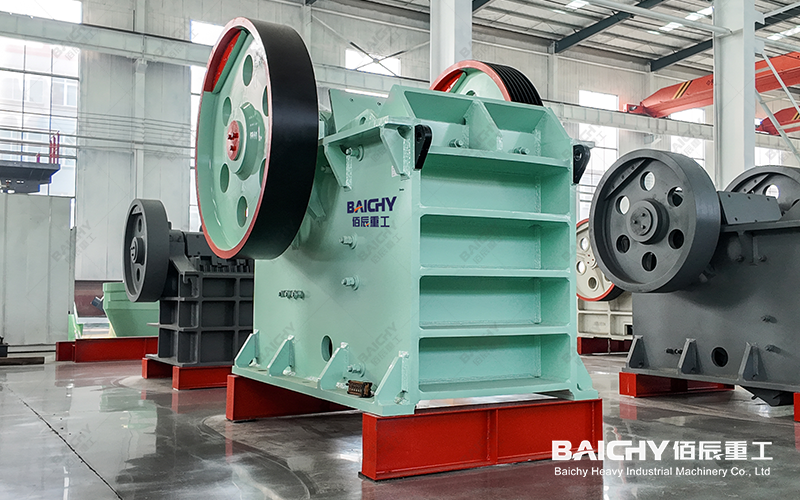
• Coarse Crushing Unit: Equipped with a PE500×750 or PE600×900 jaw crusher, responsible for the primary crushing of large raw stones (≤500 mm).
• Medium & Fine Crushing Unit: Equipped with a CS75 Symons Cone Crusher (900 mm diameter), which utilizes the principle of inter-particle crushing to process high-hardness materials and produce finished products with excellent particle shape.
• Screening Unit: Fitted with a 3YK1848 or 4YK1848 vibrating screen, capable of simultaneously producing 3 to 4 different specifications of finished aggregate.
• Capacity Performance: Offers a stable output capacity between 80–120 t/h, with a potential peak capacity of up to 150 t/h, depending on material hardness and operational adjustments.

Mobile Jaw Crusher PDF, Download ↓↓↓
II. Market Demand Analysis
1. Key Customer Pain Points
No Fixed Infrastructure Required: Many customers face short project cycles or require frequent site relocation; consequently, they are unwilling to incur the high costs associated with constructing permanent foundations and fixed infrastructure.
Integrated Solution: Customers seek a single, comprehensive equipment unit to address all processing needs, thereby eliminating the installation, wiring, and coordination complexities typically associated with operating multiple separate machines in tandem.
High-Standard Finished Products: Projects involving highways, railways, and high-rise buildings impose stringent requirements regarding the flakiness and elongation of sand and gravel aggregates; the inclusion of the Symons cone crusher significantly enhances the quality of the finished product to meet these high standards.
2. Key Demand Regions
Mexico & Latin America: Driven by significant demand for highway expansion and mining operations—particularly in remote job sites—highly mobile equipment solutions are extremely popular in this region.
Southeast Asia / Africa: Primarily utilized for infrastructure development projects, such as the processing of railway ballast.
Domestic Market (China): Predominantly deployed for construction waste recycling and the operation of temporary sand and gravel production sites. 3. Application Scenarios
Natural Ores: Crushing of hard rocks such as granite, basalt, river pebbles, etc.
Construction Waste Recycling: Processing of concrete and brick into recycled aggregates during urban renewal projects.
Infrastructure Projects: Base materials for road paving, and aggregate supply for concrete batching plants.
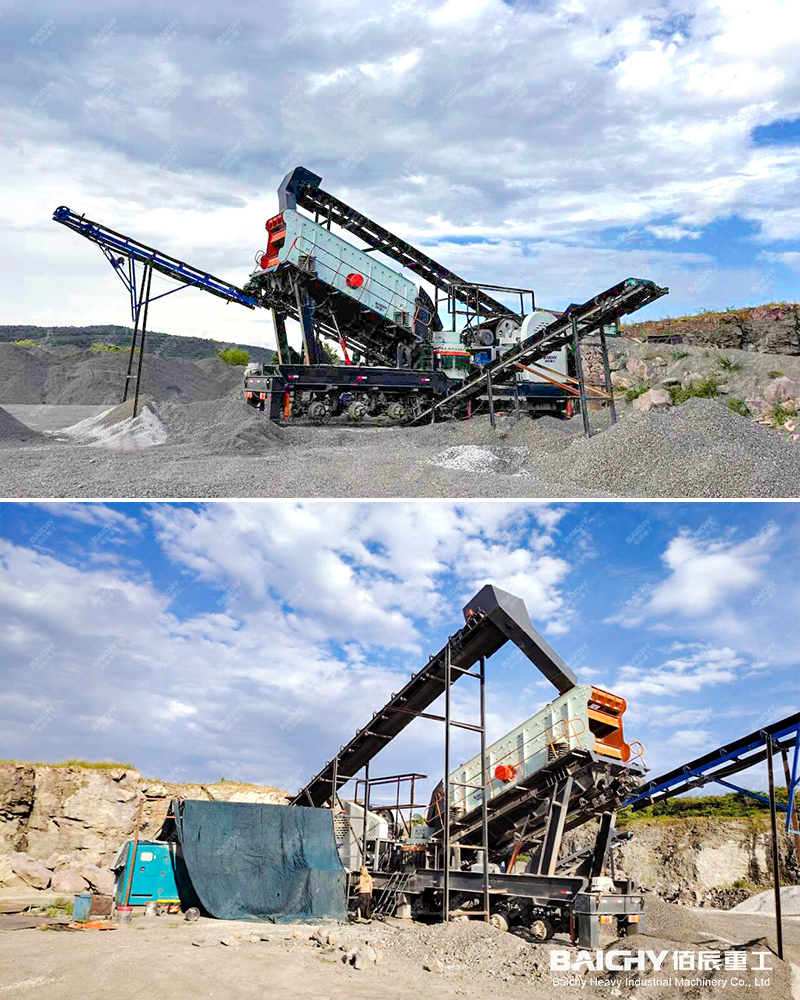
Crushing Site in Mexico Four-Unit Mobile Crushing Station
III. Case Study: Baichy Heavy Industry Client Site in Mexico
Baichy Heavy Industry boasts numerous successful project cases in Mexico; the most representative example is a project located at a local medium-sized limestone quarry.
1. Site Configuration and Parameters
Raw Materials: Limestone, Calcite.
Feed Size: ≤425mm.
Finished Product Specifications: 0–6mm, 6–15mm, 15–31.5mm.
Main Equipment Configuration: Model YDPZ57-75 4-in-1 Mobile Crushing Station (featuring a PE500×750 Jaw Crusher + CS75 Cone Crusher).
2. Operational Advantages at the Site
Rapid Commissioning: The Mexican client reported that, upon the equipment's arrival at the site, the entire process—from unloading to producing finished aggregates—took less than one day.
Flexible Relocation: Given the dispersed nature of construction sites across Mexico, this equipment features a built-in wheeled chassis, allowing it to be quickly towed by a tractor unit between different mining areas.
Stable Quality: The produced aggregates feature excellent particle shape (rounded) and uniform gradation, making them suitable for direct supply to local ready-mix concrete batching plants and road construction companies.
3. Client Feedback Summary
The client highly praised two key features: the elimination of complex conveyor belt installation processes and the intelligent PLC control system. Consequently, the entire production line requires only 1–2 personnel on-site to handle daily monitoring and operations.
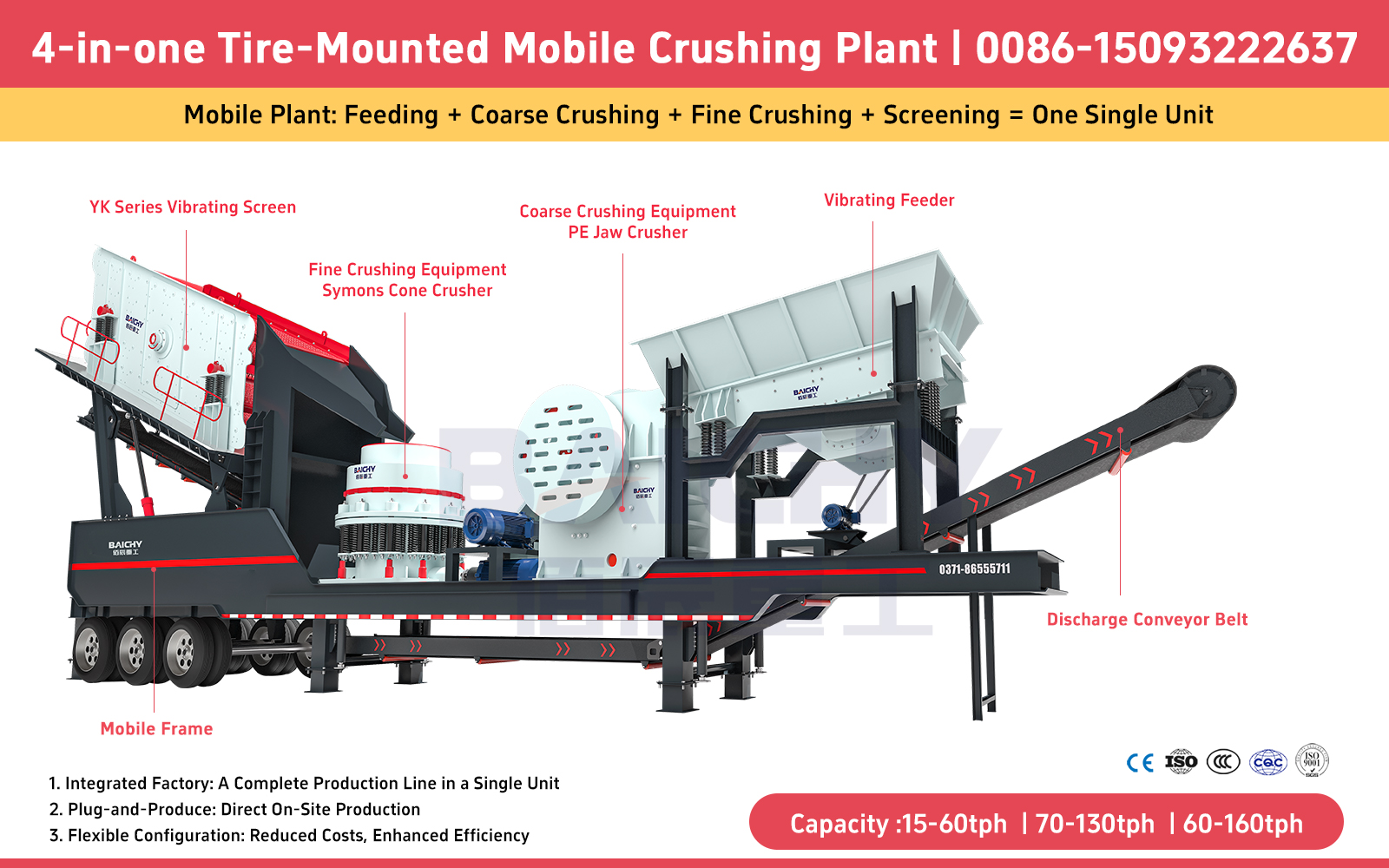
4-in-one Tire-Mounted Mobile Crushing Plant
Within the family of mobile crushing stations, the 4-in-1 combination, the 3-in-1 combination, and the Single-Module (multi-machine combination) each correspond to distinct operational logics. The core differentiating value of the 4-in-1 combination lies in its ultimate level of integration and its full-process closed-loop capability. The following are the four core points of differentiated value that distinguish the four-combination mobile crushing station from its three-combination and single-module counterparts:
1. Core Value: From Single-Machine Crushing to A Complete Plant on a Single Machine
Four-Combination (Integrated Feeding + Primary Crushing + Secondary Crushing + Screening): Completes the entire process—from raw stone intake to finished product classification—on a single vehicle chassis. It effectively condenses an entire production line onto a single mobile unit.
Three-Combination: Typically lacks one of the key stages: either secondary crushing or classification screening. For instance, a three-combination unit often consists of feeding + jaw crushing + screening, yielding only preliminarily crushed stone; to produce high-specification aggregates, an additional external crusher is usually required.
Key Differentiator: The four-combination unit truly realizes the concept of raw stone in, multi-specification finished products out, requiring absolutely no external auxiliary equipment.
2. Space & Site Adaptability: The Survival Expert for Extremely Confined Spaces
Four-Combination: Occupies the smallest footprint. Because its four major modules are integrated longitudinally, its operational layout is linear; this makes it ideally suited for work sites inaccessible to larger machinery—such as along road embankments, on narrow mountain roads, or within the tight confines of urban demolition zones.
Single-Module (Multi-Unit Collaborative Operation): Requires multiple vehicles to be parked simultaneously, connected by lengthy conveyor belts between units. The total footprint is typically 3 to 5 times larger than that of the four-combination unit.
Key Differentiator: The four-combination unit solves the problem of no space to start work, making it the optimal solution for temporary infrastructure projects (such as road and bridge construction projects that involve continuous relocation).
3. Relocation Efficiency & Cost: Minimal Logistics Overhead
Four-Combination: Requires only a single tractor unit (semi-trailer truck) to tow the entire assembly away. There is no need to dismantle conveyor belts or re-align inpidual pieces of equipment.
Single-Module: During relocation, the feeding station, jaw crushing station, cone crushing station, and screening station must be transported separately. Furthermore, the on-site installation and commissioning of the connecting conveyor belts can take anywhere from 3 to 7 days. Key Differentiator: The Four-in-One Combination achieves a stop-and-produce, load-and-go capability. For clients who need to relocate their operations site as often as once a month, this integrated unit generates substantial annual savings on relocation hoisting, labor costs, and conveyor belt wear and tear.
4. Process Logic: The Golden Ratio for Hard Rock Processing
The Four-in-One Combination (Jaw Crusher + Symons Cone Crusher): This specific configuration represents a classic workflow designed for processing hard rock materials (such as granite, river pebbles, etc.). Integrating a cone crusher—a heavy and powerful machine—onto a single chassis places extremely rigorous demands on the chassis's structural design and vibration resistance.
Inpidual Modular Units: While offering superior inpidual performance, these systems are inherently complex; consequently, their long-term maintenance requires the separate management of multiple distinct components.
Key Differentiator: Within the production capacity range of 50–150 tons per hour (tph), the Four-in-One Combination strikes an optimal balance between equipment performance and structural load. This enables small-to-medium-scale clients to access a high-end production workflow—featuring the powerful Jaw Crusher + Cone Crusher combination—with the lowest possible initial capital investment. ---
Summary Comparison Table:
| Dimension | 4-in-1 Combination | 3-in-1 Combination | Single Modules (Multi-Unit Setup) |
| Equipment Composition | Feeding + Primary Crushing + Secondary/Fine Crushing + Screening | Typically lacks secondary crushing | One machine per function; modular design |
| Finished Product Quality | High (Laminated crushing via Symons Cone Crusher) | Average | Highest (Greater configuration flexibility) | |
| Relocation Speed | Extremely Fast (Within 1 day) | Fast | Slow (Requires disassembly and reassembly) |
| Initial Investment | Best overall unit cost | Lower, but functionality is incomplete | HigLarge-scale mines; long-term fixed operations |
Conclusion: The true value of the 4-in-1 combination lies not in pursuing maximum output, but rather in consistently producing high-quality aggregates anywhere—with the simplest operation, the smallest footprint, and the fastest speed.
About of Baichy Heavy Industry
Baichy Heavy Industry is a high-tech mining equipment company integrating R&D, manufacturing, sales, and after-sales service. Focusing on crushing, grinding, and mineral processing equipment, we provide professional solutions to our customers. We are ISO9001:2015 、certified, and our products include mobile crushing palnts, crawler crushing plant, construction waste crushing plants, jaw crushers, sand making machines, cone crushers, fine crushers, grinding mills, ball mills, etc., all with reliable performance to meet diverse project needs.
Our advantages:
• Professional pre-sales support: Free project design and comprehensive solutions to help you accurately select the right equipment;
• Comprehensive on-site service: Providing installation guidance and worker training to ensure smooth equipment commissioning;
• Reliable after-sales guarantee: A complete after-sales system, timely response to technical inquiries and equipment maintenance, ensuring long-term stable operation.
To protect your rights, please contact us through the following official channels for professional service:
Official Website Customer Service
https://wa.me/+8615093222637
Email: [email protected]
We are committed to providing high-quality equipment and full-cycle services to deliver comprehensive intelligent solutions for the global mining industry!
Customer Frequently Asked Questions (FAQ)
Q1: Can your 4-in-1 mobile crushing station truly operate without a concrete foundation?
Yes, this is precisely the core advantage of our product. The equipment is integrated onto a towable wheeled chassis and features built-in hydraulic support legs. Upon arrival at the site, you simply need to level the ground and lower the support legs to begin production. This completely eliminates the need for concrete foundation pouring, multi-unit alignment, and complex conveyor corridor installation—processes typically required for traditional production lines—thereby truly achieving ready-to-use functionality.
Q2: Compared to a traditional setup involving multiple separate machines, is the particle shape quality of the finished product from the 4-in-1 mobile station guaranteed?
It is absolutely guaranteed—in fact, it is often superior. The key lies in the fact that our 4-in-1 combination comes standard with a CS75 Symons Cone Crusher. This crusher utilizes a unique laminated crushing principle to effectively reduce the content of flaky and needle-like particles. The resulting aggregates feature a rounder particle shape and a more optimal gradation, making them particularly well-suited to meet the strict aggregate requirements for high-grade highways, railway ballast, and high-strength concrete. This is a capability that many three-unit combinations—or simple impact crusher setups—simply cannot match.
Q3: Just how fast is the equipment relocation process? Is the operation complex?
Relocation is extremely efficient. The entire process requires only three steps: retract the hydraulic outriggers, connect the tractor unit, and tow it away. There is no need to dismantle any of the main processing units or conveyors. Typically, when moving from one job site to an adjacent one, production can resume on the very same day. In terms of operation, the equipment is equipped with an intelligent PLC centralized control system; all start-up, adjustment, and monitoring functions can be managed directly from the main electrical control cabinet, requiring only 1–2 operators on-site.