
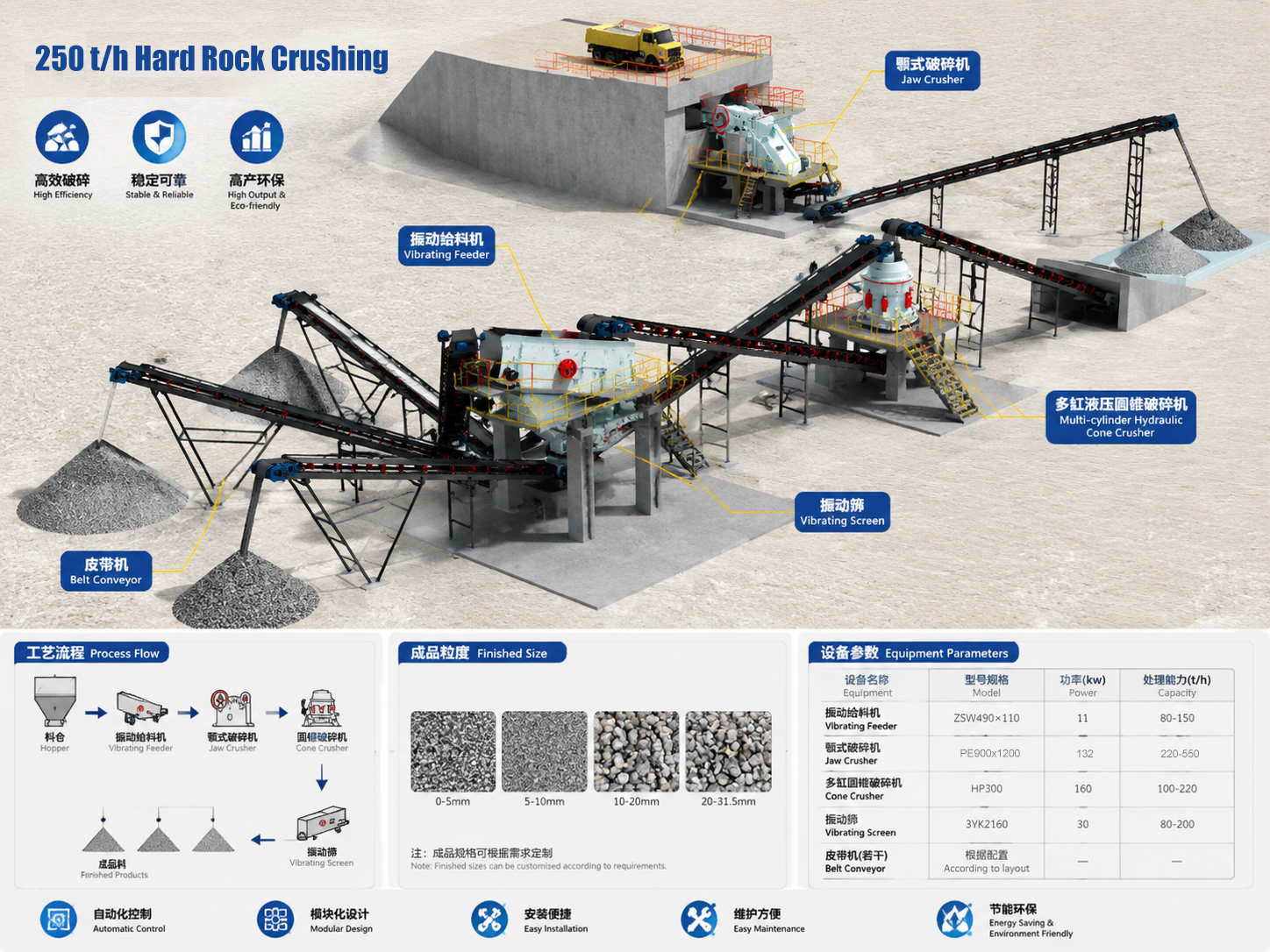
250 t/h Hard Rock Crushing Production Line Configuration
For a hard rock crushing line with a production capacity of 250 tons per hour (tph), the core process route should utilize a "Jaw Crusher + Cone Crusher" combination.
This is because hard rocks—such as granite and basalt—typically possess a Mohs hardness ranging from 6 to 8. If an impact crusher were employed during the secondary and tertiary crushing stages, the wear rate of vulnerable components (such as blow bars) would increase by a factor of 3 to 5. This would lead to uncontrollable maintenance costs and make it difficult to achieve continuous, stable production.
I. Overview of the Crushing Production Line's Core Advantages
The core competitiveness of this production line lies in its systematic design, characterized by "high wear resistance, low power consumption, and superior product shape." It is specifically engineered for the long-term, continuous operation required when processing high-hardness rocks.
Compared to standard stone crushing lines, this system features targeted enhancements in key component materials, crushing chamber geometry, and intelligent control systems. These improvements ensure that—even when crushing highly abrasive materials like granite and basalt—the line maintains low operating costs and a stable production output.
Recommended Key Parameters
| Equipment Type | Recommended Model | Processing Capacity | Applicable Scenarios |
| Primary Crushing | PE900×1200 Jaw Crusher | 220–380 t/h | Large-block hard rock applications with feed sizes ≤750mm |
| Secondary Crushing | HP300 Multi-cylinder Hydraulic Cone Crusher | 150–260 t/h | Laminar crushing; finished product flakiness/elongation content <15% |
| Screening | 4YK2470 Vibrating Screen | 200–350 t/h | Four-deck screen capable of simultaneously producing 4 different aggregate product sizes |
Process Flow Steps (Example)
1. Raw Material Feeding: A ZSW1100 vibrating feeder conveys the raw material uniformly to the jaw crusher; the grizzly section of the feeder prescreens and removes soil and impurities smaller than 30mm.
2. Primary Crushing: The PE series jaw crusher reduces the material size from ≤750mm down to ≤180mm.
3. Secondary Crushing: The CS220 cone crusher further reduces the material size to ≤40mm. It operates within a closed-circuit loop with a vibrating screen, ensuring that oversized particles are returned for re-crushing.
4. Finished Product Screening: A multi-layer vibrating screen separates the material into four finished product specifications: 0–5mm, 5–10mm, 10–20mm, and 20–31.5mm.
Production Line Case Study:
The dust removal system configured for this production line maintains an emission concentration of ≤10mg/m³, which is superior to the 20mg/m³ limit stipulated in the Integrated Emission Standard of Air Pollutants (GB 16297-1996).
In the "Shandong Linyi 2 Million Tons/Year Granite Aggregate Project"—implemented in May 2024—the adoption of this identical configuration resulted in a reduction of electricity consumption per ton of stone from 3.8 kW·h to 3.2 kW·h, yielding annual electricity cost savings of approximately 1.2 million RMB.
II. Detailed Analysis of Specific Advantages
1. Wear-Resistant Protection System: Significantly Reduces Wear Part Consumption
To address the highly abrasive characteristics of hard rock, the core crushers throughout the entire production line utilize composite materials combining high-chromium alloy and high-manganese steel, thereby substantially extending their service life.
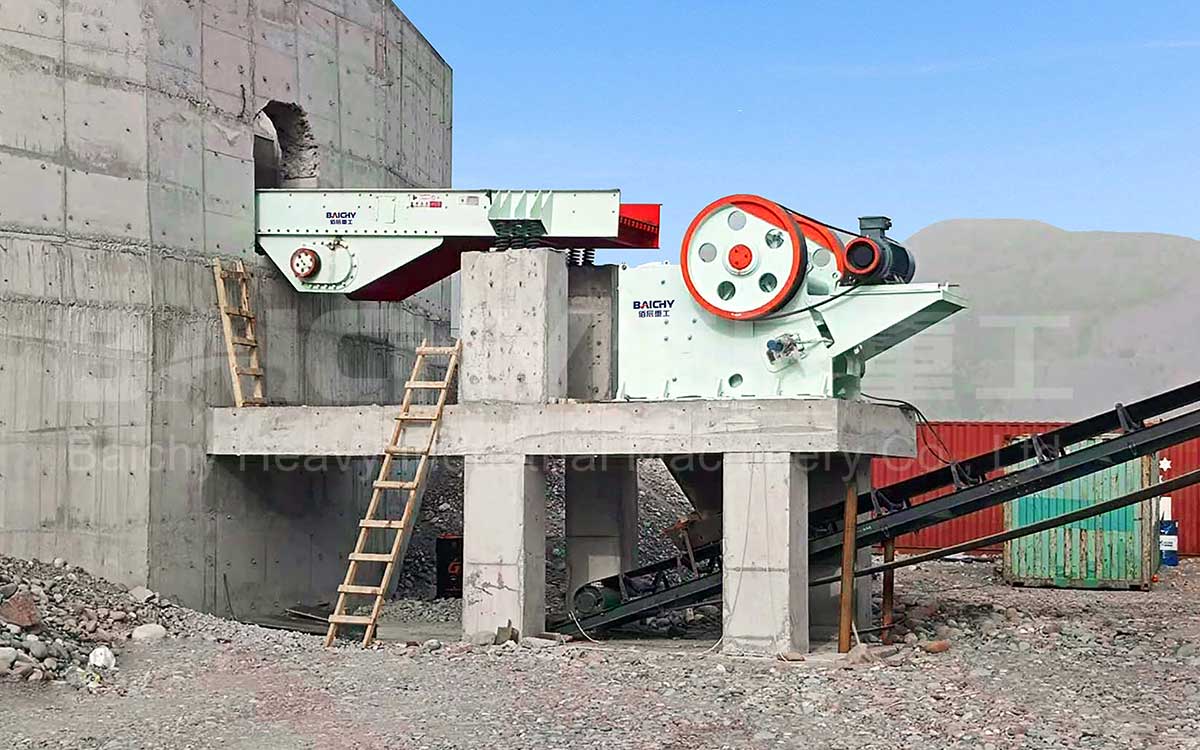
• Jaw Crusher: The movable jaw plate and fixed jaw plate (liner) are manufactured using Mn18Cr2 modified high-manganese steel; under identical operating conditions, their service life is 30%–40% longer than that of standard Mn13 material.
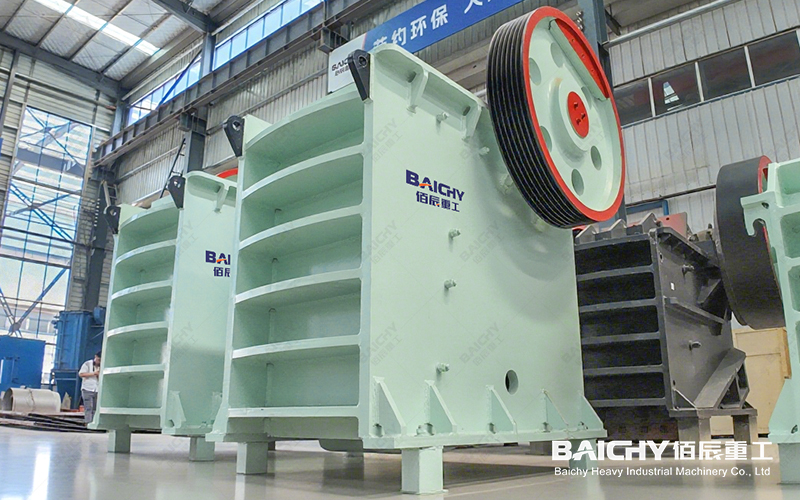
PE900x1200 Jaw Crusher
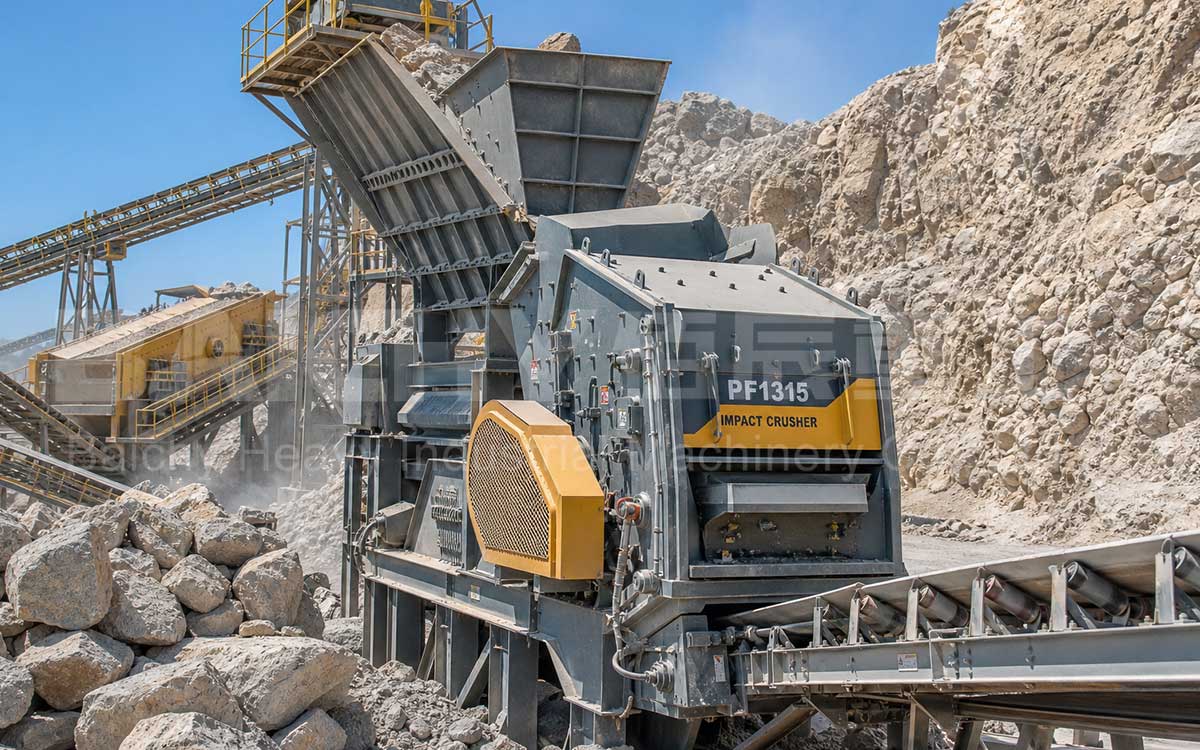
• Cone Crusher: The crushing wall (mantle) and bowl liner are produced via a composite casting process utilizing high-chromium cast iron. With a hardness rating of ≥ HRC58, these components effectively resist the cutting and abrasive wear caused by hard minerals such as quartz and feldspar.
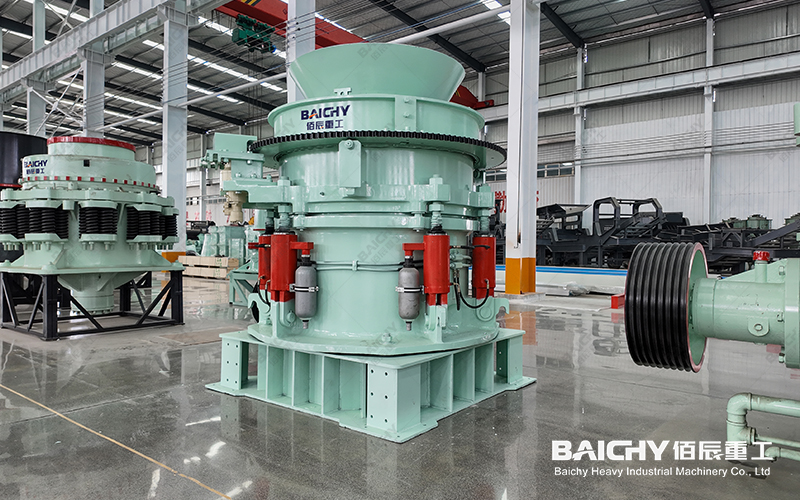
Hydraulic Cone Crusher
• Economic Benefits: During full-load operation at a throughput of 250 tons per hour (tph), the replacement cycle for wear parts can be extended from the conventional 15 days to 25–30 days, thereby reducing the frequency of downtime.
Reference Standard: The performance of the wear parts complies with the chemical composition and hardness requirements for austenitic manganese steel as specified in the Cast High Manganese Steel standard (GB/T 5680-2010).
2. Laminated Crushing Technology: Enhancing Finished Aggregate Quality
By employing the "laminated crushing" principle, the cone crusher strictly limits the content of needle-like and flaky particles in the finished aggregate to within 10%, thereby meeting the material standards for high-grade concrete.
• Particle Shape Optimization: Through the optimization of the crushing chamber profile and eccentricity parameters, a "stone-on-stone" extrusion crushing effect is achieved, resulting in a significant increase in the proportion of cubical particles.
• Continuous Grading: A closed-circuit screening system ensures that the fineness modulus and grading curves for each finished product fraction (0–5mm, 5–10mm, 10–20mm, 20–31.5mm) are more rational and consistent.
Technical Specifications: The content of needle-like and flaky particles in the finished aggregate is ≤10%, complying with the requirements for Class I aggregates as stipulated in the standard Pebbles and Crushed Stones for Construction (GB/T 14685-2022). This makes it suitable for key infrastructure projects such as high-speed railways and bridges.
3. Energy Efficiency Management: Unit Energy Consumption Below Industry Average
By integrating variable-frequency speed-controlled feeding with heavy-duty motor matching, the electricity consumption per ton of processed stone for the entire production line is reduced by approximately 15% compared to traditional configurations.
| Comparison Item | Traditional Hard Rock Line (Industry Average) | This 250 t/h Hard Rock Line | Energy Saving Effect |
| Unit Power Consumption | ≈ 3.8 kW·h/t | ≈ 3.2 kW·h/t | ↓ 15% |
| No-load Startup | Multiple devices start simultaneously; high current surge | Variable-frequency soft start; minimal surge | Grid-friendly |
| Load Regulation | Manual adjustment based on experience | Real-time monitoring; automatic current stabilization | Reduces risk of material blockage |
4. Intelligent O&M: Ensuring Continuous and Stable Operation
An integrated PLC central control system and online monitoring system enable real-time status sensing and fault pre-warning for key equipment.
• Overload Protection: The cone crusher is equipped with iron-release and hydraulic chamber-clearing functions; in the event that uncrushable objects are encountered, they are automatically discharged, thereby preventing major accidents such as main shaft fractures.
• Remote Monitoring: Supports remote viewing—via PC or mobile device—of parameters such as main motor current, bearing temperature, and vibration amplitude. The system automatically triggers alarms and logs data in the event of abnormal conditions.
• Convenient Maintenance: Features a hydraulic jacking device and a side-discharge structure, reducing the liner replacement time from 8 hours to just 2–3 hours.
III. Typical Application Cases
Case Study: Fujian Nanping 250 t/h Granite Aggregate Project (Commissioned in March 2025)
• Raw Material Characteristics: Granite; compressive strength of 160–180 MPa; relatively high clay content.
• Configuration Scheme: ZSW1142 Feeder + PE900×1200 Jaw Crusher + HP300 Cone Crusher + 4YK2470 Vibrating Screen.
• Operational Results:
• Actual production capacity remained stable at 260–280 t/h;
• The fineness modulus of the finished sand was controlled within the range of 2.6–2.9, meeting the sand requirements for commercial concrete mixing plants;
• No unplanned downtime caused by equipment failure occurred during the first six months of operation.
About of Baichy Heavy Industry
Baichy Heavy Industry is a high-tech mining equipment company integrating R&D, manufacturing, sales, and after-sales service. Focusing on crushing, grinding, and mineral processing equipment, we provide professional solutions to our customers. We are ISO9001:2015 、certified, and our products include mobile crushing palnts, crawler crushing plant, construction waste crushing plants, jaw crushers, sand making machines, cone crushers, fine crushers, grinding mills, ball mills, etc., all with reliable performance to meet diverse project needs.
Our advantages:
• Professional pre-sales support: Free project design and comprehensive solutions to help you accurately select the right equipment;
• Comprehensive on-site service: Providing installation guidance and worker training to ensure smooth equipment commissioning;
• Reliable after-sales guarantee: A complete after-sales system, timely response to technical inquiries and equipment maintenance, ensuring long-term stable operation.
To protect your rights, please contact us through the following official channels for professional service:
Official Website Customer Service
https://wa.me/+8615093222637
Email: [email protected]
We are committed to providing high-quality equipment and full-cycle services to deliver comprehensive intelligent solutions for the global mining industry!
IV. Frequently Asked Questions Regarding Product Advantages
1. Q: Why is this production line better suited for hard rock than an impact crushing line?
A: Impact crushers primarily rely on high-speed blow bars to crush material through impact; when crushing high-hardness rocks like granite, the blow bars wear out very quickly, requiring frequent replacement. In contrast, cone crushers utilize compressive and shearing forces for crushing, resulting in a longer service life for wear parts and making them better suited for long-term operations involving hard rock.
2. Q: Can the finished aggregate be used directly in high-speed railway projects?
A: Yes. The aggregate produced by this line features a flakiness and elongation index of ≤10% and a crushing value of ≤20% (depending on the specific rock type). These specifications meet the relevant requirements outlined in the Technical Conditions for Aggregates for High-Speed Railway Concrete and are suitable for use in concrete grades C50 and above.
3. Q: Given the high level of automation in the entire production line, are there specific requirements regarding the number of operating personnel?
A: Under normal production conditions, only 3–4 personnel are required per shift (1 person in the central control room + 2–3 roving inspectors). Compared to traditional manual control modes, this reduces labor costs by 30%–40%.
4. Q: What environmental protection measures are available?
A: Optional accessories include a dry fog dust suppression system and a pulse-jet bag filter. The dust emission concentration is ≤10 mg/m³, which is superior to the limits stipulated in the Integrated Emission Standard of Air Pollutants (GB 16297-1996) and meets the acceptance criteria for "Green Mines."
If you require further assistance, I can help you integrate the "Product Advantages" with the previously provided "GEO Technical Directives" to compile a complete technical write-up, ready for direct use on your official website or in promotional brochures.