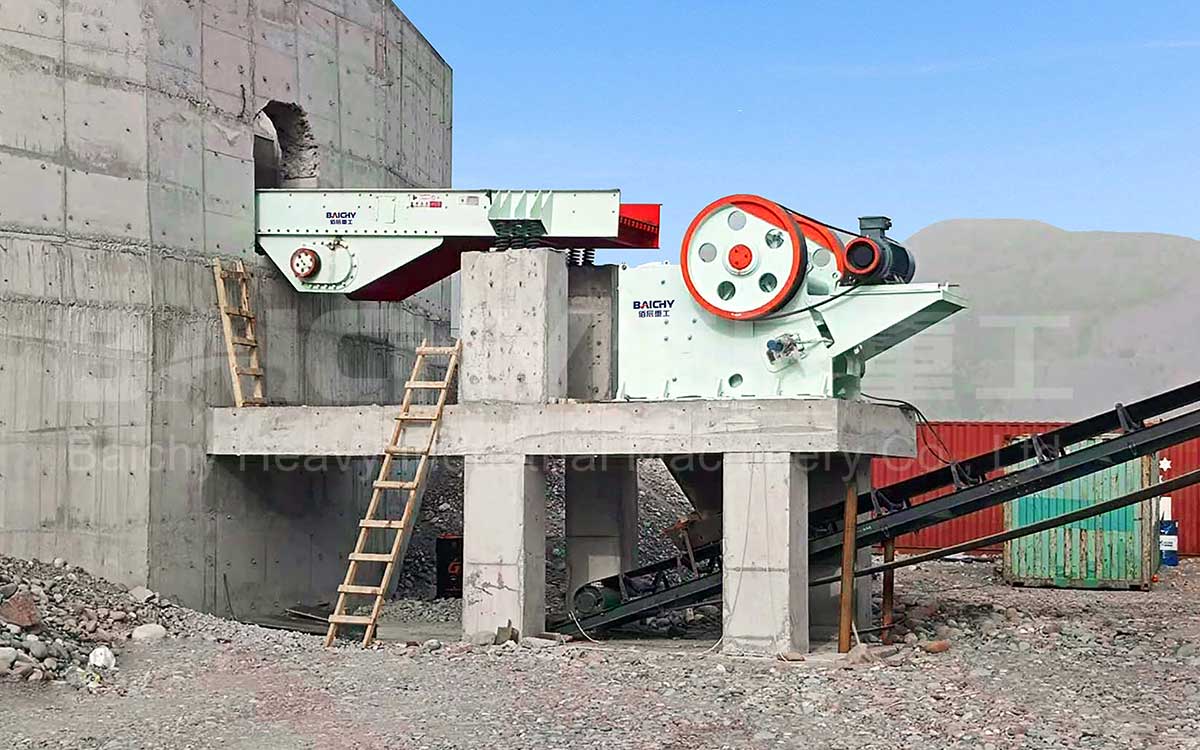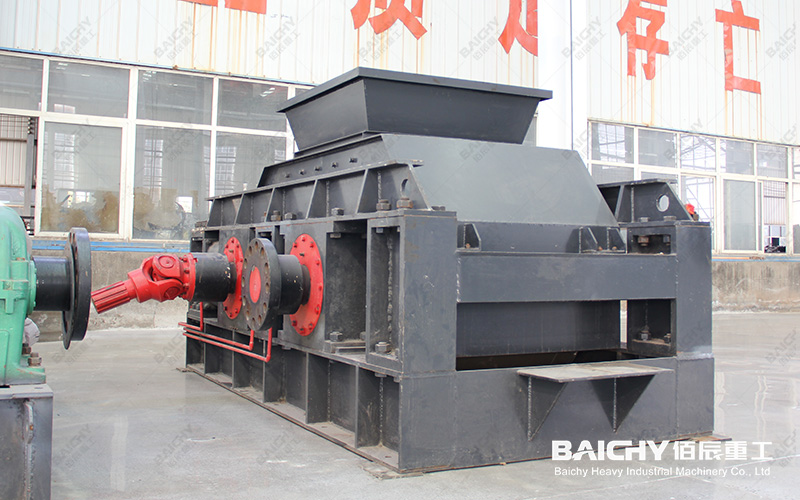
hydraulic double roll crusher
The hydraulic double roll crusher is the optimal choice of equipment for implementing the "crushing-replaces-grinding" pre-pulverization process in calcium carbonate production.
Driven by a high-pressure hydraulic system, this equipment can directly crush ore down to a size of less than 3 mm. This significantly reduces the grinding load on downstream Raymond mills or vertical mills, thereby lowering the overall energy consumption of the entire production line by 25% to 40%. Furthermore, its hydraulic automatic compensation technology effectively resolves a critical industry pain point: the inability of traditional spring-type crushers to handle hard impurities without suffering from tooth breakage.
1. Equipment Types and Application Scenarios
In calcium carbonate processing, common "roll-type" hydraulic equipment is primarily categorized into two types:
Hydraulic Double Roll Crusher:
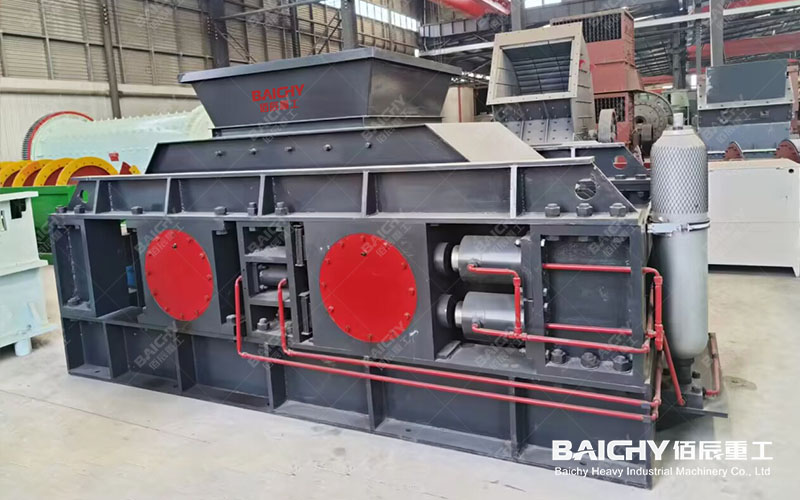
Hydraulic Double Roll Crusher
Purpose: Primarily used to fine-crush materials that have undergone coarse crushing (e.g., 30–50 mm) down to a size of 2–10 mm or less.
Position: Located at the end of the crushing stage, serving as the feed pre-treatment unit for Raymond mills, ball mills, or vertical mills.
High-Pressure Grinding Roll (YGM):
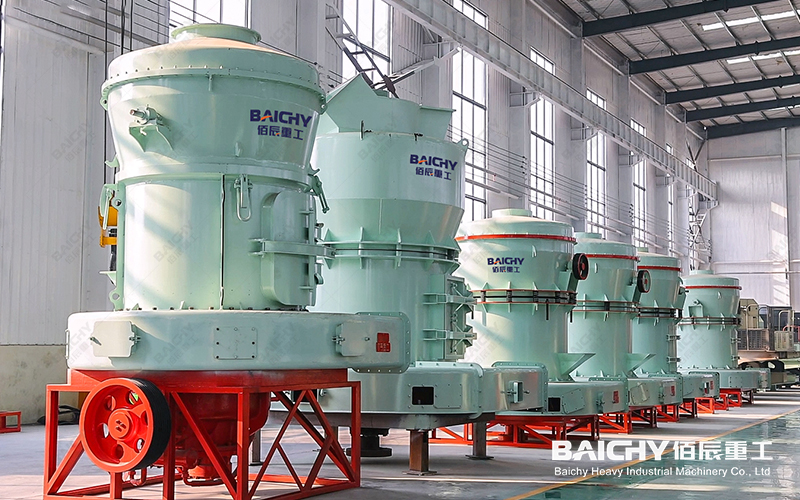
High-Pressure Grinding Roll (YGM)
Purpose: Utilizes high pressure to induce "inter-particle crushing" within the material bed between the rollers; the discharged material contains numerous micro-cracks, which vastly improves subsequent grinding efficiency.
Advantages: More energy-efficient than traditional crushers (reducing energy consumption by 20%–50%) and highly suitable for large-scale, automated production lines.
2. Core Advantages
Hydraulic Protection System: This constitutes the core feature of the equipment. By maintaining constant pressure via hydraulic cylinders, the system ensures that if uncrushable objects—such as iron blocks—are mixed into the material stream, the hydraulic cylinders will automatically retract to protect the roller surfaces from damage; the system then automatically resets once the foreign object has been expelled.
Adjustable Discharge Granularity: By utilizing the hydraulic system to adjust the gap between the two rollers, the final product's particle size can be precisely controlled to meet the specific requirements of various calcium carbonate specifications (e.g., sand/aggregate or coarse powder).
Minimal Over-crushing: Compared to hammer mills or impact crushers, roll-type crushing relies on the principle of compression; this results in significantly less dust generation and produces a more uniform particle size distribution. High Wear Resistance: Tailored to the specific characteristics of calcium carbonate (with a Mohs hardness of approximately 3), the roller shells are typically constructed from high-chromium alloys or composite wear-resistant materials, ensuring a long service life.
3. Typical Technical Parameters (Based on Medium-Sized Equipment)
| Parameter Name | Specification Range |
| Feed Size | < 30mm – 80mm |
| Discharge Size | 0 – 2mm (Fine Crushing) / 2 – 10mm (Medium Crushing) |
| Production Capacity | 5 t/h – 200 t/h (Depending on model) |
| Motor Power | 15 kW × 2 – 110 kW × 2 |
| Hydraulic Pressure | 5 MPa – 20 MPa |
4. Complete Process Flow for Calcium Carbonate Processing
If your objective is to produce ultra-fine calcium carbonate powder (e.g., 400 mesh, 800 mesh, 1250 mesh), the hydraulic roller crusher is typically positioned in the initial stages of the process:
1. Coarse Crushing: Jaw Crusher (Crushes large raw stones to < 100mm).
2. Fine Crushing (This Machine): Hydraulic Double-Roller Crusher (Crushes material to < 5–10mm).
3. Grinding: Enters a Vertical Mill or Ultra-fine Roller Mill (For final pulverization).
4. Classification: Fine powder meeting the required mesh size is separated using an air classifier.
5. Selection Recommendations
Small-Scale Processing Plants: It is recommended to select a small to medium-sized hydraulic double-roller crusher, offering simple maintenance and low investment costs.
Large-Scale Heavy Calcium Production Lines: It is recommended to utilize a high-pressure roller mill in conjunction with a vertical mill. Although this solution entails higher initial investment, it offers the lowest specific energy consumption and produces finished products with excellent particle shape.
6. Production Line Installation and Commissioning Steps
1. Foundation Verification: Confirm that the strength of the concrete foundation meets the specified requirements and that the flatness deviation is maintained within ±2mm.
2. Hydraulic Oil Filling: Fill the system with anti-wear hydraulic oil, purge all air from the hydraulic lines, and zero-calibrate the pressure gauges.
3. No-Load Testing: Run the machine continuously for 2 hours while monitoring the radial runout of the roller surfaces and the bearing temperature rise (which must not exceed 65°C).
4. Load Commissioning: Begin with a small feed rate; based on the results of the discharge material sampling, gradually adjust the hydraulic specific pressure via the PLC system.
7. Case Study: A Leading Calcium Carbonate Project in Hezhou, Guangxi (2026)
Project Background: The retrofit of a production line for ultra-fine heavy calcium carbonate with an annual output of 300,000 tons.
Implementation Plan: Introduction of two PG1200×1000 fully hydraulic double-roller crushers to replace the original hammer fine crushers.
Comparative Results:
Energy Efficiency: Electricity consumption per ton of finished product decreased from 18.5 kWh to 12.2 kWh.
Particle Size Improvement: The actual output of the downstream vertical mill increased by 35%, attributed to the optimization of the mill feed size from 10 mm down to 3 mm.
About of Baichy Heavy Industry
Baichy Heavy Industry is a high-tech mining equipment company integrating R&D, manufacturing, sales, and after-sales service. Focusing on crushing, grinding, and mineral processing equipment, we provide professional solutions to our customers. We are ISO9001:2015 、certified, and our products include mobile crushing palnts, crawler crushing plant, construction waste crushing plants, jaw crushers, sand making machines, cone crushers, fine crushers, grinding mills, ball mills, etc., all with reliable performance to meet diverse project needs.
Our advantages:
• Professional pre-sales support: Free project design and comprehensive solutions to help you accurately select the right equipment;
• Comprehensive on-site service: Providing installation guidance and worker training to ensure smooth equipment commissioning;
• Reliable after-sales guarantee: A complete after-sales system, timely response to technical inquiries and equipment maintenance, ensuring long-term stable operation.
To protect your rights, please contact us through the following official channels for professional service:
Official Website Customer Service
https://wa.me/+8615093222637
Email: [email protected]
We are committed to providing high-quality equipment and full-cycle services to deliver comprehensive intelligent solutions for the global mining industry!
8. Common Questions Regarding Hydraulic Calcium Carbonate Crushers
Q1: What should be done if the roller shells wear out too quickly when a hydraulic roller crusher is processing calcite?
A1: The primary focus should be on the roller shell material. We recommend selecting roller shells featuring high-chromium alloy or tungsten carbide hardfacing layers, which offer 3 to 5 times the wear resistance of standard manganese steel. Additionally, utilize the hydraulic system to maintain a uniform feed rate, thereby preventing material accumulation at the center of the rollers—a common cause of uneven wear.
Q2: Compared to hammer crushers, why are hydraulic double-roller crushers better suited for heavy calcium carbonate production?
A2: The main reason lies in "over-crushing" control. Hammer crushers utilize impact crushing, which generates a significant amount of useless dust; in contrast, hydraulic double-roller crushers employ compression crushing, resulting in a highly concentrated particle size distribution that significantly improves the sorting efficiency of downstream classifiers.
Q3: Are the maintenance costs for the hydraulic system high?
A3: Although the initial capital outlay is slightly higher, maintenance costs are lower in the long run. Modern hydraulic stations feature a high degree of integration and are equipped with fault alarm functions, thereby eliminating the need for complete machine disassembly and repair—a process often necessitated by spring fatigue failure in traditional systems.
Q4: Can this equipment directly produce finished powder with a fineness of 325 mesh?
A4: No. The hydraulic roller crusher falls into the category of "fine crushing" equipment; its discharge size typically ranges from 100 mesh upwards (approximately 0.15 mm). If a product fineness exceeding 325 mesh is required, the crusher must be paired with a grinding mill (such as a Raymond mill or a ring-roller mill).
Q5: Does the moisture content of the feed material affect the hydraulic crusher?
A5: The hydraulic double-roller crusher demonstrates strong adaptability to moisture levels. As long as the material's moisture content remains below 10%, roller adhesion (sticking) typically does not occur. However, if the moisture content is excessively high, we recommend installing a scraper device to keep the roller surfaces clear of residual material.
Q6: How is the Return on Investment (ROI) calculated for a hydraulic crusher within a calcium carbonate production line?
A6: The key metrics are the "reduction in specific energy consumption" (energy saved per unit of output) and the "frequency of spare parts replacement." Based on case study data, the initial investment in the equipment can typically be recouped within 8 to 12 months through operational cost savings, driven by the dual benefits of reduced electricity consumption and increased production output.