Baichy Heavy Industrial Machinery Co., Ltd
Phone/Wechat/Whatsapp:+008615093222637
24 hours online

Are You Using the RIGHT Vibrating Screen for Your Quarry? A Guide to Types and Working Principles

2024-05-11 14:32:41
Baichy
plays
Warm Tip:

If you want to know more details about equipment, solutions, etc, please click the button below for free consultation, or leave your requirements!

Types-Of-Vibrating-Screen-and-How-It-Works.jpg

In mining crushing production lines, vibrating screens play a crucial "sorting" role. They determine the particle size, grade, and purity of the final product, directly impacting its market value and the efficiency of the entire production line. However, faced with a dazzling array of vibrating screen types on the market, many decision-makers are often confused: which one is best suited to my ore characteristics and production needs?

As a marketing expert with many years of experience in the mining crushing industry, I understand the importance of "tailoring the solution to the problem." Today, we will delve into several mainstream vibrating screen types and their working principles to help you make the most informed investment decisions.

I. The Core Mission of Vibrating Screens: Why are they so critical?

Before delving into the details, we must first understand the core role of vibrating screens in the crushing process. Located after the crusher, it is responsible for:

1. Pre-screening: Separating qualified fine materials before crushing to avoid over-crushing and reduce the load on the crusher.

2. Inspection screening: Ensuring that all crushed products meet the predetermined specifications; unqualified coarse materials are returned to the crusher for further processing.

3. Grading and Screening: Materials are separated into various products according to different particle size ranges to meet perse market demands.

A high-efficiency and stable vibrating screen is the cornerstone for ensuring continuous and efficient operation of the production line and producing high-value products.

II. Mainstream Vibrating Screen Types and Their Working Principles

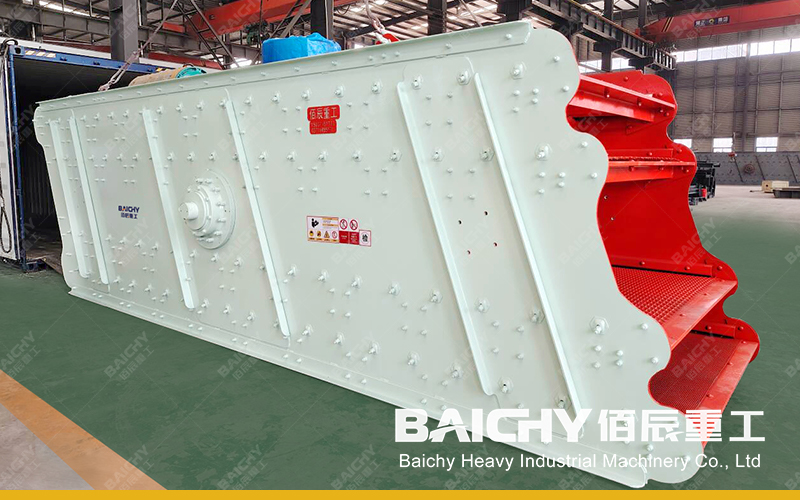
Vibrating screens can be classified in various ways, but the core difference lies in the way they generate vibration and their motion trajectory. The following are some of the most common and efficient types in the mining industry:

1. Circular Vibrating Screen

• Working Principle: This is the most classic and widely used type. Its vibration source (vibrating motor) is located on the side plate or above the screen box. The eccentric block in the vibrator rotates at high speed under the drive of the motor, generating a strong centrifugal force. This force causes the screen box to produce an approximately circular motion trajectory. The material is thrown up and jumps forward on the screen surface, thus achieving screening.

• Structural Characteristics: Typically uses a shaft-eccentric or block-eccentric vibrator, with a relatively large screen surface inclination angle (15°-25°), resulting in high material movement speed.

• Application Scenarios: Particularly suitable for screening large, high-density materials to a coarse or medium particle size. For example, pre-screening or grading granite, iron ore, etc., after primary crushing. Its advantages are high throughput and robust structure, but its disadvantage is relatively lower screening accuracy.

2. Linear Vibrating Screen

• Working Principle: A linear screen typically consists of two symmetrically mounted vibrating motors (or driven by a box-type vibrator). The two motors rotate synchronously in opposite directions. Their centrifugal forces cancel each other out in the direction parallel to the motor axis, while superimposing in the direction perpendicular to the motor axis, ultimately synthesizing a powerful directional excitation force that drives the screen box and screen surface in a forward jumping linear motion.

• Structural Features: The screen surface is installed horizontally or slightly inclined (0°-10°), and the material's trajectory on the screen surface is a straight line.

• Application Scenarios: Ideal for dewatering, desliming, demediuming (medium) and precise grading of medium and fine-particle materials. In sand and gravel aggregate production, it performs excellently for washing and dewatering manufactured sand and for precise grading of finished products. Its advantages include high screening accuracy and good sealing, but its processing capacity is slightly smaller than that of a circular vibrating screen of the same specifications.

3. High-Frequency Vibrating Screen

• Working Principle: As the name suggests, the high-frequency screen is characterized by a vibration frequency much higher than that of ordinary vibrating screens (usually up to 3000 times/minute). It typically uses an external vibrating motor or electromagnetic exciter to break the surface tension of water through high-frequency, low-amplitude vibration, thus promoting the rapid separation of fine particles.

• Structural Features: The screen surface vibrates intensely, but the amplitude is very small, making it ideal for processing fine powders and slurries.

• Applicable Scenarios: Mainly used for screening fine materials, especially for dewatering, dehydration, and recovery of mineral slurries. It is indispensable in mineral processing plants, tailings treatment, and washed sand production lines. It is a key piece of equipment for achieving efficient recovery of fine particles and wastewater recycling.

4. Banana Screen (Equal Thickness Screen)

• Working Principle: The banana screen is an innovative linear vibrating screen. Its name comes from the fact that its screen surface is composed of multiple segments with different inclination angles, resembling the shape of a banana. The large inclination angle at the feed end allows the material to spread and thin rapidly; the inclination angle gradually decreases in the middle section, ensuring sufficient screening time; the near-horizontal discharge end completes precise screening. This design achieves "equal thickness screening," meaning the material layer thickness remains relatively constant throughout the screening process.

• Structural Features: Multi-segment screen surface, relatively complex structure, but highly efficient.

• Applicable Scenarios: Significantly advantageous for handling difficult-to-screen medium to fine granular materials. Within limited installation space, it provides far greater processing capacity than ordinary linear screens, making it particularly suitable for modern large-scale sand and gravel aggregate and mineral processing plants with limited space.

III. How to Choose the Most Suitable Vibrating Screen for Your Mine?

After understanding the working principles of different types, the key to selection lies in matching your specific operating conditions:

• Material Characteristics: Particle size distribution, moisture content, viscosity, bulk density, corrosivity.

• Production Requirements: Processing capacity, screening efficiency (penetration rate), number of product specifications.

• Process Location: Is it for pre-screening, inspection screening, or fine grading?

• Investment and Maintenance: Initial budget, expected operating costs, and ease of maintenance.

Key Recommendation: Thorough communication with experienced equipment suppliers, providing detailed material samples and production data, allows them to conduct professional selection calculations and solution design for you. This is the shortcut to maximizing ROI.

While the vibrating screen is not the largest piece of equipment on the production line, it is a crucial link connecting upstream and downstream processes, ensuring product quality and profitability. Choosing the right type of vibrating screen means choosing higher production efficiency, superior product quality, and lower overall operating costs.

logo.png
mobile-crusher-kefu.png